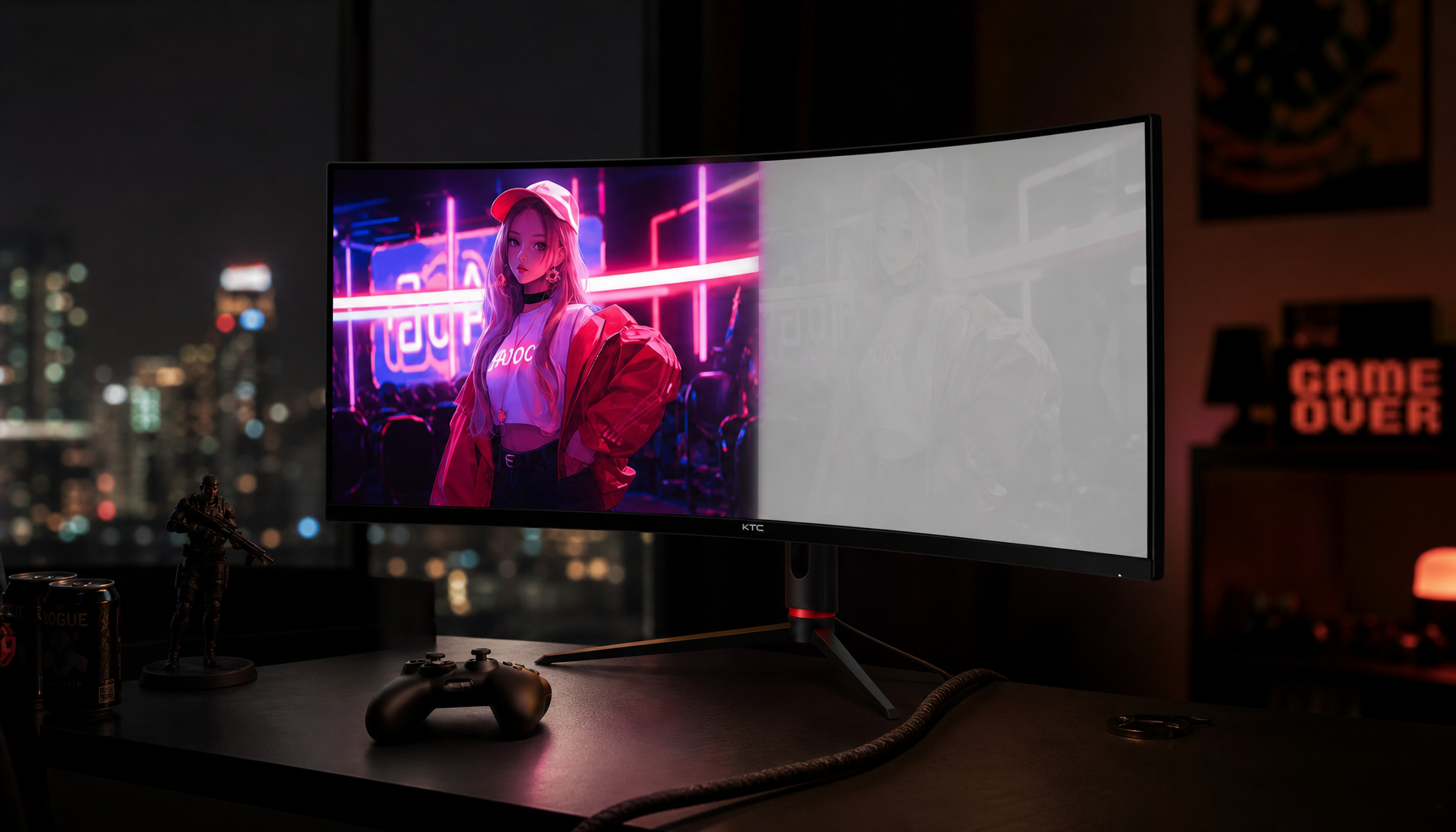
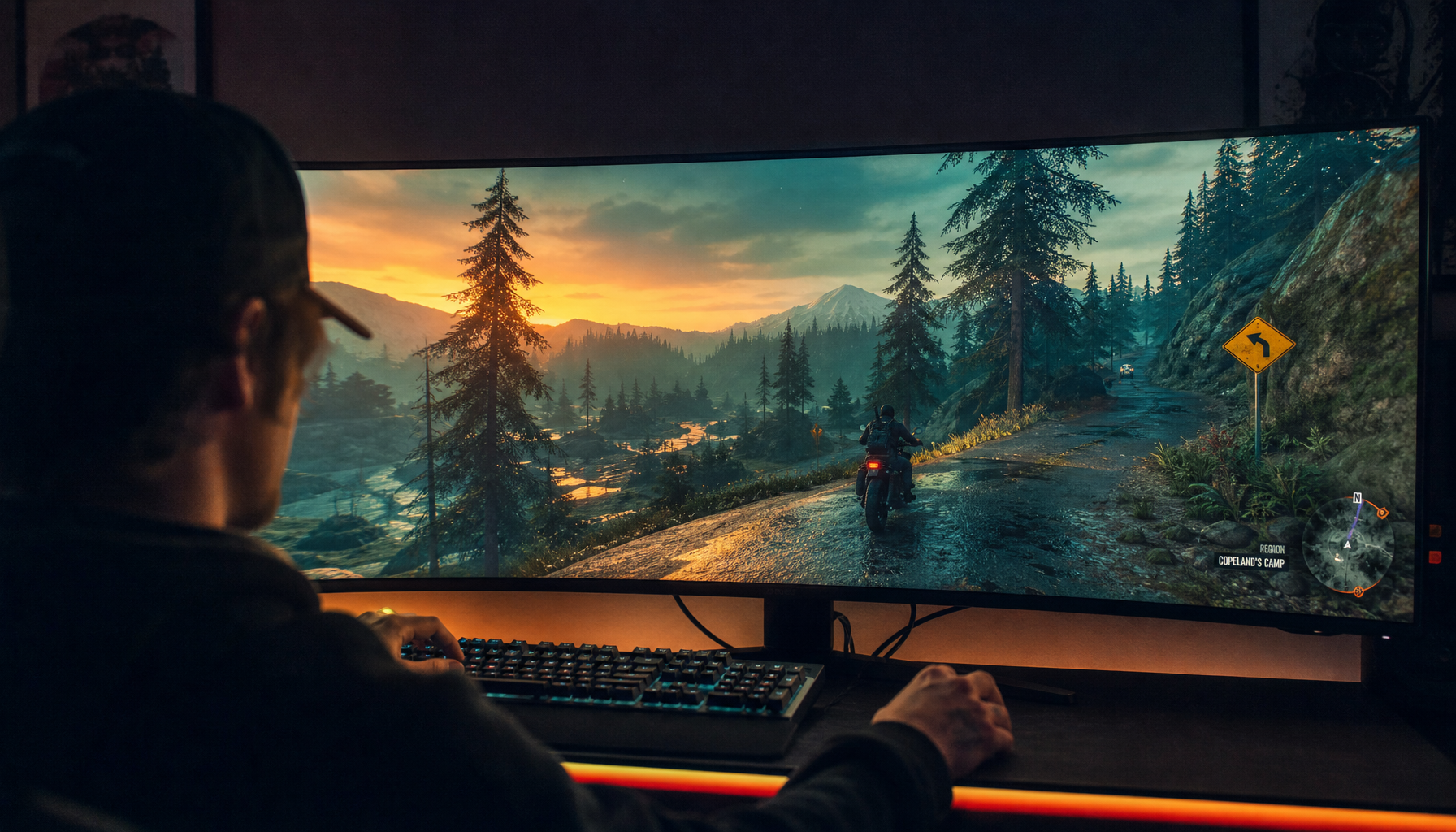
Peak brightness tells you the brightest small highlight a monitor can hit, not how convincing HDR will look across an actual game, movie, or desktop workflow. Real HDR depends more on sustained brightness, contrast control, local dimming, tone mapping, and content support.
You can buy two monitors with the same “1,000-nit HDR” claim, load the same game, and still get two very different results. One may make sunlight, explosions, and reflections stand out, while the other dims bright scenes, lifts blacks, or looks oddly flat. This breakdown shows which monitor specs actually predict real-world HDR performance before you spend money on a gaming monitor, ultrawide, or portable display.

What Peak Brightness Actually Measures
Small highlights, not the whole image
Lab testing measures HDR brightness with small white windows and real-scene clips, which is why a peak number usually describes a tiny bright area rather than the whole screen. That matters because HDR in actual games is rarely just a single white square on a black background. A snowy map, a sunlit racetrack, or a bright open-world sky puts a much larger demand on the panel than a 2% highlight test.

Forum-level buying advice regularly points out that peak brightness can apply only to 1% to 10% of the screen for a short time, especially on OLED panels that reduce output as more of the screen turns bright. In practice, that means a monitor marketed at 1,000 nits may look impressive on sparks, headlights, or a specular reflection, yet still feel dim once a bright HUD, white webpage, or daytime scene fills more of the panel.
HDR content has to be HDR all the way through
Display behavior also changes because baseline HDR content needs metadata to trigger HDR tone mapping. Without that metadata, the monitor does not simply treat ordinary white pixels as “1,000-nit white.” SDR and HDR use different brightness curves, so the same pixel value can mean very different things depending on the source and signal path.
That is why different HDR formats are not interchangeable beyond a brightness number. One common HDR format uses static metadata, while dynamic-metadata formats can adjust scene by scene. For monitor buyers, the practical takeaway is simple: a strong nit rating cannot rescue SDR content, weak tone mapping, or a mismatch between the source format and what the monitor actually handles well.
Why Similar Peak Numbers Produce Different HDR Results
Sustained brightness changes the look of bright scenes
A monitor’s real HDR impact depends heavily on sustained brightness across larger screen areas, not just its headline peak number. This is where automatic brightness limiting shows up: the display hits a high short burst on a small highlight, then backs off when the scene stays bright or expands across more of the screen. That is why two “high-tier HDR” displays can diverge so quickly in a racing game, sports title, or desktop HDR workflow.
The same testing logic appears in a monitor review site’s use of multiple window sizes and real-scene measurements, because bright scenes reveal weaknesses that a tiny highlight test hides. If you care about HDR gaming in a bright room, or you want an ultrawide monitor that keeps daylight scenes punchy, sustained brightness is often more predictive than the biggest nit claim on the product page.
Contrast and local dimming decide whether highlights stand out
LCD-based HDR depends on backlight control, and local dimming is the core reason one LCD monitor can look much more “HDR” than another. Global dimming treats the whole backlight as one zone and usually cannot exceed the panel’s native simultaneous contrast of roughly 1,000:1. Local dimming splits that backlight into zones, and better systems can dramatically improve highlight separation from dark backgrounds.
That is why contrast ratio and dimming quality matter alongside peak brightness. A mini-LED gaming monitor with hundreds of zones can often deliver brighter HDR with stronger full-screen output, while OLED usually wins at black level and halo control but may fall off harder on bright full-screen content. IPS panels typically sit around 1,000:1 native contrast, while VA panels often land around 2,000:1 to 7,000:1, so the panel type under the HDR badge still matters.

Setup differences can make matching monitors look mismatched
Even before you compare two different models, matching monitor settings do not guarantee matching brightness or black level. One user with two identical 24.5-inch monitors from a brand saw one screen look brighter and show black as dark gray despite using the same settings, which is a useful reminder that cables, signal conversion, panel variance, and processing can all shift what you see.
That problem gets worse because real HDR requires the whole chain to cooperate: GPU, cable, monitor OSD, operating system, and HDR content source. When buyers say a monitor’s HDR looks washed out, the failure is often not just “bad HDR.” It may be SDR content mapped into HDR poorly, the operating system’s HDR mode left on for the desktop, or a preset that prioritizes brightness over accuracy.
The Monitor Specs That Predict Real HDR Better
A better buying checklist
A more useful shopping method starts with HDR certification tier, bit depth, brightness, tone mapping, and metadata support rather than the peak number alone. Peak brightness still matters, but it is only one input. For example, a monitor like a 27-inch 180Hz 2K high-tier HDR gaming monitor combines a high-tier HDR rating with Mini LED 1152-zone backlighting, which is the kind of supporting spec worth comparing instead of relying on peak brightness alone. If you want a monitor that makes HDR games look obviously better, the best predictors are sustained brightness, local dimming quality, contrast, and whether the panel can keep bright highlights and deep shadows on screen at the same time.
Spec to Check |
Why It Matters |
What to Look For |
Common Pitfall |
Peak brightness |
Shows maximum highlight capability |
Higher is better, but only if other HDR basics are strong |
Treating one peak number as the whole HDR story |
Sustained brightness |
Determines how bright large or lasting scenes stay |
Better full-screen and mid-window output |
A monitor looks great in a logo splash, then dims in gameplay |
Local dimming |
Controls highlight contrast against dark areas |
Local dimming beats global dimming; more zones usually help |
“HDR support” with no meaningful dimming control |
Native contrast |
Affects black depth and shadow separation |
VA usually beats IPS; OLED behaves differently again |
Bright highlights with gray blacks still look flat |
HDR certification |
Adds context for brightness, gamut, and bit depth |
A mid- or high-tier HDR certification is usually more reassuring than vague HDR claims |
Assuming any HDR badge means strong HDR |
Metadata support |
Helps the monitor map content correctly |
A baseline HDR format is expected; dynamic-metadata formats can improve scene handling |
Expecting premium dynamic-metadata support to fix non-HDR or poorly mastered content |
Signal path |
Enables actual HDR delivery at the resolution and refresh you want |
Match GPU, cable, port, and refresh target |
Buying a high-refresh HDR monitor, then feeding it the wrong format |
Certification and metadata add context, not magic
HDR badges help because formal HDR certification tiers separate basic HDR capability from higher-end implementations with stricter requirements. An entry-level HDR certification is a low floor and often does not translate into dramatic HDR on a desktop monitor. Higher tiers such as 500-, 600-, 1000-, or 1400-class certification generally become more meaningful because they raise expectations for dimming, bit depth, and color gamut instead of just quoting one brightness ceiling.
Content format still matters because tone mapping is required when SDR and HDR content cross into each other. A monitor can have solid hardware and still disappoint if desktop HDR is configured badly, if the game’s HDR implementation is weak, or if the display preset chases brightness at the expense of the intended curve. In other words, certification improves your odds, but it does not replace setup and content quality.
How This Changes Buying Advice by Monitor Type
High-refresh-rate gaming monitors
For gaming monitors, OLED and mini-LED can both deliver strong HDR, but they do it in different ways. OLED usually gives you near-perfect blacks, fast response times, and no haloing around bright objects. Mini-LED often wins on raw HDR brightness and can hold bright scenes better, which matters if you play in a bright room or spend more time in daylight-heavy games than dark cinematic titles.
Ultrawide monitors
On ultrawide monitors, backlight design matters more as bright content stretches across a larger horizontal area. Edge-lit designs with 8 to 16 zones can improve contrast, but they still have limited precision when a wide HUD, a bright skybox, and dark scene elements all appear together. A full-array design with hundreds of zones is much better at keeping those elements separated, especially in racing, flight, and open-world games where bright scene coverage is broad and continuous.
Portable monitors
Portable displays face harder power and thermal limits because global dimming is common in notebook-class HDR designs and is cheaper and lower power than dense local dimming. That makes portable monitors the category where marketing overreach is most common. If a portable monitor advertises HDR but lacks strong brightness, local dimming, and careful tone mapping, expect only a mild improvement over SDR rather than dramatic HDR highlights.
Setup Choices That Affect HDR More Than Most Buyers Expect
Signal path and OS settings
The connection path matters because HDR support depends on compatible GPU output, cable bandwidth, monitor settings, and operating system configuration. For example, one older video interface version can handle 4K at 60 Hz with HDR, while a newer version is far better suited to 4K at 120 Hz gaming. A common PC video interface is often used for standard HDR PC output, and newer versions offer more headroom for high-end HDR gaming monitors.
Desktop behavior also changes because many users report washed-out HDR until they calibrate the operating system and the monitor together. A practical habit is to turn HDR on when you are launching HDR games, movies, or editing work that actually uses it, then switch it off for ordinary SDR desktop use if your monitor handles SDR-in-HDR poorly.
Room lighting and calibration
Room conditions matter because bright-room performance can contradict the impression created by a peak-brightness claim alone. Some panels preserve black levels better in ambient light, while others lose perceived contrast even if their lab peak number is higher. On a real desk, that can make the “less bright” monitor look better during daytime use.

Content and picture mode matter too because HDR monitors can only improve non-HDR material to a limited extent through tone mapping and calibration. If your HDR preset makes everything brighter but less natural, that is not better HDR. It is usually a sign the display is bending the image to appear vivid instead of following the intended HDR tone curve cleanly.
FAQ
Q: Is an entry-level HDR certification enough for real HDR on a monitor?
A: An entry-level HDR certification is the entry tier, and many monitors at that level can accept HDR signals without producing dramatic HDR impact. It is better than a vague “HDR supported” label, but buyers looking for obvious gaming or movie improvements should usually aim higher.
Q: Why does desktop HDR sometimes make everything look washed out?
A: SDR and HDR are not directly interoperable without tone mapping, so SDR desktop content can look wrong when HDR is forced on all the time. Poor calibration, the wrong preset, or a monitor with weak HDR processing can make that effect much worse.
Q: Is OLED or mini-LED better for HDR gaming?
A: OLED and mini-LED excel in different areas. OLED usually gives cleaner blacks and no blooming, while mini-LED often delivers stronger sustained brightness and more punch in bright rooms. The better choice depends on whether you value black depth or full-scene luminance more.
Final Takeaway
If you are buying a monitor for HDR gaming, movie viewing, or creator work, treat peak brightness as a screening spec, not a verdict. It tells you the ceiling for a best-case highlight, but it does not tell you how the monitor handles a bright full-screen scene, how dark its blacks stay, how precise its dimming is, or whether its HDR mode is well tuned.
A practical shortlist should prioritize: - HDR certification tier over vague HDR marketing - Sustained brightness, not just peak brightness - Local dimming quality and zone count - Native contrast and panel behavior - Proper HDR support across the GPU, cable, OS, and content chain
References
- A Q&A site: How to get maximum brightness from an HDR monitor?
- A monitor company: HDR tiers: A guide
- A hardware forum: Two monitors have different brightness
- An industry certification page: LCD dimming in HDR displays explained
- A manufacturer: How do HDR monitors enhance gaming and movie viewing?
- A tech forum: HDR peak brightness
- A photography site: Recommended HDR monitors for photography
- What Is HDR on a Monitor?
- A PC forum discussion citing a monitor review site’s HDR monitor comparisons
- A monitor review site: The Best HDR Gaming Monitors of 2026