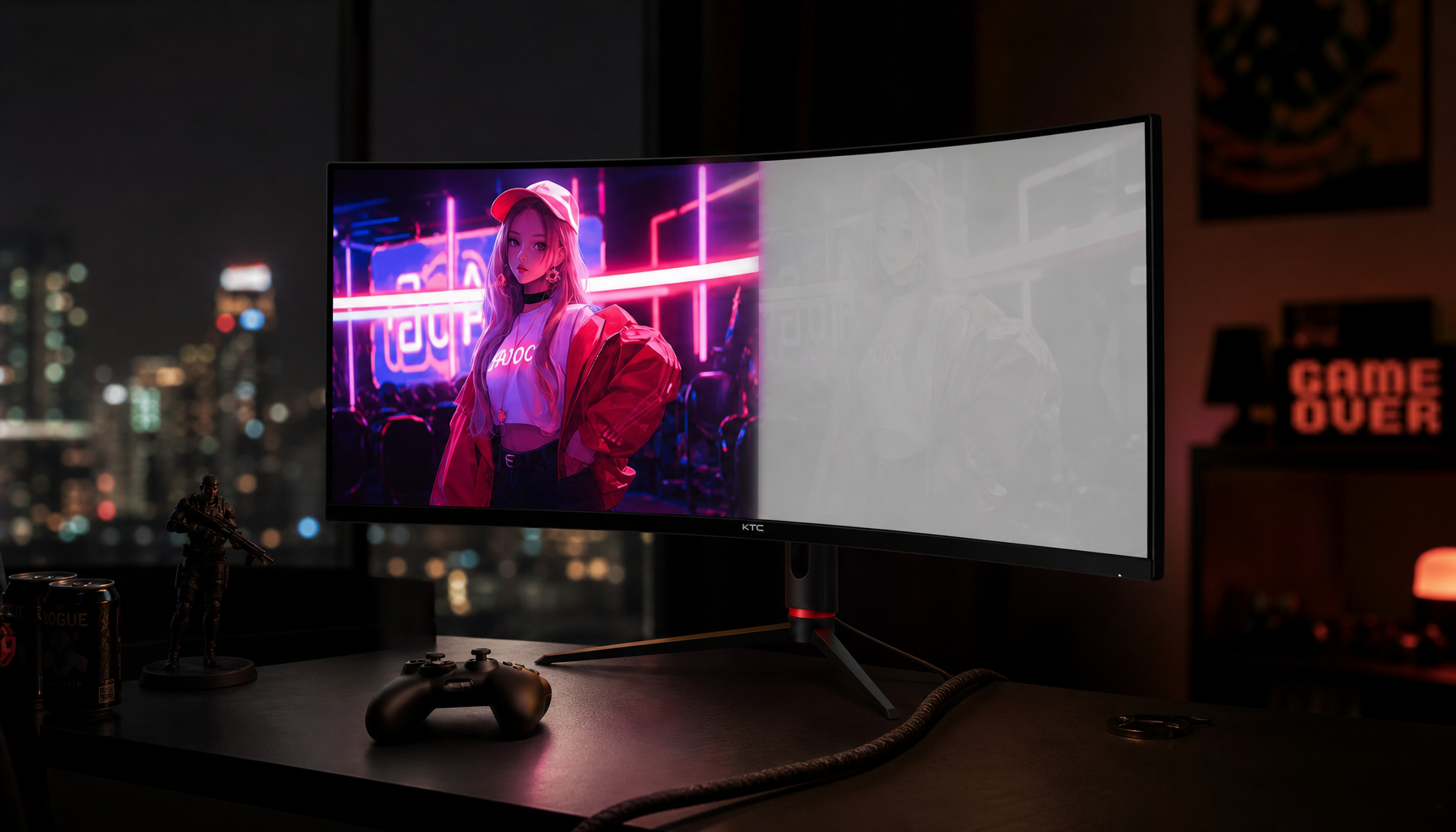
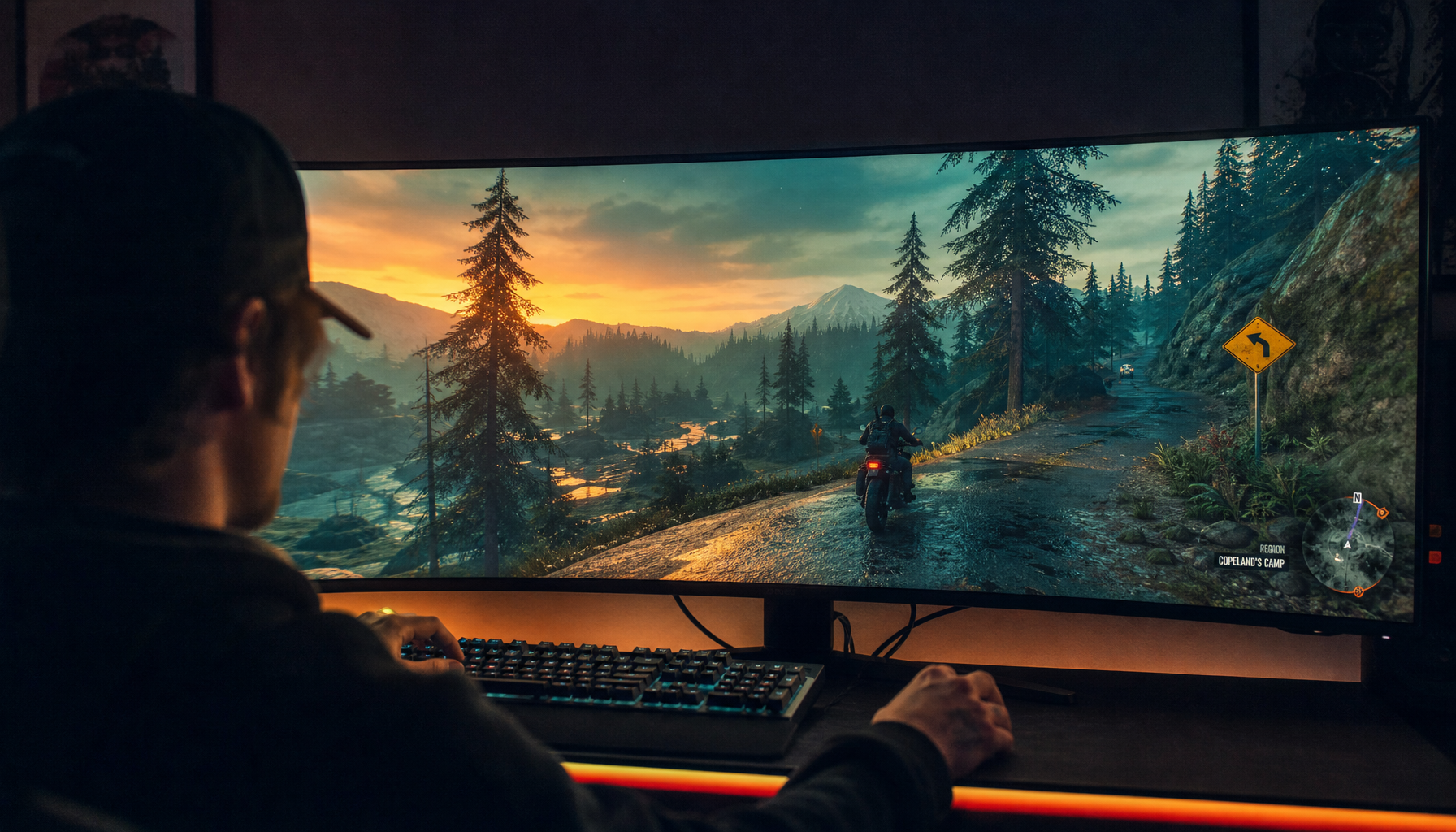
Ambient light usually narrows OLED’s image-quality advantage and makes Mini LED the more practical choice for bright-room gaming, while OLED still looks best in dim setups.
If your gaming monitor looks stunning at night but flatter once daylight hits the room, the screen may not be the main problem. Bright-room testing at 1,000 lux and side-by-side user reports both show that room light can lift blacks, weaken shadow depth, and change which panel type looks better. You’ll leave with a clear way to match OLED or Mini LED to your room, your games, and your HDR expectations.
Why Room Light Changes What You See
Ambient light lifts black levels
Ambient light raises black levels on all monitors, which reduces perceived contrast and makes dark scenes look grayer than they do in a dark room. That matters more with gaming monitors because a lot of modern titles depend on subtle shadow detail, dark interiors, and high-contrast HDR effects to create depth.

OLED still starts from the strongest baseline in darkness because each pixel can shut off completely, while Mini LED is still an LCD with a backlight and local dimming zones. But once a room gets bright enough, reflected light becomes part of the image your eyes see, so OLED’s “perfect black” stops looking as perfect in practice.
Reflections matter as much as panel type
Direct light hitting the screen can cause uneven glare or reflections, and that can override the theoretical strengths of either display technology. A monitor placed across from a sunlit window or under a bare ceiling bulb will often look worse than the same monitor in a controlled room, even if its measured contrast is excellent.

Screen coating changes the tradeoff. Glossy coatings usually reduce black-level raise more than matte coatings, but they also make direct reflections more obvious. In real buying terms, a glossy OLED can look richer in a softly lit office, yet become more distracting than a matte or semi-matte Mini LED if a lamp or window is directly reflected on the screen.
OLED in Dark Rooms vs Bright Rooms
Dark-room gaming is where OLED separates itself
OLED monitors perform best in dark rooms because self-emitting pixels deliver true blacks, no haloing, and near-instant response times. On a high-refresh-rate gaming monitor, that combination makes dark scenes look cleaner and motion look sharper at the same refresh rate than many Mini LED alternatives.
This is most obvious in games with dark backgrounds and small bright details: space games, horror titles, or neon-lit night scenes. OLED’s HDR advantage is strongest in medium-to-dark scenes with a few bright highlights, where pixel-level lighting can keep a tiny specular highlight bright without washing out the nearby shadow detail.
Bright rooms cut into OLED’s advantage
Ambient light reduces the visible benefit of deep blacks, and that is the main reason OLED can look less impressive during daytime use. A review site also notes that some QD-OLED panels can show raised black levels or even a purple tint in bright rooms, while WOLED models tend to hold darker-looking blacks better because of their polarizer.
Real-world comments line up with the measurements. In one side-by-side comparison, OLED looked better in dark scenes while Mini LED often looked better in bright or daylight-heavy scenes. That does not mean OLED becomes bad in daylight; it means the premium you paid for black depth is harder to appreciate when the room keeps pushing blacks upward.
Why Mini LED Often Wins in Bright Rooms
Higher sustained brightness helps fight room light
Mini LED monitors are the better choice for well-lit rooms because they get much brighter, especially on larger bright areas of the screen. That matters for desktop gaming because daytime scenes, bright maps, white UI elements, and full-screen HDR flashes depend on sustained brightness, not just a tiny highlight window.

For general monitor buying, a company places many standard displays in the 250 to 350 nit range and notes that 400+ nits is better for bright rooms or HDR content. HDR-focused reviews push that further: around 1,000 nits is where HDR becomes much more compelling across varied lighting conditions, and Mini LED is usually better at sustaining that brightness across most of the screen. If you regularly game in daylight, a Mini LED example that fits this use case is a monitor, a 27-inch 2560×1440 display with a 180Hz refresh rate and HDR1400 spec.
Mini LED keeps more impact in daylight-heavy games
A 1,000-nit Mini LED may sustain that brightness across most or all of the screen, while an OLED may only hit its highest number on a small 1% to 10% highlight area. In practice, that means an open-world game with a bright sky, snow, sand, or daytime cityscape often looks punchier on Mini LED during the day.
This is also where Automatic Brightness Limiter can become noticeable on OLED. In bright-dominant scenes, OLED panels can trigger ABL, dimming the overall image instead of only capping the brightest details. If you game in a sunlit room or keep your display bright for work and play, Mini LED usually feels more consistent.
The Tradeoffs: Haloing, Shadow Detail, and Motion
OLED is cleaner around bright objects
OLED uses per-pixel illumination, which is effectively far more precise than the roughly 500 to 2,000 dimming zones common on many Mini LED monitors. That precision helps OLED preserve fine HDR texture, subtitles, star fields, and small UI highlights without the blooming or haloing that can appear when a Mini LED zone has to light both a bright object and a dark background.
Mini LED performance still varies a lot by implementation. A model with 1,152 zones can look much better than one with 336 zones, but zone count alone does not guarantee better performance. The dimming algorithm, panel type, and native contrast all affect whether highlights stay bright, shadows stay visible, and halos stay controlled.
Mini LED can be easier to read in some mixed scenes
Mini LED’s lower dimming precision can lift dark shades around bright areas, which is less accurate but can make shadow detail easier to notice to the eye. That is one reason some players prefer Mini LED in tricky scenes where OLED looks technically correct but very dark near a bright sign, explosion, or window.
Motion is the opposite story. OLED has near-instantaneous response times and clearer motion than Mini LED at the same refresh rate, so fast shooters and high-refresh esports titles still favor OLED if the room is controlled. If your top priority is pure motion clarity and dark-room image quality, OLED remains the stronger gaming display.
Features That Matter More Than Marketing
Compare the room, not just the panel label
The biggest buying mistake is assuming “OLED” or “Mini LED” tells you everything. Mini LED performance depends on measured results and dimming behavior, not just zone count, and OLED behavior changes meaningfully between WOLED and QD-OLED in brighter rooms.
For a bright office or gaming room, prioritize sustained brightness, good reflection handling, and strong local dimming. For a darker setup, prioritize black depth, motion clarity, and how well the screen handles small HDR highlights. If your use spans both work and gaming, the most practical answer is often the display that looks slightly less spectacular at night but far better at 2:00 PM.
Bias lighting can improve comfort, not core panel performance
Bias lighting can reduce visual fatigue in dim rooms and may improve perceived contrast a bit, which makes it a useful add-on for long evening sessions. A light placed behind the monitor can also make a bright OLED or Mini LED feel less harsh against a dark wall.

What bias lighting does not do is turn an LCD into an OLED or solve direct glare. It is best treated as a comfort upgrade for a gaming desk, not as a substitute for choosing the right monitor technology for your room.
OLED vs Mini LED in Different Gaming Setups
Setup or Priority |
OLED |
Mini LED |
Dark-room immersion |
Best choice for true blacks and zero haloing |
Very good, but blooming risk remains |
Loses some contrast advantage as room light rises |
Usually better due to higher sustained brightness |
|
HDR highlights in daylight scenes |
Can look limited by ABL on large bright areas |
Usually stronger and more consistent |
Shadow detail accuracy |
Excellent in controlled lighting |
Can look brighter but less precise |
Motion clarity at high refresh rates |
Best-in-class response time |
Good, but usually behind OLED |
Reflection sensitivity |
Can look gray or purple-tinted on some bright-room QD-OLEDs |
Often more usable in daylight-heavy rooms |
Burn-in risk |
Still a consideration for static HUDs and desktop use |
No permanent burn-in risk from static elements |
Premium pricing |
Often cheaper for similar size and refresh rate |
FAQ
Q: Does ambient light reduce the visual advantage of an OLED gaming monitor?
A: Yes. Ambient light raises visible black levels, so OLED’s strongest advantage, deep black depth and near-infinite contrast, becomes less obvious in bright rooms.
Q: Is Mini LED better than OLED for a bright room gaming setup?
A: Usually, yes. Mini LED monitors tend to sustain more brightness across the full screen, which helps them fight glare and keep HDR scenes looking impactful during the day.
Q: What matters most besides panel type?
A: Brightness, screen coating, reflection control, local dimming quality, and your room layout matter a lot. A well-placed monitor with controlled lighting can outperform a technically better panel used in a bad spot.
Practical Next Steps
If you mostly game at night or in a light-controlled room, OLED is still the better performance display because it delivers the best blacks, the cleanest HDR structure, and the clearest motion. If your monitor sits near windows, overhead lighting, or a bright mixed-use desk, Mini LED is usually the safer buy because it holds brightness better, fights room light more effectively, and avoids burn-in concerns.
For buyers choosing between two similarly priced gaming monitors, use this shortcut: pick OLED for dark-room immersion and competitive motion clarity, pick Mini LED for bright-room usability and stronger daytime HDR impact. Then check the specific model’s coating, dimming behavior, and measured bright-room performance before you buy.
References
- A company: Why Monitor Brightness and Contrast Ratios are Key to Display Quality
- A forum: Ambient lighting (bias lighting) for monitors
- A website: Recommended HDR monitors for photography
- A review site: Ambient Black Level Raise
- A forum: Experiences with Mini LED vs OLED
- A forum: Gaming In A Dark Room OLED vs High Peak Brightness LED
- A media outlet: Best gaming monitors in 2026
- A review site: Mini LED vs OLED
- A review site: Best HDR Gaming Monitors
- A review site: Best Mini LED Monitors
- A forum: HDR quality, OLED vs MiniLED