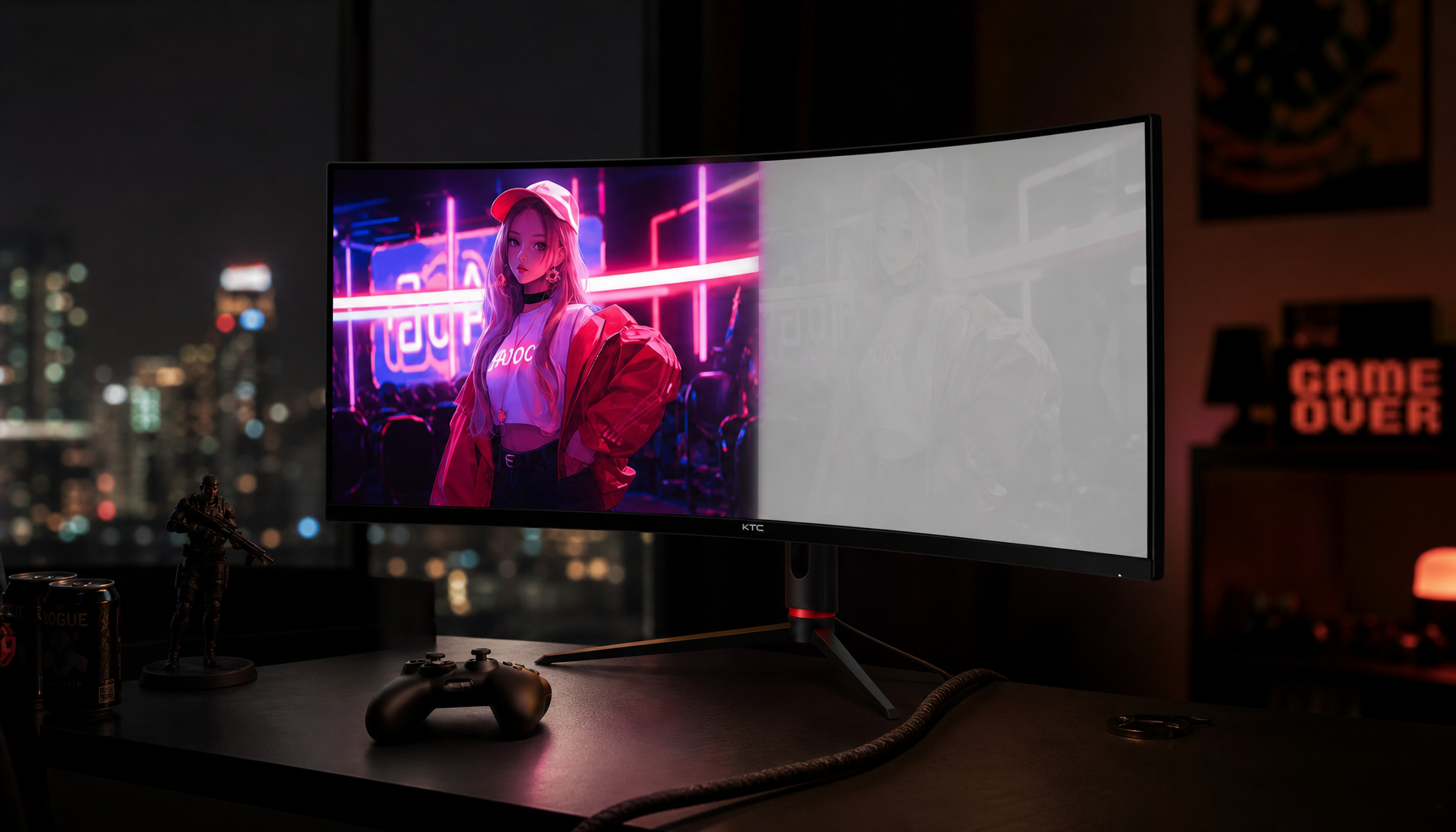
Local dimming can make a gaming monitor’s blacks look deeper, but it can also make shadow detail change from one part of the screen to another. The consistency depends on zone size, dimming speed, algorithm tuning, panel contrast, brightness settings, and the content on screen.
Have you ever moved through a dark hallway in a game and noticed that one corner shows texture while another turns into a black block or gray haze? In lab-style blooming checks, even a bright 340-nit patch can create measurable glow nearby, so small UI elements and highlights can affect the shadows around them. This guide explains why that happens and how to judge a monitor’s local dimming behavior before you buy or calibrate it.
Why Shadow Detail Changes Across the Screen
Local dimming exists because LCD monitors do not emit light at the pixel level. LCD panels use a separate backlight, and local dimming improves HDR by changing backlight brightness in different screen areas instead of lighting the entire panel evenly.
That helps a Mini-LED or full-array local dimming monitor create deeper blacks next to bright highlights. The problem is that a dimming zone is still much larger than a single pixel. If a bright cursor, crosshair, subtitle, star, muzzle flash, or HUD icon appears inside one zone, the monitor may brighten that whole zone even if most of that area should remain dark.
The Zone-Level Problem
On a per-pixel display technology such as OLED, one bright pixel can sit beside a black pixel with very little shared light. On an LCD gaming monitor with local dimming, the backlight works in groups. Each Mini-LED zone still covers many pixels, so shadow detail is controlled by zones rather than by every individual pixel.

This is why shadow detail may look stable in a dark area with no bright objects nearby but washed out around subtitles or a minimap. The monitor is trying to keep the bright object bright while dimming the surrounding scene, and the zone boundary rarely matches the exact shape of the game content.
Blooming, Black Crush, and Gray Blacks
Three artifacts matter most for shadow consistency:
- Blooming: a glow or halo around bright objects on dark backgrounds.

- Black crush: dark gray details collapse into flat black, hiding textures and enemy outlines.
- Elevated blacks: dark areas look gray, reducing contrast and making HDR feel flat.
A strong local dimming mode may reduce gray blacks but crush near-black texture. A mild mode may preserve more dark detail but raise the black floor. The best setting is not always the strongest one.
Zone Count Helps, but It Is Not the Whole Story
More zones usually improve shadow control because each zone covers a smaller part of the screen. A 32-inch monitor with 1,152 zones can usually localize light better than a similar 384-zone model because each zone covers less area.

However, buyers should not treat zone count like a simple quality score. A monitor with more zones can still show halos, brightness pumping, or uneven near-black handling if its dimming algorithm reacts too aggressively or too slowly. Zone density also matters: a 1,152-zone count on a 27-inch display is not the same as 1,152 zones stretched across a much larger ultrawide panel.
Practical Zone Tiers for Gaming Monitors
For 27- to 32-inch gaming monitors, the useful buying categories are roughly:
Local Dimming Type |
Typical Zone Range |
Shadow Detail Behavior |
Best Fit |
Watch For |
Edge-lit dimming |
Very limited zone control |
Bright and dark areas affect each other more visibly |
Basic HDR compatibility, office use |
Large bands of glow, weak black levels |
Low-zone FALD |
8 to 96 zones |
Coarse dimming, obvious halos around UI |
Entry-level HDR testing |
Large bright patches in dark scenes |
Mid-tier Mini-LED |
About 400 to 966 zones |
Better dark-scene control, still content-dependent |
Mixed gaming and video |
Clouding, flashlighting, subtitle bloom |
Balanced Mini-LED |
Around 1,152 zones |
Stronger HDR contrast with better halo control |
HDR gaming monitors |
Algorithm tuning, black crush, pumping |
High-end Mini-LED |
2,304+ zones |
More precise control around small highlights |
Premium HDR gaming and content viewing |
Cost, firmware quality, remaining halos |
OLED |
Pixel-level light control |
Excellent black consistency |
Dark-room gaming, cinematic HDR |
Burn-in risk, brightness limits by model |
A 27-inch Mini-LED 2K 180Hz HDR1400 gaming monitor, for example, fits the 27-inch Mini-LED, 1,152-zone range, but zone count still needs to be judged alongside dimming behavior around HUDs, subtitles, and near-black texture.

These tiers are practical ranges, not guarantees. Higher zone counts generally reduce haloing and dark-scene uniformity problems, but firmware, optical design, panel type, and zone layout still shape the result.
Why Ultrawide Monitors Are Harder
Ultrawide monitors make local dimming consistency harder because the screen area is larger and bright UI elements may sit far from the center. A minimap in the corner, a health bar at the bottom, or a white mouse cursor on a dark desktop can trigger local zones that make nearby blacks look different from the center of the screen.
For ultrawide HDR buying, look at zone density rather than only the advertised zone count. A large monitor needs more zones to maintain the same precision as a smaller 27-inch panel. This is especially important if you play dark games, use black desktop themes, or keep static bright interface elements near the edges.
Algorithm Tuning Decides the Trade-Off
The dimming algorithm decides how the monitor uses its zones. It chooses when to brighten zones, when to darken them, how quickly to react, and whether to prioritize highlight brightness or shadow preservation. That decision can change how much detail you see in caves, night maps, space scenes, and dark indoor levels.

Aggressive dimming can produce deeper blacks and stronger perceived contrast, but it can also hide subtle dark information. In practical terms, that means a rock wall, black jacket, tire tread, or enemy silhouette may lose separation when the scene gets darker or when a bright highlight enters the same zone.
Strong Dimming vs. Stable Visibility
For cinematic HDR gaming, stronger local dimming can be impressive. Explosions look brighter, letterbox bars look darker, and night scenes feel more dramatic. For competitive gaming, the same behavior can be a disadvantage if it makes dark corners unpredictable.
A competitive player may prefer reduced or disabled local dimming because stable shadow visibility matters more than maximum black depth. If a dark doorway changes from readable to crushed when a bright scoreboard or ability effect appears nearby, the image may look more contrasty but become less useful.
Brightness Pumping and Moving UI
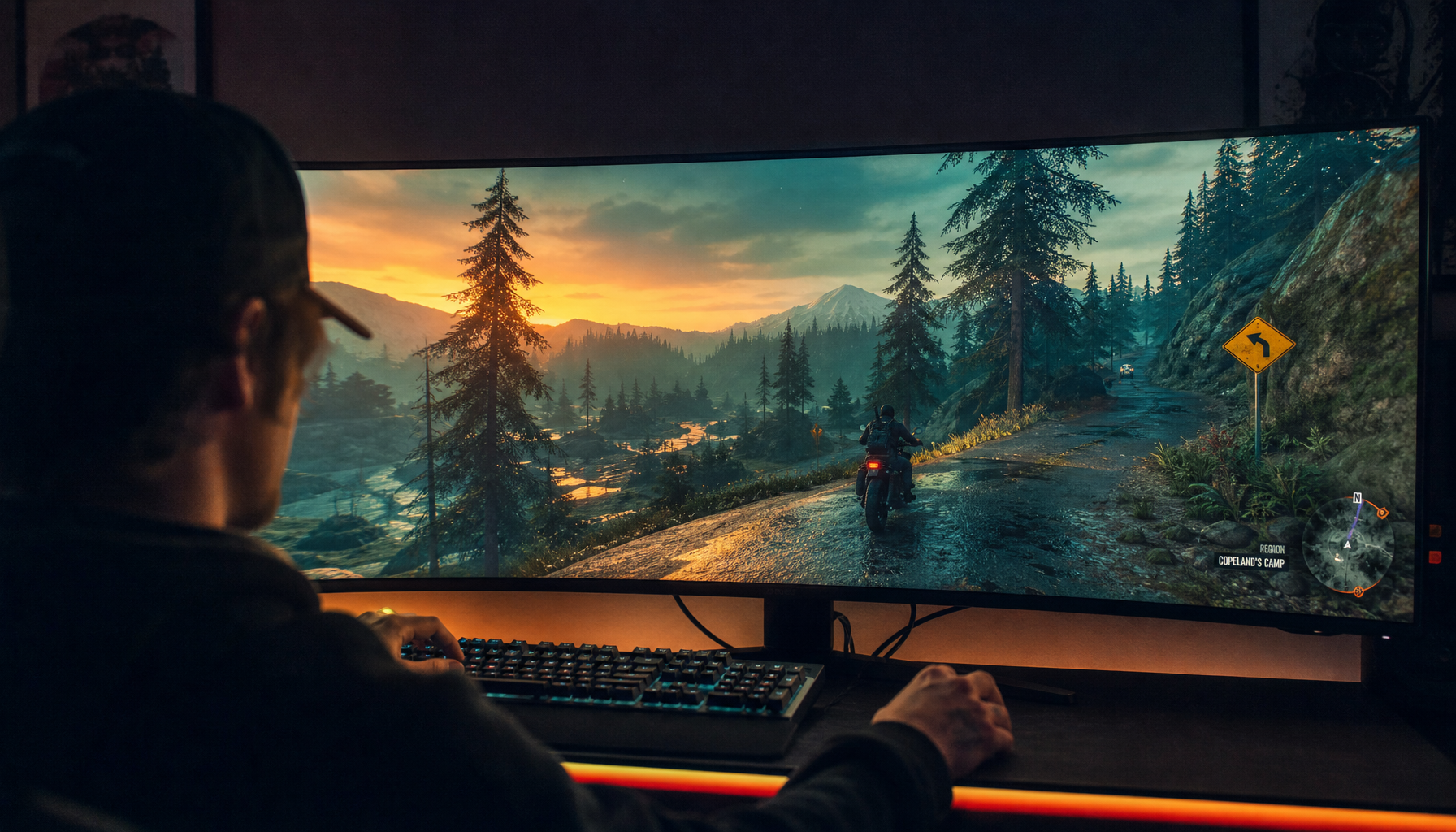
Games expose local dimming flaws more than still images because the camera and UI are constantly moving. A crosshair crossing a dark wall, a flashlight sweeping across a room, or subtitles appearing over black bars can force the backlight to adjust repeatedly. Gaming can expose pumping, flicker, halos, and crushed detail because the backlight has to react to changing content.
A useful real-world check is to load a dark scene with a stable HUD, then slowly pan the camera. Watch whether shadow texture stays visible as the HUD passes over darker parts of the image. If detail appears and disappears around the HUD, the dimming mode is affecting consistency.
Panel Type Changes How Visible the Artifacts Are
Local dimming does not operate in isolation. The LCD panel’s native contrast determines how much help the backlight needs and how visible the artifacts become. VA, IPS, OLED, and Mini-LED LCDs behave differently even when their HDR labels sound similar.
VA LCD panels often hide blooming better because their native contrast is typically higher. IPS panels are popular for speed, color, and viewing angles, but their lower native contrast can make lifted blacks and halos more noticeable in a dark room. VA panels are often cited around 3,000:1 to 5,000:1 native contrast, while IPS panels are commonly closer to 1,000:1.

IPS Mini-LED
IPS Mini-LED monitors can deliver strong HDR brightness, high refresh rates, and wide viewing angles. They can also show more obvious halos because the LCD layer blocks less stray light than a higher-contrast VA panel. In a bright room, this may be minor; in a dark room, subtitles and cursors can reveal it quickly.
If you want an IPS Mini-LED gaming monitor, pay close attention to real tests with black backgrounds, white UI, and HDR games rather than only peak brightness claims. Peak brightness can be excellent while shadow consistency remains uneven.
VA Mini-LED
VA Mini-LED monitors often look stronger in dark-room contrast because the panel itself starts with deeper blacks. This can make local dimming artifacts less obvious, especially in games with large dark areas. The trade-off is that some VA panels may have response-time limitations, dark-level smearing, or viewing-angle shifts depending on the model.
For single-player HDR gaming, a well-tuned VA Mini-LED can be very convincing. For fast esports play, check motion performance and overdrive behavior as carefully as HDR contrast.
OLED
OLED avoids dimming zones because each pixel controls its own light. That gives it excellent dark-room black consistency and avoids zone blooming around small highlights. However, OLED monitor buying still involves other trade-offs, including peak full-screen brightness, automatic brightness limiting, image retention risk, and long-term static UI considerations.
If your priority is shadow consistency in dark games and movies, OLED is the cleanest answer. If you want very high HDR brightness, strong desktop usability, and less concern about static HUDs, Mini-LED may be the more practical compromise.
How to Test a Monitor for Shadow Detail Consistency
The best test is not a single spec sheet number. You need to check how the monitor behaves with content that stresses local dimming: small bright objects, dark backgrounds, moving UI, near-black texture, and full-screen HDR.
A strong first check is white UI over black. Small bright objects such as subtitles, cursors, stars, crosshairs, and HUD elements can activate zones larger than the object itself, creating halos and changing nearby shadows. Move a cursor over a black wallpaper, open subtitles over a dark movie scene, or pause a game menu over a black loading screen.
A Practical 10-Minute Check
Use this quick workflow when evaluating a gaming monitor in a store, at home during the return window, or after changing HDR settings:
- Set the monitor to its accurate HDR or creator-oriented HDR mode if available.
- Set brightness for your room, not just maximum output.
- Open a near-black test pattern and confirm the first visible shadow steps are separated.
- Run a dark game scene with HUD elements enabled.
- Move the camera slowly and watch for halos, pumping, and disappearing texture.
- Try local dimming modes from low to high.
- Keep the least aggressive mode that preserves HDR impact without hiding key shadow detail.
The goal is not to eliminate every halo. On Mini-LED LCDs, some blooming can remain even with many zones. The goal is to find the setting where shadows remain readable across the screen without turning the whole image gray.
Use Dedicated Motion and Blooming Patterns
Test patterns can exaggerate local dimming artifacts so they are easier to identify. A local dimming test tool lets users change shape size, color, density, brightness, and direction, and it is designed to expose blooming behavior in Mini-LED and FALD displays.
Run these tests full-screen. Try small bright shapes on black backgrounds, then compare the same pattern across local dimming settings. If halos expand dramatically, if dark areas pulse as shapes move, or if small bright objects lose brightness to suppress bloom, the algorithm is making visible compromises.
How to Set Local Dimming for Gaming, HDR Video, and Desktop Use
The right local dimming setting depends on what you are doing. There is no universal best mode because the monitor has to balance highlight brightness, black depth, shadow detail, and response behavior.
For HDR single-player games, start with a medium or low local dimming mode, then raise it only if dark scenes still look washed out. The preferred starting point is often the least aggressive preset that still keeps HDR contrast and highlight impact. This helps avoid crushing enemies, terrain edges, and texture detail in dark areas.
Suggested Settings by Use Case
Use Case |
Local Dimming Starting Point |
Brightness Approach |
What to Check |
Competitive gaming |
Off, low, or mild |
Match room lighting; avoid excessive HDR brightness |
Enemy visibility in corners, stable shadows during camera movement |
Single-player HDR gaming |
Low to medium |
Let highlights pop without washing out blacks |
Caves, night maps, HUD halos, weapon flashes |
HDR movies and shows |
Medium |
Use mild room lighting if blooming distracts you |
Subtitles, letterbox bars, star fields |
Desktop productivity |
Off or low |
Moderate brightness |
Cursor halos, window edges, black wallpaper glow |
Dark-room ultrawide use |
Low to medium |
Avoid maximum brightness unless needed |
Edge uniformity, corner UI, subtitle bloom |
Bright-room use |
Medium or high |
Higher brightness may be acceptable |
Overall contrast, reduced visible blooming |
HDR black level should be adjusted separately from basic brightness when the monitor and operating system allow it. Black level adjustment controls whether the darkest visible tones stay separated or merge into one flat block, while general brightness often shifts the whole image.
Avoid Overcorrecting With Shadow Boost
Many gaming monitors include black equalizer, shadow boost, dynamic contrast, or game genre presets. These tools can help visibility, but they can also fight the local dimming algorithm. Raising shadow boost too far can make blacks look gray; lowering black level too far can crush the first few near-black steps.
A practical approach is to change one control at a time. Set HDR mode first, then local dimming, then brightness, then black level or shadow detail. If you change everything at once, it becomes difficult to know which setting caused the improvement or the artifact.
FAQ
Q: Why do shadows look detailed in the center but crushed near a bright HUD element?
A: The HUD element may be triggering a local dimming zone. Because the zone is larger than the HUD graphic, the monitor has to choose between keeping the HUD bright, dimming the dark area, or compromising between both. That can make nearby shadows bloom, wash out, or crush depending on the algorithm.
Q: Does a higher zone count always mean better shadow detail consistency?
A: No. More zones usually help, but zone count is only one factor. Algorithm tuning, panel contrast, screen size, zone layout, firmware, brightness level, and content type all affect whether shadow detail stays consistent across the screen.
Q: Should I turn local dimming off for gaming?
A: It depends on the game. For competitive games, off or low local dimming can give more stable visibility. For single-player HDR games, low or medium local dimming often gives a better balance of contrast and readable shadow detail. Use dark maps, HUD-heavy scenes, and near-black test patterns to decide.
Key Takeaways
Local dimming improves HDR contrast on LCD gaming monitors, but it does not create pixel-level control. A Mini-LED monitor can make blacks deeper and highlights brighter while still showing inconsistent shadow detail around subtitles, crosshairs, cursors, HUD icons, and other small bright objects.
Do not buy only by peak brightness or zone count. For a 27- to 32-inch HDR gaming monitor, 1,000+ zones is a strong target, but the real test is whether the monitor preserves near-black texture while controlling bloom. For ultrawide monitors, prioritize zone density and real dark-scene testing because the larger screen area makes uniformity harder.
For setup, start with an accurate HDR mode, choose the least aggressive local dimming preset that still looks like HDR, then fine-tune brightness and black level with real game scenes. If you play competitive games, prioritize stable shadow visibility. If you play cinematic HDR games, accept a little blooming if it preserves highlight impact without crushing important dark detail.
References
- KTC, Mini-LED Blooming Reduction Guide For Gaming
- KTC, Mini-LED Blooming: What Causes It & How to Reduce It
- KTC, Understanding Local Dimming Zones: How Mini-LED Works
- KTC, Local Dimming Zone Count & Black Level Quality
- KTC, Aggressive Dimming vs. Shadow Detail: The Trade-Off
- KTC, HDR Black Level Adjustment: Guide to Perfect Shadow Detail
- KTC, Mini LED Zone Count & Monitor Uniformity Explained
- VESA DisplayHDR, LCD Dimming in HDR Displays Explained
- Blur Busters, Local Dimming Test / MiniLED / FALD / Blooming - UFO Test
- KTC, Gaming Contrast: Why Local Dimming Zone Count Matters