Some display technologies preserve near-black detail better because they combine faster dark-pixel transitions, stronger native contrast, better gamma tracking, and cleaner motion handling. OLED usually has the clearest advantage, while LCD performance depends heavily on panel type, overdrive tuning, refresh rate, and local dimming behavior.
Ever swing the camera across a dark hallway in a game and watch enemy outlines, armor texture, or foliage turn into gray mush? A 60 Hz screen holds each frame for about 16.7 ms, while a 240 Hz screen cuts that hold time to about 4.2 ms, but refresh rate alone does not fix every dark-scene problem. This guide explains what actually preserves shadow detail during fast pans, and how to compare gaming monitors without being misled by a single “1 ms” spec.
Why Near-Black Detail Breaks Down During Fast Pans
Near-black detail is the faint texture just above full black: dark clothing against a cave wall, tire grooves in a night racing game, or a dim doorway in a horror title. On a static image, those details can look fine because each pixel and, on Mini-LED monitors, each dimming zone has time to settle. During motion, however, many brightness values change every frame, so black level, tone mapping, scaling, overdrive, and panel response all affect what your eye actually sees.
Fast camera pans make the problem more obvious because display motion blur comes from two major sources: sample-and-hold persistence and pixel transition speed. On sample-and-hold displays, each frame stays visible while your eyes track motion, creating retinal blur even if the pixels themselves are fast. If the pixels are also slow to move between dark shades, near-black edges can smear, trail, or disappear.
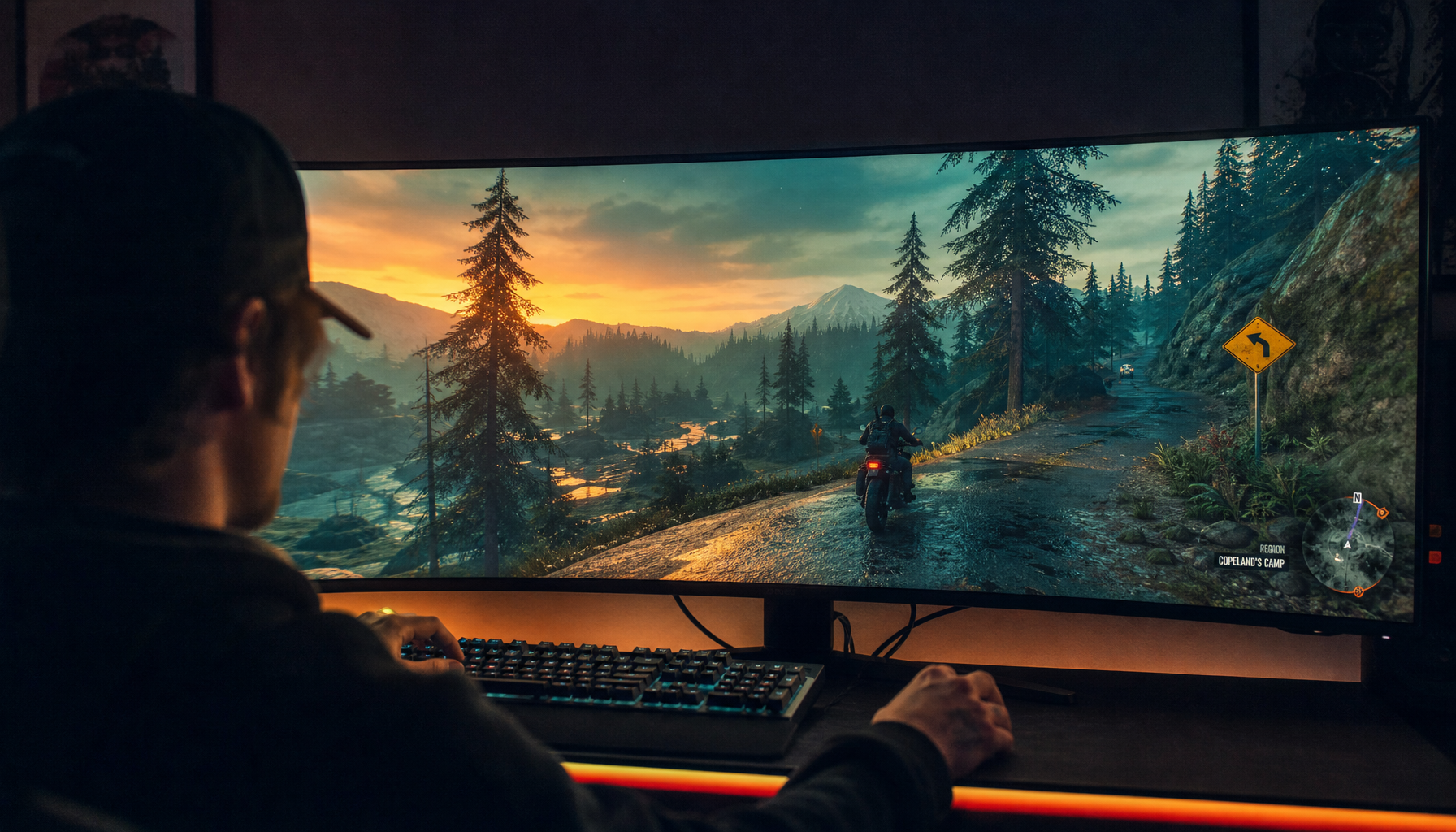
A useful real-world test is a slow walk through a dark game scene followed by a quick mouse pan at the same brightness setting. If the wall texture is visible while standing still but turns into a soft shadow wash during the pan, the issue is not just “low brightness.” It is usually a mix of persistence blur, dark-transition response, contrast handling, and gamma behavior.
Static Black Is Not Moving Black
A monitor can look excellent on a paused dark scene and still struggle in motion. LCD black levels depend on how well liquid crystals block the backlight, while OLED pixels emit their own light and can shut off individually; that difference explains why static images often tell only part of the story. For buying decisions, evaluate both a paused near-black pattern and moving dark content.
This matters especially for high-refresh gaming monitors and ultrawide displays, where peripheral motion is part of the appeal. A 34-inch ultrawide can make dark smearing easier to notice because more of the scene moves across your field of view during a pan. A portable monitor used for console gaming may show the same issue at lower refresh rates, especially if its panel response and overdrive tuning are basic.
The Three Technical Causes That Matter Most
Persistence Blur
Persistence is how long each frame remains visible. At 60 Hz, a frame lasts about 16.7 ms; at 144 Hz, about 6.9 ms; and at 240 Hz, about 4.2 ms. Higher refresh rates reduce sample-and-hold blur because each frame is displayed for less time, but they do not automatically make dark pixels switch faster.

That is why two 144 Hz monitors can look very different in a dark shooter. One may keep a black doorway readable during a quick pan, while another turns it into a smeared patch even though both refresh at the same rate. Strobing or black frame insertion can reduce perceived blur by shortening visible frame time, but shorter pulse widths also reduce brightness and may add flicker, crosstalk, or double images.
Pixel Response and Dark Transitions
Pixel response is separate from persistence. It describes how quickly a pixel changes from one shade to another, and the most troublesome transitions are often not bright-to-bright but dark-to-dark. Many LCD monitors advertise “1 ms,” but that number often reflects a best-case gray-to-gray transition rather than every real transition you will see in a game.
This is where near-black detail often fails. Slow dark transitions can leave trails behind moving edges, while aggressive overdrive can create overshoot or inverse ghosting. Reviewers often call this “black smearing” on some VA panels, but the broader issue is transition consistency across shades; darker scenes make those weak transitions easier to spot.
Contrast and Gamma
Contrast does not make pixels faster, but it helps your eyes separate dark objects from dark backgrounds. Native contrast is more useful than dynamic contrast for motion clarity because the monitor must show bright and dark detail in the same frame without constantly shifting the image. IPS gaming monitors often sit around the 1,000:1 class, while many VA panels reach about 3,000:1 or higher, though that extra depth can come with slower dark transitions on some models.
Gamma controls how digital shadow values map to visible brightness. Gamma 2.2 is the usual SDR baseline for computer displays, web content, office work, and many games; gamma 2.4 can look richer in a dim room but may crush shadows in brighter rooms. If gamma is too high, near-black steps move closer together, and shadow texture can disappear before motion blur even enters the picture.
How OLED, IPS, VA, and Mini-LED Compare

OLED is usually strongest for preserving near-black detail during fast pans because each pixel produces its own light and can turn off individually. That gives OLED very deep blacks and extremely fast pixel transitions, with many OLED gaming monitors advertising response times as low as 0.03 ms. For a concrete comparison point, a 27-inch 2K 240Hz/0.03ms USB-C OLED gaming monitor with 2560×1440 resolution, 240 Hz refresh rate, 0.03 ms response specs, USB-C, and KVM can be a useful reference against similarly sized IPS, VA, and Mini-LED options. The practical result is cleaner motion in dark scenes, less LCD-style trailing, and better separation between black backgrounds and slightly brighter objects.

IPS LCD monitors are often a balanced choice for competitive gaming because they can offer fast response, stable color, and high refresh rates. Their weakness is native contrast: many IPS panels land near the 1,000:1 class, so dark scenes may look more gray than black, especially in a bright room. For players who value motion consistency over deep blacks, a well-tuned IPS at 144 Hz, 180 Hz, 240 Hz, or higher can still be easier to track than a slower high-contrast LCD.
VA LCD monitors often produce deeper static blacks than IPS, which is appealing for single-player games, movies, and atmospheric ultrawide setups. The tradeoff is that some VA panels have slower dark-pixel transitions, so a paused night scene can look excellent while a fast pan shows smearing. This is why panel type alone is not enough; you need evidence of real dark-transition performance.
Mini-LED LCD monitors improve contrast by dividing the backlight into local dimming zones. In HDR, that can make bright highlights and dark areas coexist more convincingly, but local dimming can also create blooming, haloing, or brightness shifts during motion. HDR improves visibility range, not pixel speed, and local dimming can expose panel flaws when a bright object moves across a dark background.
Display option |
Strength in dark pans |
Common weakness |
Best fit |
OLED gaming monitor |
Excellent pixel response and true blacks |
Higher price, burn-in considerations, brightness limits in some full-screen scenes |
Dark games, fast shooters, premium ultrawide setups |
IPS high-refresh monitor |
Good response consistency and strong competitive motion |
Lower native contrast, grayish blacks in dark rooms |
Esports, mixed work and gaming, budget-to-premium builds |
VA gaming monitor |
Stronger native contrast, often around 3,000:1 or higher |
Possible dark smearing and slow black transitions |
Cinematic games, contrast-focused buyers, careful model selection |
Mini-LED LCD |
Strong HDR contrast and brighter highlights |
Blooming, dimming lag, haloing, tone-mapping shifts |
HDR gaming, bright rooms, premium productivity and entertainment |
Portable monitor |
Convenient second-screen or console use |
Often lower brightness, weaker overdrive, limited refresh |
Travel, compact setups, casual gaming |
Why Higher Refresh Rate Helps but Does Not Solve Everything
Higher refresh rate improves motion clarity because each frame is held for less time. Moving from 60 Hz to 144 Hz is usually obvious in camera pans, cursor movement, and fast game tracking. Moving from 144 Hz to 240 Hz can still help, especially in competitive games, but the improvement depends on whether the monitor’s pixels can actually keep up.
A 240 Hz LCD with weak dark transitions can still smear shadow detail more than a lower-refresh OLED. Likewise, a 144 Hz VA ultrawide can feel smooth in bright scenes but look dirty or streaky in a dark dungeon if the panel’s black-to-gray response is slow. Treat refresh rate as one part of the system, alongside response consistency, native contrast, overdrive quality, and brightness control.
This is also why frame rate matters. Blur-reduction modes tend to work best at fixed refresh rates with matched frame rates, commonly around 120 Hz or 144 Hz. If a game fluctuates heavily, enabling strobing may reduce blur in one moment but introduce flicker, double images, or loss of adaptive sync in another.
The “1 ms” Spec Is Not Enough
The advertised response number is often a best-case value. What you need is consistent response across many transitions, especially dark shades. If a monitor uses a very aggressive overdrive mode to hit a headline number, it may create inverse ghosting, which looks like bright or colored halos behind moving objects.
For practical buying, look for reviews that show response-time heat maps, pursuit-camera photos, dark-level transitions, or motion-pattern tests. If those are unavailable, read user reports carefully for phrases like “black smearing,” “inverse ghosting,” “overshoot,” “dark trails,” or “VRR flicker.” Those terms are more useful than a single response-time claim on a product page.
Settings That Preserve Shadow Detail in Real Use

Start with the basics: run the monitor at native resolution and the highest stable refresh rate your GPU or console can sustain. Disable dynamic contrast, automatic black equalizers, and heavy sharpening while you tune the display. Those features can be useful later, but they hide what the panel is doing by changing the image while you test it.
For SDR gaming, gamma 2.2 is the safest starting point. If you play mostly in a dim room and want a richer cinematic look, gamma 2.4 may work, but check that dark-gray test patches remain visible. Lower gamma or a shadow boost can reveal enemies in dark scenes, but too much makes blacks look foggy and reduces the very contrast that helps motion edges stand out.
Brightness should match the room. Reflections and glare raise perceived black levels, so a monitor that looks deep at night may look washed out at noon near a window. A practical setup order is to warm up the display for about 30 minutes, choose a neutral picture mode, set brightness with black-level patterns, set contrast with white-level patterns, then test near-black ramps and dark game scenes.
Action Checklist for Better Dark Motion Clarity
- Set the monitor to native resolution and the highest refresh rate that stays stable in your games.
- Use a neutral or standard picture mode before changing gaming enhancements.
- Disable dynamic contrast, automatic brightness, heavy sharpening, and extreme overdrive while testing.
- Start with gamma 2.2 for SDR, then adjust only if near-black ramps are clearly crushed or raised.
- Test overdrive modes in a dark scene; avoid the mode that creates bright inverse trails.
- Try strobing or black frame insertion only when frame rate is steady and the brightness loss is acceptable.
- Reduce room glare with better monitor placement, curtains, or a dim bias light behind the display.
Buying Guidance for Gaming, Ultrawide, and Portable Monitors
For a fast desktop gaming monitor, prioritize real response consistency over the lowest advertised response number. If you play competitive shooters, a fast IPS or OLED at 240 Hz or higher may give cleaner tracking than a high-contrast LCD with weaker dark transitions. If you play horror, RPGs, racing games at night, or cinematic single-player titles, OLED or a carefully reviewed Mini-LED model will usually preserve dark-scene readability better.
For ultrawide monitors, be more cautious with VA. Many VA ultrawides have excellent contrast on paper, which helps movies and static dark scenes, but some show visible smearing when the camera pans across dark environments. A well-reviewed OLED ultrawide is often the strongest dark-motion option, while a fast IPS ultrawide may be the safer productivity-plus-gaming pick if you want fewer burn-in concerns.
For portable monitors, check more than size and resolution. Many portable displays are built for convenience, not elite motion processing, so dark scenes can suffer from lower brightness, weaker contrast, and simpler overdrive. If the portable monitor is for gaming, favor models that clearly list refresh rate, adaptive sync support, brightness, and panel type, then look for user tests in dark games rather than relying only on product photos.
FAQ
Q: Does HDR make near-black motion clearer?
A: HDR can make dark and bright details easier to separate on a capable monitor, but it does not make pixels faster. Poor HDR tone mapping can crush blacks, clip highlights, or shift brightness during motion, so HDR quality depends on the panel, local dimming, peak brightness, and tone-mapping behavior.
Q: Is VA always bad for fast dark scenes?
A: No. VA panels often have better native contrast than IPS, which can help dark-scene depth. The risk is slower dark-pixel transitions on some models, so a VA monitor should be judged by dark-motion reviews, not just its contrast ratio.
Q: Should I use black equalizer or shadow boost?
A: Use it lightly. A small shadow boost can reveal near-black enemies or UI detail, but too much raises blacks, flattens the image, and can make dark scenes look hazy. Set the monitor correctly first, then add shadow boost only for games where visibility matters more than image depth.
Practical Next Steps
The best monitor for near-black detail in fast camera pans is not simply the one with the highest refresh rate or the deepest static black. It is the one that balances fast dark transitions, low persistence, stable gamma, usable contrast, and restrained motion processing. OLED generally leads here, fast IPS is often the practical competitive choice, VA needs careful model-by-model checking, and Mini-LED can be excellent for HDR if its dimming behavior stays controlled in motion.
When comparing monitors, use one dark game scene, one near-black test pattern, and one fast pan as your repeatable benchmark. If the monitor keeps texture, object edges, and shadow steps visible while moving, it is doing the work that matters. If everything looks good only when paused, the spec sheet is not telling the full story.
References
- Display motion blur
- Contrast Ratio for Motion Clarity in Dark Scenes
- Monitor Strobing: How It Reduces Motion Blur on Displays
- Display Gamma: A Guide to Shadow Detail & Color
- HDR & Motion Blur: A Guide to Gaming & Motion Clarity
- Why Black Levels Look Different: Static vs. Moving Video
- Is Shadow Detail Really HDR’s Greatest Advantage?
- 3 monitor specs that affect motion clarity more than refresh rate