A curved monitor can make the same screen size feel larger, but the effect comes mostly from edge distance, screen width, and seating position rather than the curve by itself.
Ever sit in front of a wide gaming monitor and feel like the corners are farther away than the action in the middle? On larger displays, pulling those outer edges closer can make the screen feel more present without adding inches. You’ll leave with a practical way to judge when curvature helps, when it barely matters, and which curve strength fits your desk.
Why a curved monitor can feel bigger than a flat one
The diagonal stays the same, but the geometry changes
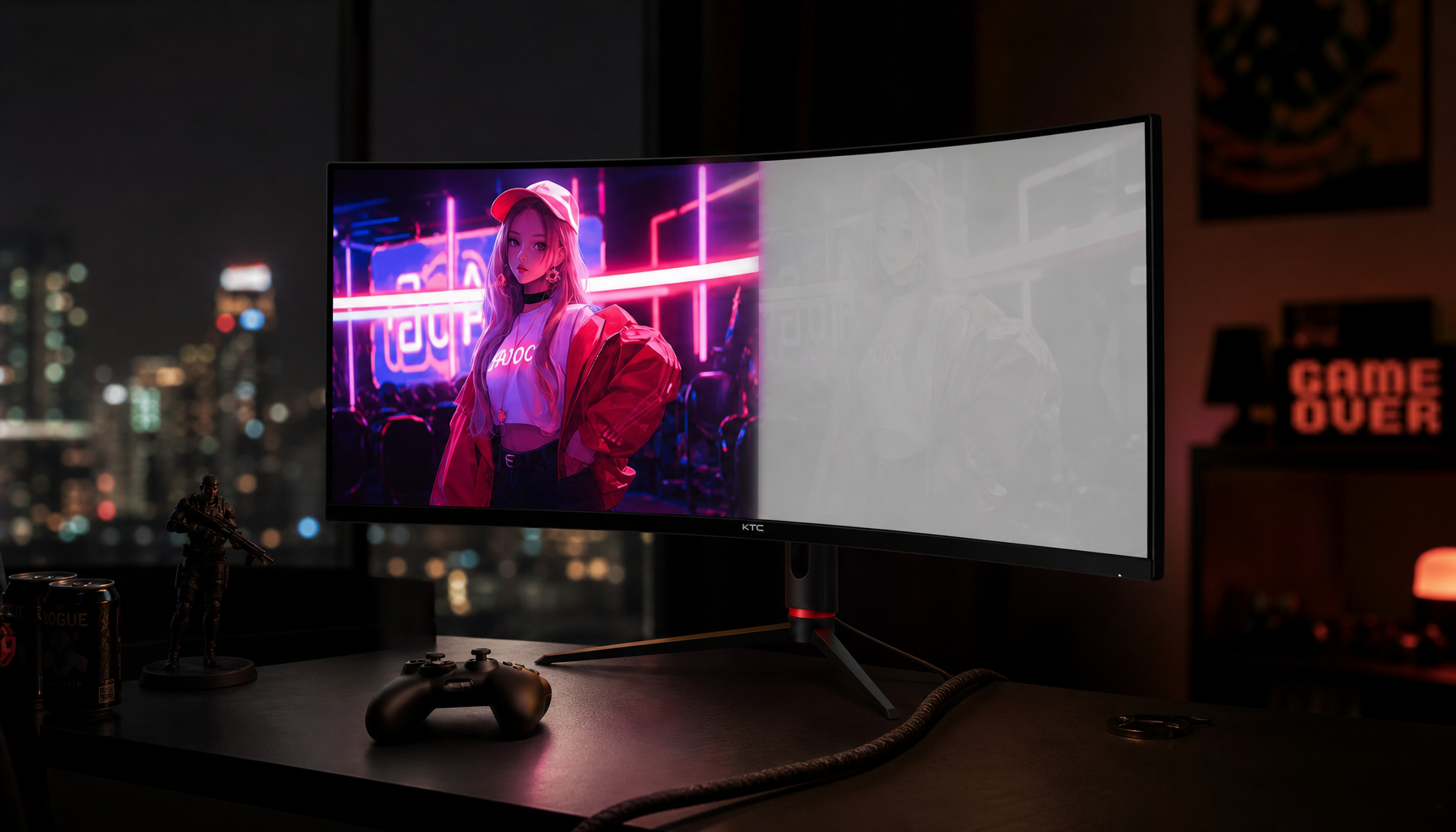
On large desktop displays, the screen edges sit closer to the viewer on a curved panel, which is why a curved monitor can feel more enveloping than a flat monitor with the same diagonal size. You are not getting more panel area, but more of that area stays within your natural forward view.

In monitor buying terms, the wider field-of-view effect can make the display feel larger in use, especially on gaming monitors and ultrawide monitors. That is why a curved 34-inch ultrawide often feels more expansive at the desk than a flat 34-inch screen, even though the spec sheet shows the same size.
What curvature does not change
For image quality basics, curvature does not add sharpness or change text clarity. It changes how the screen reaches your eyes, not how many pixels you have, so resolution, panel quality, and scaling still matter more for fine text.
Where curvature changes field-of-view coverage the most
Width matters more than curve alone
For immersive use, 21:9 ultrawide panels give curvature more room to work because the extra horizontal span pushes more image area toward your side vision. A curved 16:9 monitor can still feel more natural at the edges, but the difference is usually more obvious once you move into ultrawide or super-ultrawide shapes.

The main ergonomic benefit is that the display wraps more of your field of vision and can reduce the need to twist your neck when you sit centered. In practice, that matters far more on a 34-inch gaming monitor or a 49-inch ultrawide than on a small secondary screen or most portable monitors; a 34-inch 1500R display such as the a brand 34” 2K 180Hz/1ms 1500R Curved Gaming Monitor is the kind of setup where the edge-distance difference becomes easier to notice from a centered seat.
Bigger screens make the effect easier to notice
In curved-display research, 34-inch and 49-inch models can feel overwhelming if you sit too close, which is useful because it shows the other side of the same rule: the screens that benefit most from curvature are also the screens that punish bad placement most quickly. If a large display feels too big on your desk, moving back a little can matter more than switching curve types.
How to read 1000R, 1500R, and 1800R in real buying terms
Lower numbers mean a stronger curve
In monitor specs, the “R” value is the radius of the curve, so a lower number means a tighter, more aggressive bend. A 1000R screen is more curved than 1500R, and 1500R is more curved than 1800R.
As a practical seating guide, the curve rating roughly maps to the intended viewing distance: 1000R lines up with about 3.3 ft, 1500R with about 4.9 ft, and 1800R with about 5.9 ft. You do not have to match that perfectly, but the farther you get from that target, the less meaningful the wraparound effect becomes.
Desk fit matters as much as the spec
For real desks, many 27-inch-plus setups land around 27 to 32 inches for gaming and 30 to 35 inches for productivity, with the top of the screen at or just below eye level. That is why tighter curves make more sense on deep desks and centered gaming setups, while gentler curves are usually easier to live with in mixed work and entertainment use.
Monitor setup |
Best fit |
Main caution |
|
27-inch 16:9 curved |
Mild |
Single-user gaming or mixed use |
Smaller gain in side coverage |
34-inch 21:9 ultrawide |
Strong |
Gaming, movies, multitasking |
Works best when you sit centered |
49-inch 32:9 super ultrawide |
Very strong |
Sim racing, flight sims, immersive play |
Can feel overwhelming if too close |
Minimal |
Travel, second screen, collaboration |
Flat is usually simpler and more flexible |
Why FOV setup still matters more than curvature
Curvature helps, but geometry still wins
In sim racing, correct FOV makes on-screen object size match your seating position instead of just looking dramatic. The useful part for monitor buyers is the input list: diagonal size, eye-to-screen distance, and aspect ratio all matter, which reinforces that perceived size depends on setup geometry, not on curve alone.
For curved gaming monitors, arc-based FOV calculations usually change the result by only a few degrees. That is a meaningful change, but it is not magic. A poorly placed curved monitor can still feel wrong, while a well-positioned flat monitor can feel more natural than buyers expect.
This is most obvious in sim-style genres
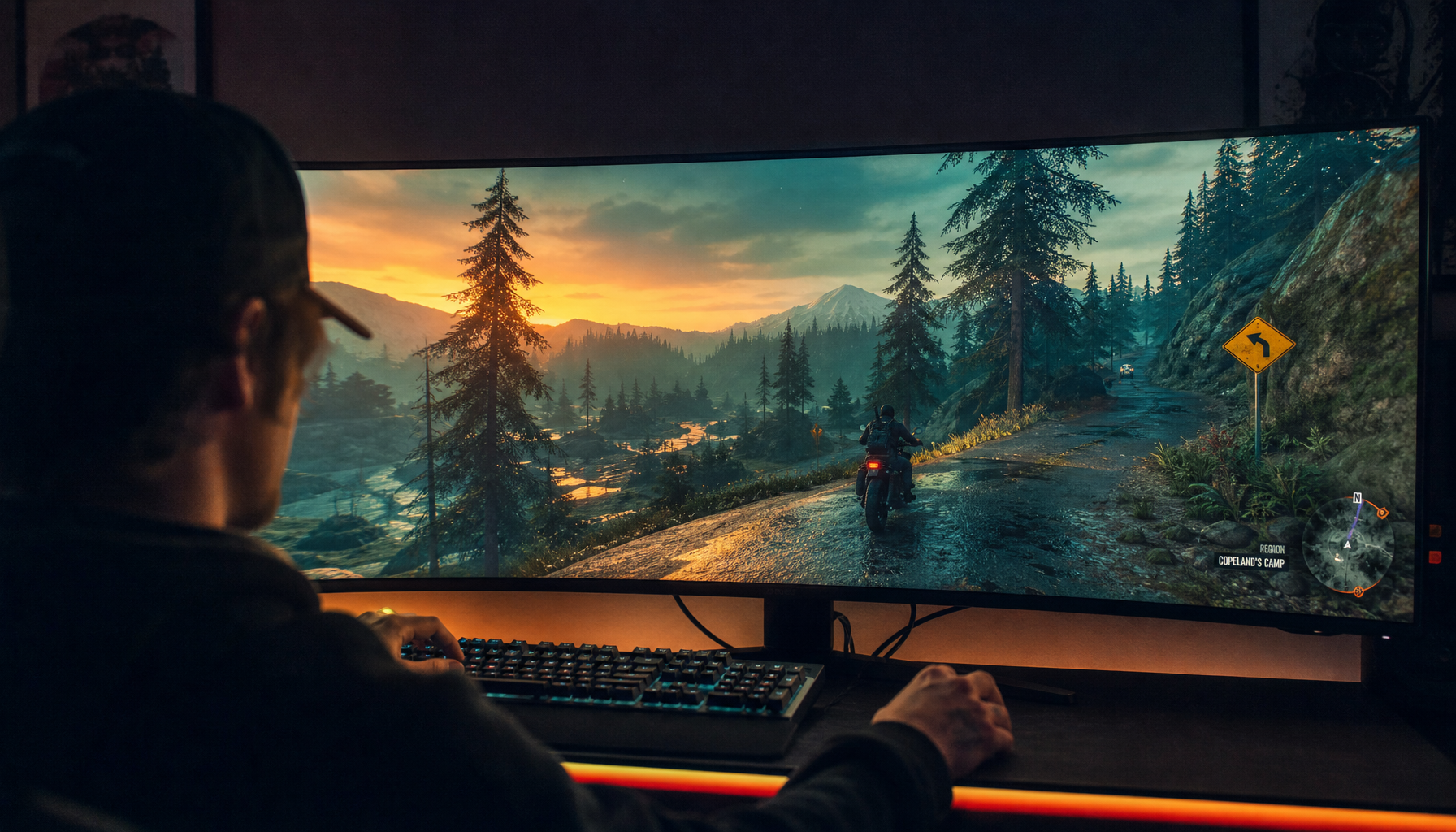
In games where spatial awareness matters, curvature can extend visuals farther into peripheral vision, which is why racing, shooters, and flight sims benefit more than slower desktop tasks. If you run triple screens, the geometry gets even more specific because bezel width and side-screen angle affect the usable field of view.
Some titles also use different FOV conventions such as horizontal, vertical, doubled vertical, or even radians, so copying another player’s slider setting is unreliable. For a high-refresh-rate display, that is a useful reality check: 180 Hz or 240 Hz improves motion, but correct FOV is what makes the world scale look believable.
When curved monitors are worth it, and when flat screens are safer
Best use cases for curved screens
For a centered single-user desk, curved monitors make the most sense when the goal is a more surrounding view, which is why they are easiest to justify on gaming monitors, ultrawide monitors, and larger high-refresh-rate displays. In those categories, curvature is not just styling; it changes how usable the outer screen area feels.
A useful buying comparison is that a 34-inch 21:9 screen can feel more immersive than a narrower 32-inch 16:9 display, even if the 16:9 model offers more total pixels. For buyers deciding between a flat 4K panel and a curved ultrawide, horizontal coverage often matters more for immersion than raw resolution.
Cases where flat is still the better tool
For shared viewing, curved screens are less suitable from the side and less convenient for screen sharing. That matters in home offices, collaborative desks, and many portable-monitor scenarios where the display angle changes constantly.

There is also a visual tradeoff: aggressive curves can make straight lines look bent and change how reflections behave. If your day is mostly spreadsheets, layout work, or frequent side-by-side collaboration, a flat panel or a mild curve is usually the safer buy.
Practical Next Steps
A simple rule for choosing
For real-world buying, the key variables are monitor size, aspect ratio, and eye-to-screen distance, with curvature acting as an amplifier rather than a substitute. On most desks, the curve becomes meaningfully helpful once you move into 34-inch ultrawide, 32-inch-plus gaming, or 49-inch super-ultrawide territory.

The setup works best when you stay roughly within the curve’s intended distance and keep the display centered at eye level. If you cannot do that, the practical benefit of curvature drops quickly, no matter how impressive the spec sheet looks.
Action checklist
- Measure your eye-to-screen distance before shopping.
- Treat 1000R, 1500R, and 1800R as rough fit guides for about 3.3 ft, 4.9 ft, and 5.9 ft.
- Prioritize aspect ratio first if immersion is the goal; 21:9 and 32:9 gain more from curvature than 16:9.
- Use an FOV calculator for sim racing or cockpit games instead of copying a slider value from a forum post.
- Pick flat or a mild curve if you often share the screen, work off-angle, or want a portable secondary display.
- Judge refresh rate, resolution, and curvature as one package, not as separate specs.
FAQ
Q: Does a curved monitor really feel bigger than a flat monitor with the same size?
A: Yes, the display can feel larger in use because the outer edges sit closer and cover more of your side vision. The effect is strongest on wider monitors and at the right seating distance.
Q: Is 1000R always better than 1800R?
A: No, a lower R value simply means a stronger curve. A 1000R screen suits close, centered seating better, while 1500R or 1800R is often easier for mixed work and gaming.
Q: Does curvature help competitive gaming performance?
A: Sometimes, especially in genres where peripheral awareness matters, but curvature does not replace proper FOV, panel response, or refresh rate. On smaller esports displays, those factors often matter more.