Curvature changes perceived blooming more than it changes actual HDR performance. If haloing bothers you, panel type, local dimming quality, and seating position matter much more than the curve alone.
Ever notice a bright subtitle, HUD element, or cursor glowing harder than it should on a dark screen and wonder whether the curve is helping or hurting? Current monitor testing and buying guidance already shows the pattern: mini-LED sets with roughly 1,152 to 1,196 zones can look dramatically cleaner than coarse-zone LCDs, while OLED avoids zone-based halos entirely. The goal here is to make that interaction easy to judge before you buy a curved gaming monitor or ultrawide.
HDR Blooming Starts With the Backlight, Not the Curve
Why halos appear on LCD HDR monitors
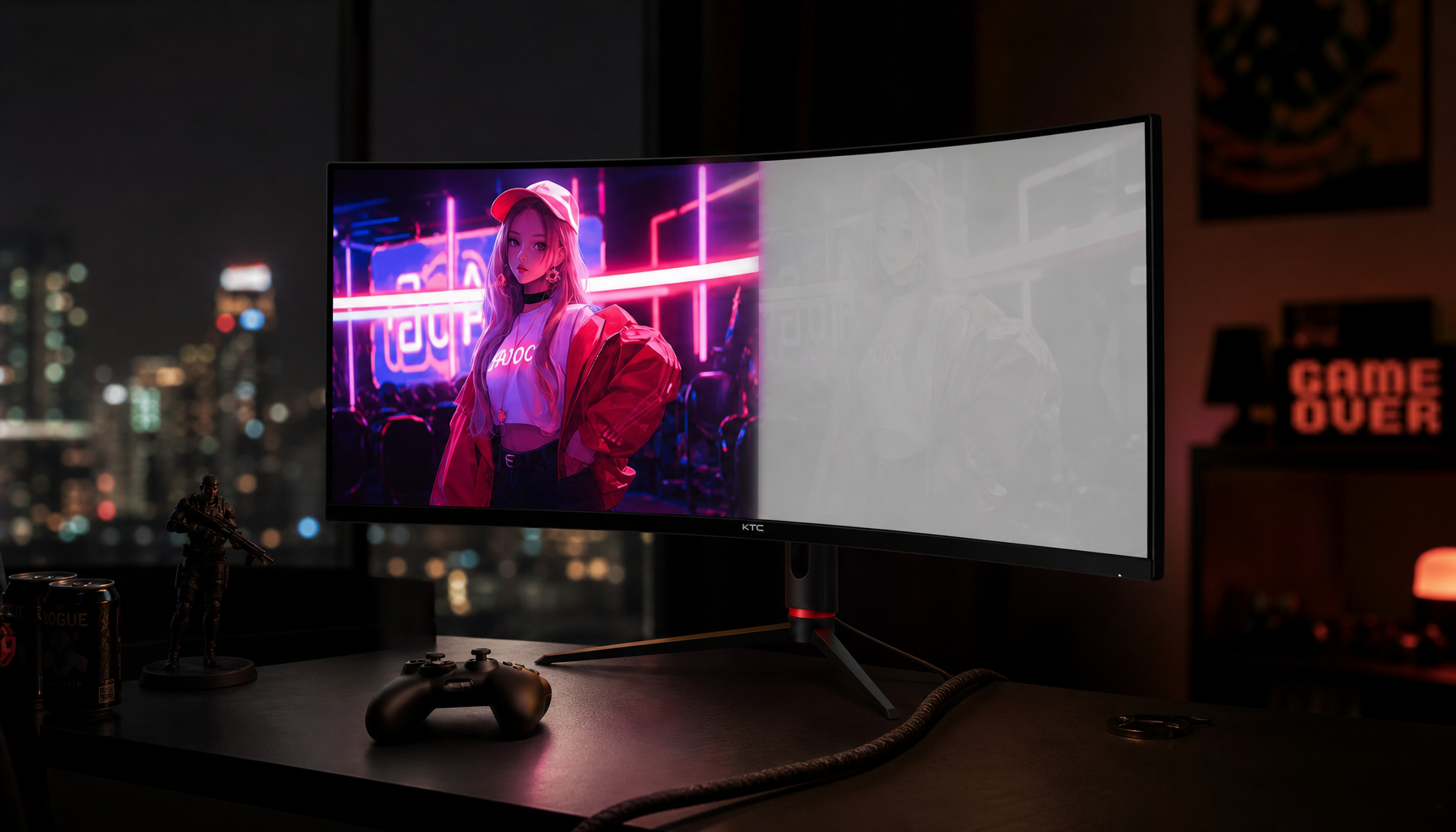
Local dimming uses independently controlled backlight zones, so blooming happens when one bright object forces a whole zone to light up and spill light into nearby dark pixels. That is why the classic stress cases are white text on black, subtitles, loading icons, bright moons, or small explosions in a dark game scene.

Smaller dimming zones are better because they reduce light bleed into dark areas, but zone count is only part of the story. Responsiveness, algorithm tuning, and black-level handling also shape whether the picture looks clean, crushed, or overly aggressive during motion.
Why HDR can make the issue more obvious
Good HDR depends on strong contrast, deep black levels, high brightness, and wide color performance, so weak black handling makes halos stand out more instead of less. HDR is not just “more color”; it also asks the display to show very bright highlights and very dark image areas at the same time, which exposes LCD backlight limits quickly.
Mini-LED local dimming improves black depth and highlight intensity versus simpler LCD backlighting, but it still cannot match OLED’s pixel-level light control. For monitor buyers, that means blooming is mainly an LCD local-dimming problem, not a generic HDR problem.
Curvature Changes Perception More Than Zone Precision
What the curve can and cannot do
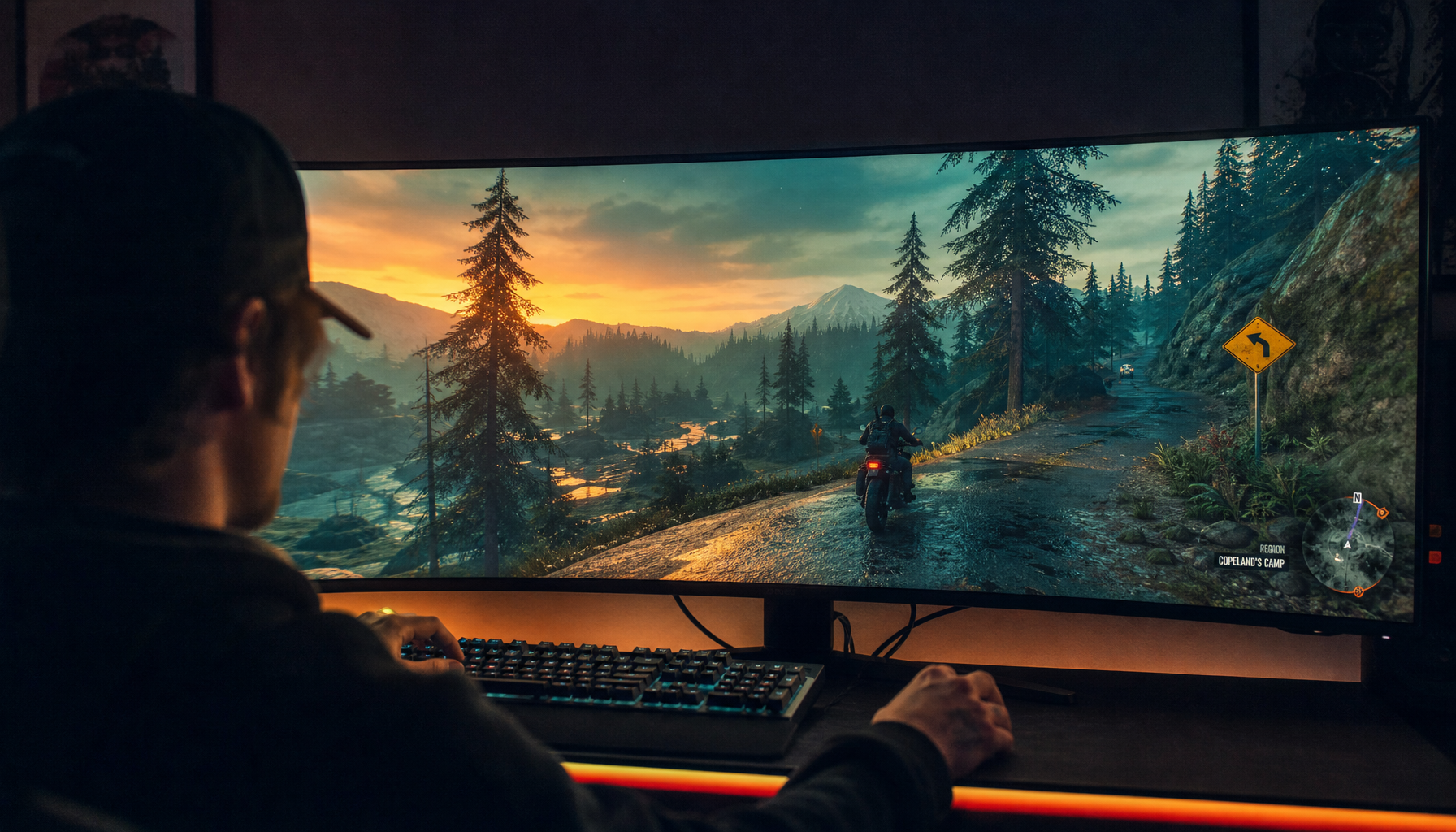
Curved monitors can make blooming appear stronger from off-center viewing angles, which is the clearest supported reason curvature matters here. The curve does not create more dimming zones or make each zone smaller; it changes the way your eyes meet the screen, especially near the edges of a large ultrawide panel.

Minimal front-view haloing can still turn into more visible side-view haloing on monitors that otherwise look strong head-on, as shown by one premium mini-LED example in current testing notes. That matters because many curved gaming monitors are large enough that even a small shift in posture turns part of the panel into a side-angle view.
Why this matters more on ultrawides
Curved display buying guidance now centers on very large models such as a 45-inch monitor from a company, a curved OLED ultrawide from a brand, and a 57-inch super-ultrawide from a brand. On screens that wide, blooming is not just about the panel’s center; edge behavior matters more because dark UI, subtitles, and map elements often sit away from the middle.
A real-world comparison between a 34-inch 1800R OLED ultrawide and a curved VA ultrawide also shows why buyers get confused: both displays can be curved, but their HDR behavior differs far more because one is self-emissive and the other depends on LCD backlight control. In practical terms, the curve changes how the flaws look, while the panel and dimming design decide whether those flaws exist in the first place.
Ultrawide and High-Refresh Displays Expose the Tradeoffs Faster
Large canvas, larger dimming decisions
Fewer, larger zones brighten larger parts of the image, so screen size and aspect ratio amplify mistakes when zone counts stay modest. A super-ultrawide gaming monitor can look immersive and still show obvious haloing if each zone covers too much screen area.
The strongest current mini-LED monitor examples cluster around 1,152 to 1,196 zones, which is a useful shorthand when comparing serious HDR LCD options. It is not a magic number, but it is a practical sign that the monitor is at least trying to solve HDR contrast with finer control instead of broad, obvious lighting blocks.
High refresh does not solve blooming
Local dimming responsiveness is a trade-off: fast dimming can make blooming more visible, while slow dimming can dim or trail bright moving objects. That trade-off shows up more often on gaming monitors, where the user is asking the panel to handle dark scenes, bright highlights, and fast motion at the same time.
One flagship curved monitor’s headline 240 Hz mode depends on a modern wired display interface and GPU headroom at its massive native resolution, so the HDR buying decision should not stop at refresh rate. A huge, fast curved monitor can still disappoint if the backlight logic, seating position, or system output keeps the HDR image from looking stable in actual games.
Quick comparison for buyers
For buyers comparing shape against backlight design, a flat model such as the a flat mini-LED 27-inch 180 Hz 2K HDR gaming monitor is a useful reminder that Mini LED with 1,152 zones is usually the more relevant anti-blooming factor than screen curve on a similar-size display.
Monitor category |
Example from the notes |
Blooming expectation |
Best fit |
Curved OLED ultrawide |
Curved OLED ultrawides from a brand |
No zone-based blooming; curve mainly affects immersion and edge presentation |
Buyers who hate halos and want premium dark-scene gaming |
Curved mini-LED ultrawide or super-ultrawide |
A curved mini-LED super-ultrawide from a brand |
Strong HDR potential, but blooming still depends on zone count, algorithm, and seat position |
Buyers who want brightness and scale more than perfect blacks |
Flat mini-LED 16:9 gaming monitor |
Flat mini-LED gaming monitors from a brand |
Often easier to judge head-on; low haloing is possible with many zones |
Buyers who want strong HDR value and simpler viewing geometry |
Curved productivity ultrawide without HDR |
A curved productivity ultrawide from a company |
Curve helps workflow, not HDR blooming |
Office and mixed-use buyers who do not need real HDR |
What to Prioritize If You Want Better HDR With Less Haloing
If blooming bothers you most
OLED is self-emissive and does not need local dimming, so it remains the cleanest answer for shoppers who cannot stand subtitle glow, cursor halos, or bright-object spill in dark scenes. That is why curved OLED gaming models such as premium curved OLED ultrawides from a brand stand out in current curved-monitor recommendations.
Curved gaming picks that emphasize OLED also emphasize wide color gamut and color accuracy, which lines up with what HDR buyers usually notice first: black integrity and highlight separation. If the budget allows it, this is the simplest path to “good HDR without blooming math.”
If you want LCD brightness and lower OLED risk
Mini-LED monitors usually cost less than OLEDs, get brighter, and avoid burn-in risk, but buying the right one means checking more than the spec sheet. One premium flat mini-LED model is noted for minimal front-view haloing but more side-view haloing and some black crush, while two value-focused 1,152-zone models show that even 1,152-zone options can differ in smearing, oversaturation, and overall balance.
Zone count alone does not guarantee better performance, so buyers should treat “1,000+ zones” as a threshold, not a verdict. After that, the real questions are how the monitor handles motion, whether blacks stay clean, and whether the image remains consistent once you are not perfectly centered.
If your curved monitor is mostly for work
A curved IPS ultrawide such as one office-focused model from a company can have strong contrast and ports while still lacking HDR support, which makes it a poor choice for anyone chasing dramatic HDR game scenes. In that case, curvature is a workspace decision, not an HDR decision.
One work-focused curved ultrawide’s 165 Hz refresh, power delivery, built-in hub, and KVM-focused feature set are a reminder that many curved displays are really multitasking tools first. If your day is split between spreadsheets, side-by-side windows, and occasional gaming, it can be smarter to separate “good curved workflow monitor” from “serious HDR display” instead of forcing both jobs into one purchase.
FAQ
Q: Does a curved monitor reduce HDR blooming compared with a flat monitor?
A: No, not by itself. Curvature changes how blooming is perceived, especially off-center, but zone size, panel type, and dimming behavior still decide how much haloing exists.
Q: Are more local dimming zones always better?
A: Usually, but not automatically. Higher zone counts reduce the size of each lighting decision, but algorithm quality, black crush, side-angle behavior, and motion handling can still make one 1,152-zone monitor look better or worse than another.
Q: Should HDR be enabled in both the operating system and the game?
A: True HDR only works when both the monitor and the source support it and HDR is enabled on both. After that, calibration matters: if both the PC and the monitor tone map aggressively, the image can end up too dark.
Practical Next Steps
A local-dimming test with a small white object on a black background is still the fastest way to judge a monitor during the return window. Run it in a dark room, then check subtitles, HUD elements, and cursor movement from your normal seat and from a slight lean left or right; that quickly reveals whether the curve is helping immersion or making edge haloing harder to ignore.

Tone mapping should happen once and cleanly, so use the operating system’s HDR calibration tool, then verify the game’s HDR sliders instead of stacking fake “HDR effect” modes on top. For buyers, the simplest rule is this: choose curved OLED if halos are a deal-breaker, choose 1,000-plus-zone mini-LED if you want bright HDR and better value, and treat non-HDR curved monitors as productivity displays rather than HDR upgrades.