Switch inputs from the monitor’s menu, remote, hotkey, or KVM control instead of unplugging cables; keep both smart monitor apps and the PC session running in the background. The reliable setup is separate inputs, stable cables, correct sleep settings, and app windows that remember where they belong.
Is your streaming app, browser tab, or work dashboard closing every time you jump from smart monitor mode back to your PC? A clean input-switching setup can keep your PC apps open, preserve your smart screen session, and avoid the cable-pulling routine that causes no-signal problems. You’ll get the practical steps to move between modes smoothly without restarting your workflow.
Smart Monitor Mode vs. PC Input: What Actually Changes
Smart monitor mode means the display is acting like a standalone screen with its own built-in apps, interface, Wi-Fi features, or media controls. PC input means the monitor is receiving video from a connected computer through HDMI, DisplayPort, USB-C, Thunderbolt, or an adapter.

The key point is that switching modes changes the active video input, not necessarily the running state of your apps. Your PC can keep rendering documents, game launchers, browser tabs, chat tools, or trading dashboards while the monitor shows smart mode. Likewise, the monitor’s built-in app may remain active while you view your PC, depending on the monitor’s software behavior.
The monitor input menu is the same control layer that lets a display scan ports such as HDMI, DisplayPort, and VGA. When a monitor gets stuck cycling through inputs instead of opening the main on-screen menu, it is a reminder that switching should happen through stable controls, not repeated cable disconnects.
The Best Setup: Separate Inputs and No Cable Swapping
The most reliable way to move between smart mode and PC input is to dedicate one input to the PC and keep the monitor’s smart interface as its own mode. For example, connect a desktop PC through DisplayPort for high-refresh-rate work or gaming, connect a laptop through USB-C for power and video, and use the smart monitor home screen for streaming or quick browser-style tasks.

USB-C can simplify this because video, data, and power may travel through one cable on compatible monitors, which reduces desk clutter and lowers the chance that a loose adapter causes a blank screen. Before relying on USB-C, confirm that the laptop and monitor both support video over USB-C, because not every USB-C port carries a display signal.
Manual input switching is still valid when you have only one PC and one smart monitor. Manual monitor input switching is the simplest low-cost method when a monitor has multiple inputs, but it does not automatically move your keyboard and mouse between devices.
For a real-world desk, think of a 32-inch smart monitor on a work surface with a laptop connected by USB-C and a gaming PC connected by DisplayPort. During the day, USB-C is the main input for spreadsheets, email, and video calls. At night, the input changes to smart mode for streaming or to DisplayPort for gaming, while the laptop remains asleep or open in the background.
Keep PC Apps Alive While the Monitor Changes Input
The PC side is where most interruptions happen. When you switch away from PC input, the computer may think the display disappeared, went to sleep, or changed resolution. That can cause windows to move, games to minimize, or apps to reopen on the wrong display.
Start in Windows Display Settings or macOS Displays and make sure your PC is set to extend or use the monitor as intended. Match the screen arrangement to the physical desk layout and choose the correct primary monitor, because many apps open on the primary display first.
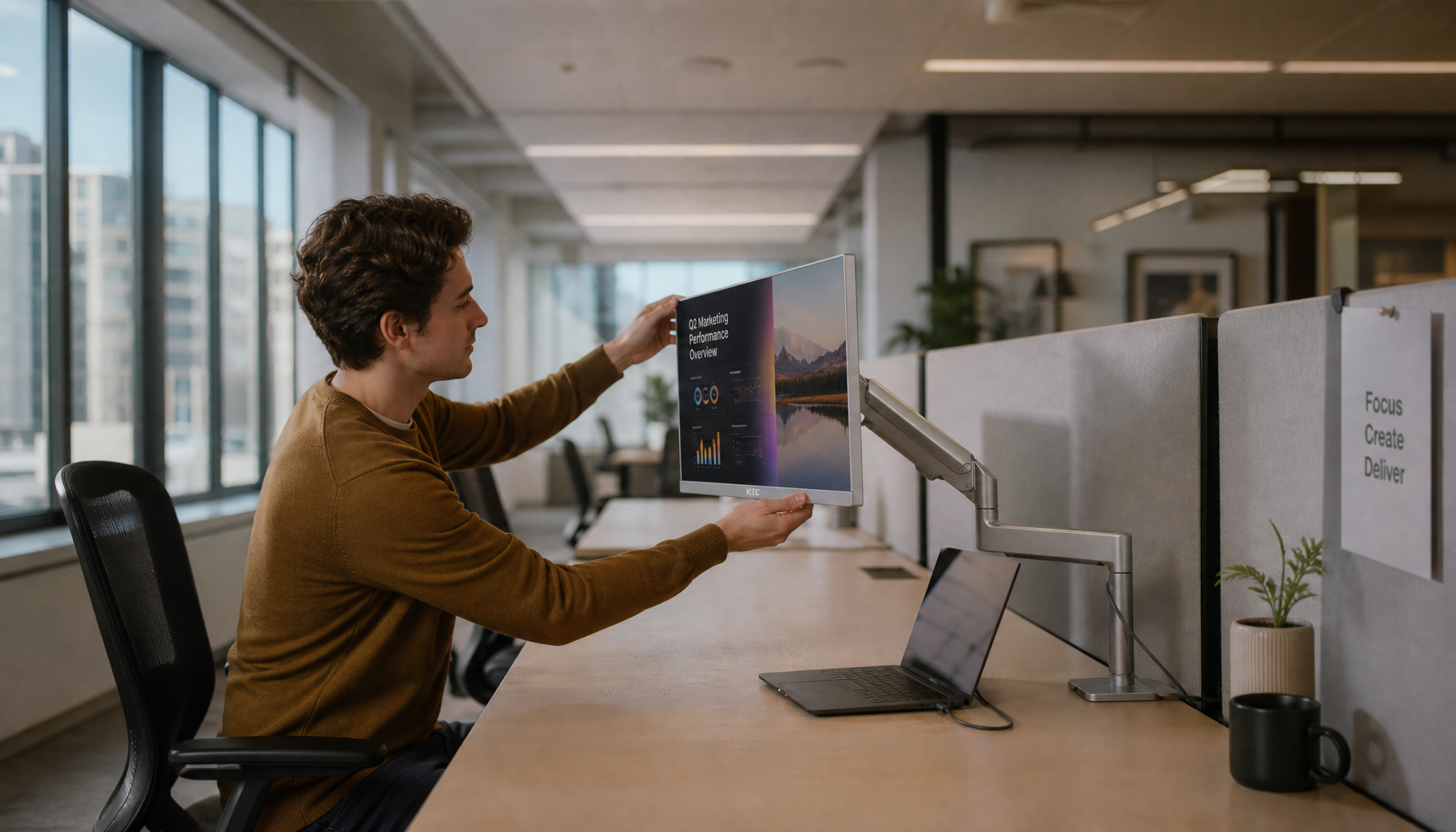
App placement is not always guaranteed by the operating system. KTC’s monitor workflow guidance notes that many apps remember their last position only after you move the window to the desired screen, resize it, close it there, and reopen it. That works well for simple productivity apps, but browsers, chat tools, launchers, and communication apps often keep background processes alive, so they may ignore last-position memory.
For stubborn apps, use a display utility or window manager that moves windows when they appear. Monitor utilities can save layouts, assign app zones, and manage display presets on supported monitors; software-driven monitor control can also handle brightness, layout, and workflow settings.
Input Switching Without Breaking Resolution or Refresh Rate
A short black screen during switching is normal. The display and input device may need a few seconds to renegotiate resolution, refresh rate, HDR, audio, and color format. The goal is not always instant switching; the goal is switching without manual repair afterward.
High-refresh-rate PC input deserves the best cable path. If your gaming PC runs at 144 Hz, 165 Hz, or higher, DisplayPort or a high-bandwidth HDMI path is usually more dependable than a random adapter chain. KTC’s refresh-rate guidance notes that missing refresh-rate options often come from limits in the monitor, GPU, port, cable, dock, adapter, or current resolution.
For mixed-use desks, a practical split is simple. Use the highest stable refresh rate on the PC input used for gaming, scrolling-heavy work, or creative precision. Let smart monitor mode run at its own default behavior for streaming and built-in apps. If the PC screen flickers or windows resize after every input switch, test a lower refresh rate, bypass the dock, or try a shorter certified cable.
Setup Choice |
Best For |
Main Advantage |
Main Tradeoff |
Monitor input button or remote |
One PC plus smart mode |
No extra hardware |
Keyboard and mouse stay with the PC |
USB-C single-cable input |
Laptop desks |
Cleaner power, video, and data path |
Requires compatible USB-C video support |
Built-in KVM |
Laptop plus desktop |
Keyboard and mouse follow the active input |
Only available on supported monitors |
External KVM |
Two PCs on one screen |
Fast switching with shared peripherals |
Must match resolution, refresh rate, and ports |
Use KVM When Keyboard and Mouse Switching Matters
If you only change what appears on the screen, the monitor input menu is enough. If you also need the keyboard, mouse, webcam, headset, or USB storage to follow the active input, you want KVM behavior.

A KVM switch lets multiple computers share one keyboard, video display, and mouse setup. For performance displays, look for HDMI 2.1, DisplayPort 1.4, USB 3.0 or better, high-refresh-rate support, hotkeys, and EDID emulation. EDID emulation is especially useful because it helps the inactive PC continue seeing a display, reducing window reshuffling when you switch away.
Built-in KVM is cleaner when the monitor supports it. In a work-and-play setup, the laptop can connect through USB-C while the desktop connects through DisplayPort or HDMI, and the monitor handles both video and USB control. Without KVM, you may switch the picture successfully but still type into the wrong machine.
Use a repeatable routine: press the monitor’s input hotkey to move from smart mode to PC input, wait for the signal to lock, then use the KVM shortcut only if you are changing computers. That avoids unnecessary USB reconnects when all you wanted was to check a streaming app.
Prevent Sleep, No-Signal, and Window Shuffling
Most “my apps restarted” complaints are not actual app restarts. They are sleep events, display disconnects, or windows restoring poorly after the monitor vanishes from the PC’s point of view.
Set the PC so it does not sleep too aggressively while you are using smart monitor mode. On Windows, adjust Power & battery settings so the computer stays awake long enough for your workflow. On a desktop, check GPU driver settings if the display disconnects randomly. On laptops, decide whether closing the lid should sleep, stay awake, or require an external keyboard and mouse.

Cable stability matters more than people expect. Start troubleshooting with secure cables, correct input selection, graphics driver updates, and resolution adjustment for blurry displays. That basic checklist is still the fastest path when switching from smart mode back to PC input gives you a blank screen.
For portable smart screens or touch-enabled displays, accidental input can also disrupt the workflow. Windows users can disable a HID-compliant touch screen in Device Manager when unintended taps cause cursor jumps or lost work. That is useful when a portable smart monitor sits beside a laptop and touch input keeps interfering with the main PC session.
Pros and Cons of Smart Mode Switching
Smart monitor mode is useful when you want entertainment, quick apps, or a lighter desk without waking a full PC. It can save power in some setups, removes the need for a separate streaming box, and keeps personal media separate from work applications.
The tradeoff is that smart mode is not the same as a second PC desktop. Built-in apps may have limited multitasking, limited file access, weaker keyboard shortcuts, or different audio behavior. PC input remains better for esports settings, color-managed creative apps, spreadsheet-heavy productivity, and any task where low input lag or precise window control matters.
A hybrid setup works best when each mode has a job. Use smart mode for streaming, casual browsing, or quick media. Use PC input for competitive play, office documents, dashboards, video calls, and anything that depends on full desktop software. Use KVM or monitor software only when the switching friction is frequent enough to justify the setup work.
A Practical Switching Routine That Works
Begin with all devices connected and powered normally. Put the PC on its preferred input, arrange your windows, and close and reopen key apps on the monitor where you want them to live. Confirm that the monitor is not duplicating displays unless you specifically want mirrored content.
Next, switch to smart monitor mode using the monitor’s remote, joystick, input button, or on-screen input menu. Do not unplug HDMI, DisplayPort, or USB-C cables. Let your streaming or smart app run. When you return to PC input, give the screen a few seconds to renegotiate before clicking or pressing hotkeys.
If apps move around, set the PC monitor as the primary display, test whether the app remembers its last position, and use a layout utility for repeat offenders. If the screen goes black, verify the selected input, reseat the cable, try another port, and restart only after the simple signal path checks fail.
FAQ
Will switching to smart monitor mode close my PC apps?
Usually no. Switching the monitor input does not close PC software by itself. Apps may appear to restart if the PC slept, the display disconnected, or the app restored its window poorly after the input changed.
Why do my windows move after I switch back?
The PC may be detecting the monitor as removed or changed. EDID emulation through a good KVM, a stable direct cable, correct primary display settings, and window-layout software can reduce this.
Is USB-C better than HDMI for smart monitor switching?
USB-C is better for clean laptop desks when it supports video, data, and power. HDMI or DisplayPort may be better for a desktop gaming PC where high refresh rate stability is the priority.
A smart monitor should feel like a control center, not a reset button. Keep every input connected, switch through the display’s input system, protect the PC from sleep and signal loss, and use KVM or layout tools when your desk has more than one serious workflow.