Lower your IPS monitor brightness, add soft bias lighting behind the screen, sit centered and slightly farther back, then adjust tilt and gamma before blaming the panel.
Does a dark movie scene look cinematic in the center but washed out in the corners, almost like a gray flashlight is leaking through the screen? A practical five-minute setup change can make that haze less distracting without sacrificing the color accuracy and sharp text that made your IPS display worth buying. Here is how to identify the problem, tune your setup, and decide when the monitor itself is the wrong tool for dark-room movies.
What IPS Glow Actually Is
IPS glow is the soft gray, silver, or sometimes yellowish haze that appears near the corners or edges of an IPS display during dark scenes. It is easiest to see when the room is dark, the screen brightness is high, and the content has large black areas, such as space shots, horror scenes, letterbox bars, or dimly lit game cinematics.
The key point is that IPS glow is usually a panel characteristic, not automatically a defect. IPS panels use a backlight, and the liquid crystal layer cannot completely block that light at every viewing angle. That tradeoff sits alongside the technology’s strengths: stable color, wide viewing angles, crisp desktop readability, and strong mixed-use performance.
For movie watching, the weakness is black depth. A good IPS monitor can look excellent for daytime productivity, editing, competitive gaming, and streaming, then look less convincing in a dark room because black areas rise toward charcoal gray. The same panel can feel premium at 2:00 PM and distracting at 11:00 PM.
IPS Glow vs. Backlight Bleed
Before tuning anything, separate IPS glow from backlight bleed. They look similar on a black screen, but they behave differently.

Symptom |
IPS Glow |
Backlight Bleed |
Movement |
Changes when your head moves |
Stays fixed in one place |
Shape |
Soft haze, often in corners |
Bright patch, streak, cloud, or edge leak |
Cause |
Viewing-angle behavior of IPS LCDs |
Panel pressure, frame fit, or uneven light leakage |
Best response |
Adjust brightness, lighting, distance, and tilt |
Test under normal use; consider return if severe |
A simple test works well. Let the monitor warm up, set brightness to a realistic movie level, open a black or very dark image, sit where you normally watch, and move your head slightly left, right, up, and down. If the glow shifts or changes intensity, it is probably IPS glow. If a bright patch stays locked to the same corner or edge, backlight bleed is more likely.
Do not judge the display from a phone photo taken in a pitch-black room. Camera exposure often exaggerates both glow and bleed, making a usable panel look much worse than it appears to your eyes.
Start With Brightness, Because It Has the Biggest Payoff
The most effective first move is lowering monitor brightness. IPS glow becomes more visible when the panel is the brightest object in the room, especially during black scenes where your eyes are adapted to darkness. Many monitors ship in vivid or gaming presets that are too bright for movie watching at night.
For a real-world starting point, if your monitor brightness is at 80% or 100%, drop it into the 30% to 50% range and replay the same dark scene. Then fine-tune from there. The goal is not to crush the image into dullness; it is to stop the backlight from overpowering the room.
Lowering screen brightness reduces visible haze and makes dark-room viewing more comfortable. If you go too far, however, shadow detail can feel too dim. That is why brightness should be paired with gamma or shadow adjustment rather than treated as the only control.
Use Bias Lighting Without Creating Glare
A completely dark room makes IPS glow stand out because your eyes compare the screen corners against black surroundings. Soft bias lighting behind the monitor raises the visual baseline around the display, so the corner haze becomes less obvious without shining light directly onto the panel.

Place a dim lamp, LED strip, or monitor light behind the screen, aimed at the wall rather than your eyes. Keep it neutral white if you care about accurate movie color. Bright colored lights can look dramatic, but they may distort your perception of skin tones and shadow contrast.
Bias lighting is inexpensive, reversible, and effective for both movies and late-night gaming. Poor placement can cause reflections, especially on glossy screens. If you see the lamp reflected on the panel, move it behind the display or lower the intensity.
Fix Viewing Position Before Replacing Hardware
IPS glow is angle-sensitive, so geometry matters. A 32-inch screen viewed from about 2 ft away puts the corners at a more extreme angle than a smaller display, or the same display from farther back. That is why large IPS monitors can show more corner glow even when the panel is not defective.

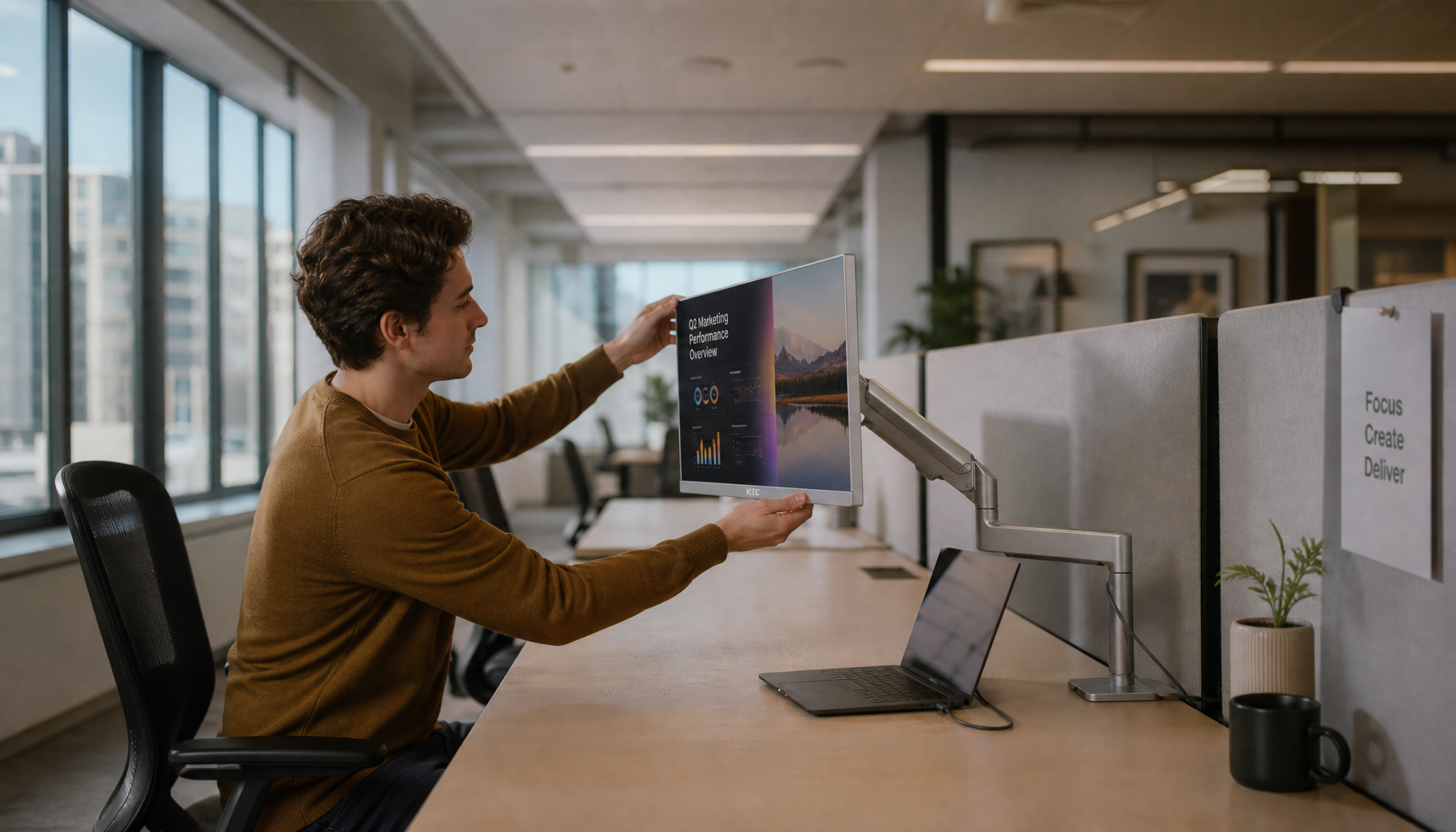
Sit centered, keep your eyes near the screen’s vertical midpoint, and tilt the panel until the corners look as even as possible. If you watch movies from a desk chair, moving back even a few inches can reduce the angle difference between the center and corners. If you use a monitor arm, check that the panel is not tilted too far upward or downward.
The viewing angle test is practical: pause a dark scene, adjust tilt by small increments, then compare the four corners. You are looking for the most balanced compromise, not perfect OLED-style black.
Adjust Gamma Before Raising Brightness Again
If the movie feels too dark after lowering brightness, resist the instinct to turn brightness back up immediately. Try gamma or shadow settings first. Gamma changes how midtones and near-black details are distributed, so it can reveal shadow detail without blasting the whole backlight.
On a monitor, this may be called gamma, black equalizer, dark boost, shadow control, or picture mode. For movies, avoid aggressive gaming modes that lift dark areas too much; they can make black bars and night scenes look gray. A modest adjustment is usually enough.
The benefit is better dark visibility with less glow penalty. The drawback is that too much shadow boost flattens contrast and can make films look less intentional. A good test scene is a dim interior with faces, black clothing, and background detail. If faces look natural and the corners are less distracting, the setting is working.
Calibrate for a Night Movie Preset
A performance-focused display setup should have more than one preset. Your daytime office profile and night movie profile should not be identical.

For a night movie preset, use lower brightness, moderate contrast, warm or neutral color temperature, and restrained gamma adjustment. Turn off dynamic contrast if it causes pumping, where the whole image brightens and darkens between cuts. If your monitor has local dimming, test it with real movie content rather than menus; some edge-lit or basic local dimming systems create distracting halos.
A calibration tool can help if you also edit photos or video, but you do not need a colorimeter just to reduce visible IPS glow. The practical win comes from matching the screen to the room.
When IPS Is Still the Right Choice
IPS remains excellent for users who split time between office work, esports, content creation, browsing, and streaming. The same traits that expose glow in dark scenes also support stable color and readable text across everyday viewing positions. For a desk setup where movies are one workload among many, an IPS monitor can still be the best value.
The compromise becomes harder if your main use is dark-room cinema. In that case, VA, Mini LED, or OLED may suit you better. VA usually gives deeper blacks, though some models show slower dark transitions or smearing. Mini LED can improve contrast through local dimming, but performance varies by zone count and tuning. OLED delivers true blacks and instant pixel response, yet costs more and requires care around static desktop elements.
The most honest decision rule is simple: keep IPS if the glow is mild after setup changes and the display still serves gaming, productivity, and color work well. Consider another panel type if dark movies are your priority and the glow remains visible during normal scenes, not just black test screens.
When to Return or Exchange the Monitor
An exchange is most reasonable when the bright area is fixed, large, near the center, or clearly visible in real movies at normal brightness. That pattern points more toward backlight bleed or panel uniformity problems than ordinary IPS glow.
For pure IPS glow, exchanging is less predictable. Panel variance exists, so the next unit might be slightly better, similar, or worse. Before starting a return, test your current monitor with realistic brightness, slight ambient light, normal seating distance, and real content. A pure black screen at full brightness in a pitch-black room is useful for diagnosis, but it is a harsh and often misleading ownership test.
FAQ
Can IPS glow be completely removed?
No. IPS glow can be reduced, but not fully removed, because it comes from how IPS LCD panels handle backlight and viewing angles. You can make it much less distracting through brightness, room lighting, viewing distance, and tilt.
Is IPS glow bad for gaming monitors?
Not always. IPS is still strong for fast gaming, color consistency, and everyday productivity. It becomes a problem mainly for players and movie watchers who spend a lot of time in dark scenes with the room lights off.
Does a curved IPS monitor reduce glow?
Not reliably. Curvature can help keep screen edges more aligned with your viewing position, but panel quality, size, brightness, and distance matter more. A curved monitor can still show IPS glow if the corners are bright and the room is dark.
Should I use a black screen test?
Use it briefly for diagnosis, not as the final verdict. The better test is whether the glow distracts you during actual movies at your normal brightness and seating position.
Final Word
IPS glow is not a sign that your display is useless; it is a setup-sensitive limitation of a fast, color-stable panel type. For dark movie nights, the winning formula is lower brightness, soft bias lighting, centered seating, careful tilt, and gamma tuning. If that still cannot deliver the immersion you want, move toward VA, Mini LED, or OLED with a clear understanding of each tradeoff.