Look away from your screen for at least 20 seconds every 20 minutes, focusing on something about 20 ft away. For long work or gaming sessions, add a true 10- to 15-minute screen-free break about every two hours.
Are your eyes sharp at the start of a match or work block, then blurry, dry, or slow to refocus after an hour? A 20-second distance-focus break is widely recommended by major eye-health sources because it gives your focusing system and tear film a real reset window. Use that break correctly, go longer when needed, and tune your display setup so your eyes are not fighting the screen all day.
The Real Answer: 20 Seconds, 20 Feet, Every 20 Minutes

The most reliable baseline is the 20-20-20 rule: after 20 minutes of close screen work, look at something roughly 20 ft away for at least 20 seconds. This advice is consistent across clinical and ophthalmology sources because regular eye breaks help your eyes focus at different distances instead of staying locked on pixels, text, UI panels, spreadsheets, or game HUD elements.
The key detail is distance. Looking from your monitor to your phone does not count, because your eyes are still doing close-focus work. A better reset is looking out a window, across the room, down a hallway, or at a wall clock on the far side of an office. If you use a 27-inch monitor at arm’s length, shifting your gaze to a target 20 ft away changes the visual demand enough to let the focusing muscles relax.
For a practical setup, place a small visual target beyond your desk: a poster, plant, bookshelf, or window view. During intense work, use a timer, monitor reminder, or keyboard shortcut habit. The goal is not to interrupt performance; it is to protect it by preventing the slow blur and dryness that make you less accurate later.
Why 20 Seconds Works for Focus Reset
Screen viewing forces your eyes to repeatedly focus and refocus on tiny light-emitting details. A review of digital eye strain describes the condition as a cluster of ocular and vision-related symptoms tied to prolonged digital-device use, including dry eyes, blurred vision, glare sensitivity, tired eyes, headaches, and neck or shoulder discomfort. The same review highlights reduced blinking, focusing demand, glare, lighting, and viewing distance as major contributors to digital eye strain.
Twenty seconds is useful because it is long enough to break the near-focus lock. It also gives you time to blink fully several times, which matters more than many screen users realize. When reading dense text, tracking enemies in a fast shooter, editing video timelines, or comparing spreadsheet rows, people often stare without completing full blinks.
A simple calculation makes the value clear. If you work for three hours without breaks, your eyes may stay in near-focus mode for 180 straight minutes. If you use the 20-20-20 rule, you create nine focus resets in the same block. That is only three minutes of total looking-away time, but it changes the load pattern from continuous strain to repeated recovery.
When 20 Seconds Is Not Enough
A 20-second reset is the minimum habit, not the full recovery plan. Cleveland Clinic notes that uninterrupted screen time is a major risk factor and that two continuous hours of digital screen use per day can increase the chance of symptoms. It also recommends a longer 15-minute break every two hours along with the 20-20-20 rule for computer vision syndrome.
That longer break should be genuinely screen-free. Stand up, refill water, walk across the room, stretch your shoulders, or look outside. Swapping a monitor for a cell phone during a break keeps the same near-focus demand alive, so your eyes do not get the recovery you think they are getting.
For performance users, this is where discipline pays off. A competitive gamer between matches, a designer exporting files, or an analyst waiting on a dashboard refresh can protect the next block of focus by stepping away for a few minutes instead of scrolling. The advantage is simple: clearer focus, less dryness, and fewer end-of-day headaches.
Screen Session |
Best Look-Away Habit |
What It Solves |
20 minutes |
20 seconds at 20 ft |
Near-focus fatigue and slow refocusing |
60 minutes |
Several 20-second resets plus posture change |
Eye fatigue, neck tension, reduced blinking |
2 hours |
10- to 15-minute screen-free break |
Deeper visual and body fatigue |
Full workday |
Breaks, display tuning, hydration, eye exam if symptoms persist |
Recurring strain and productivity loss |
Blink Rate Is the Hidden Performance Bottleneck

Focus reset is only half the story. The American Academy of Ophthalmology explains that people normally blink about 15 times per minute, but during screen use that often drops to about five to seven times per minute, which can lead to dryness, stinging, redness, tearing, and blurry vision during computer use.
That means your 20-second look-away break should include deliberate blinking. Do not just stare into the distance. Blink slowly and fully a few times, letting the eyelids close completely. This helps spread tears across the eye surface and can make the next screen block feel sharper.
This is especially important for contact lens wearers, people in dry rooms, and users sitting near vents or fans. If your eyes feel gritty after long monitor sessions, display quality may not be the only issue. Your tear film may be breaking down because your blink pattern collapses during concentration.
Your Monitor Setup Can Make Breaks More Effective

Breaks work better when the screen is not creating unnecessary strain between them. For most desktop setups, the monitor should sit about arm’s length away, with the screen slightly below eye level. Harvard Health recommends placing screens 20 to 26 inches from the face, reducing glare, matching brightness to room lighting, increasing contrast, and using matte filters when needed for reducing eye strain.
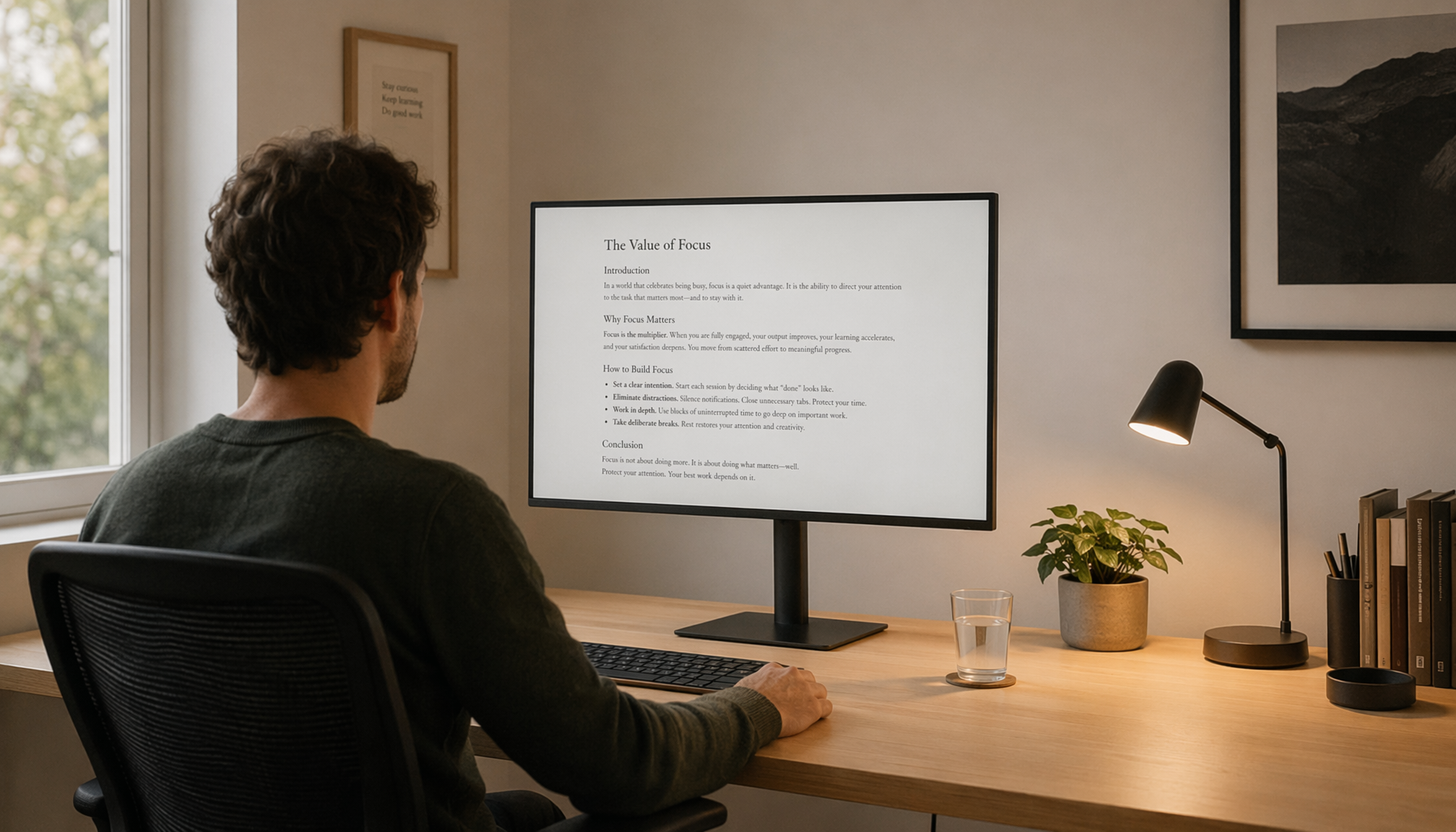
For a productivity display, text clarity matters. Increase font size before you lean forward. Use high contrast, but avoid extreme brightness in a dim room. If a white document looks like a light panel compared with your desk, lower brightness or add soft ambient lighting. If reflections from a window cut across the screen, reposition the monitor or use shades rather than forcing your eyes to compensate.
For gaming monitors, high refresh rate and low motion blur can improve visual comfort during fast movement, but they do not replace breaks. A 240 Hz display can feel smoother than a basic office panel, yet your focusing system still needs distance changes. Treat refresh rate, contrast, ergonomics, and breaks as a complete performance stack.
Blue Light Glasses Are Not the Main Reset Tool
Blue light gets a lot of attention, but it is not the first lever to pull for eye focus reset. The American Academy of Ophthalmology states that blue light from digital screens has not been shown to harm eyes or meaningfully prevent digital discomfort, while screen overuse, reduced blinking, glare, and viewing habits are more relevant to digital-device strain.
That does not mean evening screen settings are useless. Warmer color temperature, night mode, and reduced brightness can help sleep routines because bright screens late at night may interfere with circadian rhythm. But if your question is how long to look away to reset focus, the answer is still distance viewing and breaks, not glasses alone.
Computer-specific prescription lenses are different from generic blue-light glasses. If you spend many hours at a monitor and your regular glasses are optimized for distance or reading, computer lenses may help because they are set for intermediate viewing distance. Mayo Clinic notes that activity-specific prescription glasses may reduce eyestrain for some people, especially when an underlying vision need is part of the problem.
A Practical Reset Routine for Work, Gaming, and Portable Screens

For office work, set a 20-minute rhythm and look at a fixed target across the room for 20 seconds. Every two hours, step away from all screens for 10 to 15 minutes. During deep work, pair breaks with task transitions: after finishing a slide, a code review, a spreadsheet tab, or a client email batch.
For gaming, use natural pauses. Between rounds, look across the room instead of checking chat on a second screen. During queue times, stand up and focus on a distant object. If you play on a large monitor, keep the display far enough away that you can scan the full field without leaning in.
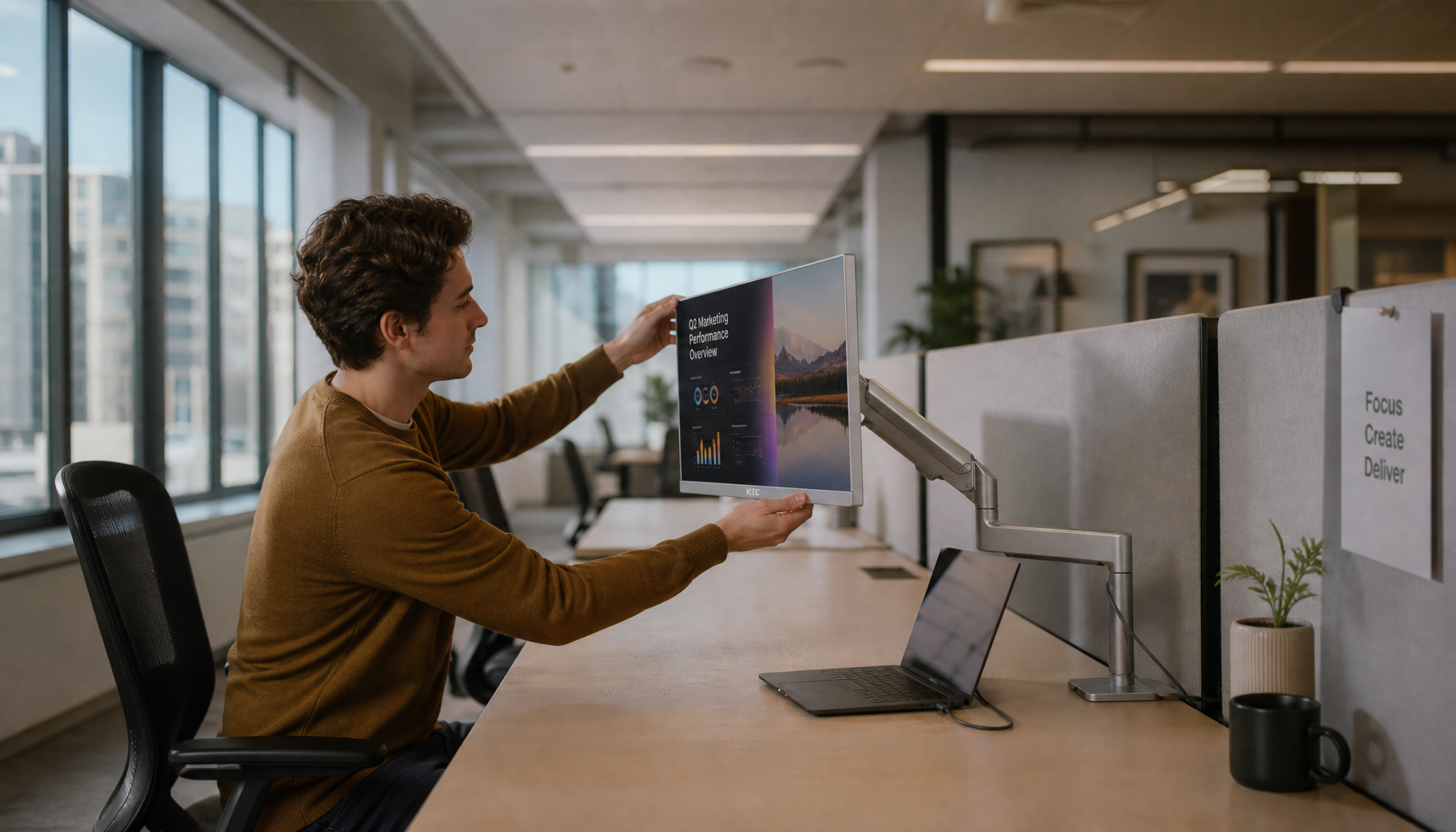
For portable screens and laptops, the biggest risk is creeping too close. A compact screen on a coffee table or airplane tray can pull your face forward. Raise the device, enlarge text, and keep it as close to arm’s length as practical. If the screen is small, do not solve readability by hunching; solve it with scaling, brightness balance, and more frequent resets.
When Eye Strain Needs More Than Breaks
Most screen-related discomfort is temporary, but persistent symptoms deserve attention. Cedars-Sinai notes that symptoms often improve after stopping device use, but they can continue when contributing factors like glare, poor viewing distance, posture, dry eye, or uncorrected vision problems are not fixed in computer vision syndrome.
Book an eye exam if headaches, blurred vision, eye pain, redness, dryness, or focusing trouble keep returning despite better breaks and setup. The issue may be an outdated prescription, dry eye, binocular vision strain, or a contact lens problem. For heavy screen users, the strongest upgrade is often not a new accessory; it is a corrected visual system matched to the display distance you actually use.
FAQ
Is looking away for 10 seconds enough?
Ten seconds is better than nothing, but 20 seconds is the better target because it gives your eyes more time to relax focus and blink fully. If you are already symptomatic, extend the break to 30 to 60 seconds when possible.
Does closing my eyes count?
Closing your eyes can help dryness and fatigue, but it does not train your focus to shift to distance. The better reset is to look at something far away, then blink slowly. If your eyes feel dry or irritated, add a brief eye closure after the distance look.
Should I take breaks even with a premium monitor?
Yes. A high-quality monitor can reduce flicker, blur, glare, and text harshness, but it cannot eliminate the biology of sustained near focus. Better displays lower the load; breaks change the load pattern.
A serious screen setup is not just resolution, refresh rate, and color accuracy. The most reliable focus reset is simple: every 20 minutes, look 20 ft away for 20 seconds, blink fully, and give yourself a real screen-free break every couple of hours. That small habit keeps your eyes clearer for the work, play, and creative sessions that matter.