OLED keeps color vivid beside true black, while quantum-dot LCD keeps color bright across sunlit rooms and large HDR highlights. The better choice depends on where the color has to hold up: shadow, highlight, desktop, or game scene.
Is your HDR game supposed to glow, but the flames either look flat on an LCD or dim on an OLED after a few minutes of bright action? Current monitor testing and product data make the tradeoff easier to judge: OLED delivers unmatched contrast and pixel-level precision, while quantum-dot LCD uses stronger light output to keep saturated color visible in brighter scenes. The practical question is not which panel has “more color,” but which one preserves the right colors in the way you actually use the screen.
Color Volume, Not Just Color Gamut
Color gamut tells you how far a display can reach toward red, green, and blue on a flat color map. Color volume adds brightness to that picture. In real use, that means a monitor may claim wide DCI-P3 coverage yet still lose punch when HDR asks for a bright red brake light, a golden sunset, or a saturated game HUD at high luminance.

That is why color volume matters more than the familiar “99% DCI-P3” badge. A monitor with wide gamut but modest brightness can produce rich colors in midtones and shadows, yet compress highlights. A brighter quantum-dot LCD can often keep those colors more forceful in the upper brightness range, while OLED can make lower-brightness colors feel more dimensional because black is genuinely black.
Quantum-dot displays use semiconductor nanocrystals that emit narrow, saturated colors when excited by light. In LCD monitors, the quantum-dot layer improves the backlight before it passes through the LCD stack. In QD-OLED, quantum dots are used differently, converting blue OLED light into red and green, which is why modern QD-OLED can combine OLED contrast with a broader color spectrum than older OLED designs.
OLED Color Volume: The Strength Is Contrast
OLED’s advantage starts at the pixel. Each pixel can emit light independently, so black areas can turn off instead of being dimmed by zones behind the panel. That is why OLED color can look so dense in dark game maps, sci-fi interfaces, cinematic cutscenes, and photo edits with deep shadow separation.
Modern OLED gaming monitors use pixels that emit their own light, with black represented by turning off the necessary pixels; that behavior leads to deep black levels and very high perceived contrast. In practice, a red status light on a black spaceship wall looks cleaner on OLED because the surrounding black does not glow. Your eye reads the red as richer even if a bright LCD can measure higher peak luminance.
The limitation is the top of the brightness range. OLED monitors have improved dramatically, with some models reaching 1,300 nits in HDR peaks under specific conditions. Still, large bright areas are harder for OLED than small highlights because power and heat management limit sustained full-screen brightness. For a gamer, that matters in snow maps, daytime racing scenes, or bright esports arenas. For office work, it matters when a mostly white spreadsheet or browser window fills the panel for hours.
Where OLED Feels Better
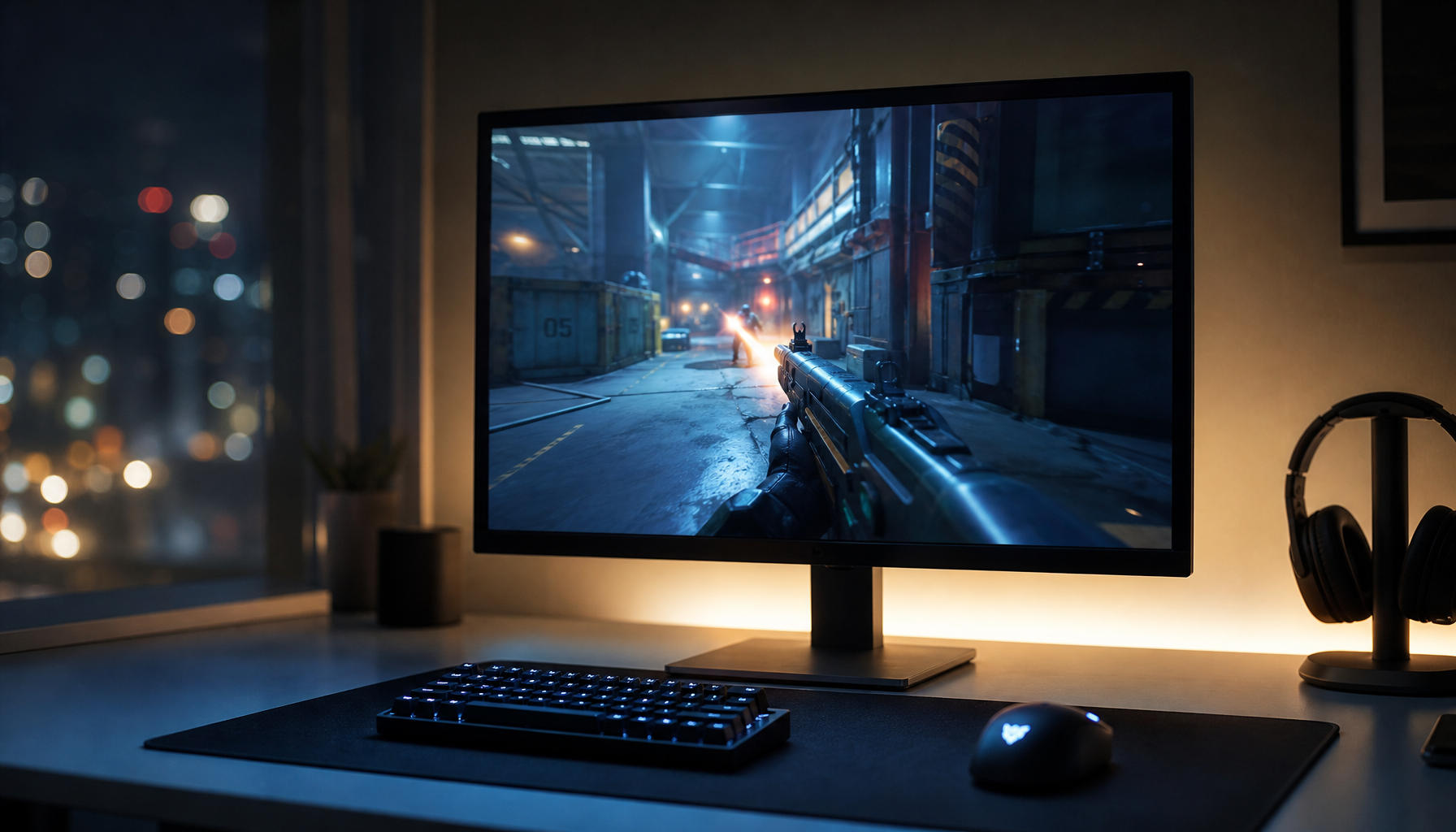
OLED feels strongest when the scene mixes saturated color with darkness. A horror game corridor with red emergency lights, a cyberpunk city at night, or a timeline editor with dark UI panels will often look more immersive on OLED than on QD-enhanced LCD. The color does not need extreme brightness to feel powerful because the black floor is so low.

It also helps motion clarity. Current OLED gaming monitors commonly advertise very fast gray-to-gray response, and several tested models list 0.03 ms response specifications with high refresh rates. Color volume is not motion performance, but the two interact in the user experience: a saturated object that stays clean during fast movement feels more solid than one smeared by slower pixel transitions.
Quantum-Dot LCD Color Volume: The Strength Is Brightness
Quantum-dot LCD, often marketed as QLED in TVs and some displays, keeps the LCD architecture but improves the color quality of the backlight. A blue LED backlight is converted by quantum dots into purer red and green, improving useful light throughput and color gamut before the LCD filters shape the final image.
The practical result is simple: a quantum-dot LCD can drive very bright color. Display technology analysis often frames QLED objectives around wider color gamut, higher peak brightness, and improved color volume compared with conventional display technologies. That aligns with what buyers see in stores: QD-enhanced LCDs often look vivid under bright lighting because the backlight has plenty of headroom.
The compromise is black level and local dimming behavior. Since LCD pixels modulate a backlight rather than emit their own light, dark scenes depend on how well the panel blocks light and how precisely the backlight can dim. Mini LED backlights improve this, but blooming can still appear around bright objects on dark backgrounds. A white mouse cursor on a black desktop, subtitles over a space scene, or a bright health bar in a night game can reveal that difference quickly.

Where Quantum-Dot LCD Feels Better
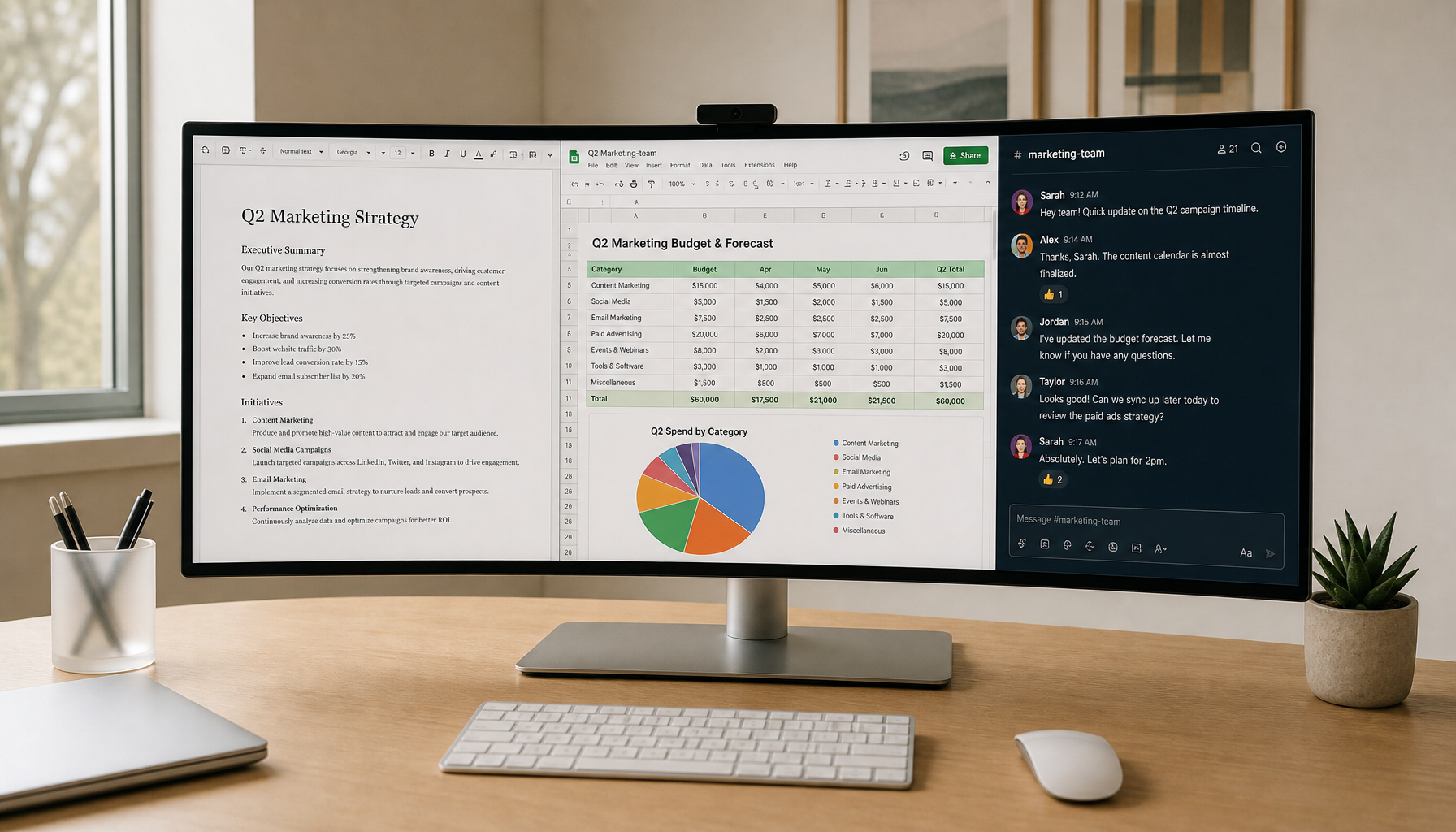
Quantum-dot LCD feels strongest in bright rooms and bright content. If your monitor sits beside a window, if you work with white-background documents most of the day, or if you play HDR games with large daylight scenes, the extra brightness can preserve color impact where OLED may look more restrained.

That does not mean every QD-LCD beats every OLED. It means the category has a brightness pathway that OLED handles more cautiously. A well-tuned mini LED quantum-dot LCD can make a full-screen HDR landscape look dazzling. An OLED may render the same scene with better black depth and pixel precision, but less sustained brightness across the whole panel.
QD-OLED Changes the Middle Ground
The cleanest comparison is not only “OLED versus quantum-dot LCD,” because QD-OLED borrows strengths from both camps. It remains self-emissive like OLED, but uses quantum-dot color conversion to improve red and green output. QD-OLED displays can achieve the same perfect black behavior as OLED while using quantum-dot converters, with examples reporting 90% Rec. 2020 coverage and 1,500-nit peak brightness in specific display contexts.
Current QD-OLED monitor lineups also show how common wide-gamut claims have become, with many models listing DCI-P3 99% coverage. The useful buying lesson is that QD-OLED is often the premium gaming sweet spot when you want OLED black levels, wide color, high refresh, and strong HDR highlights without moving to a larger, brighter LCD.
There is still a workstyle tradeoff. OLED and QD-OLED need more care with static content than LCD, especially for users who keep fixed taskbars, dashboards, trading windows, or editing palettes on screen all day. If your monitor is mostly for mixed gaming and content, QD-OLED is compelling. If it is mostly for static office work at high brightness, a QD-enhanced LCD remains the lower-maintenance choice.
Practical Buying Guidance
Use Case |
Better Fit |
Why It Wins |
Dark-room immersive gaming |
OLED or QD-OLED |
True black makes color look deeper and cleaner |
Bright office productivity |
Quantum-dot LCD |
Higher sustained brightness handles white apps and ambient light |
QD-OLED |
Strong contrast with wider quantum-dot color conversion |
|
Static dashboards and long spreadsheets |
Quantum-dot LCD |
Less concern around static UI wear patterns |
Portable smart screen use |
Depends on brightness |
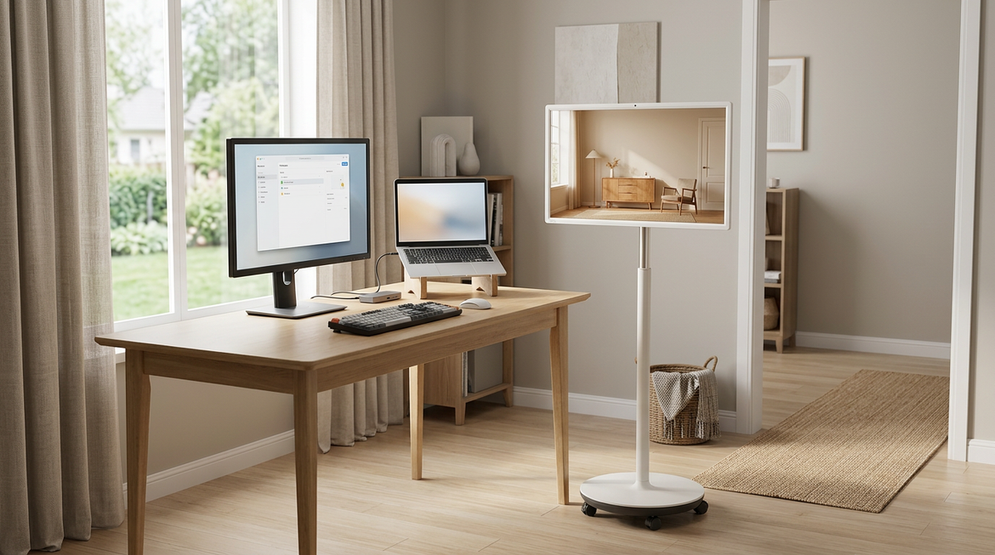
OLED looks premium indoors, LCD is easier outdoors |
For gaming, prioritize the scene type you actually play. If you spend most nights in RPGs, space sims, horror titles, or single-player cinematic games, OLED color volume feels more convincing because contrast is doing real work. If you play bright competitive shooters during the day, a fast QD-enhanced LCD can be easier to see and more consistent across large bright scenes.
For office productivity, do not buy only from a color-gamut number. A 99% DCI-P3 OLED may be gorgeous for review work, but a high-brightness QD-LCD can be more comfortable for documents, code, video calls, and browser-heavy workflows. Practical monitor traits such as size, resolution, connectivity, and usability matter because home office monitors succeed by being comfortable all day, not just spectacular for a demo clip.
For creators, separate color accuracy from color volume. Professional monitor positioning often centers on trusted colors, which is a useful reminder that wide color is only valuable when it is controlled. If you edit photos, grade video, or design brand assets, look for factory calibration, sRGB and DCI-P3 modes, uniformity control, and hardware calibration support where available. A display that can produce an intense red is not automatically a display that can reproduce a client’s red correctly.
Pros and Cons in Plain Terms
Technology |
Pros |
Cons |
OLED |
Perfect black, excellent perceived depth, fast response, premium gaming feel |
Lower sustained full-screen brightness, static-content care needed |
QD-OLED |
OLED contrast plus stronger quantum-dot color, excellent for premium gaming and HDR |
Usually expensive, still shares OLED static-content concerns |
Quantum-dot LCD |
High brightness, strong bright-room color volume, office-friendly durability |
Blacks depend on panel and dimming quality, possible blooming or weaker contrast |
The value call is straightforward. Spend on OLED or QD-OLED when immersion, contrast, and motion clarity are the performance targets. Spend on quantum-dot LCD when brightness, static desktop reliability, and price-to-size matter more.
The Calibration Factor
Color volume is only useful when the monitor maps content correctly. QLED tuning involves color temperature, gamma, color space, brightness, contrast, white balance, HDR tone mapping, and uniformity, all of which affect accurate color reproduction. The same logic applies to OLED. A vivid panel in the wrong mode can oversaturate skin tones, crush shadow detail, or make SDR content look artificially loud.
A simple setup pass goes a long way. Use sRGB mode for general web and office work when accuracy matters. Use DCI-P3 or wide-gamut modes for HDR games, video, and creative review when the content supports it. Keep HDR off on the desktop unless your operating system and monitor handle SDR-to-HDR mapping cleanly. For OLED, enable the panel care features and avoid running maximum brightness on static layouts all day.
Final Verdict
OLED panel color volume is more convincing in dark and mixed-contrast scenes because perfect black gives color a stronger foundation. Quantum-dot LCD color volume is more forceful in bright rooms and large HDR highlights because the backlight can push more sustained luminance. For the most balanced premium gaming display, QD-OLED is the strongest current choice; for work-first reliability and bright-room value, a well-calibrated quantum-dot LCD is still the smarter buy.