Gen 6 OLED vs Tandem OLED is mostly a question of how much static desktop time you plan to live with. If your day is a mix of coding, documents, and gaming, both can work, but neither should be treated as burn-in proof. The real decision is whether you want OLED image quality with mitigation habits, or a safer long-ownership path with Mini-LED.

What Changes Between Panel Generations
Gen 6 OLED and Tandem OLED are not the same kind of upgrade. In plain terms, one label often points to panel generation and layout changes, while the other points to a stack design that spreads emissive work across more than one layer. That matters because the architecture can change brightness behavior and stress per layer, but it does not guarantee a longer desktop lifespan on its own.
Subpixel Layout and Text Clarity
For desk use, text clarity is often the first thing people notice. Perceived sharpness depends on subpixel layout, resolution, scaling, and OS rendering together, not just on whether the panel is “new.”
That means a Gen 6 panel can look cleaner than older OLEDs in some setups, especially if the layout is better suited to text, but it can still show fringing in code editors or dense documents. If your work is mostly motion content or games, that difference may stay minor. If you stare at small UI text all day, it becomes part of the buying decision.
Single-Stack Versus Dual-Stack Emission
Tandem OLED is easier to understand as a durability-oriented architecture. A current-generation Tandem OLED overview describes stacked emissive layers as a way to lower current density per layer, which can improve brightness and extend usable life compared with single-stack designs.
That sounds encouraging, but the useful takeaway is narrower: Tandem OLED may reduce some stress, not erase it. For desktop buyers, that makes it a better version of the OLED idea, not a different category with zero retention risk.
What the Market Usually Means by Longevity
When people say a panel has better longevity, they usually mean it should tolerate repeated use a little better under similar conditions. Newer designs can improve static-image tolerance, but burn-in risk still depends heavily on daily exposure and mitigation habits.
That is the key boundary. Generation names help you compare architectures, but they do not tell you how your taskbar, IDE, browser tabs, brightness level, and sleep settings will age a panel over five years.
Why Burn-In Anxiety Persists
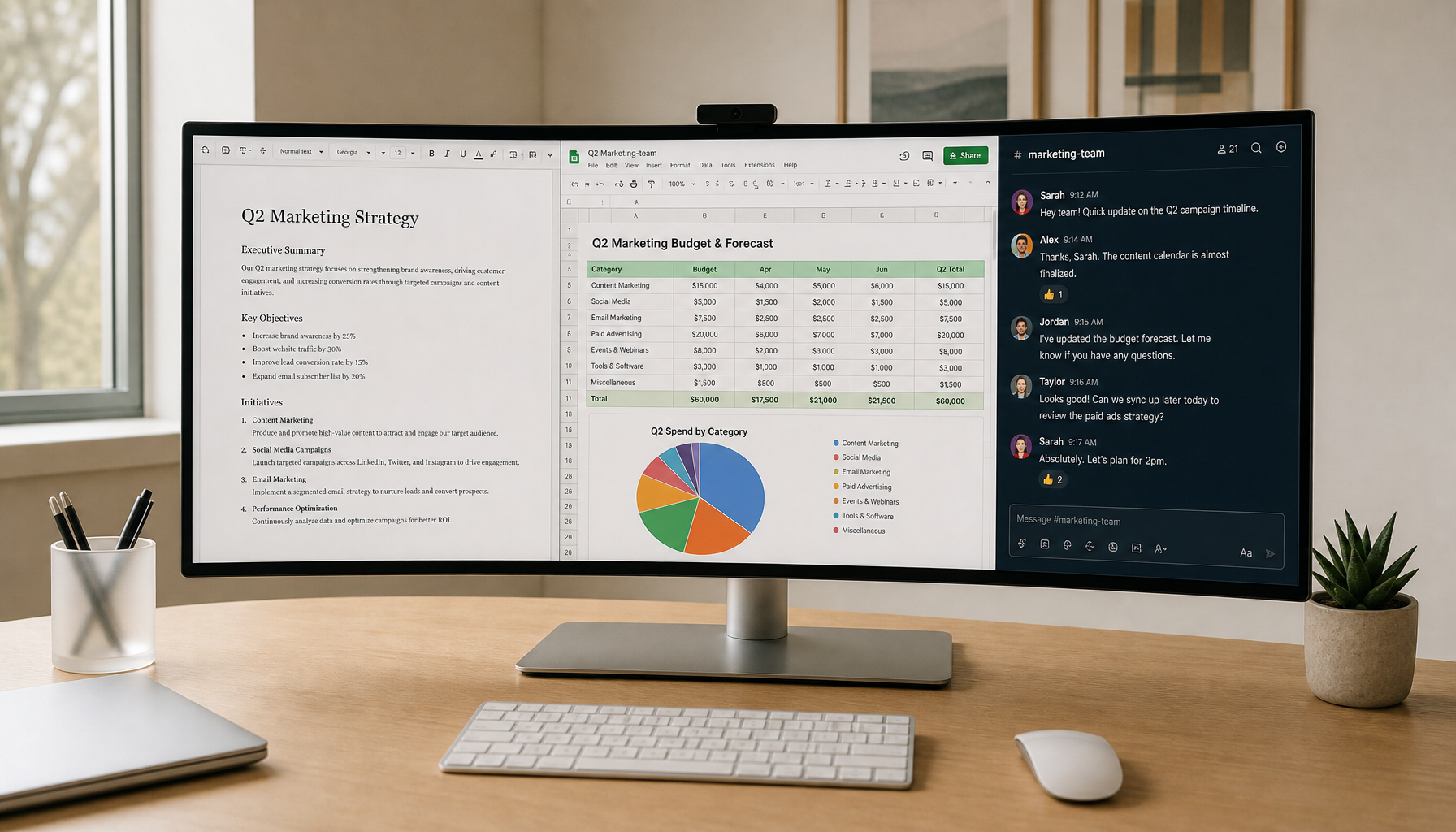
Burn-in anxiety persists because the desktop is full of static UI. Taskbars, dock icons, code panes, spreadsheet headers, and browser chrome sit in the same place for hours, then repeat tomorrow. A desktop taskbar burn-in guide makes the basic point clearly: static interfaces are the real risk factor, not just the panel label.

What matters is cumulative exposure. Six to eight hours a day of mostly static content is a very different situation from a few evening gaming sessions. Mitigation helps, but it is not magic. Dark mode, logo shifting, compensation cycles, auto-hide taskbars, and sensible brightness caps can delay problems, yet they do not guarantee immunity.
That is why an informed skeptic should ask a harder question than “Which panel is newer?” The better question is: how much of my day locks the same shapes in place, and how disciplined will I really be about settings after the honeymoon period ends?
Text Clarity and Workspace Readability
For most users, text clarity only becomes a deal breaker when the monitor doubles as a work display. If you code, write, or live in spreadsheets, you are buying a text tool first and a gaming panel second. In that case, the subtitle-level differences between Gen 6 OLED vs Tandem OLED matter more than marketing language.
Perceived sharpness depends on the whole signal chain. The panel’s subpixel layout, the native resolution, operating-system scaling, and font rendering all interact. Running below native resolution almost always makes the picture softer, which is why a panel can look excellent in motion and still feel annoying at a desk. Our panel native resolution guide covers that trade-off well.
That is also where a lot of regret comes from. People upgrade for motion smoothness, then discover that text fringing bothers them more than they expected during long sessions. If your work is mostly documents or IDEs, the safer check is not “Is it OLED?” but “How does this exact panel handle text at my intended scaling?”
Longevity Under Static Desktop Loads
The table below is a decision aid, not a lifetime promise. It shows the likely pattern in typical setups: OLED remains more comfortable to consider when static UI exposure is lighter, Tandem OLED may reduce some stress relative to older OLED designs, and Mini-LED becomes the lower-regret choice once daily static desktop time gets heavy.
| Daily Static UI | Gen 6 OLED | Tandem OLED | Mini-LED |
|---|---|---|---|
| 1-4 hours | Moderate | Moderate | High |
| 4-8 hours | Moderate | Moderate | High |
| 8-10+ hours | Low | Low | High |
A practical read of the table is simple. If your static UI use stays moderate and you value OLED contrast, either OLED family can still be reasonable. If your day is dominated by IDEs, spreadsheets, dashboards, or fixed browser layouts, Mini-LED is usually the calmer five-year bet.
That does not make OLED a bad choice. It means the ownership math changes once static content becomes the default rather than the exception.
Which Panel Fits Your Workflow
-
If you are a mixed gamer who spends a few hours a day in static apps, Gen 6 OLED is the more cautious OLED starting point when the text layout is clearly improved in the exact model you are considering. It is still an OLED, so keep mitigation habits in place.
-
If you want the better OLED architecture but still expect long desk sessions, Tandem OLED is the more interesting option. It can be the right compromise when you want a stronger durability story than older single-stack designs without leaving OLED behind.
-
If your workday is built around spreadsheets, IDEs, dashboards, or remote desktop windows, the safer choice is often not OLED at all. In that case, All-Mini-LED Monitors is the category to compare first, because the burn-in question largely disappears.
-
If you want a specific lower-regret path for mixed work and play, KTC Mini LED 27" 4K 160Hz HDR1400 Gaming Monitor | M27P6 is the more conservative 4K option, with Mini-LED local dimming, HDR1400, and a full ergonomic stand that helps when you move between work and gaming. KTC Mini LED 27" 200Hz 2K HDR1000 Gaming Monitor | M27T6S is the faster 1440p alternative if you care more about refresh-rate headroom than 4K workspace density. For an OLED option with strong motion performance, consider the KTC OLED 27" 2K 240Hz/0.03ms USB-C Gaming Monitor | G27P6.
-
If you are shopping the OLED side anyway, All-OLED Monitor is a sensible browsing starting point, but only if you accept that the trade-off is still longevity management rather than immunity. For pure gaming bias, Gaming Monitor helps you compare OLED and Mini-LED options in one place.
A simple decision sentence is this: if static UI is a daily habit, choose the panel that reduces regret, not the one that sounds newest. A second one is this: if you only fear burn-in because of occasional gaming, OLED is usually easier to justify than it is for all-day office use. A third is this: if you need a monitor to behave like a work appliance for five years, Mini-LED is the more conservative default.
Practical Longevity Checks Before You Buy
Before you commit, check the actual way you work, not just the headline spec sheet. A monitor that looks great in motion can still become tiring if you leave the same UI in place for eight hours a day.
- Count your static hours honestly. IDEs, spreadsheets, and dashboards matter more than mixed media use.
- Check the brightness ceiling you will really use in your room. Higher brightness is not always better for OLED ownership.
- Look at the stand and ergonomics. If you can change height, angle, or distance, you are less likely to leave one composition frozen for months.
- Read burn-in coverage carefully. A warranty may reduce financial regret, but it does not change panel physics.
- If possible, view the exact panel in your own lighting before you buy.
FAQs
Q1. How Much Static UI Time Is Too Much for OLED in 2026?
There is no universal cutoff, but the risk conversation changes once static UI becomes your default for many hours a day. A few hours of mixed use is very different from a workday built around fixed taskbars, toolbars, and spreadsheets. If you are regularly above that pattern, Mini-LED deserves serious consideration.
Q2. What Makes Tandem OLED Different From Gen 6 OLED in Daily Use?
Tandem OLED changes the emission-stack design, which can improve brightness and reduce stress per layer. Gen 6 is better thought of as a generation and layout story. In daily use, the difference matters most if the exact panel also improves text rendering and you still keep static exposure under control.
Q3. Can Gen 6 OLED Improve Text Clarity Enough for Coding?
It can help, but only if the specific subpixel layout, resolution, and scaling work well together. Coding and document work are the hardest test cases because text sits still for long periods. If readability is a major part of your day, try to verify the panel in person or through detailed reviews first.
Q4. Is Tandem OLED Worth It for Coding and Spreadsheets?
It can be worth it if you want a stronger OLED design and your workload still includes plenty of gaming or media use. It is not automatically the best office panel, though. For all-day spreadsheet or IDE use, the lower-regret answer is often still Mini-LED.
Q5. What Is the Safer Choice for a Five-Year Desktop Upgrade?
For many static-work users, Mini-LED is the safer long-term choice because burn-in anxiety is much lower. OLED can still make sense if you value contrast and motion quality enough to accept more careful habits. The safer answer depends less on the brand name than on how static your workday really is.
The Skeptical Bottom Line
Gen 6 OLED vs Tandem OLED is not a contest with a universal winner. Tandem OLED is the more reassuring OLED architecture, but it is still OLED, and long static desktop use still matters more than the label. If your desk life is mostly documents, IDEs, and dashboards, Mini-LED is usually the calmer five-year decision. If you want OLED, choose it with your actual workload in mind, not with burn-in optimism. Always verify text rendering on the exact model and confirm your static UI hours before purchase.