Choosing between OLED and Mini-LED for home cinema HDR comes down to your room and what you value most in movies. OLED delivers perfect blacks that make dark scenes feel truly deep, while Mini-LED offers higher peak brightness that keeps highlights explosive even when some ambient light is present.

Beyond the Specs: How HDR Performance Defines the Home Cinema Experience
HDR in movies is about the full range from the darkest shadow to the brightest highlight, not just maximum brightness numbers. The ITU-R BT.2100 standard sets the reference target at 1000 nits peak luminance with a very low black floor, which is the level most films are mastered to for theatrical and streaming releases. This benchmark helps explain why both OLED and Mini-LED aim for DisplayHDR certifications that match cinematic intent.
OLED achieves pixel-level light control because each pixel emits its own light and can turn completely off. Mini-LED uses thousands of tiny LEDs grouped into dimming zones behind an LCD panel to approximate that control while reaching much higher brightness. The practical difference appears most clearly in dark-room viewing versus rooms with windows or lamps.
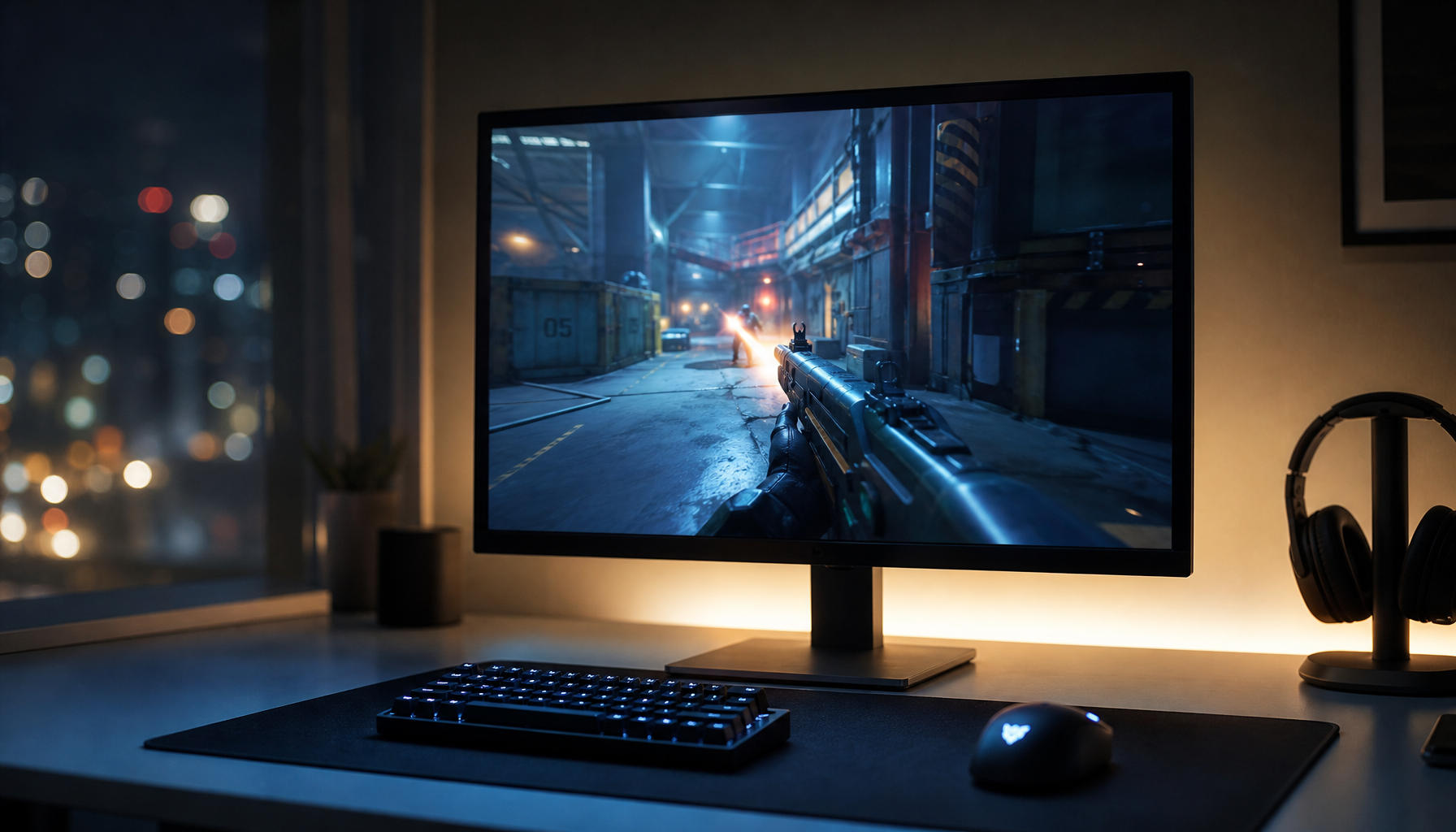
OLED’s Infinite Contrast: Why ‘True Black’ is Essential for Dark-Room Movie Nights
In a completely dark room, even a small amount of backlight bleed becomes noticeable and reduces immersion. OLED panels reach a black level of 0.0005 nits according to VESA DisplayHDR True Black requirements, which is effectively zero light output. This produces infinite contrast because there is no gray floor behind letterbox bars or night scenes.
Shadow detail stays visible without the crushing that sometimes occurs when backlights try to hide their own glow. Films with long dark sequences, such as space epics or moody thrillers, benefit most because every subtle texture in shadows remains intact rather than disappearing into a slightly lifted black level.
Mini-LED’s Luminance Advantage: Delivering Explosive Highlights and Daylight Visibility
Standard OLED panels often top out around 400-600 nits in full-screen brightness, while high-end Mini-LED monitors reach the DisplayHDR 1400 tier with 1400-nit peaks. This extra headroom makes specular highlights such as sunlight glints, explosions, and neon signs feel more visceral and three-dimensional.
Quantum-dot layers in many Mini-LED models help maintain color volume even at high brightness, so saturated reds and blues do not wash out during bright sequences. For viewers who watch in the evening but still have some ambient light from windows or lamps, the higher sustained output prevents the image from looking dim or flat.
The Artifact Trade-off: Understanding OLED ABL vs. Mini-LED Blooming in Films
Every high-performance display technology introduces its own compromise. OLED uses automatic brightness limiting to protect the panel during long bright scenes, which can reduce overall punch in daylight sequences or desert vistas. Mini-LED can produce visible halos around bright objects on dark backgrounds because light from one zone bleeds into adjacent dimmed zones.
Subtitles become a useful test case: white text on a black letterbox bar often reveals Mini-LED blooming more clearly than any other content. Higher zone counts, such as 1152 zones on certain 4K Mini-LED models, reduce the size of these halos but do not remove them entirely in pitch-black rooms.
Environment Matters: The Light Threshold Where Mini-LED Overtakes OLED
Room lighting is the single largest variable that flips the recommendation. Below roughly 10 lux, OLED’s perfect blacks provide the clearest advantage for cinematic depth. Between 10 and 50 lux the two technologies are closer, with OLED still preferred if blooming is your main concern. Above 50 lux, Mini-LED’s higher brightness usually wins because reflected ambient light raises the perceived black floor on OLED and reduces its contrast edge.
Ambient Light Tipping Point: OLED vs Mini-LED for HDR Movies
This chart shows the typical choice by room brightness tier for HDR movie viewing.
View chart data
| Scenario | <10 lux | 10-50 lux | >50 lux |
|---|---|---|---|
| OLED | 3.0 | 2.0 | 1.0 |
| Mini-LED | 1.0 | 2.0 | 3.0 |

Cinematic Chooser: Which KTC Display Technology Fits Your Viewing Habits?
If you watch primarily in a controlled dark room and want the deepest blacks with zero blooming risk, consider an OLED option such as the KTC OLED 27" 2K 240Hz/0.03ms USB-C Gaming Monitor. It matches the needs of viewers who prioritize shadow detail and subtitle clarity above all else.
For living rooms with windows or mixed lighting where you want sustained bright highlights, the KTC Mini LED 27" 4K 160Hz HDR1400 Gaming Monitor provides stronger impact. Its 1152 dimming zones keep blooming manageable while delivering the higher peak brightness that fights ambient light.
Hybrid users who want good HDR on a tighter budget can look at the KTC Mini LED 27" 200Hz 2K HDR1000 Gaming Monitor. It balances color volume and brightness without requiring a fully light-controlled space.
Frequently Asked Questions
Does OLED or Mini-LED handle dark movie scenes better?
OLED handles completely dark scenes better because each pixel can turn off individually, producing true black without any backlight glow. This advantage is most noticeable in dedicated home theaters with lights off.
Will Mini-LED blooming ruin subtitles in films?
Blooming can appear around bright subtitles on dark backgrounds with Mini-LED, but higher zone counts reduce the halo size. In rooms with even modest ambient light the effect becomes far less noticeable.
How much brightness do I actually need for HDR movies?
Most films are mastered around 1000 nits peak. Displays certified at HDR1000 or higher can reproduce those levels, while lower-tier panels tone-map the same content and lose some highlight punch.
Is burn-in a real concern for movie watching on OLED?
Static HUD elements or channel logos can increase risk over thousands of hours, but varied movie content spreads pixel usage more evenly. Many viewers watch several hours of films weekly without visible issues when brightness is kept moderate.
Should I choose 4K or 1440p for a home cinema monitor?
4K provides sharper detail on larger screens or when sitting closer, while 1440p Mini-LED models often deliver higher refresh rates and strong HDR at a lower price. The right choice depends on screen size and seating distance more than resolution alone.