HDR10 describes a signal format that tells a monitor how to handle brighter highlights and deeper shadows, while DisplayHDR 1400 certifies the actual hardware performance needed to display that signal properly. Many gamers see little or no improvement on entry-level monitors that only claim HDR10 support because the panel cannot produce the required brightness or contrast.

Why HDR10 is a Language, Not a Performance Score
If a monitor lists HDR10 in its specs, the panel can accept the metadata sent by a game or console, yet that does not mean the screen can produce the intended brightness range. HDR10 is simply the protocol that carries the data, similar to how a language carries words without guaranteeing the speaker's volume or clarity.
Entry-level monitors often produce a grey haze in dark scenes because their edge-lit backlights stay partially on to support one bright object elsewhere on screen. The result can look flatter than standard SDR content until local dimming hardware is added.
The Hardware Reality of VESA DisplayHDR 1400
VESA DisplayHDR 1400 certification requires a peak luminance of 1,400 nits, at least 95 percent DCI-P3 color coverage, and full-array local dimming with enough zones to keep black levels inky next to bright highlights. The standard also demands a dynamic contrast ratio roughly 3.5 times higher than the DisplayHDR 1000 tier.

These strict thresholds place DisplayHDR 1400 almost exclusively in the domain of Mini-LED backlights. Only this technology currently delivers the sustained brightness and zone control needed without compromising other panel characteristics.
What You Actually See: Specular Highlights and Shadow Depth
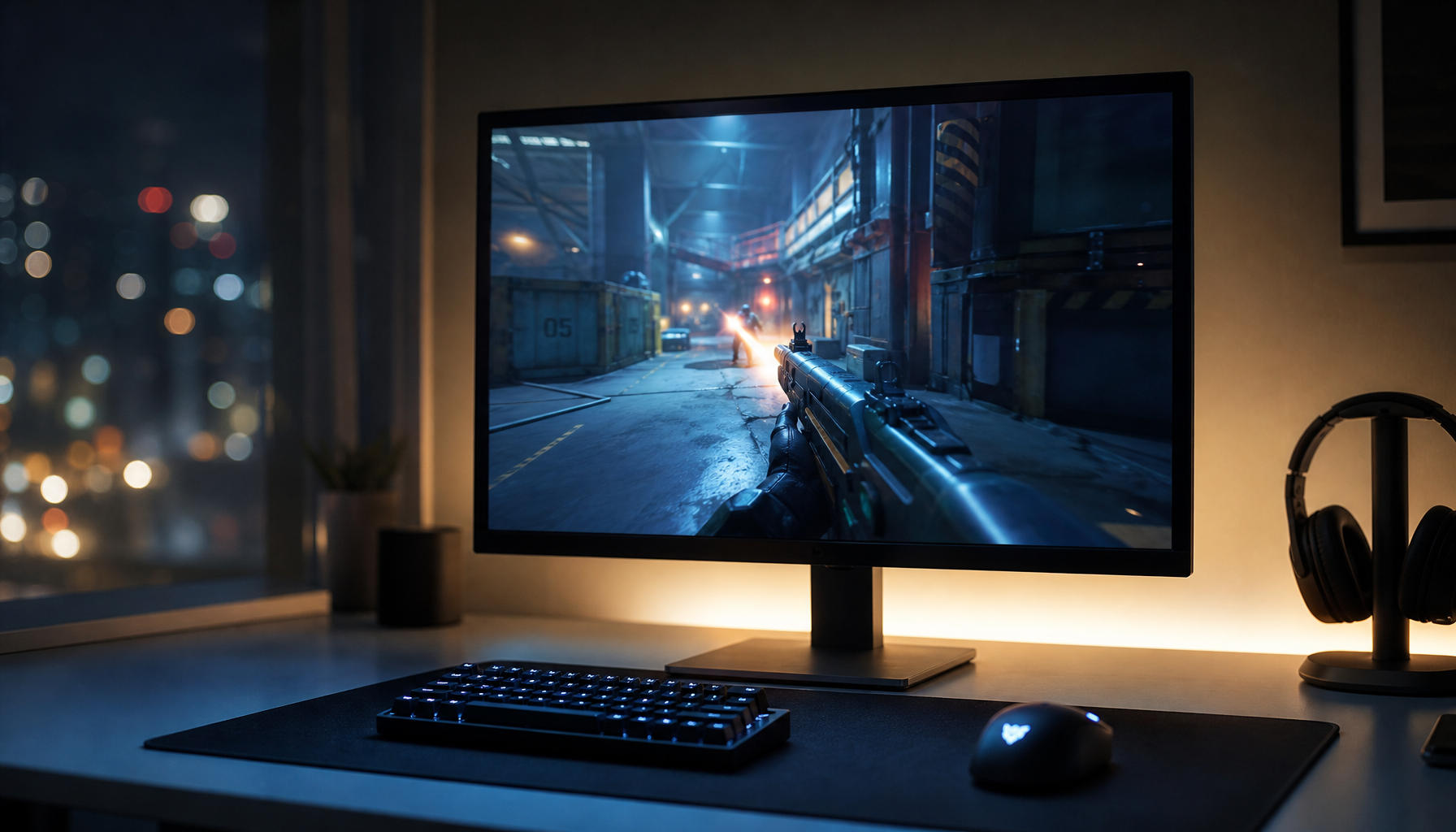
On a true DisplayHDR 1400 display, small bright elements such as sunlight glinting off metal or sparks in an explosion retain visible texture instead of clipping into flat white blobs. Lower-brightness panels must aggressively tone-map the same signal, compressing those details.
Local dimming zones allow one area of the screen to reach blinding intensity while an adjacent area stays near black. This separation creates the depth gamers notice in cinematic titles and horror games.
HDR Tier Hardware Requirements Comparison
Tiered comparison of peak brightness, contrast, and local dimming needs across HDR certifications.
Show data table
| HDR Tier | Peak Brightness (nits) | Relative Contrast Ratio | Local Dimming Zones (typical) |
|---|---|---|---|
| HDR400 | 400 | 1x | ~8 |
| HDR1000 | 1000 | 2.5x | ~128 |
| HDR1400 | 1400 | 8.75x | ~500+ |
Mini-LED vs. OLED: Choosing Your HDR Peak
Mini-LED panels with DisplayHDR 1400 certification maintain high brightness in rooms with windows or overhead lights, where OLED screens can appear washed out. OLED models deliver perfect per-pixel blacks and faster pixel response, making them preferable for dark-room cinematic play.
The practical crossover often occurs around the $500–600 price range. Above this threshold, the added brightness and zone count of Mini-LED frequently outweigh the contrast advantage of OLED for mixed-use desks that include productivity work.
Outcome-Oriented: Matching HDR Performance to Your Gaming Setup
Budget buyers who mainly play competitive titles at high frame rates can stay with HDR400 panels and accept modest dynamic range. Players who want noticeable specular punch and shadow separation without moving to OLED should look for Mini-LED models that list both peak HDR brightness and zone count.
All-Mini-LED Monitors from KTC include the M27T6 at 1440p 180 Hz and the M27P6 at 4K 160 Hz. Both reach the 1400-nit tier with hundreds of local dimming zones, giving gamers a clear step up from basic HDR10 signal support.
Check the number of local dimming zones alongside the HDR certification when comparing monitors. Zone count directly affects how cleanly bright highlights sit next to deep shadows in actual gameplay.
Frequently Asked Questions
Does HDR10 Alone Guarantee Better Picture Quality Than SDR?
No. HDR10 is only the data format. Without sufficient peak brightness and local dimming hardware, the monitor cannot expand the dynamic range and may produce flatter images than standard SDR content.
How Many Nits Do Gamers Actually Need for Noticeable HDR Improvement?
Most visible gains appear once a display exceeds 800–1000 nits with active local dimming. Below that range, specular highlights often clip and lose texture even when the game sends an HDR10 signal.
Can Console Games Take Full Advantage of DisplayHDR 1400 Monitors?
Yes, when the title supports HDR and the console outputs at the monitor's native resolution and refresh rate. The extra headroom in brightness and contrast becomes most apparent in dark-room cinematic scenes rather than bright competitive esports titles.
Is Mini-LED the Only Way to Reach DisplayHDR 1400 Certification?
Currently it is the most practical route. OLED panels rarely sustain 1400 nits across enough screen area, while LCD backlights without thousands of Mini-LED diodes struggle to meet both brightness and contrast requirements simultaneously.
Should I Disable HDR for Competitive Play?
Many players leave HDR off during fast-paced esports because tone mapping can add slight input lag or alter perceived brightness. In slower, story-driven games the same setting usually improves immersion once the monitor meets DisplayHDR 1000 or higher standards.