Mini-LED vs OLED monitor choices for bright room desks usually come down to one thing: how much daylight you have. If your desk sits near a window or under strong overhead light, Mini-LED is often the safer starting point. If your room is controllable and you care more about black depth for games, OLED can be the better feel.

What Bright Rooms Do to Monitor Image Quality
Bright rooms do not just make a screen feel "less vivid." They raise the viewing burden, so perceived contrast matters as much as headline brightness. A monitor can look strong in a dim demo area and still feel washed out once reflections, glare, and raised black levels are added.
For most desk buyers, that means the room matters before the panel does. Why Do Some HDR Displays Perform Better in Dark Rooms Than Bright Environments? explains how the same monitor can feel impressive at night and ordinary in afternoon light.
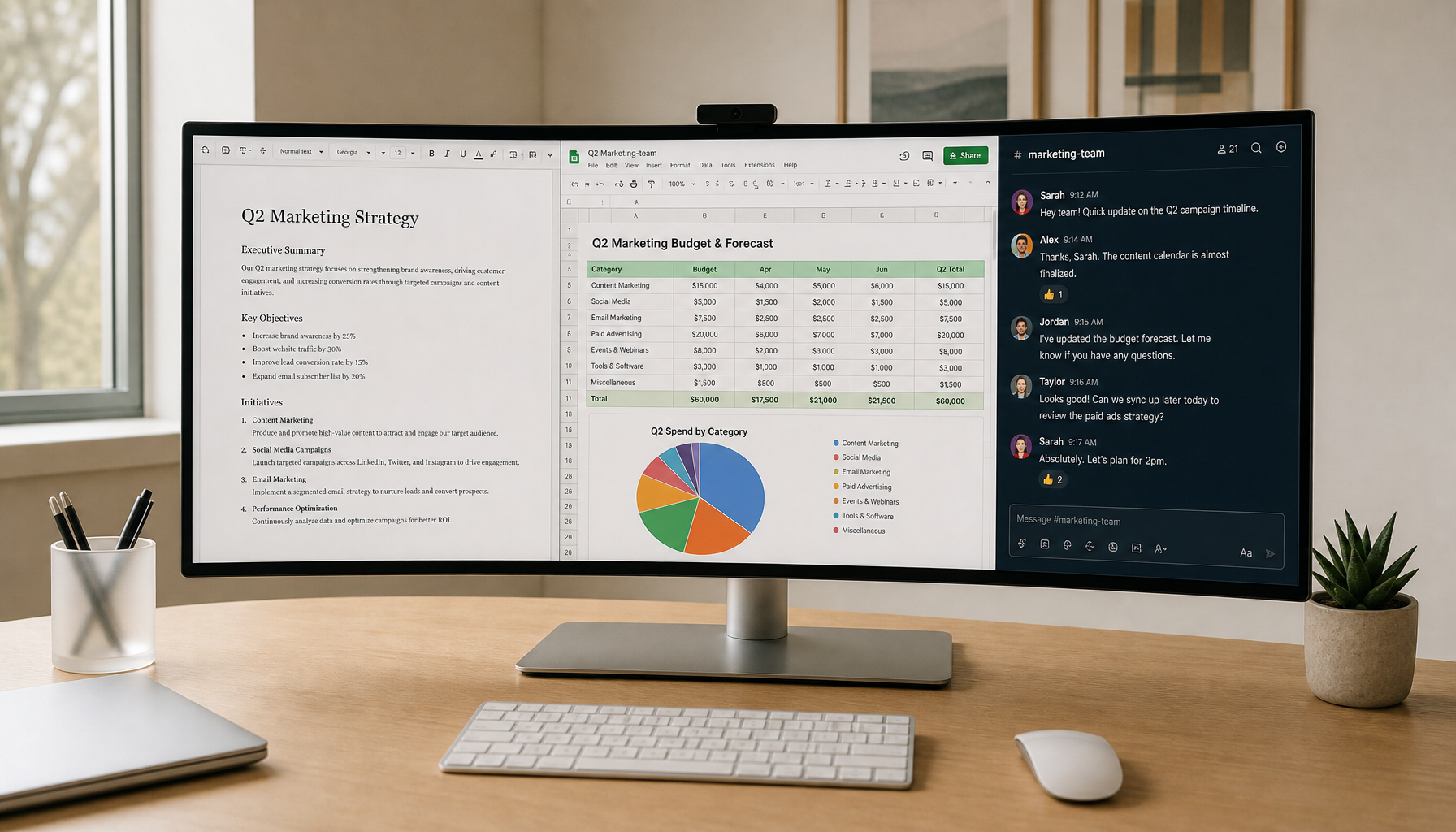
If your workday is mostly spreadsheets and browser tabs, the main question is not "which panel is prettier?" It is whether the screen stays readable when the room gets bright. That is the first filter that should shape a mini-LED vs OLED monitor decision.
Peak Brightness, Contrast, and Haloing Compared
Mini-LED usually has the edge when sunlight or overhead light is the main problem, because higher peak output helps the image stay visible. OLED usually wins on black depth and pixel-level contrast, which is why it often looks cleaner in dark rooms and with darker content. In practice, the trade-off is simpler than the spec sheet sounds.
| Trait | Mini-LED Tendency | OLED Tendency | Bright-Room Implication | Who Benefits Most |
|---|---|---|---|---|
| Peak brightness | Usually higher | Usually lower | Better visibility in brighter rooms | Daytime desk users |
| Sustained bright scenes | Usually steadier | Can be limited by ABL | More consistent punch during long white content | Spreadsheet and office users |
| Black level | Good, but not perfect | Excellent | Dark scenes can look richer on OLED | Gamers in controlled rooms |
| Haloing / blooming | Can be visible around bright objects | Avoids this type of artifact | May distract on dark UI or white text | Text-heavy workers |
| Brightness limiting | Less of a concern in the usual sense | Can reduce output as the screen gets brighter overall | Bright scenes may feel less forceful over time | Mixed-use desks |
| Text clarity perception | Often steadier under bright light | Can look very crisp, but depends on subpixel behavior and room light | Room conditions can change how sharp text feels | Productivity buyers |
| Long-session comfort | Often more forgiving in daylight | Can be excellent if glare is controlled | Comfort depends on reflections and output stability | All-day desk use |
That is why the comparison should not stop at black levels or nits. As TFTCentral's OLED brightness explainer notes, OLED brightness limiting is tied to how much of the screen is bright at once. And as this Mini-LED comparison explains, Mini-LED tends to deliver more peak brightness for light-filled rooms. Radiant Vision Systems on game contrast adds that local dimming performance varies with content and room lighting.
A useful decision sentence is this: if your desk gets real daylight and you spend hours in documents or browsers, Mini-LED is usually the safer pick; if your room is dimmer and your priority is contrast texture, OLED is more attractive.

How Mini-LED and OLED Feel at a Desk
At a desk, the annoying part is usually not the panel headline. It is what happens around windows, menus, and text edges after a few hours.
Text Work and Spreadsheets
Mini-LED haloing, blooming, and dimming transitions can show up around bright windows, thin sheet borders, and white cursor areas. That does not make Mini-LED unusable for office work, but it can be the thing that keeps bothering you if you stare at static white interfaces all day.
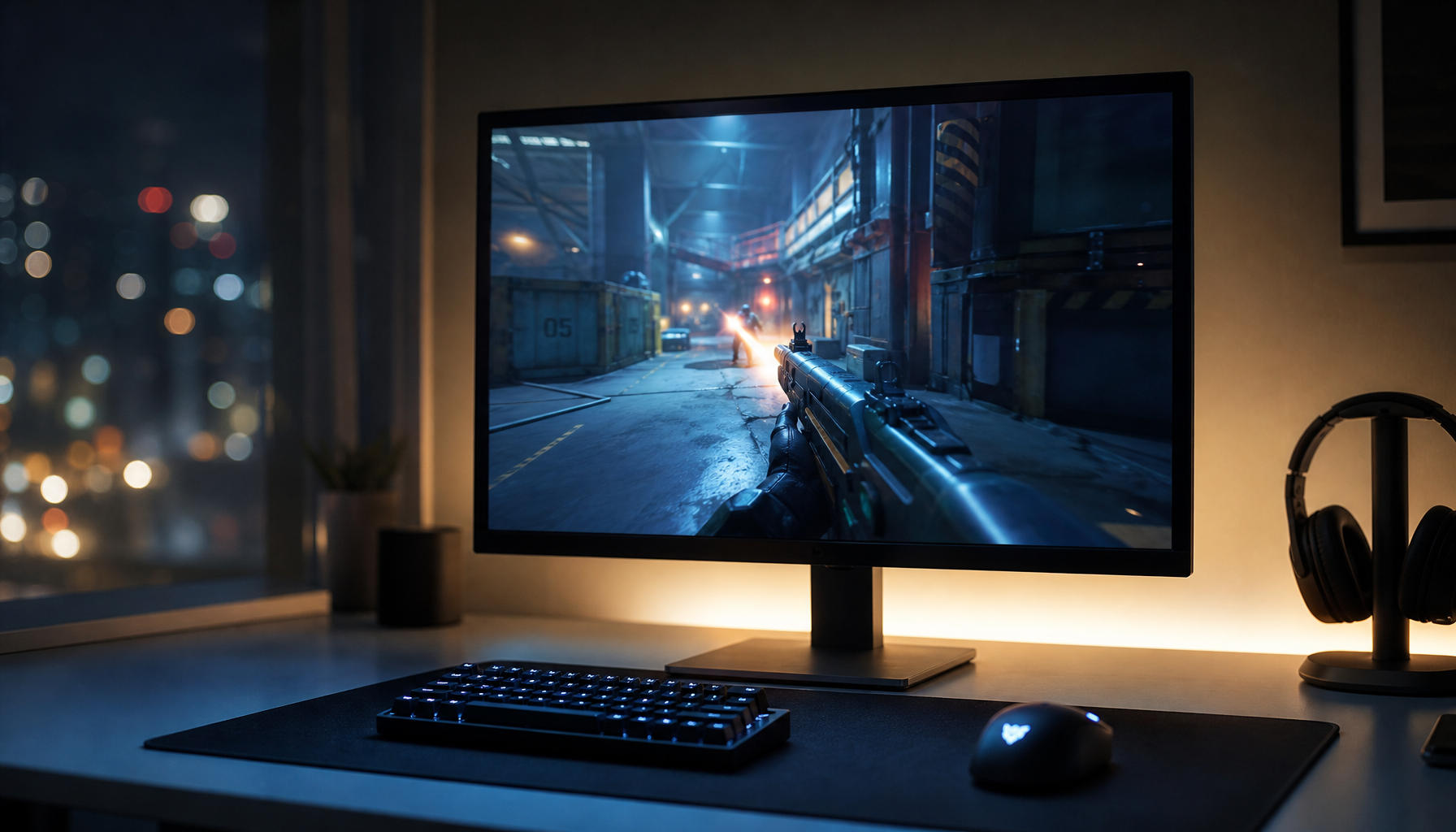
OLED often looks cleaner in dark UI, which many people notice immediately in games and dark apps. The catch is that bright-room buyers should still weigh reflections and sustained brightness before assuming OLED will feel equally easy at noon as it does at night.
Evening Gaming After Work
If the desk shifts from spreadsheets to games after dark, OLED has a real appeal. Dark scenes feel more cohesive, and the panel can make menus and game art look more polished when ambient light is under control.
Still, the practical question is whether you want one monitor to handle both moods without fuss. If yes, Mini-LED often behaves more predictably in daylight. If your gaming time mostly starts after work and the room is controllable, OLED can be the more satisfying choice.
For readers worried about panel care, OLED burn-in risks for gaming monitors is a sensible follow-up, but the real buying question is simpler: do you want the cleaner dark-scene look badly enough to accept the bright-room compromises?
Heat, Fatigue, and All-Day Comfort
Comfort is not only about image quality. It also includes how often you feel the urge to change brightness, how much glare you see, and whether the screen looks stable during long sessions.
For long daytime desk use, steady output and easy readability usually matter more than refresh-rate bragging rights. That is why bright-room desk buyers often prefer the panel that asks less of the room, not the one with the flashier spec sheet.
Mini-LED Models for Bright Rooms
If Mini-LED is the direction that fits your room, the right model depends on how much resolution and speed you want.
- KTC Mini LED 27" 180Hz 2K HDR1400 Gaming Monitor | M27T6 fits value-focused 1440p buyers who want bright-room visibility without stepping up to 4K pricing. The supplied product facts list HDR1400, a 27-inch flat screen, and full ergonomic adjustment, which makes it a practical bright-room desk option rather than a niche pick.
- KTC Mini LED 27" 200Hz 2K HDR1000 Gaming Monitor | M27T6S fits mixed work-and-play desks that want more motion headroom and stronger color coverage. It is the better Mini-LED fit if you still want a fast QHD panel and do not need the extra cost of a 4K model.
- KTC Mini LED 27" 4K HDR1400 Gaming Monitor | M27P6 is the premium bright-room option if sharp 4K text and stronger HDR impact matter together. Its fact pack shows 27-inch 4K, HDR1400, 1152 local dimming zones, USB-C, and a fully adjustable stand, so it suits buyers who want one monitor for work and play.
For a bright-room desk, Mini-LED is the practical choice when daylight is the dominant problem and OLED blacks matter less than visibility. If you want to browse the category first, All-Mini-LED Monitors is the cleanest starting point.
Choose the Right Panel for Your Desk
A simple rule works better than a spec duel.
- Check the room first. If the desk faces a window or sits under strong overhead light, lean Mini-LED.
- Decide what dominates. If text work fills most of the day, Mini-LED is usually the safer fit; if dark-room gaming matters more, OLED rises.
- Set a glare threshold. If reflections already bother you, do not expect a panel swap alone to fix it.
- Judge text clarity and brightness stability before refresh-rate marketing.
- Match size and price. For most bright-room desks, 27-inch flat panels are the safest starting point.
- Confirm stand adjustability if your desk height is fixed or the monitor sits beside a window.
One decision sentence is worth keeping in mind: if your room is bright and your work is text-heavy, Mini-LED usually reduces regret; if your room is controllable and you game more than you spreadsheet, OLED can be the more rewarding choice.
The All-OLED Monitor collection is worth a look only if you already know you can control room light and want the OLED look on purpose, not by default.
Bright-Room Setup Checks Before You Buy
Before you click buy, use the room itself as the final filter.
- Confirm the screen choice against your actual desk lighting, not just the spec sheet.
- Check the stand height and tilt range if the monitor will sit near a window or above a laptop.
- Verify the desk footprint so the screen does not create new reflection or angle problems.
- Look at the return window and warranty in case the first panel type feels wrong in your room.
- Treat the product page as the last step after the room and desk setup are already clear.
If you are comparing specific models, the KTC OLED 27" 2K 240Hz/0.03ms USB-C Gaming Monitor | G27P6 is the OLED-side reference point, while KTC Mini LED 27" 200Hz 2K HDR1000 Gaming Monitor | M27T6S is the more conservative bright-room Mini-LED option.
For many buyers, that is the whole decision: Mini-LED is the safer daytime desk choice, and OLED is the more satisfying dark-room choice. Pick the one that matches your room first, then your gaming habits second.
FAQs
Q1. How Bright Should a Monitor Be for a Sunlit Desk?
There is no universal nit target that works for every bright room. Window direction, screen coating, desk distance, and whether you work in full-screen white apps all change the practical threshold. A monitor that looks fine in the evening may still feel underpowered at noon.
Q2. What Causes Haloing on Mini-LED Monitors at Work?
Haloing is most noticeable when bright UI elements sit on dark backgrounds, like a white cursor in a dark spreadsheet or a menu over a black app. If that kind of contrast is common in your workday, Mini-LED may still be fine, but it is not the most invisible choice.
Q3. Can OLED Stay Comfortable in a Bright Room All Day?
It can, but only if the room light is controlled and the reflections are manageable. If you leave blinds open or work under strong overhead light, OLED comfort depends more on the room than on the panel itself. That is why many daytime desk users still lean Mini-LED.
Q4. Why Does Text Look Different on Mini-LED vs OLED?
Text perception changes with room brightness, subpixel behavior, and contrast. OLED can look very crisp in controlled light, while Mini-LED often feels steadier when the room is bright. For spreadsheet-heavy users, that consistency is often more valuable than the prettier dark-scene look.
Q5. What Is the Safer Long-Session Choice for a Mixed Desk?
For most mixed office-and-gaming desks, Mini-LED is the more conservative choice because it handles daylight and static UI more predictably. OLED still makes sense if dark-room gaming matters more and you are comfortable managing the trade-offs that come with a self-emissive panel.
The Best Choice for a Bright Desk
If your desk is bright for most of the day, Mini-LED is usually the more forgiving choice. If you can control the room and want deeper blacks for gaming, OLED can be the better experience. The right answer is the one that fits your light, your desk hours, and your tolerance for trade-offs, not the one that looks best in a spec comparison. A mini-LED vs OLED monitor decision ultimately rests on matching panel strengths to actual room conditions rather than headline specs alone.