MegPad vs tablet is mostly a choice between a bigger, room-to-room screen and a lighter device you can hold in one hand. If you want a large touch display for calls, streaming, and flexible placement, MegPad has the edge. If you need the most portable personal device for travel or couch use, a tablet still makes more sense.
Battery Life and Mobility Trade-Offs
For most people, the first question is not raw battery size. It is whether the device stays useful without turning every move into a cable search.
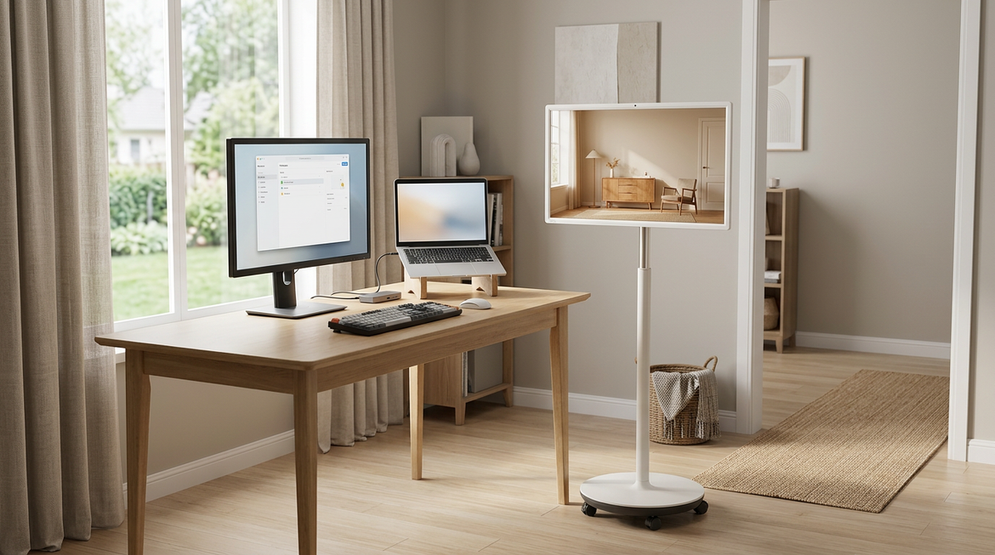
MegPad-style displays are built for that in-between space: bigger than a tablet, but still mobile enough to roll from desk to living room. KTC's 27-inch MEGAPAD includes a built-in battery and wheels, and the product page lists up to 6 hours of runtime in supported use. The 32-inch MEGAPAD models also include built-in batteries, with the product pages listing 8550mAh or 9500mAh depending on version. That makes them easier to keep in the room where you actually want to use them.
Tablets still win when true portability matters. They are easier to carry, easier to use one-handed, and less awkward if you are moving around quickly or using the screen while standing. That is why the KTC MEGAPAD 27" FHD Android 14 Google EDLA Smart Touch Monitor with 9500mAh Battery is more of a room-to-room display than a pocketable personal device.
Battery runtime is not fixed, even on the same device. Brightness, volume, workload, and battery age all change the result, so published figures are really setting-specific snapshots rather than universal endurance promises. A decision sentence to keep in mind: if you mostly move between rooms and want to avoid wall hunting, MegPad is usually the better fit; if you need to carry the screen in your hand, tablet wins.

App Access and Productivity Gaps
The app question matters more than most buyers expect. If your daily routine depends on a specific mobile app, the "best" screen is the one that supports that workflow with the least friction.
A tablet usually feels more familiar because it is built around app-first mobile use. That makes it the safer pick for people who already know they want a phone-like software experience on a larger screen. MegPad devices, by contrast, are better when the screen itself is the point and the workflow is closer to shared viewing, light productivity, or media use.
Google EDLA certification is useful here because it supports direct Google Play access and Google account sign-in on supported Android displays (source). For a buyer comparing a smart monitor collection against a tablet, that usually means less guesswork around mainstream Android apps, but you still need to check your exact work tools before buying. For niche productivity apps, browser-based tools, or work accounts with extra policies, the safest move is to verify the app list first.
If you want a deeper explainer, Google EDLA Certification Explained: Why Your 2026 Smart Display Needs It is useful background. A second decision sentence: if your app life is mostly mainstream Android and shared use, MegPad can work well; if you depend on a tightly tuned mobile app workflow, a tablet is still the cleaner choice.
Why MegPad Changes the Trade-Off
MegPad becomes more interesting when the screen needs to move with you, but you do not want to give up the feeling of a larger display.
That is the practical difference. A tablet is better at being carried. MegPad is better at being placed where you need it and then used like a shared screen. The 32-inch MEGAPAD with Android 14 and Google EDLA fits that pattern, especially if your day includes work calls, casual streaming, or family viewing in different rooms. The 27-inch model does the same job in a smaller footprint.
The 32-inch version also makes the trade-off clearer because the screen is large enough to feel like furniture, but the battery keeps it from being tied to a single outlet all day. The KTC MEGAPAD 32" 4K Android 14 Google EDLA Smart Touch Monitor with 8550mAh Battery is the more obvious pick if you want a bigger shared screen and are willing to give up handheld convenience.
If you are browsing by category instead of model, the portable touch screen options collection is the right place to compare sizes and battery-equipped options. For decision help, this is the key boundary: if your priority is shared viewing and easy room-to-room placement, MegPad makes sense; if your priority is carrying the screen in your hand, it does not.

Tablet Wins for Personal Use
- Choose a tablet when you need true hand-held portability for commuting, travel, or moving between rooms with no setup.
- Choose a tablet when your workflow depends on app-native mobile design and quick, touch-first navigation.
- Choose a tablet when you want a lighter device for reading, messages, or standing in the kitchen.
- Choose a tablet when you do not need a large shared screen for calls, streaming, or multitasking.
That is the simple filter. A tablet is usually the more satisfying buy if the screen lives in your hands most of the time. It also tends to be the better fit when setup friction is annoying, because there is no stand, no floor space, no rolling base to think about.
If you are comparing portable touch screen options to a tablet, ask whether your real use case is personal carry or room-based use. The answer often settles the MegPad vs tablet comparison faster than specs do. A third decision sentence: if you keep saying "I want to move it with me," MegPad is in the conversation; if you keep saying "I want to hold it," tablet is the better buy.
Buy When These Conditions Match
- Buy MegPad if you want a large, battery-powered screen for hybrid work, streaming, and room-to-room movement.
- Buy MegPad if your biggest annoyance is outlet hunting rather than app availability.
- Buy a tablet if you want the most portable personal device and do not need a big shared screen.
- Check battery runtime, app access, and charging behavior against your daily routine before you decide.
- If you want a broader shopping path, the smart monitor collection can help you compare display-first alternatives.
If you want a place to compare the usual buying checkpoints before checking out, Portable Smart Display Buying Checklist is a practical follow-up. The main rule is simple: buy MegPad when mobility means moving a screen between rooms, and buy a tablet when mobility means holding it in your hand.
What a MegPad Really Replaces
MegPad is not trying to be a better tablet in every sense. It is trying to solve a different problem: a larger screen that can travel around the home without being tied to one wall or one desk.
That is why the comparison gets easier once you stop asking which one is "better" and start asking where the device will live most of the time. A MegPad can cover calls, streaming, browsing, and light work in a shared setting. A tablet is still the better daily carry for travel, errands, and quick solo use.
If you are choosing for a household, the larger screen may reduce conflict over who gets the display. If you are choosing for one person on the go, the lighter device usually wins. This portable smart display battery life comparison is a useful side read if your main concern is runtime behavior rather than screen size.
Related Resources
- KTC MEGAPAD 32" 4K Android 13 Google EDLA Smart Touch Monitor with 9500mAh Battery for larger rolling options
- Portable touch screen monitor specs guide for key checkpoints
- Smart display app access overview for workflow fit
FAQs
Q1. How Long Does a MegPad Last on Battery Compared With a Tablet?
MegPad runtime depends on brightness, volume, workload, and battery age, so published figures should be treated as setting-specific. The 27-inch model is listed at up to 6 hours, while one 32-inch model is listed at up to 11 hours in product materials, but your actual result can be lower or higher depending on use.
Q2. Can a MegPad Replace a Tablet for App Use?
It can replace a tablet for many shared-use and Android app scenarios, especially when the screen stays in one room or rolls between rooms. A tablet still feels better for mobile-first apps, one-handed use, and quick personal tasks.
Q3. What Makes a Rolling Smart Display Better for Hybrid Work?
A rolling smart display is better when you want a larger screen for calls, docs, and streaming without staying at a desk. It is especially useful when the same screen needs to move from office to living room during the day.
Q4. Why Does Google EDLA Matter in This Comparison?
Google EDLA matters because it supports Google Play access and direct Google account sign-in on supported Android displays. That makes app access feel more familiar, but you should still verify your exact work apps before buying.
Q5. What Should I Check Before Buying a MegPad?
Check the battery runtime, app support, and how often you expect to move the screen. If you need handheld convenience more than room-to-room mobility, a tablet is usually the better purchase.
The Faster Choice for Most Buyers
MegPad suits users who need a large shared screen that rolls between rooms without constant outlet access. Tablet remains preferable for one-handed carry, travel, and personal mobile workflows. Match the device to how the screen will actually be used most often rather than chasing headline specs.