









When comparing monitors, the spec sheet claim of '1.07 billion colors' can refer to either a true 10-bit native panel or an 8-bit panel using Frame Rate Control (FRC) temporal dithering. For most gamers and HDR enthusiasts, a high-quality 8-bit+FRC implementation delivers visually smooth gradients and excellent performance without the higher cost or refresh-rate trade-offs of native 10-bit panels. Professionals doing color-critical grading or retouching in static workflows, however, often benefit from native 10-bit to minimize any chance of temporal artifacts.

Decoding the '1.07 Billion Colors' Claim: 8-bit vs. 10-bit Math
An 8-bit panel can display 256 shades per red, green, and blue channel, for a total of about 16.7 million colors. A 10-bit panel (whether native or simulated) supports 1,024 shades per channel, producing roughly 1.07 billion colors. On paper, both 8-bit+FRC and native 10-bit reach the same final count.
The practical difference lies in hardware. Native 10-bit panels can produce each shade directly. 8-bit+FRC panels use a mathematical workaround to simulate the extra shades. This distinction matters most when you zoom in on gradients or work with very dark tones, but for typical viewing distances and dynamic content it is often invisible.
How FRC Works: The Science of Temporal Dithering
Frame Rate Control, commonly called FRC, is a form of temporal dithering. The monitor rapidly cycles an individual pixel between two neighboring shades—say, shade 100 and shade 101—so the human eye perceives an intermediate value such as 100.5. Because the switching happens faster than we can consciously track, the brain averages the colors.
This differs from spatial dithering, which mixes colors across neighboring pixels. Temporal dithering lets manufacturers use more affordable 8-bit panels while still meeting HDR color-depth requirements. The technique is mathematically valid and has been refined for years.
A helpful way to visualize the process is the following diagram.

DisplayHDR 1.2: Why FRC Is Now the Industry Standard for HDR
According to the VESA DisplayHDR 1.2 specification, all certified monitors must support at least 8-bit + 2-bit FRC as the minimum for every certification tier. This update, introduced in 2024, recognizes that well-implemented temporal dithering delivers the color precision needed for HDR10 signals.
In practice, the “10-bit” label on a modern monitor spec sheet almost always assumes FRC support. The standard treats FRC as a validated, high-performance technology rather than a compromise, giving buyers confidence that an 8-bit+FRC panel can deliver certified HDR performance when the rest of the signal chain is configured correctly.
Mini-LED and OLED: When FRC Artifacts Become Visible
FRC artifacts, sometimes described as twinkling or crawling in dark gradients, appear most readily in near-black HDR shadows or slow-moving gradients. Mini-LED backlights with hundreds of local-dimming zones can amplify these effects because the backlight transitions interact with the temporal color switching.
Mini-LED & FRC Artifact Diagnosis
- FRC “crawling” is a rapid pixel-level color change.
- Mini-LED “blooming” is spatial light leakage between zones.
- Quick self-check: if shimmering remains when local dimming is turned off, it is likely FRC-related; if it only appears with dimming enabled, it is probably a zone-transition issue.
On OLED panels the near-instant pixel response can make dithering less noticeable in motion but potentially more apparent in static dark scenes for highly sensitive viewers. Visibility varies by individual sensitivity, panel implementation quality, and room lighting. Most gamers report no practical issue in fast-paced titles.
Our MiniLED vs. OLED monitor comparison explores how these panel technologies affect perceived smoothness in real gameplay.
The 10-bit Integrity Chain: GPU Settings and Cable Bottlenecks
FRC only activates when the GPU actually sends a 10-bit signal. If the graphics driver is set to 8-bit output, the monitor never receives the high-precision data it needs to dither effectively.
The 10-bit Integrity Chain
Use this quick pre-flight checklist:
- Set NVIDIA or AMD control panel to 10 bpc (bits per color).
- Enable Windows HDR toggle—this acts as the master switch for the desktop pipeline.
- Confirm your cable and port support the required bandwidth. HDMI 2.0 often drops to 8-bit at 4K 144 Hz or higher because it lacks headroom for 10-bit chroma. DisplayPort 1.4 or HDMI 2.1 usually resolves this.
As explained in this Microsoft Q&A thread, the 10-bit option appears even for FRC monitors because the driver must feed the panel’s internal processing pipeline the extra precision.
See our guide on What Does Bit Depth Mean, and How Does 8-bit Differ From 10-bit Display? for more setup details.
When 8-bit+FRC is enough vs when native 10-bit is worth it
Decision guide for buyers: higher scores indicate better fit for the use case, considering artifact risk, cost, and performance.
View chart data
| Category | 8-bit+FRC Suitability | Native 10-bit Advantage |
|---|---|---|
| Gaming | 9.0 | 3.0 |
| HDR Video | 6.0 | 7.0 |
| Photo Editing | 4.0 | 8.0 |
| Color Grading | 3.0 | 10.0 |
Gaming vs. Professional Work: Choosing Your Bit Depth
The best choice depends on your primary workload and sensitivity to artifacts.
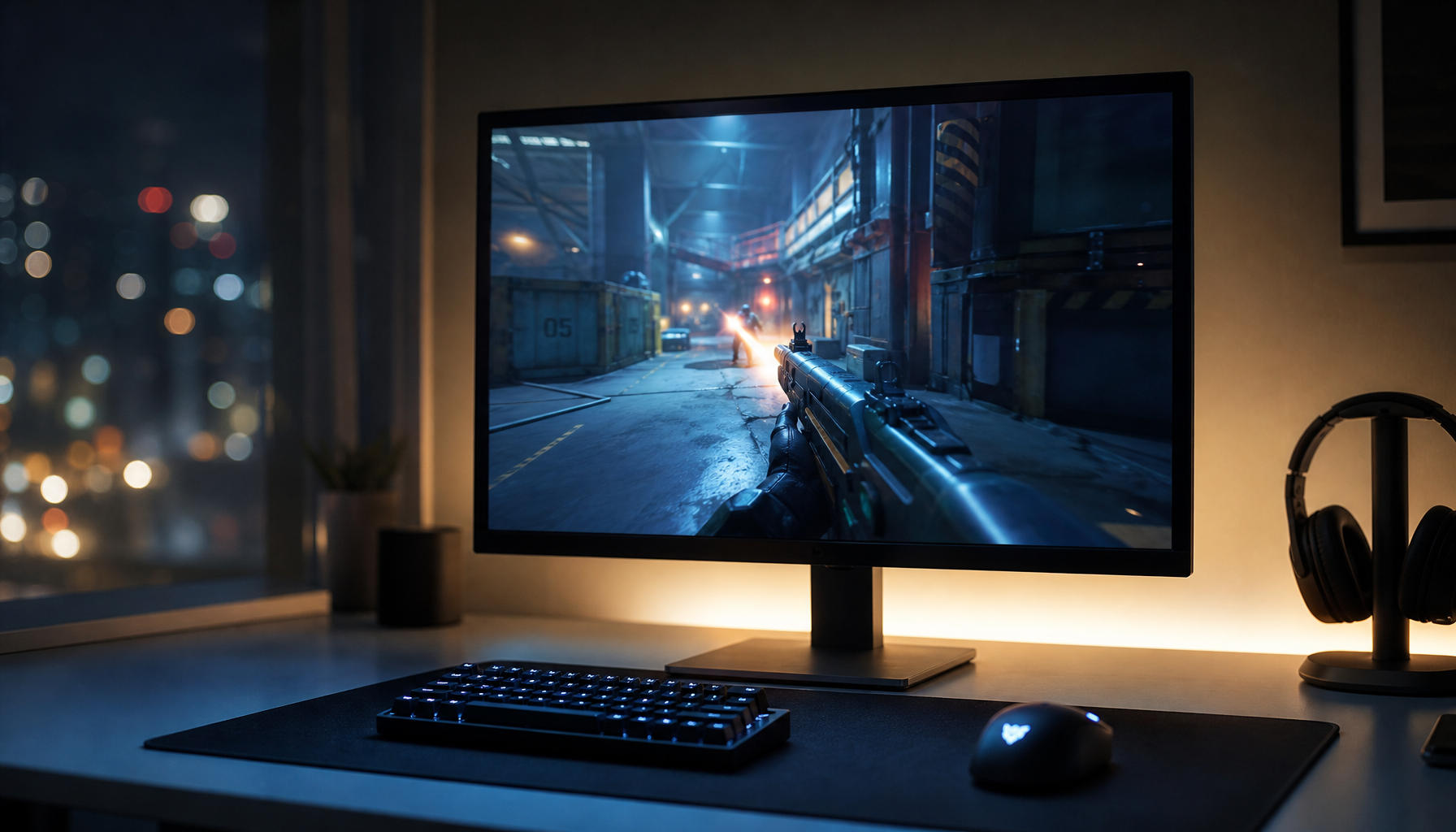
For competitive gaming, HDR movies, and general entertainment, 8-bit+FRC usually provides the sweet spot. The temporal dithering is rarely noticeable during motion, and you gain higher refresh rates or lower prices compared with many native 10-bit panels. Models such as the KTC M27P6 4K Mini-LED or G27P6 OLED demonstrate how well-optimized FRC panels deliver vibrant HDR without visible drawbacks for most users.
Professional photographers, video editors, and colorists working on static images or precise gradients often prefer native 10-bit. Even subtle twinkling can become distracting during long retouching sessions or when pixel-peeping. In these cases the extra cost of a true 10-bit panel is usually justified.
Panel quality, factory calibration (measured by Delta E), and local-dimming algorithm quality frequently matter more than the native-versus-FRC distinction alone. Our article on What Delta E Values Actually Mean for Your Creative Work explains how to evaluate overall color accuracy beyond bit depth.
Final Verdict: Is 8-bit+FRC Right for Your Setup?
8-bit+FRC is not “fake” 10-bit; it is a certified, mathematically sound method that meets VESA HDR standards and looks indistinguishable from native 10-bit for the majority of gaming and video content. The trade-off appears mainly in static, color-critical professional work where any temporal artifact can interrupt workflow.
- Choose 8-bit+FRC if you game, watch HDR media, or edit non-critical content and want maximum refresh rate or value.
- Prioritize native 10-bit if you perform professional color grading, retouch photos at high zoom, or are unusually sensitive to dark-scene flicker.
- Always verify the full 10-bit integrity chain (GPU output, cable, Windows HDR) regardless of panel type.
For most savvy enthusiasts, a well-implemented 8-bit+FRC Mini-LED or OLED monitor from the All-Mini-LED collection or All-OLED collection delivers the best balance of performance, price, and real-world image quality. Check the specific model’s calibration reports and user feedback on gradient smoothness before purchase.
Frequently Asked Questions
Is 8-bit+FRC good for HDR?
Yes, when the full signal chain is set to 10-bit. VESA DisplayHDR 1.2 explicitly accepts 8-bit+2-bit FRC as the baseline for certification, so certified monitors deliver the required color precision for HDR10 content in typical viewing conditions.
Can you see the difference between 8-bit+FRC and true 10-bit in gaming?
For most players in motion-heavy games the difference is not noticeable. Artifacts are more likely in very dark, slow-moving HDR scenes or when pausing on gradients. High refresh rates and good panel tuning usually mask any temporal dithering.
What is FRC in monitors?
FRC (Frame Rate Control) is temporal dithering that rapidly alternates a pixel between two shades so the eye perceives an intermediate color the panel cannot produce natively. It allows cost-effective 8-bit panels to support the 10-bit color depth required by modern HDR standards.
Does GPU output depth still matter with an FRC monitor?
Absolutely. The monitor’s FRC engine needs a 10-bit input signal to perform its dithering calculations effectively. Setting the GPU to 8-bit output disables the benefit and the display behaves like a standard 8-bit panel.
Should professional creators always buy native 10-bit?
Not always, but it is the safer choice for color grading, high-end retouching, or any workflow involving long inspection of static dark gradients. Many photographers find high-quality FRC acceptable for general editing, especially when paired with excellent factory calibration.
Do Mini-LED local dimming zones make FRC artifacts worse?
They can interact. Aggressive zone transitions in dark areas sometimes amplify the perception of FRC crawling. Turning local dimming off during testing helps isolate whether the shimmer is from dithering or backlight algorithms.
Is it worth paying extra for true 10-bit if I mainly game?
Usually not. The incremental cost often funds higher refresh rates, better brightness, or more dimming zones instead. Spend the budget on overall panel quality and system configuration rather than chasing native bit depth for gaming alone.


%20temporal%20dithering.%20For%20most%20g...
)