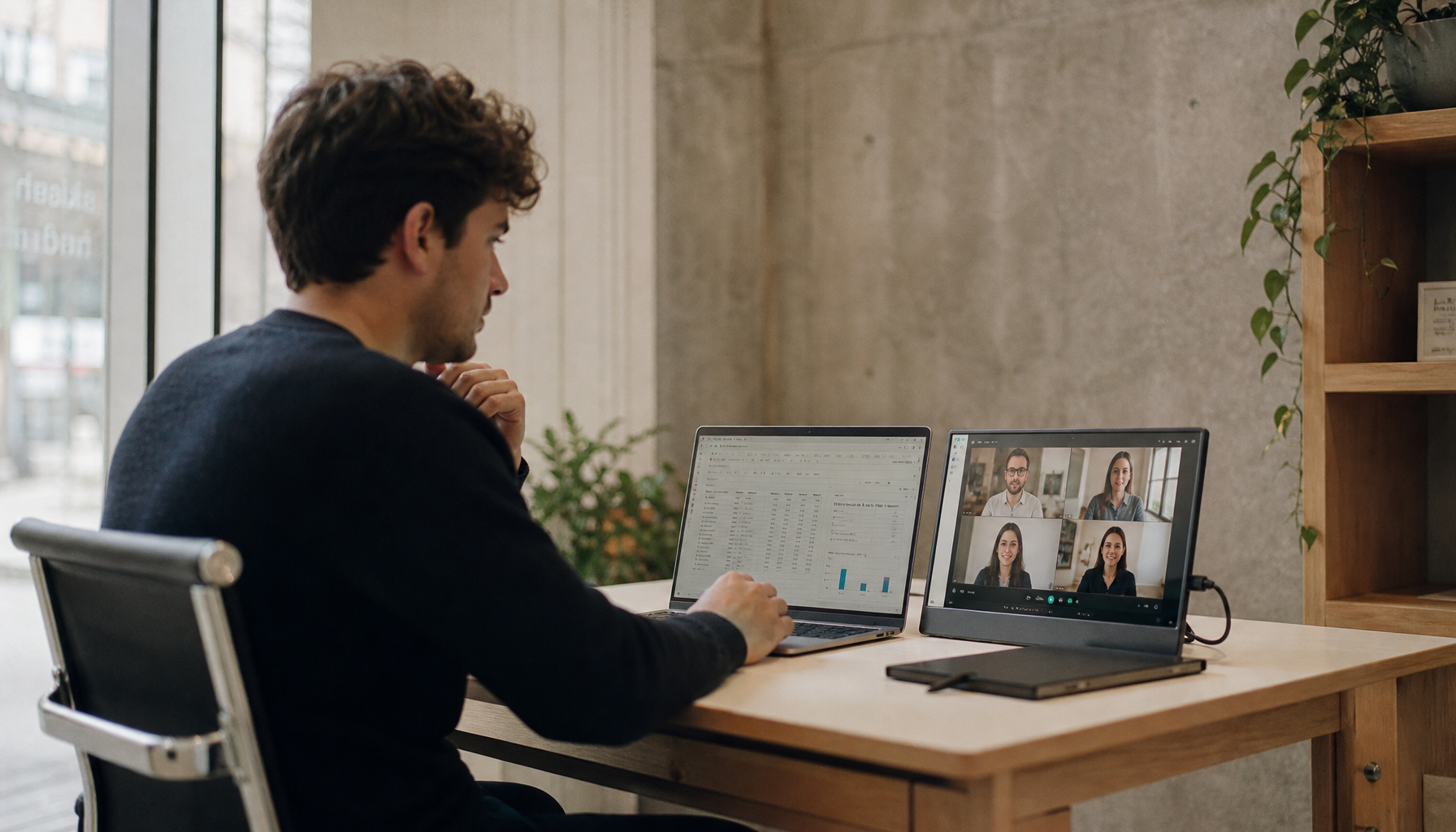
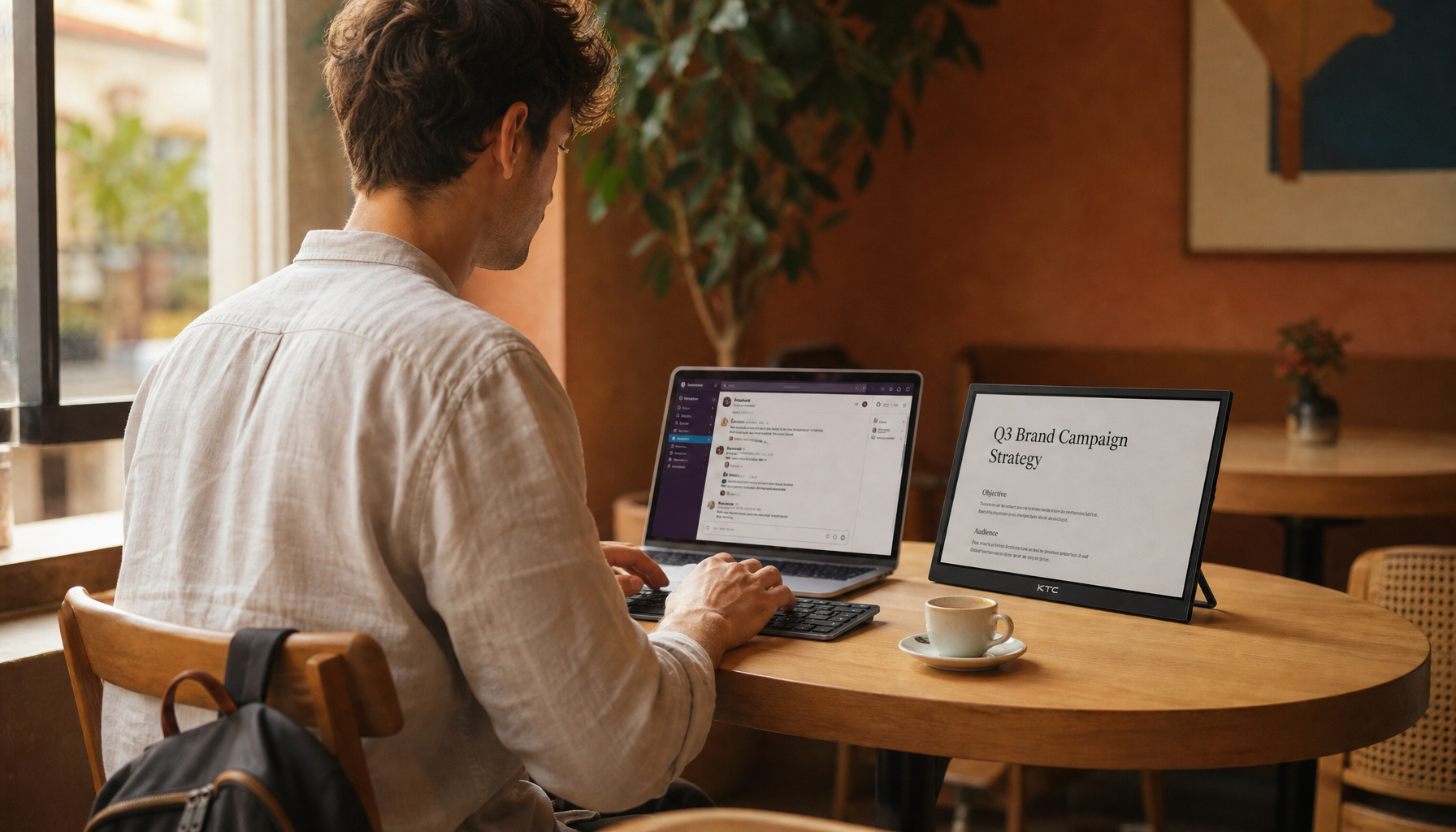
Vertical monitors are becoming more common because much of modern work is read from top to bottom: code files, PDFs, documentation, email, chat threads, and web pages. A portrait display can show more vertical context while reducing the desk width of multi-monitor setups.
Ever lose your place while scrolling through code, a long PDF, or a documentation page beside your main screen? A well-chosen vertical monitor can show roughly twice as many lines of text as a typical landscape layout, making it easier to review context without constant scrolling. Here is how portrait orientation fits into real monitor buying and setup decisions, including when a horizontal, ultrawide, portable, or high-refresh display is still the better choice.
Why Vertical Screens Fit Modern Workflows
Coding and documents are naturally vertical
Most coding and document work is not shaped like a movie or a game. Source files, Markdown documents, word processor files, PDFs, API references, terminal output, issue trackers, email threads, and chat feeds all move downward. That makes portrait orientation appealing because it gives the screen more height where the content actually lives.
A productivity display guide notes that a vertical monitor can show about 80 to 120 lines of code, compared with about 40 lines on a standard horizontal screen, making more lines of code visible at once. That does not automatically make anyone faster, but it does reduce one common friction point: losing surrounding context while jumping between functions, logs, comments, and documentation.

For document work, the advantage is similar. Letter-size documents are vertically oriented, so a portrait monitor often displays PDFs, contracts, briefs, reports, and academic papers closer to their printed shape. In a forum example, a user working with two 27-inch 1440p monitors from a brand used portrait mode for PDFs and word processor documents because full-page document viewing made it easier to see whole paragraphs at once.
Less scrolling can mean better context, not automatic productivity
The biggest practical benefit is context. When reading code, seeing the function, related helper, comments, and error handling in one view can reduce mental backtracking. When editing a document, seeing the paragraph before and after the current sentence helps keep flow and structure intact.
Developers discussing portrait monitors on a platform describe the benefit as seeing more code context, especially when reviewing files with thousands of lines, while one setup used a portrait 4K display specifically for coding and a laptop screen for office tools and email. That kind of coding setup is not about replacing all monitors with portrait screens; it is about assigning the right shape to the right job.
Still, vertical orientation is not a universal upgrade. If your daily work is mostly spreadsheets with many columns, video timelines, wide dashboards, CAD tools, gaming, or side-by-side design comparisons, horizontal width matters more than vertical height. In those cases, a landscape monitor, ultrawide monitor, or dual horizontal setup can be more efficient.
Why Hybrid Monitor Setups Are Becoming the Default
One horizontal main display, one vertical side display
The most common practical setup is hybrid: a horizontal primary monitor centered in front of the user, with a vertical monitor on one side. The main screen handles wide work such as an IDE, browser preview, game, video call, spreadsheet, or design canvas. The portrait side screen holds documentation, terminals, team chat platforms, email, logs, pull requests, or research.

A real-world desk experiment from May 2024 found that three horizontal monitors provided plenty of visible context, but turning displays vertical reduced the total horizontal span of the workstation. The author noted that webpages, email, and code are mostly vertical content, while also reporting drawbacks such as clunky mouse movement and extra window-moving steps in a desktop environment, showing that vertical orientation is a tradeoff rather than a magic fix.
This explains why portrait monitors are becoming more visible in coding desks, streaming setups, and home offices. They let users keep the primary display directly in front while moving secondary, scroll-heavy content into a tall column. On a narrower desk, that can be more comfortable than stretching two 27-inch or 32-inch landscape screens across the full width.
Better use of side-monitor space
A vertical side monitor also avoids wasting screen area on content that was never meant to be wide. Many websites, documentation pages, and chat tools leave large blank side margins on a horizontal monitor. Rotating the display gives those same pages more useful height.
One dual-monitor user reported that turning the second monitor vertical freed desk space and made it practical to keep team chat tools and a video platform visible in separate windows while continuing work on the main display. That kind of vertical second monitor works especially well for narrow apps that behave like feeds: team chat, build logs, music apps, social dashboards, and mobile-style video calls.
For streamers and gamers, the logic is similar. A high-refresh-rate gaming monitor can stay centered in landscape mode for the game, while a vertical side display keeps streaming software, chat, a live-streaming platform, team chat, or browser tools visible. That setup preserves the gaming monitor’s refresh rate and aspect ratio while giving live tools a tall, readable layout.
Vertical Monitor vs. Ultrawide vs. Dual Monitors
The right choice depends on the shape of the task
A vertical monitor is best when the work is tall. An ultrawide monitor is best when the work is wide. A dual-monitor setup is best when you need separation between tasks. A portable monitor is best when you need extra space away from a permanent desk.

For coding, a portrait monitor shines when reviewing long files, reading logs, scanning tests, comparing documentation, or keeping a terminal stack visible. An ultrawide monitor is stronger when you need an IDE, browser preview, database client, and console visible side by side. Dual monitors are often better than either alone because they let you mix orientations.
For document work, portrait mode can feel more natural than an ultrawide because it matches the page. But if you work with spreadsheets, legal redlines with side comments, page layout tools, or side-by-side drafts, landscape width may matter more. The best monitor setup is not the one with the largest panel; it is the one whose shape matches the work you repeat every day.
Setup Option |
Best For |
Main Advantage |
Main Tradeoff |
Buying Notes |
Single vertical monitor |
Coding, PDFs, long reading, logs |
Shows more vertical context |
Poor fit for wide apps and games |
Choose at least 1440p if possible; check rotation support |
Horizontal main + vertical side monitor |
Coding, documents, chat, research |
Balances wide and tall workflows |
Requires careful desk layout |
Good default for programmers and document-heavy workers |
Dual horizontal monitors |
Spreadsheets, dashboards, design, video |
Lots of width and app separation |
Large desk footprint and more head turning |
Works best on a deep, wide desk |
Ultrawide monitor |
Side-by-side apps, timelines, immersive work |
Seamless horizontal workspace |
Less natural for full-page documents |
Look for strong window management tools |
Portable monitor |
Travel, small desks, temporary setups |
Flexible extra screen |
Smaller size and lower ergonomic range |
Best as a secondary reference display |
High-refresh gaming monitor + vertical side display |
Gaming, streaming, mixed work |
Keeps gameplay smooth while tools stay visible |
More cables and stand complexity |
Use landscape for the gaming display, portrait for chat/tools |
When an ultrawide is better
An ultrawide monitor can be better than a vertical monitor when your main friction is horizontal app juggling. Developers who keep an IDE, browser, terminal, and documentation open side by side may benefit from a 34-inch or larger ultrawide because it reduces bezel breaks and cursor jumps between panels.
Landscape orientation also remains the better default for video timelines, audio production, broad spreadsheets, gaming, and group video calls. A productivity guide notes that horizontal screens fit wide-layout tasks such as video timelines, audio production, and spreadsheets with many columns, while portrait orientation prioritizes vertical text and page content.
A practical buying rule: choose an ultrawide if you constantly arrange apps left-to-right; choose a vertical monitor if you constantly scroll up-and-down; choose a hybrid setup if both are true.
What to Look for in a Vertical Monitor
Size and resolution matter more in portrait mode
A 24-inch monitor can work well in portrait mode because the height stays manageable and the width is often enough for documentation, terminals, chat, or one code column. A 27-inch monitor gives more usable space, especially at 1440p, but it can become physically tall when rotated. Some users find a 27-inch portrait screen too high if the stand cannot lower enough.
Resolution is a bigger issue than many buyers expect. Older 1080p monitors become 1,080 pixels wide in portrait mode, which can feel cramped because many apps and websites assume at least 1,280 pixels of horizontal space. In a platform discussion, users reported that 1080p or 1200-by-1920 portrait displays could feel narrow, while 1440-by-2560 portrait layouts allowed useful splits such as halves or thirds.
For most coding and document setups, 1440p is a strong minimum for a primary portrait display. A 4K monitor can be excellent if scaling is comfortable, because it allows larger text without losing as much visible content. That matters for long work sessions: tiny text defeats the purpose of showing more content.

Panel type, viewing angles, and stand design are critical
A monitor that looks good in landscape may look worse when rotated. Some panels shift brightness, contrast, or color when viewed off-axis, and that can become more noticeable in portrait orientation. Before buying, check whether reviewers mention vertical use, viewing angles, and uniformity.
Stand support is just as important. A portrait-friendly monitor should rotate 90 degrees cleanly, lower enough so the top edge does not sit too high, tilt for glare control, and keep cables from binding when rotated. Mounting-arm compatibility is valuable because a monitor arm can solve height, depth, and angle problems better than many stock stands.
For a 27-inch or 32-inch display, verify arm weight capacity before buying. Also check whether the ports face downward or outward; stiff display or USB cables can press into the desk or twist awkwardly when the monitor is vertical.
Ergonomics: The Part Many Setups Get Wrong
Keep the top of a portrait monitor under control
The main ergonomic risk with vertical monitors is height. A tall display can push the top of the screen above eye level, encouraging chin lifting, neck extension, and shoulder tension. That problem gets worse when users rotate a large monitor but leave it on a stand designed mainly for landscape use.
Office ergonomics guidance from an occupational health and safety organization says comfortable monitor viewing is generally around 15 degrees below the horizontal eye line, and with a tall or portrait-oriented monitor, the top of the screen should not be higher than the operator’s eye level. That is especially relevant for 27-inch and larger portrait monitors.

Distance also matters. Many desk setups work best when monitors sit about arm’s length away, often around 20 to 30 inches depending on screen size and eyesight. If text feels too small, increase font size or scaling before pulling the screen too close.
Angle the side monitor inward
For a hybrid setup, place the main horizontal monitor directly in front of you and angle the vertical side monitor inward. A 15- to 20-degree inward angle is a practical starting point for a side display because it reduces twisting while keeping the screen accessible.
Avoid placing a vertical monitor so far to the side that you must turn your head repeatedly throughout the day. If the portrait display holds reference content you glance at constantly, move it closer to the center. If it holds chat or email that you check occasionally, it can sit farther out.
A good test is simple: open your most-used coding or document workflow for 30 minutes. If you repeatedly lean, lift your chin, squint, or drag windows awkwardly between screens, the monitor is not positioned correctly yet.
Common Mistakes When Buying a Vertical Monitor
Buying only for size
Bigger is not always better in portrait mode. A large monitor can become too tall, too narrow-feeling, or too hard to position. For many users, a 24-inch or 27-inch 1440p monitor is more practical than a huge vertical display, especially on a standard desk.
A 27-inch portrait monitor can be excellent for code and documents, but only if the stand or arm allows proper height adjustment. In one workstation example, a user with two 27-inch 1440p monitors from a brand found that one display felt too high in portrait mode and another stand did not rotate fully upright, leaving the screen slightly slanted. That kind of stand limitation can turn a good panel into a poor vertical monitor.
Before buying, check four things: native resolution, physical height when rotated, stand rotation, and mounting-arm compatibility. These details matter more than marketing terms.
Expecting portrait mode to replace every display
Vertical monitors are specialized tools. They are excellent for code, documents, feeds, chats, logs, and reference material. They are weaker for games, movies, wide spreadsheets, multi-column dashboards, and most creative timelines.
That is why many real setups are mixed. Users on a platform describe combinations such as one landscape plus one portrait, two horizontal plus one vertical, or one portrait coding display beside other screens. The repeated pattern is not “vertical beats horizontal”; it is that mixed setups let each screen do a different job.
If your monitor budget allows only one display and you also game, edit video, or use wide dashboards, a quality landscape monitor may still be the safer primary purchase. If you already have a good main monitor, adding a vertical side display can be the more targeted productivity upgrade.
Practical Buying and Setup Checklist
Use this checklist before rotating an existing monitor or buying a new one:
- List your top five daily windows: IDE, browser, PDF reader, terminal, chat, spreadsheet, video call, or game.
- Mark each one as mostly tall, mostly wide, or mixed.
- Choose a hybrid layout if at least two important apps are tall and at least two are wide.
- Prefer 1440p or higher for a portrait monitor used for coding or document work.
- Confirm the monitor supports 90-degree rotation, enough height adjustment, and mounting-arm compatibility.
- Place the top edge at or below eye level, then increase text size instead of moving the monitor too close.
- Test the setup for one full work session before finalizing cable routing and desk placement.
A useful starter layout is a 27-inch or 32-inch landscape main monitor in the center, paired with a 24-inch or 27-inch vertical 1440p side monitor. For gaming, keep the high-refresh-rate display horizontal and put the vertical monitor on the side for chat, streaming software, documents, or browser tools.
FAQ
Q: Why do programmers use vertical monitors?
A: Programmers use vertical monitors because code, logs, terminals, documentation, and pull requests are usually read from top to bottom. Portrait orientation can show more lines at once, which helps when reviewing long files, tracing logic, comparing comments with implementation, or keeping a terminal session visible beside the main IDE.
Q: Is a vertical monitor better than an ultrawide monitor for document work?
A: A vertical monitor is often better for reading full-page documents, PDFs, long articles, and single-column drafts because it matches the page shape more closely. An ultrawide monitor is better when the work requires multiple side-by-side windows, wide spreadsheets, timeline editing, or dashboards with many columns.
Q: What size monitor is best for portrait orientation?
A: A 24-inch monitor is easy to position and works well for chat, email, documentation, and terminals. A 27-inch 1440p monitor is a strong choice for coding and document work, but it needs a stand or arm that can lower enough in portrait mode. Larger portrait monitors can work, but ergonomics become harder because the screen gets very tall.
Key Takeaways
Vertical monitors are becoming more common because they match the shape of coding and document-heavy work. They are especially useful as secondary displays for documentation, terminals, chat, email, logs, and long-form reading while a horizontal main monitor handles wide tasks.
The best setup for many programmers, writers, analysts, and hybrid office users is not all-vertical or all-horizontal. It is usually a mixed monitor setup: a centered landscape display for primary work and a portrait side display for vertical content.
Do not buy a vertical monitor based on size alone. Prioritize resolution, stand adjustment, mounting-arm compatibility, viewing angles, cable clearance, and whether the top of the screen can stay at or below eye level. A monitor that rotates cleanly, sits at the right height, and shows crisp text will do more for daily comfort than a larger panel with poor ergonomics.