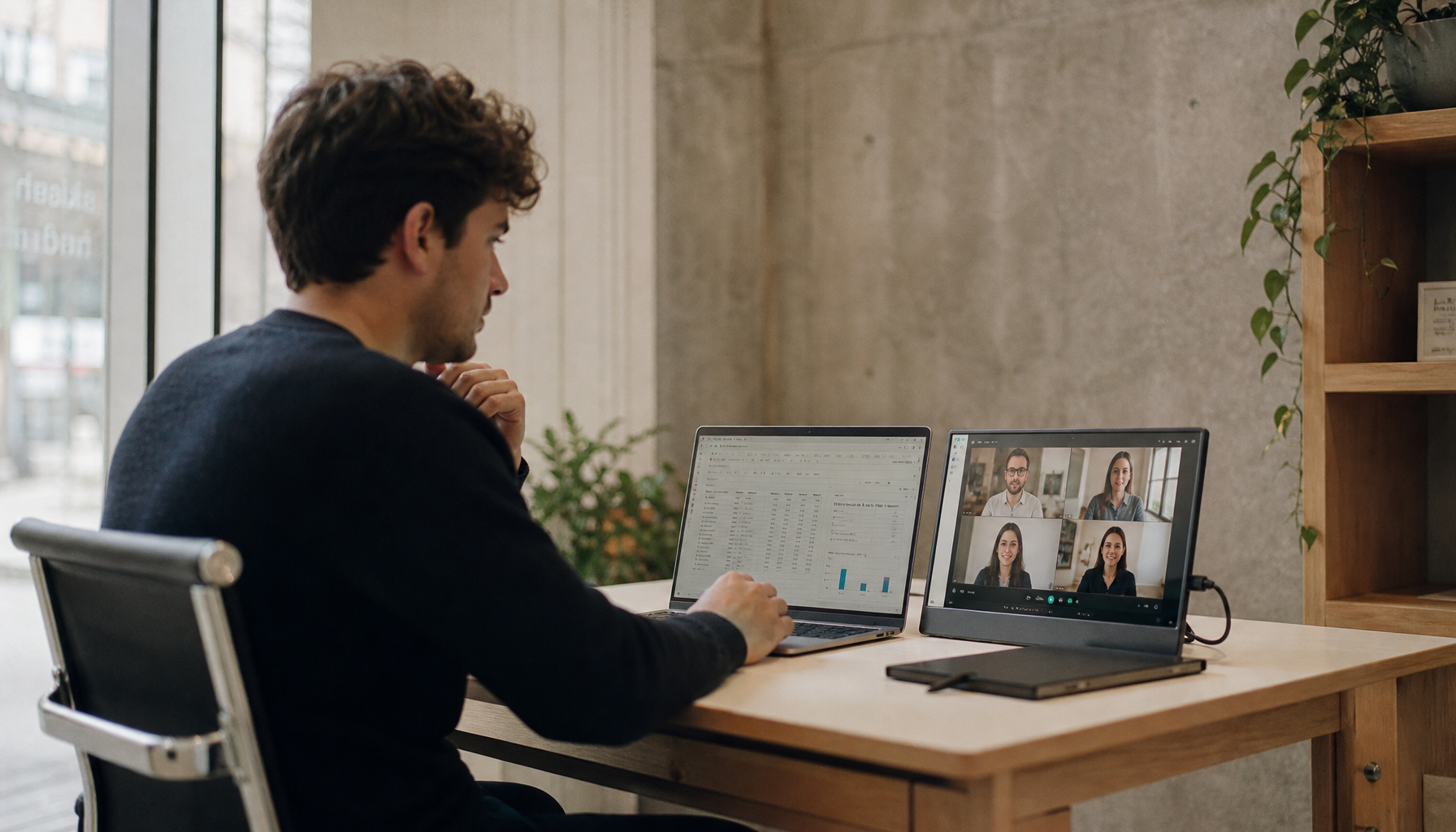
A USB-C KVM monitor can simplify a hybrid Mac/PC desk, but only if your laptop supports USB-C video, your cable is fully capable, and the monitor's port layout matches how you switch devices. If you need the monitor to handle video, charging, and peripheral handoff, check those three pieces first before you compare panel specs.

What a USB-C KVM Monitor Solves
The real payoff of a USB-C KVM monitor is less cable swapping. For a work laptop and a personal desktop on the same desk, it can reduce the dance of unplugging displays, moving USB devices, and deciding which box owns the keyboard and mouse.
That said, one-cable USB-C is a convenience path, not a universal promise. Apple notes that Macs support DisplayPort over USB-C, but they do not natively support MST daisy chaining the way some Windows setups do, which is one reason hybrid buyers should check the exact port behavior before buying. Apple's port guide for Macs is a useful starting point.
A good rule of thumb is this: if you only want cleaner switching and a simpler desk, a built-in KVM may be enough. If you expect the monitor to replace every dock, hub, and adapter on the desk, that setup often breaks down.
If you want a deeper compare-and-choose explainer, our two-computer KVM overview is a useful follow-up.
Fit Your Desk Before You Compare Specs
Before you care about refresh rate or panel type, check what your devices actually need. A USB-C KVM monitor only feels simple when the laptop can send video over USB-C, the desktop has a clean input path, and the peripherals you want to share can follow the active source without extra friction.
Check Laptop and Desktop Port Needs
Start with the source devices. For Mac users, confirm that the USB-C port is meant for display output, not just charging or data. For Windows laptops, verify the same thing, then check whether you still need HDMI or DisplayPort for the desktop tower. A one-cable desk is only one-cable if the cable and source both support it.
A monitor can charge a laptop and still fail to carry video if the signal path is incomplete. That is why the safer purchase mindset is "check first, simplify second."
Decide Whether Built-In KVM Is Enough
A built-in KVM is mainly a convenience feature for sharing keyboard, mouse, and sometimes webcam or other USB devices between two computers. It reduces clutter, but it does not automatically remove the need for a dock if your desk has several accessories or if you want more port flexibility.
For some hybrid desks, the monitor is the control point. For others, the monitor plus a dock is the better topology. That flip usually happens when the accessory count grows, or when the laptop needs a more reliable charging and upstream path than the monitor alone provides.
A practical setup guide for USB-C KVM monitor setup can help you map the ports before you order.
Plan for Webcam and Monitor Ergonomics
Webcam friendliness is an ergonomics question, not a marketing promise. OSHA recommends placing the top of the screen at or slightly below eye level and keeping the monitor about arm's length away, roughly 20 to 40 inches. That is easier when the stand has height, swivel, pivot, or VESA flexibility. OSHA monitor guidance is the clearest baseline here.
What this means in real use: if the stand is fixed or only tilts, the webcam often ends up too low, and the desk starts feeling cramped. If the stand adjusts well, the camera, laptop dock, and keyboard usually fit more cleanly.

Specs That Matter for Mixed Mac and PC Use
For hybrid work, the best monitor is not always the one with the highest refresh rate. The specs that usually change the decision are USB-C power delivery, input mix, resolution, stand flexibility, and whether the monitor is meant to be a work-first display or a mixed-use display.
Here is a practical way to read the spec sheet:
| Spec Area | Why It Matters On A Hybrid Desk | What To Verify First | Who Should Prioritize It |
|---|---|---|---|
| USB-C video and charging | Determines whether one cable can carry both image and power | Laptop port support, cable quality, charging profile | Mac and laptop users who want fewer cables |
| Built-in KVM | Lets shared peripherals follow the active computer | USB upstream path, source switching behavior | Two-computer desks with one keyboard and mouse |
| Resolution | Changes how sharp text and windows feel | 4K vs QHD vs 1080p | Anyone using the desk for work all day |
| Refresh rate | Matters more if you game or want smoother motion | 60Hz, 100Hz, 160Hz, or higher | Mixed work-and-play setups |
| Stand ergonomics | Affects posture and webcam placement | Height, swivel, pivot, VESA support | Call-heavy home offices |
| Port mix | Determines whether the desk needs a dock | HDMI, DisplayPort, USB-A, USB-C | Desks with many peripherals |
If your desk is mostly documents, calls, and browsing, comfort and clarity usually matter more than esports-level speed. If the same monitor also handles evening gaming, then refresh rate and motion handling deserve more weight. For category browsing, the office monitor range is the better starting point for work-first setups, while gaming monitor options make more sense when speed matters too.
Where the Featured Monitors Fit
The featured models below are not universal winners. Each one fits a different kind of hybrid desk, and the best choice depends on whether you want stronger charging headroom, better HDR contrast, or a more convenience-first smart-monitor setup.
H27P6 for Balanced High-Refresh Hybrid Use
The H27P6 4K 160Hz monitor is the most balanced fit if you want 90W USB-C Power Delivery, 4K sharpness, and a fully adjustable stand in one display. That makes it easier to place a webcam near eye level while still keeping the desk usable for work, creative tasks, and occasional gaming.
This is the model I would put in front of buyers who want the monitor to do a lot, but who still care about a clean desk and a normal home-office setup. It is not a universal fix for every dock situation, but it does cover more of the hybrid checklist than a basic tilt-only monitor.
M27P6 for HDR-Heavy Mixed Work and Play
The M27P6 Mini-LED monitor fits better when picture quality is the priority and the desk still needs USB-C charging plus shared peripherals. Its Mini-LED backlight, 4K/160Hz support, 65W USB-C PD, and fully adjustable stand make it a stronger mixed-use option for buyers who care about contrast, brightness, and a more premium look.
If the desk is used for editing, streaming, or work by day and entertainment by night, this is the more high-contrast path. It is still worth checking the rest of the chain, though, because even a strong monitor cannot fix a weak cable or a source device that does not support the needed USB-C behavior.
A32Q8 for Smart-Monitor Convenience
The A32Q8 smart monitor is more of a convenience-first desk center. It brings Google TV, 65W Type-C hub and KVM support, and a larger 32-inch 4K canvas, but its included stand only tilts.
That makes it a better fit when you value streaming, casual desk use, and an all-in-one experience more than webcam positioning or fine ergonomic adjustment. If you plan to use a monitor arm, the trade-off gets easier to accept. If you want a stand that does more of the positioning work for you, the H27P6 or M27P6 is the safer fit.
How to Choose the Right Desk Setup
- Identify the devices first. List the work laptop, personal desktop, webcam, keyboard, mouse, and any other USB devices you want to share.
- Confirm USB-C video support. Do not assume every USB-C port carries display output, charging, and data in the same way.
- Decide whether KVM is enough. If you only need the keyboard and mouse to follow the active computer, built-in KVM may be enough. If you need more accessories, a dock may still help.
- Match the stand to the desk. If the monitor needs to hold webcam height or reduce neck strain, prioritize height adjustability and pivot before chasing gaming extras.
- Check the cable path before checkout. A clean hybrid desk still depends on the right cable type, the right ports, and enough room for the webcam and dock.
A useful shortcut is this: choose the monitor first for the job it must do every day, then treat gaming speed or smart features as bonuses. If that sounds like your desk, the H27P6 4K 160Hz monitor is the most rounded starting point.
Final Checks Before You Buy
Before you order, verify three things: the laptop supports USB-C display output, the cable is full-featured enough for the signal path, and the stand can place the screen and webcam where you actually want them. Full-featured USB-C cables matter because 4K at high refresh over one cable depends on both video and data bandwidth, not just the connector shape. Newnex's USB-C Alt Mode guide explains that part clearly.
If your desk is mostly work and calls, choose the monitor that fits the layout first and the spec sheet second. That is usually the difference between a setup that stays clean and one that still needs a pile of adapters.
Frequently Asked Questions
How Do I Know If My Laptop Supports USB-C Monitor Output?
Check the laptop's port documentation for display output, DisplayPort over USB-C, or full-function USB-C. Charging-only USB-C ports will not carry video. If you are unsure, verify the exact port model before assuming one cable will do everything.
Can a Built-In KVM Replace a Separate Dock on a Hybrid Desk?
Sometimes, but not always. A built-in KVM can handle shared peripherals well, yet a dock may still be useful if you need more ports, more stable upstream routing, or a cleaner place to connect multiple accessories.
What Monitor Stand Features Matter Most for Webcam Use?
Height adjustability usually matters most, followed by tilt and swivel. VESA support helps if the included stand is too limited. The goal is to keep the webcam closer to eye level without crowding the desk or forcing the laptop into an awkward position.
Why Does a Dual-Computer Desk Sometimes Need More Than One Cable?
Because video, charging, and USB peripheral handoff do not always travel the same way. A desktop tower, a Mac laptop, and a webcam can each need different paths depending on the port mix and the monitor's USB upstream design.
Can a High-Refresh Monitor Still Work Well for Office Tasks?
Yes. For a work-first desk, clarity, stand flexibility, and port convenience usually matter more than very high refresh rates. Higher refresh can still feel nice, but it should not come at the expense of a worse webcam position or a more awkward cable layout.
Final Takeaway
The best USB-C KVM monitor is the one that matches your actual desk flow, not the one with the biggest spec sheet. For a hybrid Mac and PC setup, check USB-C video support, charging needs, KVM handoff, and stand ergonomics before you compare panel extras. If you want a balanced starting point, the H27P6 is the most practical fit to examine first.