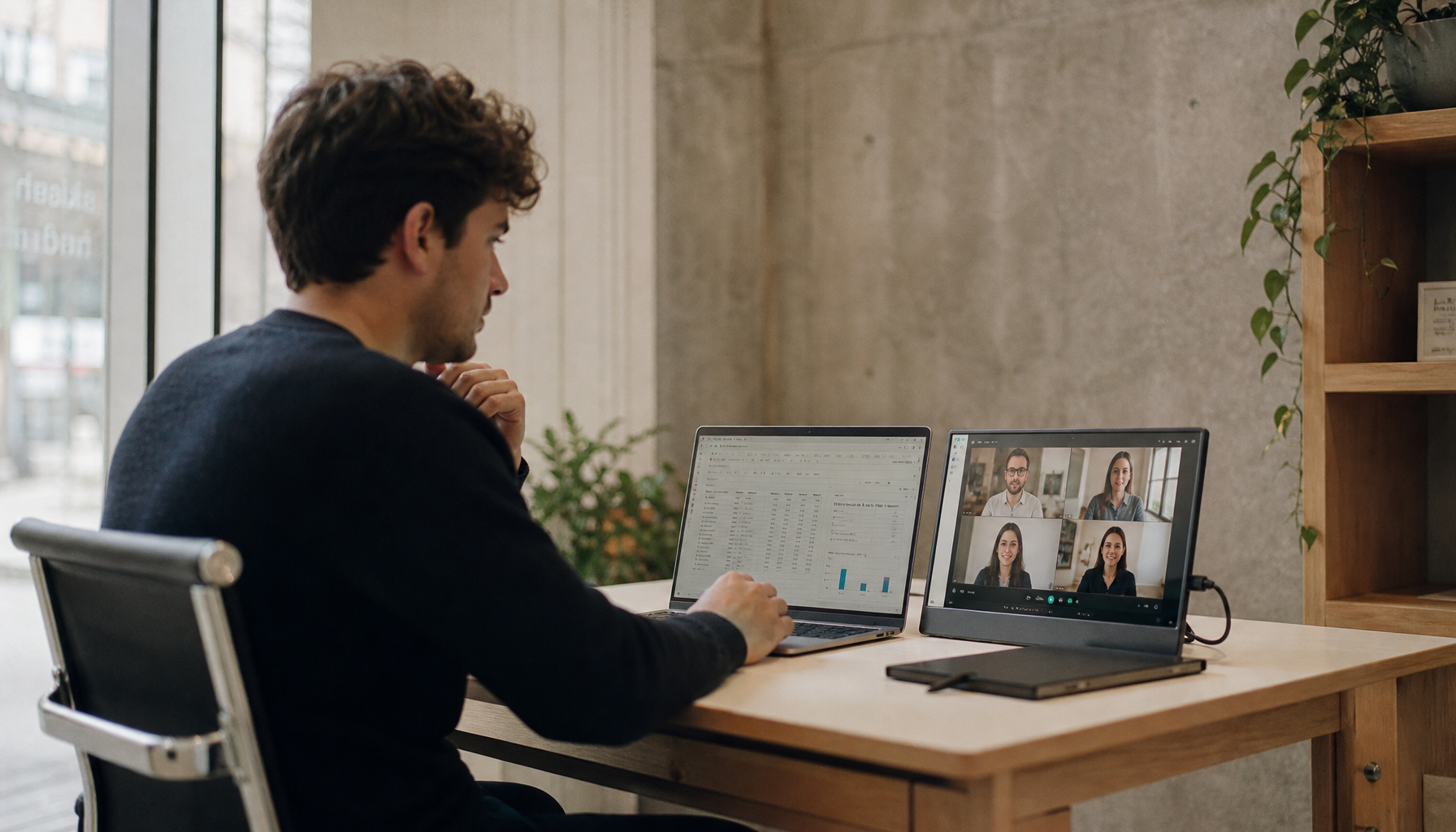
More remote workers are moving to a single ultrawide monitor because it can deliver a cleaner desk, fewer cables, smoother window layouts, and less bezel interruption than two separate displays. It is not automatically better for everyone, but for many home offices, a well-sized 34-inch ultrawide is becoming the most practical middle ground.
Your desk may already feel crowded: laptop dock, webcam, keyboard, headset, two display stands, and a tangle of cables behind it all. A single 34-inch 3440 x 1440 ultrawide can often replace the daily feel of two smaller monitors while making the setup easier to sit in front of, adjust, and maintain. The goal is to help you decide whether one ultrawide, two monitors, or a portable add-on makes the most sense for your remote work setup in 2026.
Why the Single Ultrawide Setup Is Gaining Ground
The biggest reason remote workers are reconsidering dual monitors is not novelty; it is friction. A dual monitor setup works well, but it adds more physical alignment, more cables, more dock bandwidth concerns, more display settings, and often a center bezel exactly where the eyes want a clean work area. A single ultrawide gives one continuous canvas, which is especially useful for documents, spreadsheets, timelines, dashboards, editing tools, browser tabs, and video meetings with notes beside them.
A first-hand move from dual monitors to a single ultrawide QD-OLED panel highlights the practical appeal: the writer preferred the ultrawide overall and was “not in any hurry” to return, mainly because the setup reduced cable clutter, docking complexity, display cable needs, and general cable management single ultrawide. That kind of difference matters in remote work because the desk is not a one-time installation; it is the place you reset, clean, reconfigure, and use for hours every day.
The shift is also helped by better monitor options. Ultrawide monitors now cover productivity, gaming, and hybrid work better than earlier models: 21:9 screens fit everyday multitasking, 32:9 screens mimic two displays in one chassis, high-refresh panels make scrolling and cursor movement smoother, and USB-C models can simplify laptop docking. The result is not a universal replacement for dual monitors, but a stronger default option for people who want one clean, high-quality main display.
Productivity: One Wide Canvas vs. Two Separate Screens
For many remote workers, the productivity question is simple: can one ultrawide keep enough work visible without constant window switching? A 34-inch 3440 x 1440 ultrawide is often the best answer because it gives meaningful horizontal room without becoming physically overwhelming. In daily work, that might mean a browser in the center, a messaging or collaboration platform on one side, and a reference document or project board on the other.
Ultrawide monitors support multitasking because they keep spreadsheets, chats, dashboards, tabs, and project boards visible across a wider horizontal workspace horizontal workspace. The important detail is discipline: place your primary task in the center third, then use the side zones for lower-frequency material. That pattern works better than stretching every app edge to edge, which can make email, documents, and web pages awkwardly wide.
Dual monitors still win when your workflow benefits from true separation. A developer might want code on one display and logs or documentation on another. A researcher may prefer a portrait monitor for long PDFs, source lists, or chat. Operating systems also support multi-display setup controls such as display identification, dragging displays into position, Extend mode, and display-switching shortcuts multiple monitors. That flexibility remains one of the strongest arguments for two screens.
Practical Window Layouts That Work

A single ultrawide works best when you treat it like three zones, not one giant rectangle. On a 34-inch 3440 x 1440 model, try a 50/25/25 split: the center half for the main task, the left quarter for communication, and the right quarter for references. For writing, analysis, or spreadsheet work, a 60/40 split often feels better because the main window has enough width without pushing reference material too far away.
Built-in window snapping and zone-management tools can imitate some multi-monitor layouts, but they do not restore the vertical space that a portrait secondary monitor provides window snapping. That is the main tradeoff: ultrawide improves continuity and reduces bezels, while dual monitors can provide more independent positioning and, if one is rotated, more vertical reading space.
Ergonomics: The Real Decider for All-Day Comfort

The best monitor setup is the one you can use for a full workday without twisting your neck, leaning forward, or raising your chin. Poor monitor placement can contribute to neck and shoulder discomfort, eyestrain, and work-related musculoskeletal issues poor monitor placement. This is where the single ultrawide trend needs nuance: fewer displays does not automatically mean better ergonomics if the screen is too large, too close, or too flat for your desk.
For a standard remote work desk, a 34-inch curved ultrawide is often easier to manage than a 40-inch or 49-inch model. A 2024 lab study cited in the ultrawide ergonomics research found that wider displays increased head-rotation demands, and some users found a 40-inch display overwhelming while many preferred the 34-inch option because it reduced neck twisting 34-inch option. That does not make large ultrawides bad; it means they need deeper desks, better mounts, and more careful window placement.
For daily setup, place the screen about an arm’s length away, directly behind the keyboard, with the top of the screen at or slightly below eye level. Workplace ergonomics guidance recommends positioning the monitor so the screen center sits about 15 degrees below the horizontal eye line, with an acceptable downward visual zone extending to about 45 degrees viewing angle. For ultrawides, keep your most-used apps in the center and avoid parking important windows at the far edges all day.
Curvature, Desk Depth, and Monitor Arms
Curvature matters more as width increases. A gentle curve can reduce the feeling that the screen edges are far away, especially on 34-inch and larger panels. Flat ultrawides can still work, but the outer edges may feel less natural if the monitor is close or if the desk is shallow.
Desk depth is a common hidden problem. Some large ultrawide monitor bases can exceed the practical space available on a 24-inch-deep work surface 24-inch-deep work surface. A monitor arm can help by reclaiming desk space, but it must support the display’s weight and mounting pattern. For 40-inch and 49-inch ultrawides, check arm weight limits carefully instead of assuming a standard arm will hold the panel securely.
Desk Simplicity, Cables, and Docking

A dual monitor setup can be reliable, but it is rarely simple. Two screens may require two power cords, two video cables, a stronger dock, extra desk width, and more time spent aligning height, tilt, scaling, and color. If you use a work laptop that travels between rooms or offices, the difference between one cable to a USB-C ultrawide and a dock feeding two screens can be meaningful.
A single ultrawide can reduce cable clutter and docking-station complexity because one panel replaces two separate display paths cable clutter. For remote workers who share an apartment, work in a bedroom, or need a desk that can shift from work to gaming at night, that cleaner physical setup is often part of the appeal. It also makes webcam positioning easier because the camera can sit at the center of one screen instead of above a bezel gap or off to one side.
Still, check your laptop and dock before buying. A 3440 x 1440 ultrawide at 100 Hz, 144 Hz, or higher may need more bandwidth than an older USB-C hub can provide. A 49-inch 5120 x 1440 super ultrawide can be even more demanding. If you want high refresh rate for both work smoothness and gaming, verify that your laptop, dock, cable, and monitor port all support the resolution and refresh rate you expect.
Choosing the Right Monitor Type for Remote Work

The best 2026 choice depends on the work you do, the size of your desk, and whether you also game on the same setup. For most remote workers, the safest ultrawide recommendation is a 34-inch 3440 x 1440 curved monitor with USB-C if laptop docking matters. It gives enough workspace to replace the feel of two smaller screens without demanding the same desk depth and head movement as a 40-inch or 49-inch panel.
High-refresh-rate displays are worth considering even for non-gamers. A 100 Hz, 120 Hz, or 144 Hz panel can make scrolling long documents, moving windows, and using a mouse feel smoother than a basic 60 Hz office display. If you also play games, look for adaptive sync support, good response times, and a GPU that can drive ultrawide resolution without lowering settings too aggressively.
Portable monitors still have a role. They are not a replacement for a good main display, but they are useful for travel, temporary side content, presentation notes, or a compact second screen beside a laptop. If your remote work includes frequent hotel stays, coworking days, or moving between a home office and a kitchen table, a 14-inch to 16-inch portable monitor may be more practical than a fixed dual-display setup.
Setup Option |
Best Fit |
Typical Strengths |
Main Tradeoff |
34-inch 3440 x 1440 ultrawide |
Most remote workers who want one clean main display |
Strong multitasking, manageable width, fewer cables, good gaming options |
Less vertical space than a portrait second monitor |
40-inch ultrawide |
Power users with deeper desks and strong window discipline |
More workspace for timelines, spreadsheets, and dashboards |
More head movement and desk-depth pressure |
49-inch 5120 x 1440 super ultrawide |
Users who want a dual-monitor feel in one panel |
Two-screen-like width with no center bezel |
Requires careful ergonomics, strong mount, and more GPU bandwidth |
Dual 27-inch monitors |
Users who need separated tasks or mixed orientations |
Flexible placement, portrait option, easy app separation |
More cables, more alignment work, bezel gap |
Laptop plus portable monitor |
Travelers and hybrid workers |
Lightweight, flexible, easy to store |
Smaller screen area and less ergonomic for all-day use |
When Dual Monitors Still Make More Sense
Dual monitors are still the better choice when your work depends on separation, not just space. If you constantly present on one screen while managing notes on another, compare long documents side by side, monitor live dashboards, or keep a portrait screen for code, chat, or research, two displays may be more efficient. A single ultrawide can imitate zones, but it cannot physically rotate one zone into portrait mode.
For equal-use dual monitors, the screens should touch and form a slight semi-circle around the user equal-use screens. If one display is primary, it should sit directly in front of the keyboard, with the secondary angled to one side. This matters because many dual-monitor discomfort issues come from placing the bezel in the center and forcing the neck to turn all day.
Dual monitors can also be cheaper if you already own one good screen. Adding a second matching monitor may cost less than replacing both with a premium ultrawide. The tradeoff is that you may spend more time managing stands, display scaling, cables, and dock compatibility. For buyers starting from scratch in 2026, the value gap has narrowed enough that a single ultrawide deserves serious consideration.
FAQ
Q: Is a single ultrawide monitor better than two monitors for remote work?
A: It is better if your priority is a cleaner desk, fewer cables, one continuous workspace, and less bezel interruption. It is not better if you rely on portrait orientation, physically separated tasks, or very different screen positions for different workflows.
Q: What ultrawide size is best for most home offices?
A: A 34-inch 3440 x 1440 curved ultrawide is the most balanced choice for many remote workers. It provides a useful multitasking width while staying easier to position than 40-inch and 49-inch models, especially on a desk around 24 inches deep.
Q: Should remote workers choose a high-refresh-rate ultrawide?
A: Yes, if the price difference is reasonable and your laptop or desktop can support it. A 100 Hz to 144 Hz ultrawide can make everyday motion feel smoother, and it is especially worthwhile if the same monitor is used for gaming after work.
Practical Next Steps
Choosing between a single ultrawide and dual monitors is less about chasing the largest screen and more about matching the display to your posture, desk, apps, and work habits. Start with a 34-inch 3440 x 1440 ultrawide as the default comparison point, then move up or back to dual displays only if your workflow clearly needs it.
Action checklist:
- Measure your desk depth and width before shopping; large ultrawide stands can crowd a 24-inch-deep desk.
- List your three most-used work layouts, such as video call plus notes, spreadsheet plus browser, or code plus documentation.
- Choose a 34-inch ultrawide if you want one clean display with manageable head movement.
- Choose dual monitors if you need a portrait screen, strong task separation, or flexible physical positioning.
- Check laptop, dock, cable, and port support for your target resolution and refresh rate.
- Use window zones so the primary task stays centered and side areas hold lower-frequency content.
- Position the monitor about an arm’s length away, with the top at or slightly below eye level.
The most practical 2026 setup for many remote workers is not the biggest possible screen. It is the display arrangement that keeps the main task centered, reduces desk friction, supports comfortable posture, and fits the way you actually work every day.