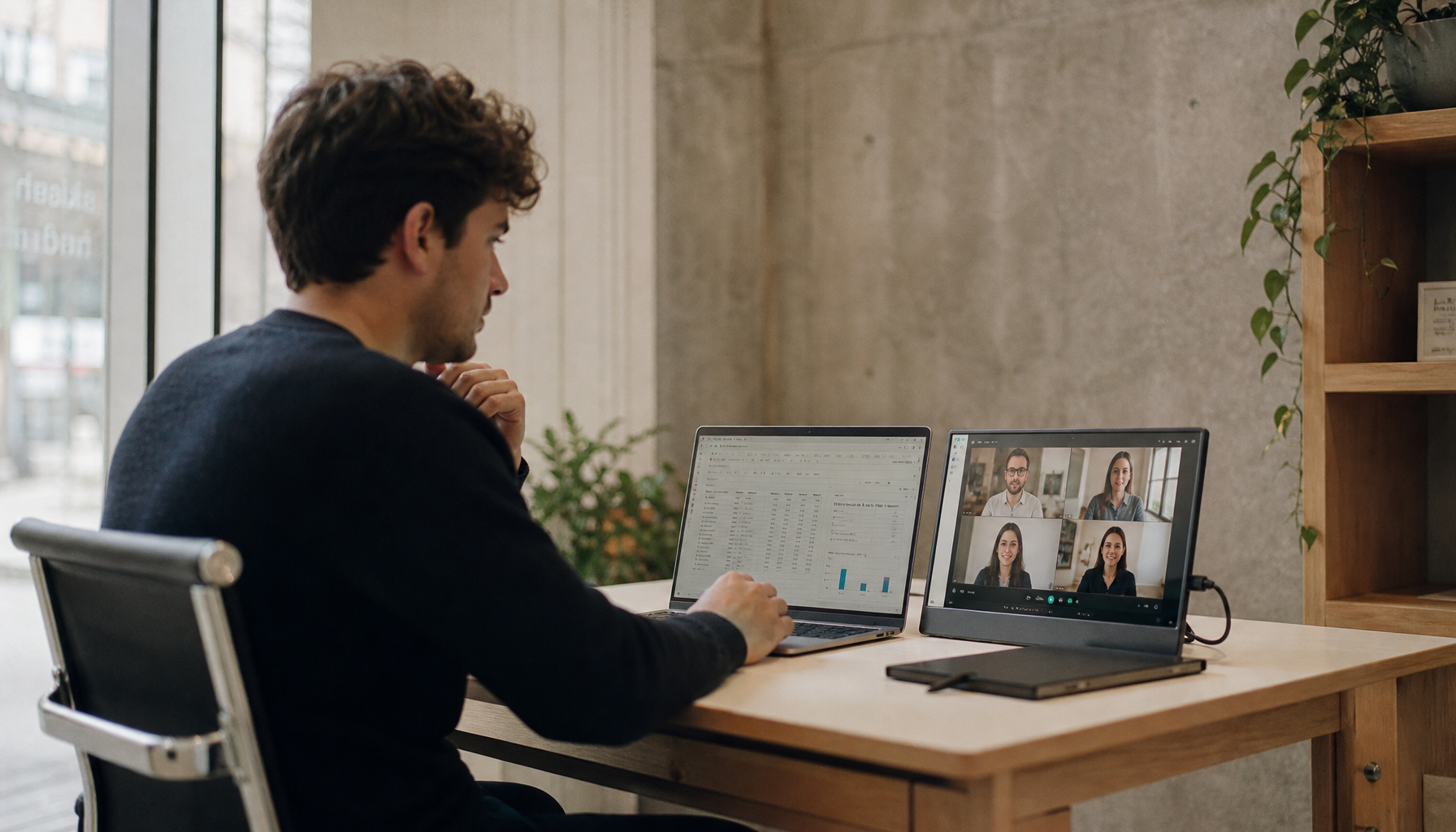
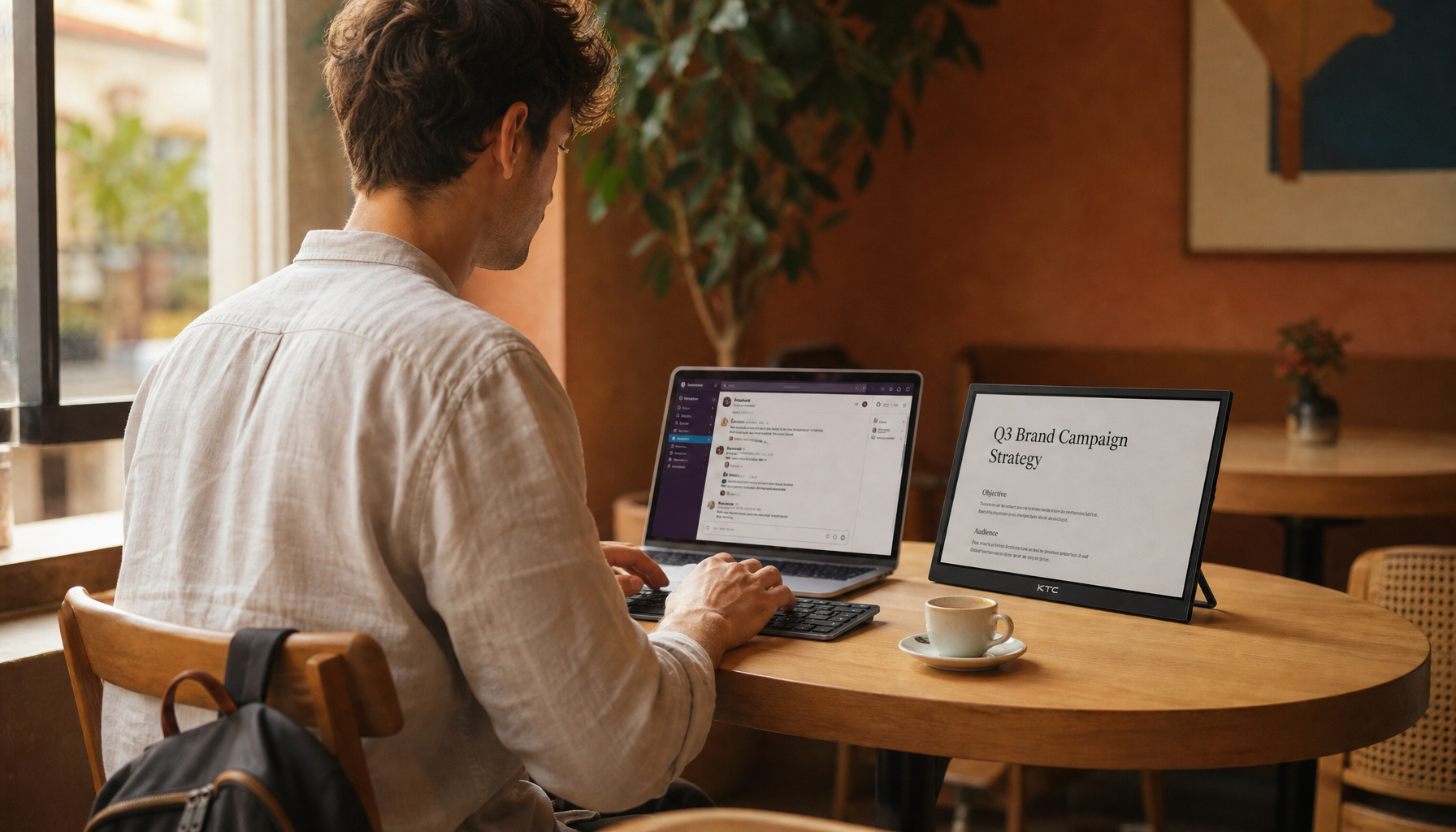
Move from one screen to two or three by preserving your main work position, assigning each added display a clear job, and using profiles or window tools only after the physical setup feels natural.
Is your desktop suddenly slower because every glance, drag, and app switch feels a little off? A well-planned dual-display setup can reduce tab switching immediately, and one industry-research figure reports up to a 42% productivity lift from dual displays. This guide gives you a practical path for adding screen space without breaking the rhythm you already rely on.
Start With the Workflow You Already Trust
The safest transition is not “more monitors everywhere.” It is one primary display that keeps your main task exactly where your eyes expect it, with the second screen serving a defined support role. For most office, creative, coding, gaming, and streaming setups, that means your current main monitor stays centered, while the new display handles reference material, chat, dashboards, timelines, preview windows, or system tools.
A multi-monitor setup means two or more displays connected to one computer so the desktop extends across more screen space. The important word is “extends.” Mirroring duplicates the same image and is useful for presentations, but extended desktop mode unlocks real productivity because each display can hold different work. The practical difference is clear: a writer can draft on the center screen while source material stays open on the side; a gamer can keep chat or stream controls visible without covering the game; a spreadsheet user can compare a report and source table without constant app switching.

The first operational rule is to protect your focus lane. If your main work is a code editor, design canvas, document, game, or spreadsheet, keep it straight ahead. A side monitor should reduce context switching, not become a second command center that forces your neck and attention to bounce all day.
Choose the Right Second Screen Before You Buy More Hardware
A second monitor is most useful when it complements your primary display. Similar size and resolution make cursor movement, text size, and window placement feel more predictable, while mismatched displays can introduce eye strain and visual inconsistency. If you are pairing a 27-inch QHD screen with an older 24-inch 1080p panel, it can still work, but you should expect to adjust scaling, brightness, and window roles more carefully.
For many productivity users, a 27-inch main display at 1440p is a strong middle ground because it provides meaningful workspace without making text scaling complicated. Programming-focused advice favors one central 27-inch main monitor because it balances screen real estate, viewing distance, and ergonomics. That point matters outside programming too: when every app renders predictably, your workflow stays fast.
Confirm connectivity before purchase. Check whether your laptop or desktop has HDMI, DisplayPort, USB-C with display output, or Thunderbolt, and verify whether the graphics hardware can drive the resolution and refresh rate you want. A dock or USB-C hub can make the transition cleaner by turning one cable into power, display, USB, and sometimes Ethernet. Peripheral setup guidance notes that docking stations and USB-C hubs reduce setup friction when the display, power, and peripherals need to move together.
Setup Choice |
Best Fit |
Tradeoff |
Laptop plus one external monitor |
Budget office work, travel, hybrid desks |
Smaller laptop display needs a stand and keyboard for comfort |
Two matching monitors |
General productivity, research, spreadsheets, support tools |
Requires more desk width and cable planning |
Ultrawide plus portrait side screen |
Immersive main work with separate reference space |
Costs more and needs careful window management |
Three monitors |
Streaming, development, creative, operations dashboards |
More visual load, more desk space, more ergonomic risk |
Place the Monitors So Your Body Does Less Work
The biggest mistake is treating monitor placement as decoration. The setup should fit your posture first and your desk photo second. University ergonomics guidance for dual monitors emphasizes positioning displays to reduce awkward neck movement, which is exactly where many first-time dual-screen setups fail.
If one screen carries most of your work, put that monitor directly in front of you. Place the second monitor beside it and angle it inward so the far edge is not drifting out of your natural viewing field. Align the top edges when the monitors are similar in size. If one is vertical, align the most-viewed region near eye level rather than obsessing over perfect top alignment.

For a simple desk check, sit about an arm’s length from the screens and ask whether you can read normal body text without leaning forward. If not, change scaling or distance before you start rearranging apps. A display that looks impressive but makes you crane your neck will cost more focus than it gives back.

Triple-monitor users should be even more disciplined. Ergonomics-oriented advice recommends a centered primary monitor with side displays angled inward for triple monitor setup layouts. That arrangement keeps the main task stable while giving each side screen a support role: active work in the center, reference or tools on the left, and communication or monitoring on the right.
Configure the Operating System Before Installing Extra Software
Start with the operating system’s native display controls. Identify each monitor, drag the numbered displays so they match the physical desk arrangement, set the correct resolution, choose the recommended scale, and use extended desktop mode. This matters because cursor travel follows the virtual layout, not your desk reality. If the system thinks the right monitor is above the left one, your mouse will behave like the setup is broken even when the cables are fine.
Use the built-in projection shortcut when switching modes. On many PCs, the system key plus P moves between single screen, duplicate, extend, and second-screen-only behavior. That is enough for many users who only need the second display during focused work sessions.

Then tune the taskbar. A clean configuration is to show app buttons on the monitor where the window is open, which reduces the “where did that app go?” problem. Use snap shortcuts to make window placement repeatable. For example, keeping your browser snapped to the left half of the side monitor and notes snapped to the right half creates a stable review station without adding another app.
Add Management Tools Only When Friction Becomes Repeatable
Third-party software becomes valuable when the same annoyance happens every day. If windows scatter after reconnecting a laptop, if you switch between single-screen and dual-screen modes often, or if you need specific apps to launch into specific zones, dedicated monitor software can save real time.
Power-user monitor utilities offer monitor profiles that can save layouts, resolutions, refresh rates, orientations, and window behavior, while triggers can react when windows open, focus changes, the desktop unlocks, or the system becomes idle. That is useful for a workday pattern like opening chat on the vertical monitor, a browser on the right, and a spreadsheet centered every morning.
Other multi-monitor utilities focus on making each screen feel more complete by extending familiar controls such as taskbars, menus, and task switching across displays. Their desktop profiles are especially relevant for laptop users who move between an internal display, a docked desk setup, and presentation mode.
Custom snap zones, cursor-jump tools, and brightness controls also fit into this layer. Snap-zone tools help divide large workspaces into repeatable regions, while cursor-jump tools reduce long mouse travel across wide layouts. Brightness tools are less glamorous, but they matter when two monitors from different makers make one white document look warm and the other look blue.
Build Your New Screen Habits Gradually
The first week should be boring on purpose. Do not move every application to a new home on day one. Keep your primary task centered, then assign one repeated support job to the second screen. A practical starter setup is main work in the center, calendar and messages on the side, and reference material snapped beside them only when needed.
After a few days, look for workflow signals. If you keep dragging the same app to the same place, make a snap zone or profile. If your eyes keep bouncing between two displays, move the higher-priority window back to the center. If your neck turns repeatedly, bring the side monitor closer and angle it inward. The goal is not to use all pixels all the time; the goal is to reduce the number of decisions between intention and action.
Gamers and streamers should be especially intentional. Secondary displays are useful for chat, broadcast software, maps, statistics, and guides, while immersive play usually still belongs on the center display. Thin bezels and matching refresh behavior help, but the best improvement is often simpler: keep the game full-screen in front and put stream controls on a vertical side screen.
Know the Pros and Cons Before Expanding Again
The advantages are direct. You get more visible workspace, less tab switching, better task separation, stronger reference workflows, and more immersive control surfaces for gaming, streaming, editing, or analysis. A dual-screen setup also supports mental separation: one screen can be for making, while the other is for checking.
The downsides are just as real. More screens can mean more cables, more heat, more desk clutter, more graphics load, more cursor travel, and more posture risk. Large or mismatched displays can create scaling problems. Triple setups can become visually noisy if every screen is treated as equally important.
A good upgrade is measured by flow, not monitor count. If a second display lets you keep source material visible while writing, that is a win. If a third display becomes a permanent inbox distraction, it is not a productivity tool; it is a bright interruption panel.
A Practical Transition Plan That Works
Start by connecting only one additional display and using extended desktop mode. Keep the original main monitor centered and assign the new screen a single role, such as reference, communication, preview, or monitoring. Match resolution and scaling as closely as possible, then align the monitors physically and digitally so mouse movement feels natural.
Once the physical setup feels stable, create two repeatable modes: focused single-screen work and expanded multi-screen work. If operating system shortcuts handle the switch cleanly, stop there. If switching still feels clunky, add a profile, snap-zone, or brightness tool based on the specific problem you are solving.
The strongest multi-monitor setups do not feel like more computer. They feel like less friction. Keep the main task centered, give every extra screen a job, and let software automation handle only the routines that prove they deserve it.