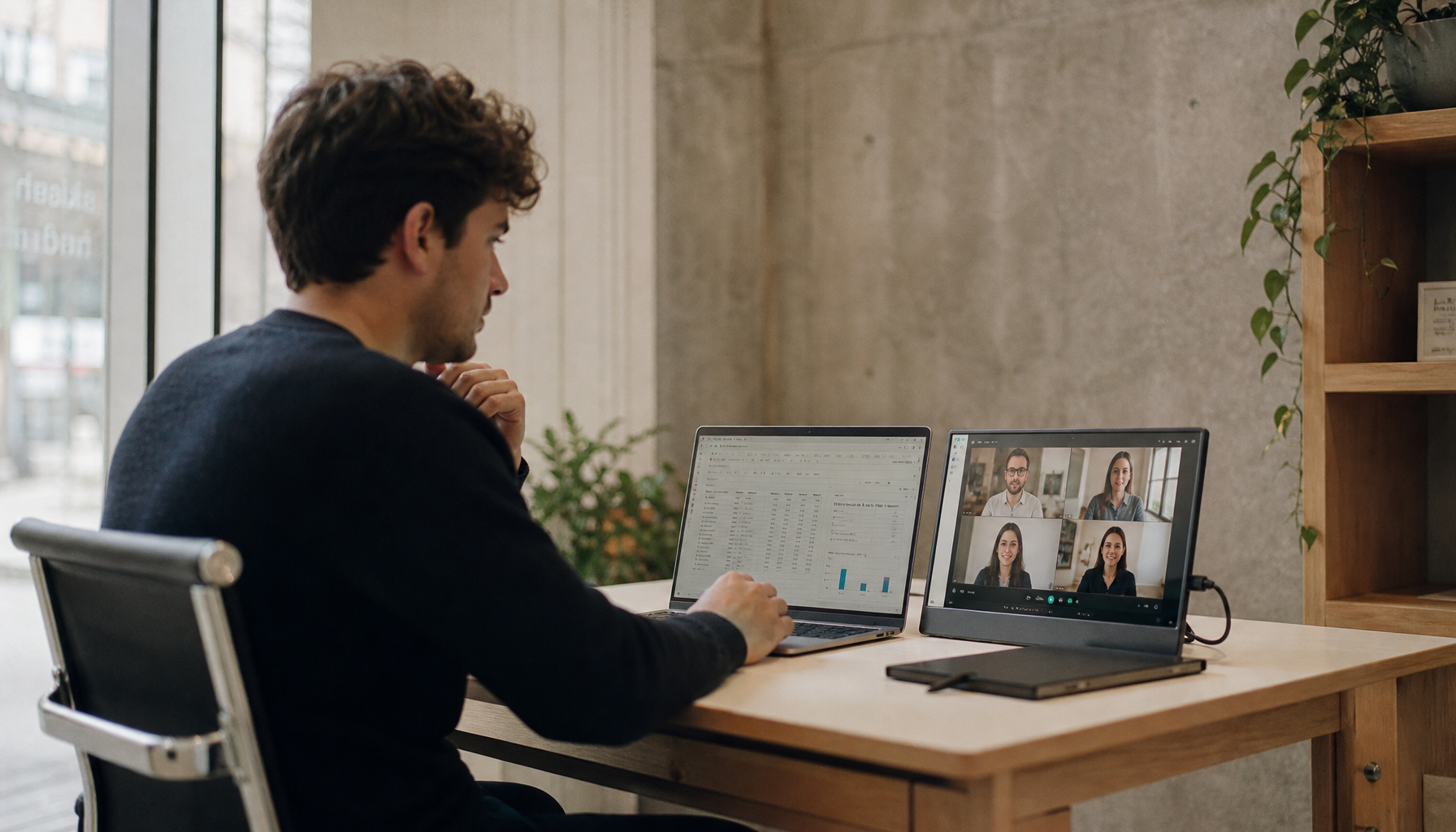
The ideal monitor height for a standing desk keeps the top of the screen at or slightly below your eye level while your elbows stay at roughly 90 degrees. This setup changes when you raise the desk because your eye-to-elbow distance typically increases by about 3.9 cm (1.5 inches) when standing compared to sitting. Using an adjustable monitor arm lets you make this quick independent correction, preventing the forward head tilt that causes neck strain during sit-stand transitions.

Why Your Monitor Height Needs to Change Between Sitting and Standing
Many people buy a standing desk to reduce sedentary time only to discover that neck and shoulder discomfort persists or even worsens. The reason is simple: your posture changes when you stand. Spinal decompression and shifts in shoulder position increase the distance between your eyes and elbows. A monitor fixed to the desk surface or using a non-adjustable stand ends up too low once the desk rises, forcing you to crane your neck downward.
This "postural delta" explains why users often report persistent neck flexion even with premium height-adjustable desks. Fixed stands cannot accommodate the change, leading to inconsistent ergonomics across your workday. Recognizing this early helps you prioritize independent monitor adjustment over relying solely on desk height changes.
The Horizontal Eye-Line Rule: Establishing Your Ergonomic Baseline
The foundational ergonomic rule is that the top of your monitor should align with or sit slightly below your horizontal eye level. This keeps your neck in a neutral position and supports a natural 15- to 20-degree downward gaze to the screen center, reducing strain on cervical muscles.

According to OSHA workstation guidance, the top of the screen should be at or slightly below eye level to maintain neutral posture. The Canadian Centre for Occupational Health and Safety adds that the center of the screen should fall approximately 15 to 20 degrees below your horizontal eye line for optimal comfort.
Start by setting your desk height so your elbows form a 90-degree angle with forearms parallel to the floor, as described in OSHA desk recommendations. Then position the monitor at roughly arm's length—typically 20 to 40 inches according to Cornell University ergonomics guidelines. This baseline works for seated use and becomes the reference point for standing adjustments.
This section pairs well with our Home Office Setup Guide: How to Choose the Right Ergonomic Monitor and The Complete Guide to Finding the Best Monitor for Productivity & a Healthier Workspace.
Seated vs Standing Monitor Height Adjustment
Monitor height shift needed when moving between sitting and standing to keep the viewing line near eye level.
View chart data
| Category | Eye-to-elbow / monitor adjustment |
|---|---|
| Seated | 0.0 |
| Standing | 3.9 |
| Delta | 3.9 |
The 3.9cm Delta: Calculating the Height Shift for Standing Work
Research shows the eye-to-elbow distance typically increases by approximately 3.9 cm (1.5 inches) when moving from a seated to a standing posture. This PubMed study on monitor height changes highlights the need to accommodate this shift independently of desk height to preserve proper viewing angles.
To calculate your personal delta, measure the vertical distance from your eyes to your elbows while seated in a neutral posture, then repeat the measurement while standing. Subtract the seated value from the standing value to find the adjustment needed. A roughly 4 cm error over several hours can contribute to noticeable neck flexion and shoulder tension.
The 3.9 cm figure serves as a reliable planning guideline based on average adult measurements, though individual results vary with height, spinal health, and posture habits. Use this as your target upward adjustment for the monitor when you raise the desk.
Optimizing Your Sit-Stand Transition: A Step-by-Step Adjustment Guide
Follow these steps to maintain consistent ergonomics:
- Set your seated desk height with elbows at 90 degrees and lock in the monitor so its top edge aligns with your eye level.
- Raise the desk to your comfortable standing elbow height.
- Independently raise the monitor arm by approximately 4 cm (or your measured delta) until the top edge returns to eye level.
- Confirm the center of the screen sits 15–20 degrees below your gaze with relaxed shoulders.
Perform this adjustment each time you switch positions. Many users find that a gas-spring monitor arm makes the change one-handed and nearly instant, removing the friction that causes people to skip proper setup.
Beyond the Standard Setup: Ergonomics for Ultrawide, Dual Monitors, and Bifocals
Special cases require additional tweaks. Bifocal or progressive lens users should lower the monitor 1–2 inches further and tilt it slightly upward to avoid neck craning, per Mayo Clinic home office ergonomics tips.
For ultrawide displays (34 inches or larger), increase viewing distance to 30–35 inches to keep edge content within your natural field of view without excessive head rotation. Dual 27-inch monitors work best in a shallow V formation with a 10–15 degree inward angle on each screen.
These larger or multiple-monitor setups often benefit from heavier-duty arms to reduce wobble at standing heights. Our guide on Vertical vs. Horizontal: How to Build the Ultimate Dual Monitor Productivity Setup explores arrangement options in more detail.
Essential Tools for a Pain-Free Workspace: Choosing the Right Monitor Arm
Factory monitor stands frequently lack the vertical travel needed for the full sit-stand delta. A gas-spring monitor arm provides the independent height range and easy adjustment required for frequent transitions.
KTC office monitors such as the 27" 4K IPS 60Hz Low blue Light Home&Office Monitor support VESA mounting, enabling full compatibility with quality arms. This flexibility proves especially valuable with standing desks where fixed stands fall short.
For glass desks, review safety considerations in our article on Can You Mount a Monitor Arm to a Glass Desk Without Breaking It? Safety Checks, Risks, and Better Setup Options.
Common Mistakes and How to Correct Them
The most frequent error is treating the monitor and desk as a single unit. Raising only the desk without adjusting the monitor creates downward neck flexion. Another mistake is setting everything once and never recalibrating after changing shoes or chair height.
Measure your personal delta rather than assuming the 3.9 cm average always applies. For very tall or short users, the actual shift may differ slightly. Finally, avoid positioning ultrawide monitors too close; the resulting head turning can negate the ergonomic gains from proper height.
Practical Checklist for Immediate Application
Use this quick checklist each time you switch postures:
- Elbows at ~90 degrees with shoulders relaxed
- Top of screen at or just below eye level
- Screen center 15–20 degrees below horizontal gaze
- Viewing distance of 20–40 inches (farther for screens over 27 inches)
- Monitor raised independently by your measured delta when standing
- Screen tilted slightly backward (5–10 degrees) for comfortable viewing
Take 30 seconds to verify these points after each adjustment. Consistent application dramatically reduces the neck discomfort many experience with standing desks.
FAQs
How high should my monitor be at a standing desk? The top edge should align with or sit slightly below eye level, with the center of the screen about 15–20 degrees below your horizontal gaze. This usually requires raising the monitor 3–5 cm higher than your seated position.
What is the best monitor position for standing and sitting? Maintain the same eye-line rule in both postures by adjusting the monitor independently when you change desk height. A gas-spring arm makes this transition seamless and keeps your neck neutral in both positions.
Does monitor height really affect neck pain? Yes. When the monitor sits too low, you flex your neck downward for extended periods. The resulting posture increases load on cervical muscles and can contribute to tension and discomfort over long sessions.
Should I lower my monitor for bifocals? Bifocal users generally benefit from lowering the monitor an extra 1–2 inches and tilting it upward slightly. This allows viewing through the lower lens portion without tilting the head back.
Can I use the same monitor height for both sitting and standing? Usually not. The typical 3.9 cm increase in eye-to-elbow distance when standing means a fixed height creates suboptimal viewing angles in one of the two postures. Independent monitor adjustment is the practical solution.
What type of monitor arm works best with standing desks? Gas-spring arms with generous vertical travel (at least 8–10 inches) offer the easiest one-handed adjustments and sufficient range for the sit-stand delta. Look for models rated for your monitor’s weight.
How far should my monitor be from my eyes at a standing desk? Aim for 20–40 inches, adjusting toward the longer end for larger or ultrawide screens. This distance supports the recommended downward gaze angle while keeping content comfortably in focus.