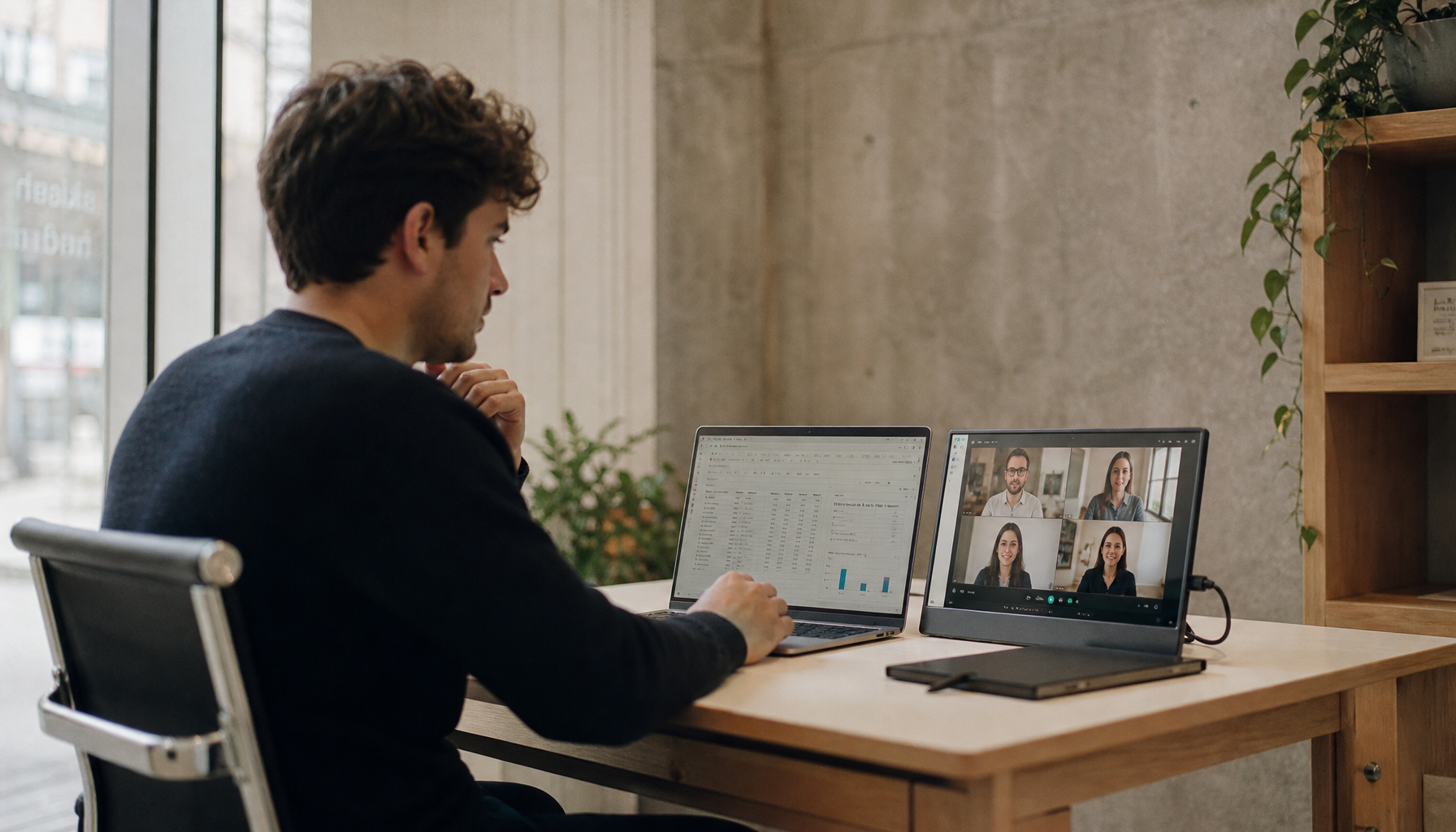
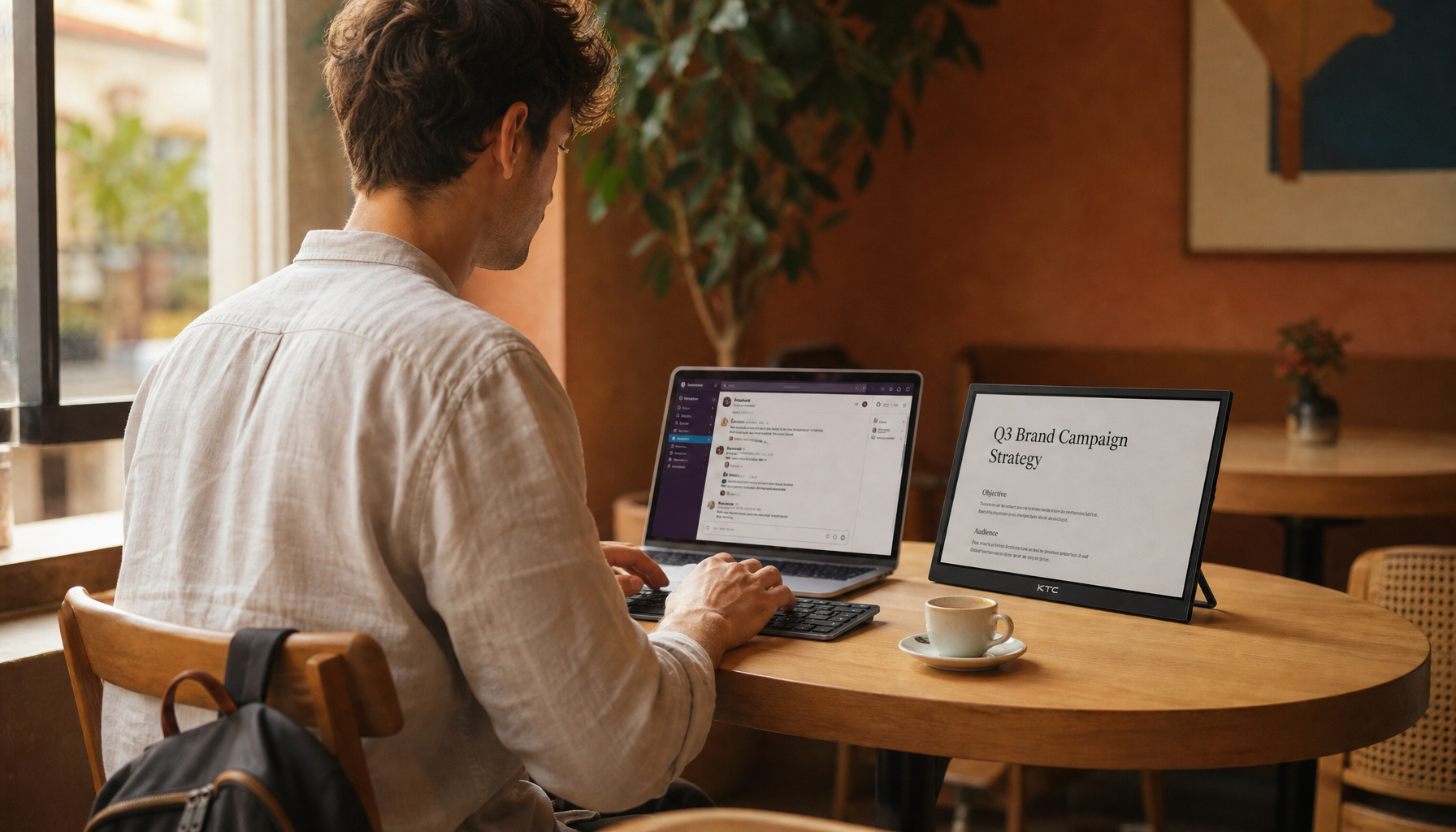
Stacked vertical monitors can save desk width, but they work best when the upper screen stays glanceable rather than becoming a second primary workspace.
Do your shoulders creep upward after an hour of looking between a bottom monitor and a screen mounted above it? A better stacked setup can give you dual-display utility on a narrow desk while keeping your primary work in a neutral viewing zone. Here is how to decide whether stacked monitors fit your workflow, where the ergonomic traps appear, and how to tune the layout for long sessions.
What a Stacked Vertical Monitor Arrangement Actually Means
A stacked monitor setup places two or more displays vertically, usually with one screen directly above another on a tall dual-arm mount, pole stand, wall mount, or riser system. It is different from a portrait monitor setup, where a single display is rotated 90 degrees. A stacked setup may use two landscape screens, one landscape plus one portrait screen, or a lightweight portable display above a main monitor.
The appeal is clear if you have lived with two 27-inch displays on a compact desk. Side-by-side monitors can consume roughly 4 ft of horizontal space before you even count speaker stands, a laptop dock, or monitor-arm clearance. Stacking uses vertical air space instead. That makes it attractive for streamers, developers, traders, support teams, and home-office users who want more information visible without turning the desk into a wall of glass.
The ergonomic problem is also clear after a full workday: the upper monitor asks your neck to do something it was not designed to do for hours. A good workstation keeps the main screen close to eye level or slightly below, because monitor height that forces tilting, craning, or lowering the head can contribute to neck and back discomfort over time.
Why Stacking Can Feel Better at First
Stacked monitors reduce lateral head rotation. If your current setup uses two large screens side by side, your neck may be turning repeatedly from left to right all day. For wide setups, that horizontal sweep can become tiring, especially when your main app is not centered in front of your keyboard.
A stacked layout can bring the primary screen back to the body midline. That matters because a dual-monitor workstation should keep the main display centered when one monitor gets most of the attention, while the secondary screen should be angled and treated as secondary. University ergonomics guidance for dual monitors makes the same core distinction: equal-use displays are arranged differently from primary-plus-secondary displays.

The desk-space win is real, too. On a 30-inch desk, two horizontal 27-inch monitors may be physically awkward or impossible. A stacked arrangement can keep the keyboard, mouse, audio controls, and notebook within reach instead of pushing everything outward. For dense workstations, that can reduce shoulder reaching and visual clutter.
Where the Ergonomic Problem Starts
The upper monitor becomes a liability when it stops being a reference display and becomes a working display. If you write code on the top screen, edit spreadsheets there, or keep your communication app high enough that every message pulls your chin upward, you trade side-to-side rotation for repeated neck extension.
The safest rule is simple: the bottom monitor is the work monitor, and the upper monitor is the glance monitor. The primary bottom display should sit directly in front of your body, with the top bezel at or slightly below resting eye level. That keeps your eyes moving slightly downward toward the center of the screen, which is generally more comfortable than looking up for long periods.
The upper display should be tilted down toward your face. If it is flat or angled upward, you end up lifting your chin and focusing through a poor viewing angle. A practical target is a downward tilt around 15 to 25 degrees for the top monitor, then fine-tune until the screen faces your eyes rather than the ceiling.

A useful field test is the 80/20 rule. If about 80% of your time is on the lower display and 20% is on the upper display, stacking can work well. If the split drifts toward 50/50, the top screen is too important to sit above your natural viewing zone.
Stacked Versus Side-by-Side: Which Is Better?
Neither layout is universally better. The right answer depends on whether your work is wide, tall, or glance-based.
Setup |
Best For |
Ergonomic Strength |
Main Risk |
Stacked monitors |
Narrow desks, streaming dashboards, logs, chat, reference docs |
Saves desk width and keeps primary screen centered |
Upper-screen overuse can strain the neck |
Side-by-side monitors |
Video timelines, spreadsheets, design canvases, equal-use apps |
Keeps both screens at similar height |
Wide setups can cause repeated neck rotation |
Landscape plus portrait |
Coding, writing, research, document review |
Keeps a wide main screen plus tall reading space |
Poor portrait height can force vertical eye travel |
Single ultrawide |
Timelines, finance dashboards, multitasking |
Continuous horizontal workspace |
Width and distance must be managed carefully |
For video editors, financial analysts working in very wide spreadsheets, and designers comparing broad canvases, side-by-side or ultrawide displays usually make more sense. For streamers, a stacked layout can be excellent because chat, alerts, streaming controls, and system monitoring can sit near the camera axis while gameplay stays centered on the main screen.
For developers, the answer depends on the task. Logs, documentation, terminal output, pull requests, and monitoring dashboards are strong top-screen candidates. Active coding on the top monitor is usually a mistake unless the screen is unusually low, small, and close to your natural line of sight.
The Correct Setup for a Stacked Monitor Workstation
Start with the chair, keyboard, and primary display, not the mount. Your feet should rest flat, your elbows should sit near a comfortable right angle, and your keyboard should be centered with your body. Once that foundation is set, place the lower monitor straight ahead.
The bottom display should be about an arm’s length away. For many office displays, that means roughly 20 to 28 inches, though larger 27-inch and 32-inch screens often feel better slightly farther back. If text looks small, increase scaling or font size before pulling the monitor too close. Moving closer often creates a new problem: leaning forward.
The upper monitor should be reserved for information you can understand in a short glance. Chat, music, calendar, system monitoring, build status, server logs, ticket queues, reference images, and documentation all fit that role. A vertical monitor setup can be useful for long-form content, but stacking a tall portrait panel above another screen can push too much information outside a comfortable vertical field of view.
Mount quality matters more than it does in a normal setup. A stacked layout raises the center of gravity, so wobble becomes more noticeable, especially on sit-stand desks. Use a tall, adjustable dual-arm or pole mount with a secure clamp or grommet attachment. A freestanding base can work for light displays, but it is rarely the best choice for a tall stack because it consumes desk depth and can feel unstable when adjusted.

Hardware Choices That Reduce Strain
The upper screen should usually be smaller and lighter than the lower screen. A 24-inch display or lightweight portable monitor can be easier to position than a second heavy 32-inch panel. Single-cable portable screens are especially clean in stacked builds because one cable can often carry power and video, reducing visual clutter and cable drag.
Panel type matters. Budget panels with weak viewing angles often look worse from above or below, and a top-mounted display exposes that weakness quickly. Panels with strong off-axis performance generally hold color and contrast better from elevated viewing positions. Reviewers emphasize viewing angle and text clarity as important buying factors for vertical and productivity displays, which lines up with what you feel in daily use: a screen that looks faded from below makes your eyes work harder.
Resolution should match the job. A 1080p top screen is fine for chat, metrics, and music. For documentation, code, or dense dashboards, 1440p often gives sharper text without the scaling quirks of very high pixel density. If you use a 4K top display, increase scaling so you are not tempted to lean upward and forward.
Pros and Cons of Stacked Vertical Monitors
The biggest advantage is space efficiency. Stacking lets a narrow workstation behave like a larger command center. It also keeps the primary display centered, which can reduce the left-right scanning common in wide dual-monitor setups.
The second advantage is focus. A lower primary screen plus upper status screen creates a clear hierarchy. Your main task stays at eye level, while secondary information remains visible without taking over the workspace.

The tradeoff is vertical strain. If the top display becomes a second main display, your neck pays for the extra pixels. Another drawback is installation complexity. You need a stronger mount, better cable slack, and more careful tilt adjustment than you would with two basic side-by-side monitors. Glare can also increase because the upper screen may catch ceiling lights or window reflections.
Signs Your Stack Is Set Up Wrong
A poor stacked layout usually announces itself quickly. You may feel tension at the base of the neck, pressure between the shoulder blades, dry eyes, or a habit of leaning back to see the upper screen. You may also notice that you keep dragging active windows to the lower display because the top one feels tiring.
The fix is not always buying new hardware. First, lower the entire stack if possible. Then tilt the upper screen downward. Next, move active apps to the bottom display and demote the top screen to monitoring, messaging, or reference. If the upper monitor is still uncomfortable, use a smaller display or switch to a side portrait monitor instead.
Movement breaks remain part of the system. Ergonomic sources commonly recommend short posture resets during the workday, and regular movement breaks help reduce fatigue from any fixed monitor arrangement. A premium arm cannot compensate for sitting frozen under a screen stack for four hours.
Should You Use a Stacked Setup?
Choose stacked monitors if your desk is narrow, your main display can stay centered, and your secondary information is truly glanceable. It is a strong layout for streamers, developers watching logs, traders monitoring dashboards, and office users who want reference material visible without expanding sideways.
Avoid stacking if both screens are equally important, if you spend long sessions editing on the upper display, or if you wear progressive lenses that already make vertical viewing angles sensitive. In those cases, a side-by-side arrangement with a gentle inward angle, a landscape-plus-portrait layout, or a single larger display may be more comfortable.
A stacked monitor setup is not an ergonomic shortcut; it is a precision layout. Keep the lower screen as the performance zone, make the upper screen a fast-reference layer, use a stable adjustable mount, and let comfort decide the final position. More screen space should make you faster, not make your neck negotiate with your workstation.