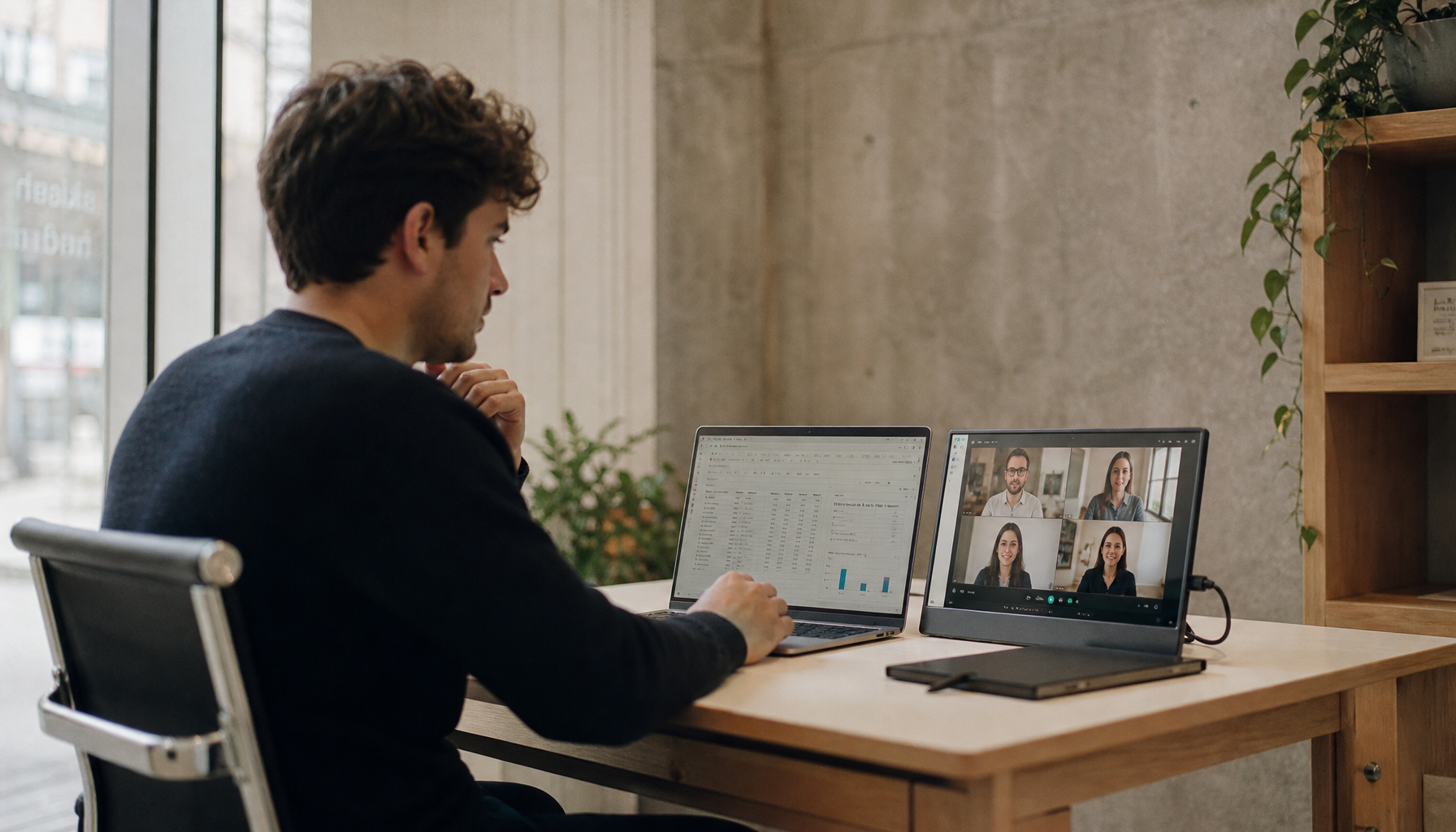
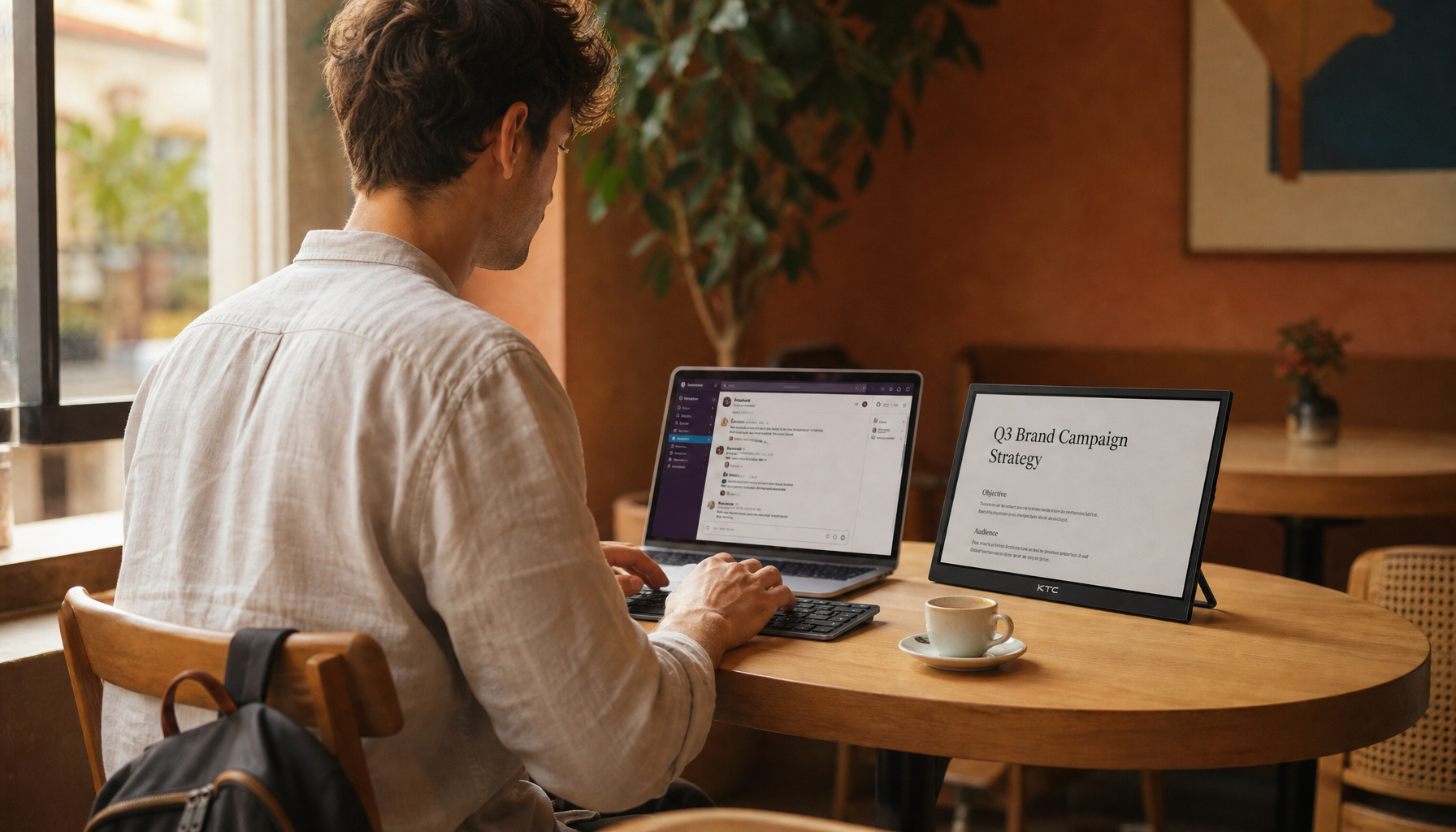
Portable rolling displays are emerging as a practical way to support dynamic hot-desking in 2026. Instead of fixed monitors that tie you to one desk, these wheeled screens let you move your workspace to where you need it—whether that is a quiet corner, a collaborative table, or a temporary spot in a shared office. The approach creates what many users describe as a “room within a room,” giving a sense of personal boundaries without walls. Evidence from ergonomic standards and workplace studies suggests this can reduce physical strain and improve focus when implemented thoughtfully, though results vary by individual and setting. This article examines the evidence, practical trade-offs, and two specific models that illustrate current options.

The 2026 Shift: Why Fixed Desks Are Fading
The 2026 workplace is shifting toward a 'deskless' office model where work is organized around tasks and context rather than fixed desks or anchored monitors. Hybrid schedules mean many employees change locations multiple times per day, making traditional monitors impractical to relocate without repeated setup friction.
A floating workstation uses a battery-powered rolling display to create a mobile zone that travels with you. The large screen acts as a visual and psychological boundary, helping carve out temporary focus areas in open-plan or multi-use spaces. This room-within-a-room effect can reduce distractions and signal to colleagues that you are in a work mode, though the benefit is subjective and depends heavily on your specific room layout and office culture.
For hybrid workers and agile teams, the mobility eliminates the need to book meeting rooms just for screen access or to tolerate poor ergonomics at temporary desks. However, this setup does not fully replace a fixed high-performance monitor for every workflow—particularly precision creative tasks or all-day stationary use.
From Solo Focus to Scrum: The Hot-Desking Journey
Rolling displays support a range of daily patterns. In solo focus mode, the screen provides enough real estate for reference materials alongside your laptop while the mobility lets you reposition for optimal lighting or to reduce glare. Many users roll the unit to a quieter corner when deep work is required, creating separation without permanent office modifications.
The transition to collaboration is where the setup shines for agile scrum teams. Instead of wheeling a laptop around or dealing with cable connections and room bookings, you roll the display to a shared table. As one smart interactive board guide notes, rolling smart displays can save up to 10 minutes of tech setup time per meeting by eliminating complex cable connections. This reduction in friction is especially valuable for standups and quick reviews where momentum matters.
In home environments, the same unit serves as a wireless second screen that moves from office corner to living room, adapting to different tasks without dedicated furniture in every room. The key is matching movement frequency to your actual routine—frequent movers benefit most, while those who stay put most of the day may find the added features less essential.
Ergonomics in Motion: Setting Up Your Floating Workstation
Maintaining good posture remains critical even when the workstation moves. According to ISO 9241-5:2024, workstation layout and postural requirements continue to govern safe human-system interaction, with updated guidance that accounts for dynamic use. The Canadian Centre for Occupational Health and Safety monitor positioning guidance recommends keeping the top of the screen at or slightly below eye level, roughly an arm’s length (20–30 inches) away, to maintain a neutral neck position.

The Mobile Display-Posture Alignment Matrix helps translate these rules to motion. During the 20-minute sitting phase, prioritize precision neutral positioning. In the 8-minute standing block, a slightly lower screen is often acceptable if it improves typing comfort. The 2-minute movement phase requires clear sightlines to avoid collisions, which may mean temporarily lowering or angling the display.
For most users, independent height adjustment on the stand is the first specification to check. Models without sufficient range (typically 40 cm or more of travel) fail the 20-8-2 heuristic for people over 5'10" or under 5'4". Start by measuring your eye height in both postures and verify the display’s minimum and maximum center height against those numbers. If the unit forces awkward neck angles in either position, it is likely to create strain over time regardless of how easily it rolls.
See also our Home Office Setup Guide: How to Choose the Right Ergonomic Monitor and The Complete Guide to Finding the Best Monitor for Productivity & a Healthier Workspace for deeper posture fundamentals that still apply to mobile units.
The Daily Workflow: Mastering the 20-8-2 Rhythm
The 20-8-2 heuristic recommends spending roughly 20 minutes sitting, 8 minutes standing, and 2 minutes moving to optimize musculoskeletal health. A rolling display makes this rhythm easier to follow because your workspace travels with you instead of being abandoned when you change posture.
According to ergonomic guidance on agile office layouts, the pattern reduces static loading on the spine and shoulders compared with all-day sitting or standing. In practice, the display’s quick height adjustment and stable casters let you complete the cycle without losing context or resetting cables.
Moving the unit safely requires planning. Lock the wheels firmly before interacting with the screen, and clear pathways of cords or obstacles. Most users settle into 2–4 purposeful relocations per day rather than constant wandering. The rhythm works best when the display’s weight and balance do not discourage the movement phase.
If the 20-8-2 timing feels too rigid, treat it as a flexible guideline and focus on changing posture at least every 30 minutes. The rolling form factor removes one major barrier—having to leave your digital environment behind.
The Reality Check: Battery Life and Stability Trade-Offs
Battery life and physical stability represent the primary practical limits of rolling displays. While battery-powered units offer genuine mobility, high brightness, wireless casting, or sustained laptop charging can reduce runtime significantly compared with standby modes. Most 9,500 mAh batteries deliver 7–9 hours under moderate mixed use but may drop to 4–5 hours at maximum brightness with continuous casting.
Stability follows a similar pattern. Lighter units roll more easily but can exhibit noticeable wobble when typing or gesturing. Heavier bases improve planted feel yet require more effort to move, especially over carpet or thresholds. High-performance models typically show less than 0.25 inches of deflection at maximum height, but real-world floors and usage often introduce additional variables.
A useful filter is the Battery Anxiety Filter. Avoid relying on a rolling display for back-to-back wireless casting exceeding 5 hours in bright environments—you will likely need to dock before the day ends. The setup is also not ideal if you cannot adopt a mid-day charging habit or if your space has frequent obstacles that would make moving a heavier unit frustrating.
The chart above visualizes typical patterns across workflows. High-brightness or casting scenarios generally favor shorter runtime expectations and more frequent docking, while medium solo work aligns better with the full 20-8-2 rhythm. These are bounded planning ranges based on manufacturer data and typical usage; your results will vary with brightness, content, and floor conditions.
Choosing Your Mobile Setup: The A32Q7 Pro vs. A25Q5
The decision between screen sizes and battery capacities ultimately depends on your dominant environment and movement pattern. Two models from the current lineup illustrate the main practical choices without overpromising universal suitability.
The 32-inch 4K A32Q7 Pro, with its 9,500 mAh battery and wheeled stand offering height adjustment from 1131 mm to 1331 mm plus 90-degree pivot, suits collaborative spaces and users who value the room-within-a-room effect. Its larger canvas supports multiple windows during standups or reviews, and the reinforced base provides better stability for users who move the unit two to three times daily on hard floors. Runtime typically reaches 7–8 hours under moderate loads, making it a fit for semi-mobile team areas where the extra screen real estate improves shared visibility.
The 24.5-inch A25Q5, with a 5,000 mAh battery and lighter 5.5 kg construction, works better in compact home offices or environments requiring frequent navigation through doorways and varied flooring. Its smaller footprint reduces visual intrusion and makes the unit easier to maneuver, though the reduced height range and screen size may require more compromise for taller users or complex multitasking. Runtime is generally 4–6 hours depending on brightness, aligning with shorter focused sessions or lighter hybrid days.
Neither model replaces a dedicated fixed monitor for every workflow. If your primary work involves precision design, extended high-brightness video calls, or very frequent movement across challenging floors, a traditional setup or a mixed fleet may be more suitable. Test the actual unit in your space if possible—real movement patterns and room constraints often differ from initial expectations. For many agile teams and remote workers, starting with one of these rolling displays provides a low-friction way to experiment with dynamic hot-desking before scaling.
Frequently Asked Questions
How Long Can I Realistically Use a Rolling Display Before Recharging?
Most 9,500 mAh models deliver 7–8 hours of mixed laptop and display use at moderate brightness, while 5,000 mAh units typically last 4–6 hours. Heavy wireless casting or maximum brightness can cut runtime nearly in half. Plan a mid-day docking habit for meeting-heavy days rather than expecting all-day untethered performance.
Does a Rolling Display Truly Improve Ergonomics Compared With Fixed Monitors?
It can when the height range covers both seated and standing postures without forcing neck tilt. The 20-8-2 rhythm is easier to follow because the screen moves with you, but stability and adjustment speed matter. Units that require two hands or feel unstable see lower daily compliance. Measure your eye height in both postures and verify the specific model’s range before purchase.
How Much Daily Setup Friction Should I Expect With a Mobile Workstation?
After the first week most users reduce relocation time to under 20 seconds—unlock casters, roll, relock, and tweak height. Friction increases on thick carpet, with snagging cables, or when the unit is heavier. Quick-release power connectors and magnetic cable management lower effort significantly. The psychological benefit of the room-within-a-room effect usually outweighs the minor transition cost once the habit forms.
Are Rolling Smart Displays Suitable for Agile Scrum Teams or Better for Solo Remote Work?
Both scenarios benefit, but the value flips by movement frequency. Agile teams gain the most from reduced meeting setup time and easy repositioning during standups. Solo remote workers appreciate the ability to reconfigure living spaces without permanent furniture. If you move fewer than twice daily, a conventional monitor may be simpler and less expensive.
What Should I Check First When Evaluating Stability for My Floor Type?
Test the unit on your actual flooring—casters that roll smoothly on hard surfaces can feel unstable on carpet or transitions. Look for weighted bases, locking mechanisms that engage firmly, and specifications showing limited deflection under load. If your space has frequent thresholds or high-pile carpet, prioritize lighter models even if it means accepting slightly less planted feel during use.