A portable monitor can give a small apartment desk a real productivity upgrade, but it trades surface space, cable simplicity, and ergonomic margin for more visible work area. The best setup is not the biggest screen you can fit; it is the cleanest layout that keeps your eyes, hands, and main task aligned.
Is your home office really a dining-table corner, a 3-foot desk, or a laptop squeezed beside coffee, mail, and a lamp? A well-placed 14- to 16-inch portable display can keep reference notes, chat, code, spreadsheets, or a video call visible without forcing a full desktop monitor into the room. Here is how to decide whether that second screen earns its footprint, and how to set it up without making your apartment workspace feel smaller.
The Core Trade-Off: More Screen, Less Margin
A portable monitor solves one problem immediately: it reduces the constant switching between windows. For writing, research, spreadsheet review, coding, and hybrid work, that is not a luxury. Multiple monitors are commonly used to expand digital workspace, keep tools visible, and reduce time lost hunting through apps.
The price is physical margin. On a small apartment desk, every added inch competes with the keyboard, mouse, laptop, notebook, drink, lamp, and charging gear. A 15.6-inch portable monitor may sound compact, but once its stand angle, cable bend, and safe viewing distance are included, it can consume the same practical zone as a stack of papers plus a tablet stand. The screen itself is thin; the working clearance around it is what people underestimate.

A simple example makes the decision clearer. If your desk is about 36 inches wide and 24 inches deep, a laptop centered in front of you may already occupy roughly half the width. Adding a portable monitor beside it can push your mouse toward the edge or force the laptop off-center. That may still be worth it if the second screen replaces tab-switching all day, but it is a poor trade if it makes your shoulders twist for eight hours.
What You Gain From the Added Screen
Better Task Separation
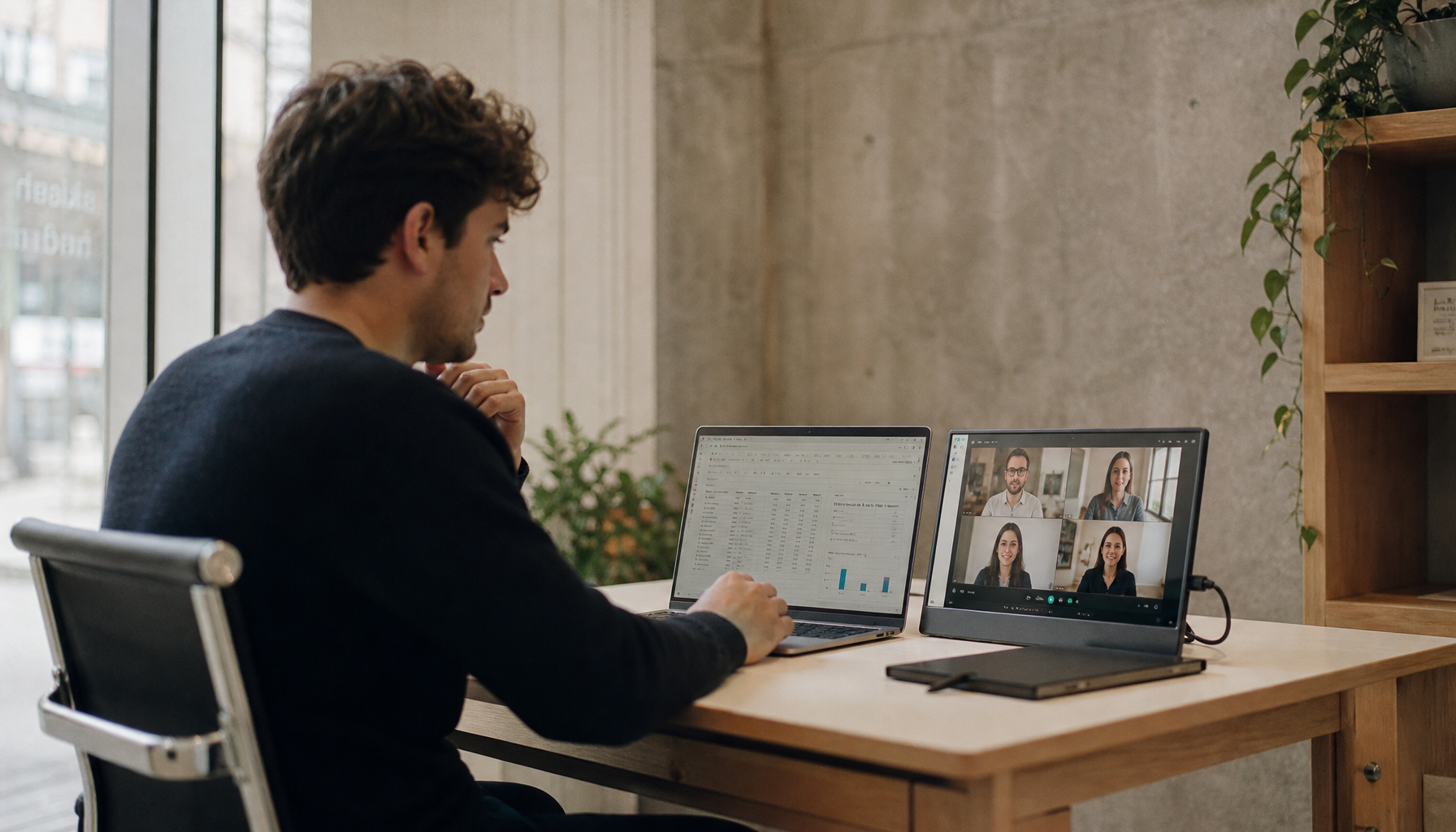
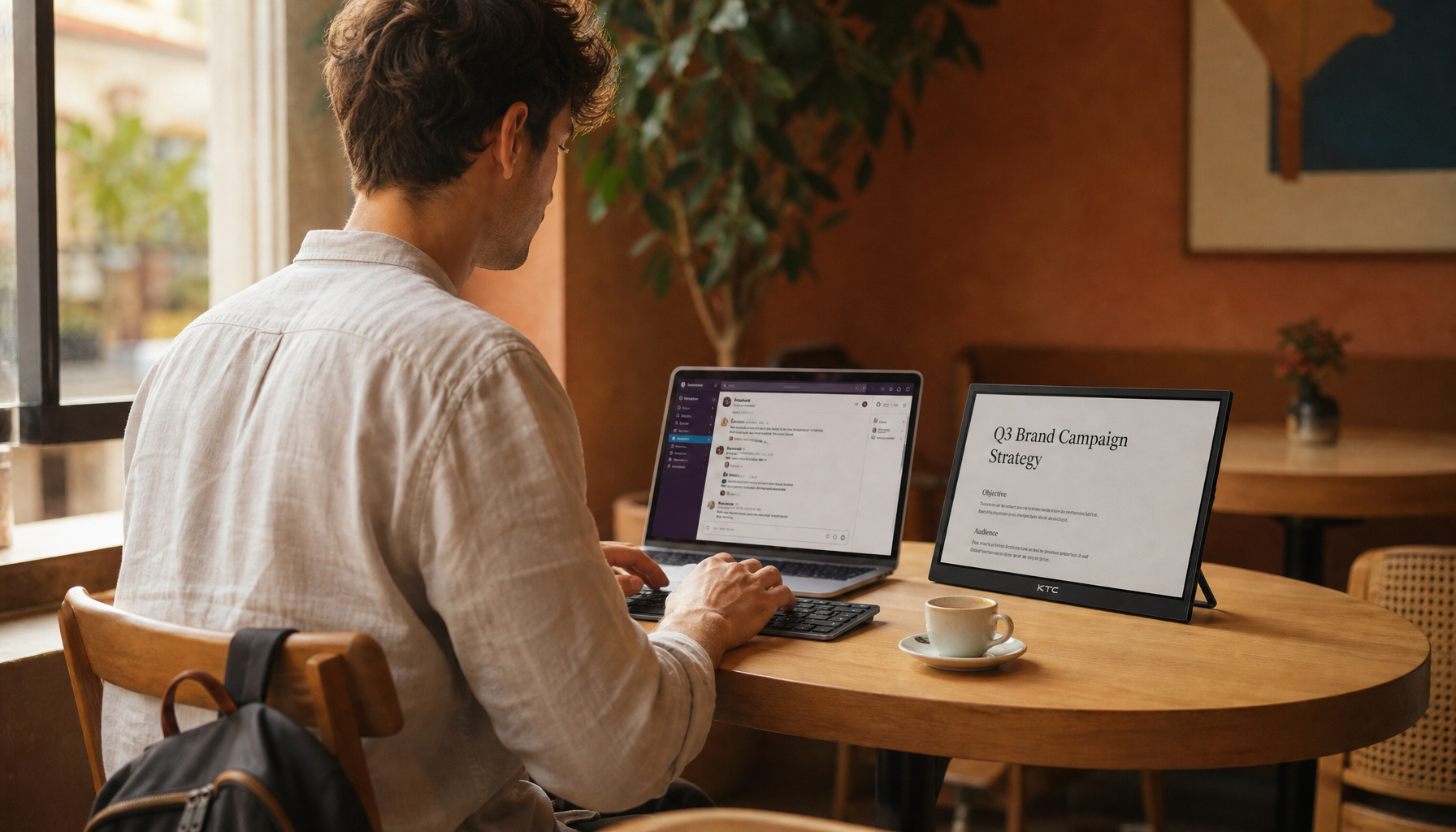
The strongest reason to add a portable display is not “more pixels” in the abstract. It is task separation. Keep your main task on the best screen, then use the portable monitor for reference material, chat, email, meeting notes, dashboards, or a preview window. Dual-monitor setups can improve workflow in roles that involve spreadsheets, coding, content work, and frequent multitasking because they reduce window switching.
In real use, that means a writer can keep the draft full-size on the laptop while source notes sit on the portable screen. A gamer who also works from the same desk can leave chat, stream controls, or performance monitoring off the main display. An office worker can keep a video call on the side display while the active document stays centered. The benefit is strongest when the portable monitor has a defined job.
Portability That a Full Monitor Cannot Match
For small apartments, portability is often more important than raw screen size. A 24- or 27-inch monitor may be better for full-time workstation comfort, but it also needs permanent desk depth, a stable stand or arm, and storage space if the desk is shared. A 14- to 16-inch portable display can be set up for work hours, then stored vertically in a drawer, shelf, or laptop sleeve.

This matters if your desk becomes a dinner table, craft surface, gaming station, or guest area after work. Portable monitors are designed as lightweight external displays that connect by USB-C or HDMI, so they fit the apartment reality better than many traditional displays. The trade-off is that you must rebuild the workstation each time unless your cable routing and stand placement are simple.
A Lower-Cost Upgrade Path
A portable monitor can also be the value play. It gives you a second screen without replacing a good laptop or buying a large monitor, arm, dock, and new desk. Portable monitor options range widely, but the practical buying filter should stay focused on size, resolution, inputs, brightness, weight, stand design, warranty, and whether sustainability claims apply to the exact product listing.
The caution is quality variance. A cheap screen with a weak stand, low brightness, poor contrast, or awkward cable placement can cost less up front and still feel worse every day. For productivity, a stable stand and readable panel often matter more than a headline spec.
What You Give Up on a Small Desk
Keyboard and Mouse Comfort
The first casualty is usually input comfort. If the monitor pushes your laptop or keyboard off-center, your wrists and shoulders will compensate. Small desk ergonomics emphasizes keeping posture natural, with arms around a 90-degree angle and the eyes aligned near the upper part of the screen area.
A compact keyboard and stationary pointing device can recover space. A 60% or 65% keyboard leaves more room for the mouse, while a trackball stays planted instead of sweeping across the desk. If your portable monitor forces you to use the laptop keyboard at an angle, the setup is not optimized; it is only expanded.
Viewing Distance and Neck Rotation
A second screen that is too far to the side creates neck rotation. For a small workspace, the primary screen should sit directly in front of you, while the portable monitor should sit slightly angled rather than flat and wide. Office monitor sizing guidance points to arm’s-length viewing and top-third screen alignment as key ergonomic principles, with dual setups arranged to reduce awkward turning.
The practical test is simple. Sit normally, look at your main screen, then glance to the portable display. If your chin has to travel far past your shoulder line, the screen is too wide, too flat, or too low. Portrait orientation can help because it narrows the footprint while keeping useful vertical space for documents, chat, terminals, or notes.
Cable and Power Clutter
Portable monitors look minimal in product photos because the cable path is often hidden. In a real apartment workspace, one USB-C cable can become two cables if your laptop does not support video output and power over the same port. HDMI usually handles video only, so the display may still need USB power.

USB-C connectivity can reduce clutter when the monitor supports video, power, or hub functions, but the laptop and cable must support the right mode. That detail is decision-critical. A USB-C-shaped port is not automatically a display port, and a charging cable is not automatically a video cable. Before buying, confirm DisplayPort Alt Mode or the manufacturer’s exact compatibility notes for your laptop.
Choosing the Right Size for a Small Apartment Desk
The sweet spot is usually 14 to 16 inches. A 14-inch display is easier to position beside a laptop and store after work. A 15.6-inch display gives more comfortable document and spreadsheet space without becoming furniture. A 16-inch 16:10 screen is especially useful because the extra vertical room fits more rows, paragraphs, and toolbars.
An 18-inch portable monitor can be excellent if you sit farther back or need larger text, but it starts behaving more like a small desktop monitor. It asks for more width, a sturdier stand, and better cable discipline. For many apartment desks, it is the point where “portable” still describes storage, but no longer describes desk behavior.
Setup Choice |
Space Trade-Off |
Best Fit |
14-inch portable monitor |
Smallest footprint, less room for dense windows |
Tight desks, travel, video calls, chat, notes |
15.6-inch portable monitor |
Balanced size, moderate stand depth |
Most laptop-based apartment workstations |
16-inch 16:10 portable monitor |
More vertical workspace, slightly larger body |
Documents, spreadsheets, coding, writing |
18-inch portable monitor |
Better readability, noticeably more desk demand |
Deeper desks, gaming, side-by-side review |
24-inch desktop monitor |
Stronger comfort, permanent footprint |
Dedicated apartment office corner |
Resolution, Brightness, and Refresh Rate Without Spec Chasing
For office work, 1080p is the baseline, especially at 14 to 15.6 inches. Text can be readable, hardware demands stay low, and cost stays controlled. A 2K or 2560 x 1600 portable display is better when you want sharper text or more vertical workspace, but it may require scaling to avoid tiny interface elements. Home office monitor guidance recommends 15.6-inch 1080p as a practical baseline and 16-inch 2560 x 1600 as a stronger productivity format.
Brightness matters more than many buyers expect. If your apartment desk sits near a window, a dim panel can look washed out even if the resolution is fine. Around 300 nits is a practical target for bright rooms, while matte anti-glare surfaces help control reflections.
Refresh rate depends on use. For documents, email, and dashboards, 60Hz is usually enough. For gaming or fast scrolling, 120Hz or higher can feel smoother, but it only pays off if your laptop, cable, and game performance can feed those frames. Portable monitor testing separates gaming needs from productivity needs, so do not pay for esports-grade refresh if the display will mostly hold chat and PDFs.
The Best Physical Layouts
Side-by-Side for Daily Productivity
The side-by-side layout is the most familiar. Put the main screen directly in front of you and the portable display on the side you glance toward most naturally. Angle the portable monitor inward so the screen faces your seated position, not the room. This keeps the second display useful without forcing your torso to rotate.
If your laptop is the main screen, raise it on a stand and use an external keyboard and mouse. Deskless workstation advice favors a raised screen, compact input devices, and a simple connection plan on stable surfaces such as dining tables or folding tables. That applies just as well to apartment desks.
Portrait Mode for Narrow Desks
Portrait orientation is the apartment power move. It reduces horizontal footprint while making the display excellent for documents, messaging, code, calendars, and research notes. A 16-inch portable screen in portrait can feel like a digital sheet of paper beside your main display.

The trade-off is stand quality. Many smart-cover stands are tolerable in landscape and awkward in portrait. If portrait mode is part of the plan, prioritize a built-in kickstand, VESA compatibility, or a stable tablet-style stand that does not slide when you type.
Stored Setup for Shared Spaces
If the workspace has to disappear at night, build a repeatable kit. Keep the monitor, correct USB-C video cable, charger if needed, compact keyboard, mouse, and stand together. The goal is a two-minute setup, not a daily cable puzzle.
Minimal desk setup principles are especially useful here: keep daily-use items on the desk and move everything else to drawers, shelves, pegboards, or side storage. In a small apartment, the best second screen is the one you can deploy without negotiating with clutter.
When a Portable Monitor Is the Wrong Trade
A portable monitor is not always the best answer. If you work eight or more hours daily at the same dedicated desk, a 24- to 27-inch monitor on an arm may deliver better comfort, larger readable workspace, and cleaner cable routing. Choose by task, workspace, workflow, ergonomics, eye care, and connectivity rather than assuming one format fits everyone.
It is also the wrong upgrade if your desk is already too shallow. If the portable display sits closer than a comfortable reading distance, you may gain pixels but lose focus and posture. A monitor arm, laptop riser, clamp lamp, or smaller keyboard may need to come first.
The same is true for creative work. A basic 1080p portable monitor is fine for timelines, tools, references, and preview windows, but color-critical editing needs stronger brightness, contrast, color accuracy, and calibration. If the portable display becomes your judging screen for color, buy accordingly or keep final review on a better-calibrated monitor.
Practical Buying Checklist in Prose
Start with the desk, not the catalog. Measure the width and depth you can actually use after leaving room for your keyboard, mouse, and arms. Then decide whether the monitor will live beside the laptop, above it, or in portrait. If the answer is “wherever it fits,” the setup will probably feel messy.
Choose 14 inches for the tightest desks, 15.6 inches for the safest all-around productivity balance, and 16 inches with a 16:10 aspect ratio if documents, spreadsheets, and coding matter. Move to 18 inches only when you have enough width and viewing distance.
Prioritize USB-C video compatibility, a stable stand, matte finish, readable brightness, and a protective cover. Treat touch, 4K, ultra-high refresh, speakers, and dual-screen clip-on designs as specialized features. They can be useful, but they should solve a specific workflow problem rather than decorate the spec sheet.
FAQ
Is a portable monitor better than a full-size monitor for a small apartment?
A portable monitor is better when the desk is shared, the setup must be stored, or you work from more than one location. A full-size monitor is better when you have a dedicated workstation and want stronger long-session comfort.
Should the portable monitor go on the left or right?
Place it on the side that matches your workflow. If you reference material while writing, put the reference screen on your dominant glance side. If you use a mouse heavily, avoid placing the portable monitor where it compresses your mouse space.
Is one USB-C cable always enough?
No. One-cable operation depends on the laptop port, monitor, and cable all supporting video and power needs. Confirm USB-C DisplayPort Alt Mode for video, and check whether the monitor needs separate power under higher brightness.
Closing Thought
A portable monitor is worth the desk space when it removes more friction than it creates. In a small apartment, the winning setup is compact, repeatable, and posture-aware: one clear main screen, one purposeful secondary screen, clean cables, and enough open surface to keep your hands moving naturally.