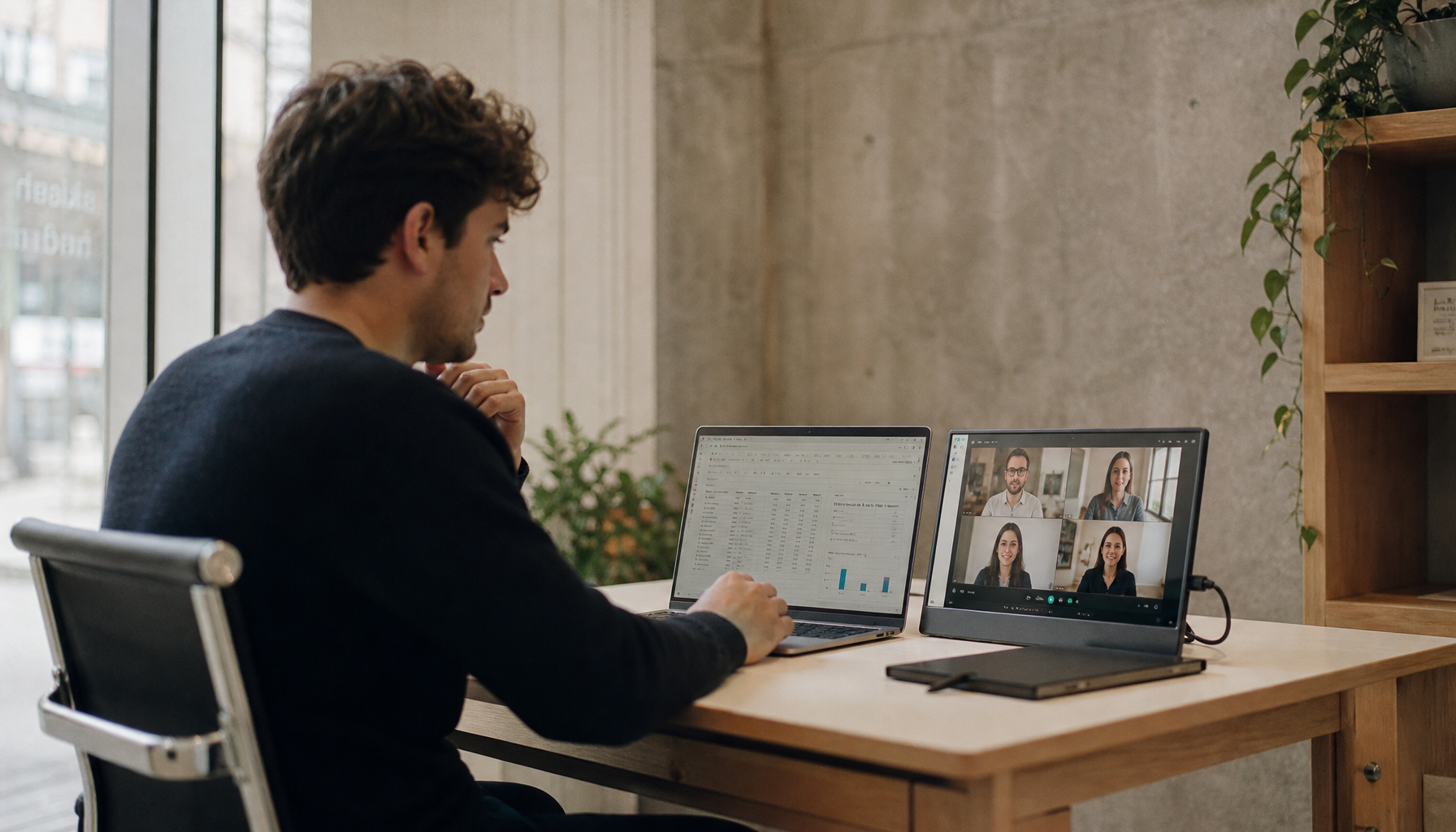
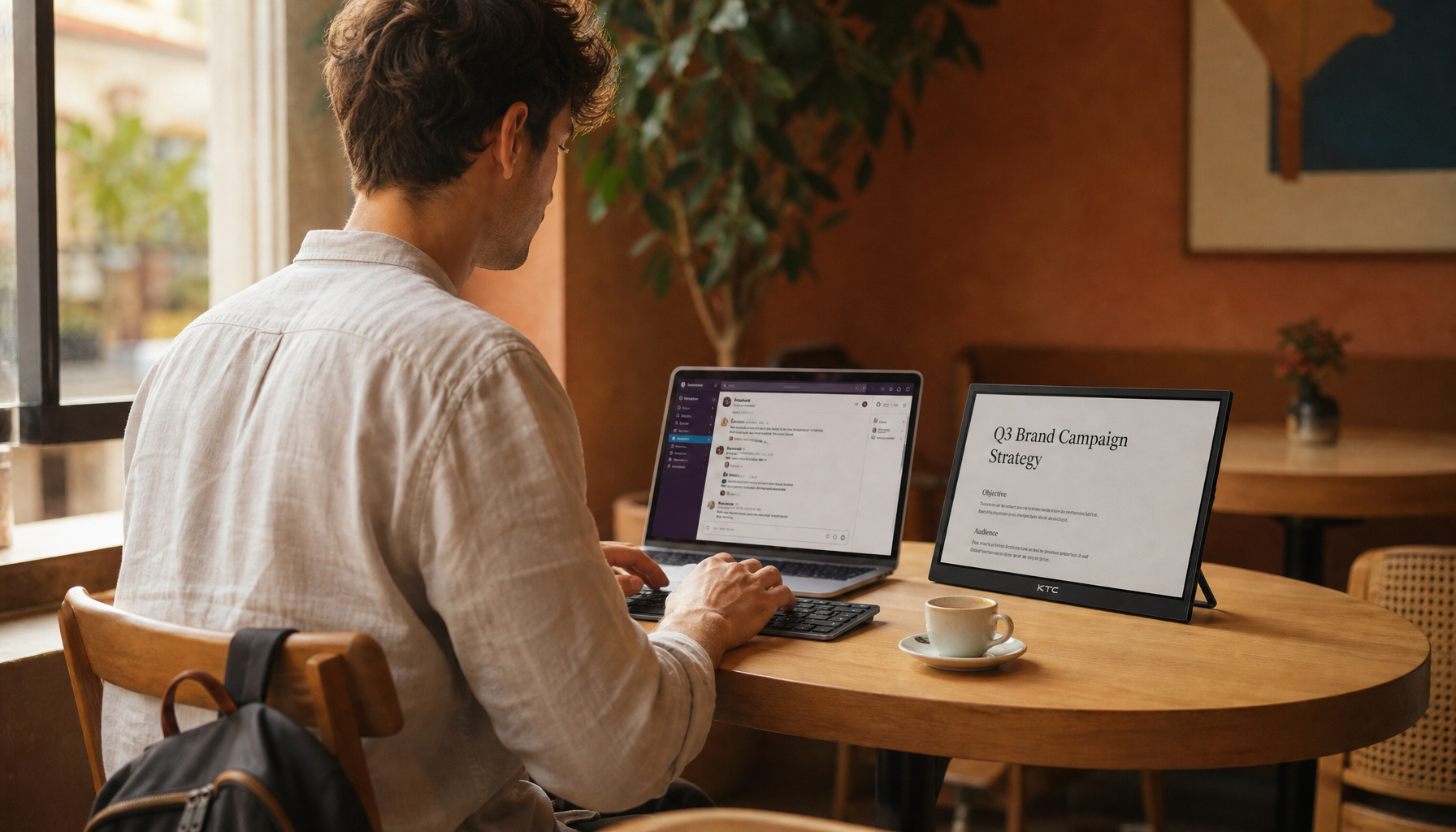
Monitor height affects comfortable viewing distance because it changes your neck angle, eye angle, and how much of the screen fits into relaxed vision. Start with the top of the display at or slightly below eye level, place the monitor about 20 to 30 inches away, and adjust from there.
Is your neck tight after a long ranked session, a spreadsheet-heavy workday, or editing on a large 4K display? A simple height-and-distance reset can make text easier to read without leaning forward, keep your head neutral, and reduce the urge to chase the screen with your shoulders. You’ll learn how to set monitor height, distance, and tilt together so your display feels sharper, steadier, and less tiring.
Why Monitor Height Changes Viewing Distance
Monitor height and viewing distance are linked because your eyes do not work in isolation. If the screen is too high, you tend to lift your chin or lean back; if it is too low, you may drop your head or slump forward. Either mistake changes the real distance between your eyes and the panel, even if the monitor stand never moves.

A well-placed display supports a relaxed downward gaze. A monitor positioned too high can force the head backward and strain the back muscles, which is why height should be set before you fine-tune distance. In practical terms, a screen that is technically 28 inches away may still feel too close if it is high enough to make your eyes open wider and your neck extend upward.
For most users, the useful starting point is simple: sit in your normal working posture, keep your head balanced over your shoulders, and place the top of the visible screen at or slightly below eye level. Then move the display back until you can read normal interface text without squinting, leaning, or enlarging everything beyond your preferred scale.
The Comfortable Viewing Distance Baseline
Comfortable viewing distance is the eye-to-screen distance where you can read, track motion, and scan the full display without forward head posture or excessive eye effort. For a typical office or gaming monitor, that lands around arm’s length, usually 20 to 30 inches.
Placing the monitor directly in front of the user at about arm’s length, with the top of the screen at or slightly below eye level, is a practical baseline. In everyday setup terms, sit back in your chair, extend your arm, and check whether your fingertips land near the screen. If you have to lean to touch it, the screen may be too far; if your palm hits it with a bent elbow, it may be too close.

The best distance also depends on screen size and resolution. A 24-inch 1080p display may feel readable at roughly 22 to 24 inches. A 27-inch 1440p or 4K monitor often feels better around 25 to 30 inches because the larger panel fills more of your field of view. A 32-inch productivity or creative display may need even more desk depth, especially if you want to see the corners without turning your head.
The Height Rule That Works for Most People
The most reliable rule is to align the top edge, or the top third on larger displays, at or slightly below eye level. This puts the center of the screen below straight-ahead vision, matching the eyes’ natural preference for a slight downward gaze.
Monitors around arm’s length away, with the top of the screen approximately at eye level, support that posture. That combination matters because height alone does not solve comfort. A perfect vertical position can still feel wrong if the screen is close enough to dominate your vision or far enough to make you crane forward.
For a real-world example, imagine a 27-inch monitor on a shallow desk. If you raise it until the center of the screen is at eye level, the top may sit too high, pushing your gaze upward when checking browser tabs, toolbars, or game HUD elements. Lowering the display so your eyes land near the address bar or top third usually lets the screen sit farther back without feeling visually demanding.
Why Center at Eye Level Can Backfire
Centering the screen at eye level sounds clean, but it can be uncomfortable on taller displays. It often places the upper half of the panel above your natural gaze, which encourages chin lift and upward eye movement. That is especially noticeable on 27-inch, 32-inch, ultrawide, and portrait monitors.
The discussion around top-edge versus center placement highlights a useful practical point: many people find a slightly downward gaze less fatiguing than looking upward. While forum experience is not the same as controlled lab evidence, it matches mainstream ergonomic guidance and is especially relevant for users with dry eyes, light sensitivity, or neck-driven headaches.
The tradeoff is that a very low monitor can create its own problem. If the screen drops enough that you bend your neck to read the lower half, distance stops helping. You may push the monitor farther away, but the posture remains poor. The winning setup keeps your head neutral while your eyes do most of the small vertical movement.
Height, Distance, and Tilt Should Be Adjusted Together
Monitor tilt is the overlooked third control. A display that is the right height and distance can still create glare or poor contrast if the panel faces the wrong angle. A slight backward tilt often helps the screen meet your downward gaze more naturally, especially on larger monitors.
An arm’s-length distance and a slight backward tilt can work well when the display stays at or below eye level. In practice, adjust in this order: set your chair and posture first, set monitor height second, move the screen forward or back third, then tilt only enough to reduce glare and keep the image even.
Here is a compact way to choose your starting point.

Setup Type |
Height Target |
Distance Starting Point |
Practical Adjustment |
24-inch office monitor |
Top edge near eye level |
20 to 24 inches |
Increase text size before moving closer |
27-inch gaming or productivity monitor |
Top edge slightly below eye level |
25 to 30 inches |
Keep the main action or document centered |
32-inch creative display |
Top third near eye level |
28 to 34 inches |
Use deeper desk space if corners require head turns |
34-inch or larger ultrawide |
Primary task area near eye level |
31 to 39 inches |
Center the active window, not always the whole panel |
Laptop on desk |
Screen raised near eye level |
Arm’s length if possible |
Use an external keyboard and mouse |
Large, Ultrawide, and Multi-Monitor Setups
Bigger screens change the comfort equation because the issue becomes viewing angle, not just distance. If a monitor is wide enough that the edges sit outside your relaxed field of view, moving it farther back can reduce head rotation. But if the screen is also too high, you simply trade side-to-side strain for upward neck strain.
For ultrawide displays, the smartest move is to place the primary task area directly in front of you. Longer viewing distances are often recommended for 34-inch and larger monitors, along with keeping the main work zone centered. That matters for competitive gaming, video timelines, code editors, and financial dashboards because your highest-focus content should sit where your eyes and neck are strongest.
Dual monitors follow the same logic. If one screen is primary, put it straight ahead and place the secondary screen at a slight angle. If both are used equally, bring them together in a shallow V so the center gap lines up with your body. The goal is not symmetry for its own sake; it is reducing repeated neck rotation across thousands of small glances.

Special Cases: Glasses, Laptops, and Standing Desks
Progressive lenses and bifocals often require a lower monitor position. If the display is too high, users may tilt the head back to look through the correct lens zone, which can turn an otherwise good distance into a neck-strain setup. Lowering the screen slightly and adding a modest backward tilt usually works better than moving the monitor closer.
Laptop users face a different constraint because the keyboard and screen are attached. If the laptop sits low enough for comfortable typing, the screen is usually too low for comfortable viewing. The clean fix is to raise the laptop screen and use a separate keyboard and mouse, which lets viewing distance and typing posture stop fighting each other.
Standing desks need a repeatable height solution. If your monitor is perfect while seated but too low when standing, you will lean down into the screen. A monitor arm or height-adjustable riser is not a luxury in that setup; it is the hardware that keeps distance consistent between modes.

Pros and Cons of Higher vs. Lower Placement
A slightly higher monitor can feel immersive for gaming and media because the screen fills your forward view. The downside is that too much height encourages chin lift, wider eye opening, and neck extension, especially during long sessions.
A slightly lower monitor supports reading, coding, writing, and browsing because it follows the natural downward gaze. The downside is that going too low can pull your head forward and compress the posture you were trying to protect.
The performance-minded compromise is to keep the top edge or top third near eye level, then tune distance for the task. For fast gaming, you may prefer the screen a little closer, around 18 to 24 inches on a smaller panel. For office productivity and creative work, 24 to 30 inches or more often gives better scanning comfort and fewer posture corrections.
A Quick Setup Check You Can Do Today
Sit back with your feet supported, shoulders relaxed, and elbows near a comfortable working angle. Without moving your head, look straight ahead, then let your eyes drop slightly. Your gaze should land near the top third of the display, not above it and not near the bottom.
Next, read typical text at your normal zoom level. If you lean forward, first increase text size or scaling before pulling the monitor closer. If you feel swallowed by the screen or need to turn your head to check corners, move the monitor back if your desk allows it. If glare makes you tilt your head, adjust lighting and panel angle before changing the height.
Finally, use breaks as part of the system. Stanford’s 20-20-20 recommendation is a practical reset: every 20 minutes, look 20 feet away for 20 seconds. Even a perfectly placed display benefits from eye movement, posture changes, and short visual resets.
FAQ
Should the top of my monitor be exactly at eye level?
Exact alignment is less important than posture. For most people, the top edge should be at or slightly below eye level, while the area you use most should sit comfortably in a slight downward gaze.
Does sitting farther away mean I should raise the monitor?
Not usually. Moving farther back changes how much of the screen fits in view, but it does not make upward viewing more comfortable. Keep the height based on your neutral head position, then adjust distance for readability and screen size.
Is a monitor arm worth it?
A monitor arm is worth it when your built-in stand cannot reach the right height, your desk is shallow, you switch between sitting and standing, or you use multiple displays. The value is not just a cleaner desk; it is faster, more precise control over height, distance, and tilt.
Comfortable viewing distance is not a single measurement printed on a spec sheet. It is the result of height, distance, tilt, screen size, and your main task working together. Set the screen low enough for a relaxed downward gaze, far enough to see without leaning, and centered on the work that matters most; that is where display performance starts feeling effortless.