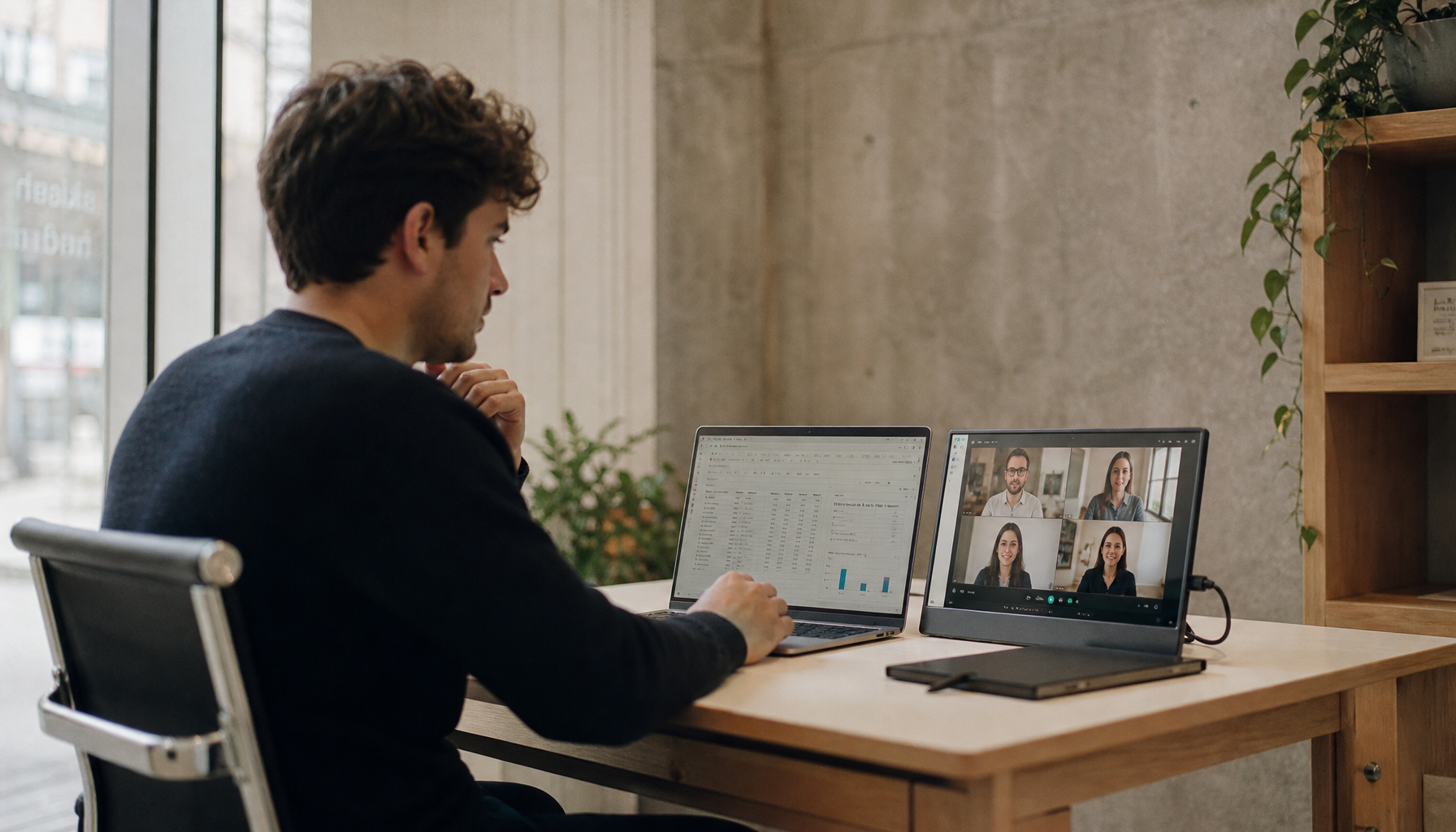
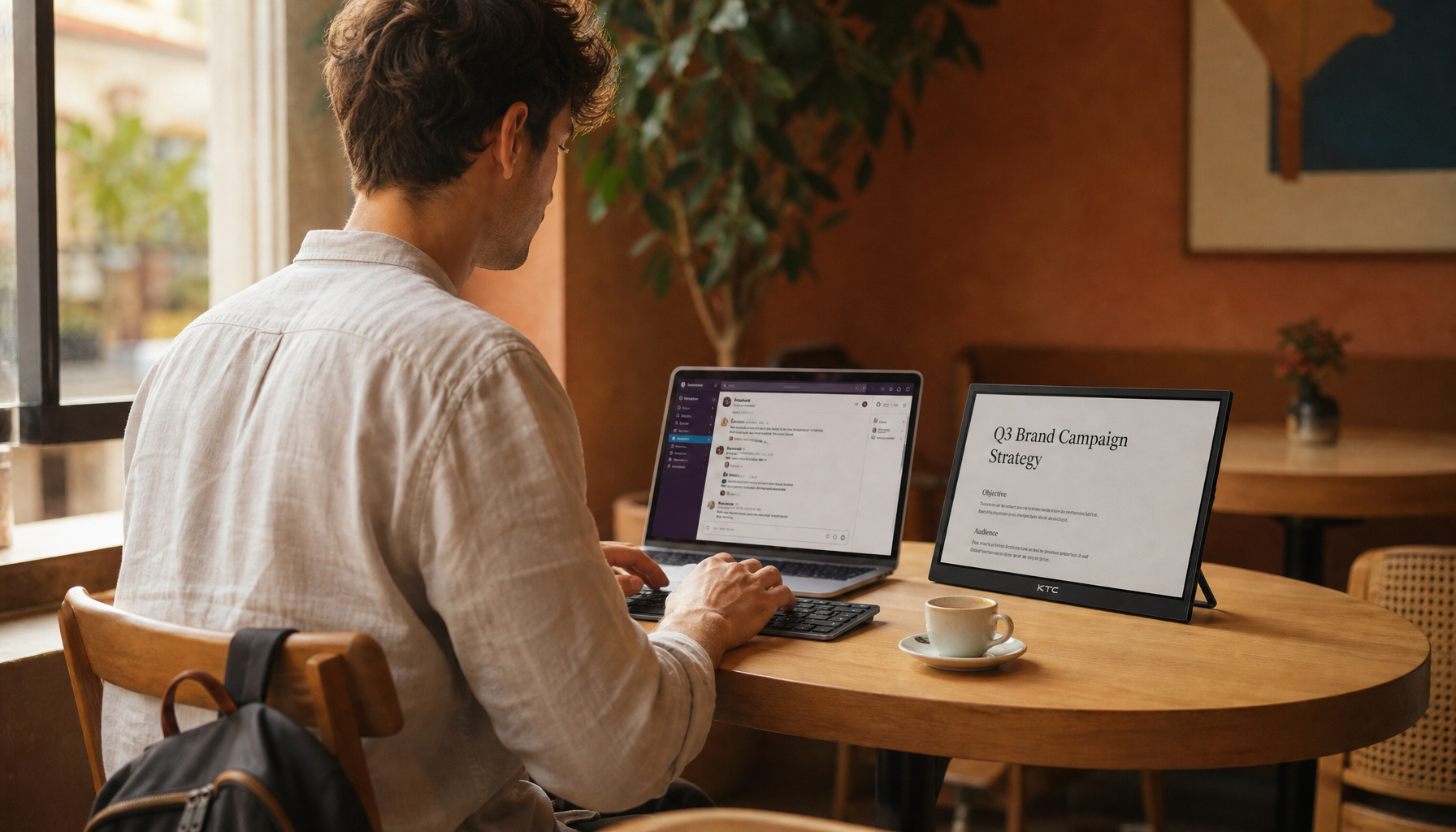
A rolling MegPad improves mobile podcasting setup 2026 when your show moves between rooms, guest setups, and livestream roles, because it keeps prompts and controls close without forcing a fixed desk layout. It is not a magic quality upgrade, though. The real win is less room rebuilding, cleaner eye contact, and faster transitions between interview, solo, and live-control modes.

Why a Rolling Monitor Changes the Workflow
For most creators, the value is convenience and control, not a visible jump in audio or video quality. A rolling display can stay near the camera, guest, or mixer, so you spend less time re-aiming the room before each episode. That matters most when the same space has to serve as interview set, teleprompter station, and control surface.
A mobile touch screen is most useful when your setup changes often, but it is less compelling if your desk is already fixed, tidy, and dedicated to one role. If you rarely move between rooms or switch formats, a standard monitor may still be the simpler choice.
A good decision rule is this: if room changes are happening every week, rolling mobility can save real friction; if your workflow is already locked in, the extra complexity may not pay off. The display should make the host position easier to manage, not become another piece of gear that needs constant adjustment.
Set Up the Rolling Guest Monitor
For guest monitoring, place the screen where talent can see prompts or shared visuals without leaning into the frame. That keeps the conversation looking natural on camera and helps the host preserve a clean eye line. Placing a screen near the camera line helps the host maintain natural eye contact while viewing guests, notes, or prompts. In practice, the best spot is usually close enough to read quickly, but not so close that the display becomes a visual obstacle.

A useful pre-live check is whether the guest can read the screen from their actual seat. If they have to twist, squint, or shift position, the setup is probably not helping the interview flow. In small rooms, that often means using the display as a side anchor instead of forcing it into the center of the shot.
When you work in client spaces or co-working studios, the rolling base also reduces how much you have to ask for permanent desk access. That makes the setup easier to deploy, but it still needs a stability check on the floor you will actually use.
Use It as a Rolling Teleprompter
A rolling display works best as a teleprompter when the script stays close enough to read naturally, but not so close that your eyes dart around the screen. Short bullets usually beat full paragraphs for intros, sponsor reads, and transitions, because they are easier to glance at without sounding locked to a page. Short bullet notes often work better than full paragraphs for podcast intros, sponsor reads, and segment transitions.
The MegPad for 2026 Remote Presenters: The Rolling Teleprompter angle is strongest when you need one screen to move between script, outline, and live chat during the same session. That is especially handy for creators who shift from interview mode to solo mode without wanting to swap devices.
For eye contact, the practical trick is simple: keep the reading surface near the camera line, then test whether your gaze looks natural on a short rehearsal clip. If the host looks like they are reading at the floor or scanning side to side, move the display before going live.
Run Session Control Without Staying Tethered
A rolling hub is most valuable when it keeps the DAW, chat, guest tiles, and camera controls visible in one place. That does not mean you need a complex command center. In many creator setups, simple split views and quick app switching are enough.
The The AI Command Center: Using Rolling Smart Displays for Real-Time LLM Monitoring article is a useful follow-up if you want a broader look at rolling-display control workflows beyond podcasting. For this use case, the main question is whether you can keep the controls reachable without returning to a desk mid-session.
This setup breaks down if it creates more task juggling than it removes. If you are constantly switching apps, hunting for cables, or re-centering the display, the workflow is too busy for live use. A rolling hub should reduce motion, not add a new kind of setup tax.
Pick the Right MegPad Size
The size choice flips based on how much you value portability versus screen space. Smaller models are easier to move and stage, while larger ones are better when you want a wider control surface for notes, chat, and multi-panel layouts.
| Model | Best Fit | Strength | Trade-Off |
|---|---|---|---|
| 25-inch | Compact host setup | Built-in camera and lighter footprint | Less canvas for multi-panel control |
| 27-inch | Rolling interview and livestream setup | Built-in wheels, 9500mAh battery, up to about 6 hours of runtime | FHD rather than 4K |
| 32-inch | Semi-permanent control room | 4K panel, height/tilt/rotate adjustment, rolling stand | Bigger and less travel-friendly |
The KTC MEGAPAD 25" FHD Google EDLA Portable Touch Monitor built in Camera is the most compact option if you want a built-in camera and the lightest room footprint. The KTC MEGAPAD 27" FHD Android 14 Google EDLA Smart Touch Monitor with 9500mAh Battery is the easiest middle ground for moving between rooms. The KTC MEGAPAD 32" 4K Android 14 Google EDLA Smart Touch Monitor with 8550mAh Battery fits better when the display needs to act more like a control center than a portable prop.
A practical boundary is this: if you need maximum mobility, start with the 25-inch or 27-inch models; if you care more about a larger working canvas and less about moving the device often, the 32-inch model makes more sense. The collection view on Mobile Touch Screen collection is the easiest place to compare the range side by side. Compare options in the Smart Monitor collection or Featured Product collection for additional workflows.
Final Checks Before Going Live
Before a live session, check the base on the actual floor surface. Carpet, thresholds, and uneven floors can change how stable the unit feels. Then confirm cable slack, power access, brightness, and app layout. A short rehearsal is the best final filter. Test host eye contact, guest visibility, scene switching, and recovery if the display has to move a few feet during the session.
FAQs
Q1. How Does a Rolling Monitor Help With Eye Contact in Podcast Interviews?
A rolling monitor helps most when you can keep the screen close to the camera line, because that lets you see notes or a guest without staring far off-axis. The benefit is not automatic. You still need a quick rehearsal to find the spot where the host looks natural on camera.
Q2. What Makes a Mobile Display Better Than a Fixed Desk Monitor for Podcasting?
A mobile display is better when your room changes often, or when one screen needs to serve as guest monitor, teleprompter, and control hub. A fixed monitor is still fine for dedicated desks, simpler productions, and setups that rarely move. The best choice depends on how often you rebuild the room.
Q3. Can One Device Handle Guest Monitoring and Live Chat at the Same Time?
Yes, if the device supports simple split views or fast app switching and the layout stays readable. That said, multitasking only helps when it reduces friction. If switching between windows becomes distracting, it is better to simplify the workflow instead of adding more panels.
Q4. Why Does Screen Stability Matter on a Rolling Podcast Setup?
Stability matters because live sessions do not leave room for tipping, wobble, or repeated repositioning. Uneven floors, carpet, or thresholds can change how secure the base feels, so the safest habit is to test the setup on the exact surface you plan to record on.
Q5. What Should I Check Before Choosing the 25, 27, or 32-Inch MegPad?
Start with room size, how often you move the display, and whether the screen is mainly for guests, scripts, or control. Choose smaller if mobility matters most, choose larger if you need more workspace, and do not pick by screen size alone. The best model is the one that matches your actual recording routine.