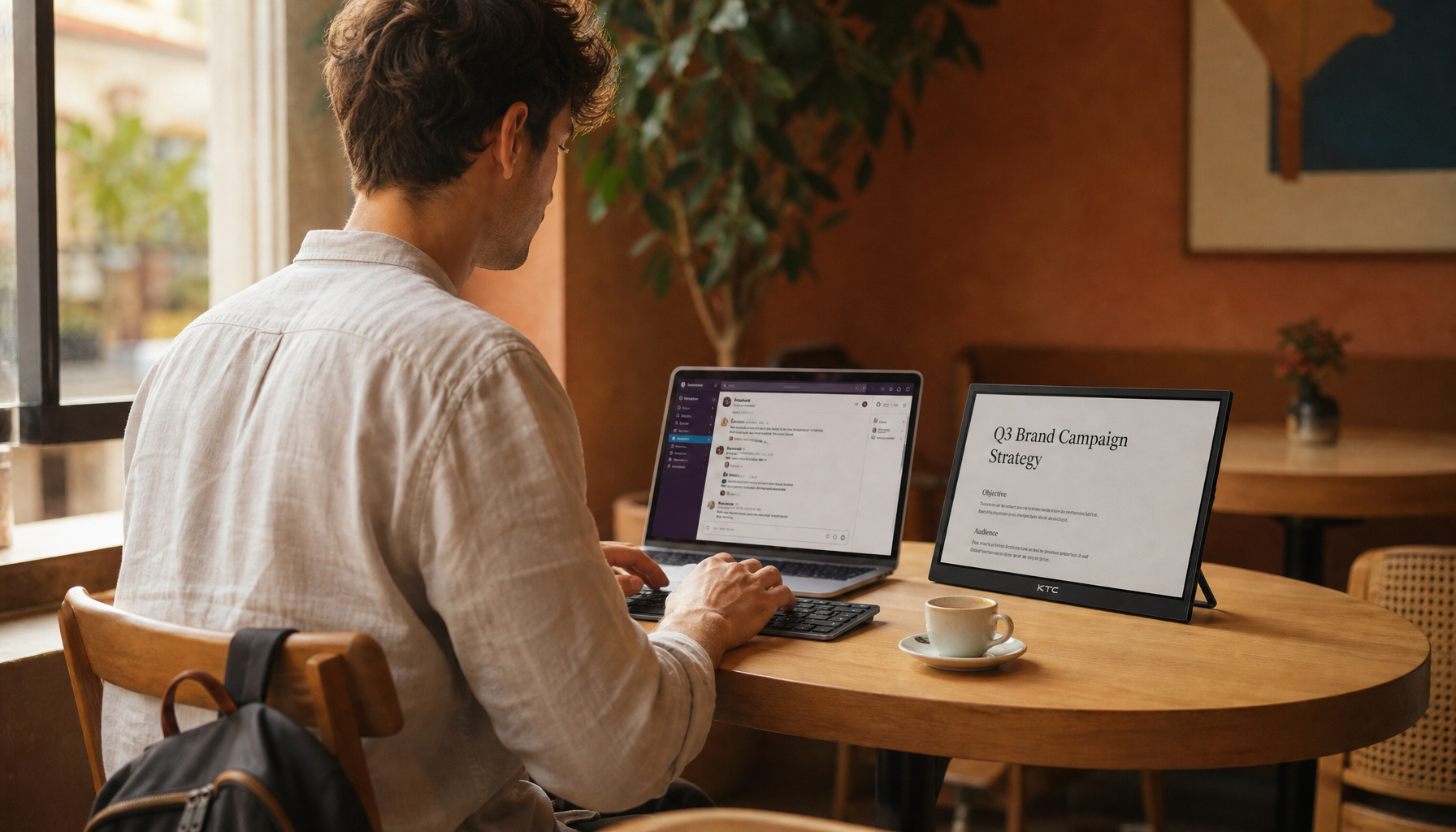
Put your highest-interaction work directly in front of you, then place monitoring, reference, and communication screens around it by urgency, viewing frequency, and neck comfort.
Is your desk full of screens, but your eyes still keep hunting for the one window that matters? A well-arranged asymmetric setup can cut window switching, keep decision-critical data visible, and reduce the head-turning that makes long sessions feel slower than they should. Here is how to build a layout that matches real trading, design, and analysis work instead of forcing every task into a neat but inefficient grid.
What Asymmetric Tasks Demand From a Monitor Setup
Asymmetric work means your screens do not all carry equal importance. A trader may need execution and primary charts at center, while scanners, news, and risk panels live around the edges. A designer may need the canvas centered, with layers, references, preview, and feedback nearby. A data analyst may need a dashboard, spreadsheet, SQL tool, documentation, and chat, but not all at the same visual priority.
That is why the best arrangement starts with function, not monitor count. A multi-monitor trading setup works because charts, news, scanners, watchlists, order books, and execution tools can stay visible at once; the same principle applies to data dashboards or creative software. The goal is not more screens. The goal is fewer interruptions between seeing, deciding, and acting.
Start With the Primary Screen, Then Build the Periphery
Your primary display should sit directly in front of your chair, keyboard, and mouse. This is where your active decision work belongs: order entry for trading, the artboard for design, the main workbook, or the BI dashboard for analysis. If the most important screen is off to one side, your posture will eventually reflect it.

For most professional setups, a 27-inch QHD or 4K display is the practical center point. A 27-inch monitor gives about 26% more screen area than a 24-inch display, enough to make side-by-side panels feel less cramped without overwhelming a normal desk. If your work is highly visual, 4K becomes more compelling because 4K resolution has more than twice the pixel count of 1440p and gives sharper text, finer image detail, and more room for dense interfaces.
For a trading example, put active charts and order execution on the centered screen. For design, put the canvas or timeline there. For analysis, put the live dashboard, spreadsheet model, or query result window there. Everything else should support that main decision surface.
Choose Side-by-Side, Stacked, or Hybrid Based on Eye Movement
Side-by-side monitors feel natural when your work is wide. Spreadsheets, design comparisons, timelines, and paired documents benefit from a broad horizontal field. The tradeoff is head movement. If your side displays sit too far out, the setup becomes impressive to look at and tiring to use.
A stacked layout uses vertical space instead. It is especially useful when the desk is narrow or when secondary material can be glanced at rather than constantly manipulated. In a stacked monitor setup, the lower screen should carry the work you touch most, while the upper screen tilts downward for reference, monitoring, or lower-frequency information. That works well for trading scanners, system logs, video-call windows, documentation, preview panels, or alert dashboards.

A hybrid setup is often best for asymmetric professionals. Place a large primary screen in the center, one angled side monitor for active support, and one upper monitor for passive monitoring. This creates a visual hierarchy: center for action, side for context, top for awareness.
Layout |
Best For |
Strength |
Caution |
Side-by-side |
Design comparison, spreadsheets, coding, office work |
Natural horizontal workspace |
Can cause repeated neck rotation |
Stacked |
Trading dashboards, monitoring, small desks, reference-heavy work |
Saves desk width |
Top screen must tilt down |
Hybrid |
Trading, analytics, creator workflows |
Matches mixed urgency levels |
Requires careful mounting and cable planning |
Ultrawide plus portrait |
Writing, design, research, mixed work and gaming |
Strong center focus plus reference column |
Window management matters |
Arrange by Frequency, Urgency, and Interaction
A clean rule is to place windows by how often you touch them. Anything you click, type into, draw on, or trade from belongs in the center or just off-center. Anything you read often but rarely manipulate belongs on the nearest side monitor. Anything you only need to monitor can move higher, farther out, or into a smaller portable display.
For trading, the center screen should hold the live chart and execution platform. A side screen can carry watchlists, Level 2, or order flow. A top screen can show indexes, portfolio risk, or filtered news. Trading screen setups commonly use 2 x 2, 3 x 2, and wider formations, but the useful part is role assignment: each display earns its place by reducing hesitation.
For design, keep the canvas centered and put tool palettes on the dominant-hand side if your software supports it. References, asset folders, client notes, or preview windows can sit on the opposite side. If color accuracy matters, do not scatter final review across mismatched panels; use the best-calibrated display for proofing.
For data analysis, put the active workbook, SQL editor, or dashboard at center. Put source documentation and definitions to one side, communication or tickets to the other, and monitoring dashboards above. This keeps the analytical chain visible: question, data, output, validation.
Ergonomics Are a Performance Feature
Monitor placement is not just about comfort. A setup that forces constant side glances or upward staring slows you down because every decision includes a small physical tax. The best asymmetric desk keeps your head mostly forward and lets your eyes do more of the travel.
Secondary monitors should angle inward so their surfaces face you rather than the opposite wall. Creator-focused workstation guidance commonly recommends a 20- to 31-inch viewing distance, with side displays angled about 15 to 30 degrees inward. In practice, that means a 60-inch-wide desk can handle two or three 27-inch displays only if mounts pull them into a shallow arc rather than leaving them flat against a wall.
Height matters just as much. Your main monitor should have its top edge at or slightly below eye level. If you use a stacked screen, the upper display should tilt downward so you can glance up without lifting your chin. If text feels too small at the right distance, increase scaling or font size instead of dragging the screen closer and crowding your posture.
Mounts, Desk Depth, and Cable Control Decide Whether the Setup Lasts
A multi-monitor workstation fails when the hardware is treated as an afterthought. Heavy displays need arms or stands rated for their actual weight, and larger panels need enough height travel, tilt, and mounting compatibility. Most common monitor mounting patterns are about 3 x 3 inches or 4 x 4 inches, and mount capacity should be checked before buying, especially with 32-inch, ultrawide, or stacked displays.

For trading and data-heavy desks, modularity is valuable because workflows change. Modular multi-monitor mounting systems are built for side-by-side, stacked, curved, ultrawide, and custom formations, which matters when a two-screen desk becomes a four-screen desk after your process matures. A clamp or grommet arm also frees surface area for notebooks, controllers, tablets, and input devices.
Desk depth is the hidden constraint. A shallow desk pushes screens too close, which makes large panels feel aggressive and increases eye movement. For side-by-side or ultrawide work, a desk around 30 inches deep gives more flexibility. If the desk is narrower, stacked screens or monitor arms become more important than buying another panel.
Cable control also affects reliability. Multiple monitors mean more power, video, USB, and docking cables. Route them in groups, leave slack for height adjustment, and label both ends if the setup includes docks, KVMs, capture devices, or multiple computers. A clean cable path is not cosmetic; it makes troubleshooting faster when a screen drops out before a market open or client review.
Resolution, Size, and Panel Choices for Each Workflow
The right monitor is the one that matches what you inspect. Office and analysis users should prioritize text clarity, useful screen area, and connectivity. Creative users should add color accuracy, contrast, and resolution. Traders should prioritize stable mounting, enough ports, readable dashboards, and a system that can drive every display without lag.
Business monitor testing increasingly favors workflow-specific features such as ultrawide panels, single-cable power delivery, KVM switching, daisy chaining, webcams, and window-management tools. Those features matter more than raw size when your desk has a laptop, a desktop, a tablet, or multiple inputs sharing the same visual workspace.
QHD remains a strong value point for 27-inch secondary displays, especially for watchlists, code, browser tabs, and documents. 4K is better for the primary monitor when you need sharper text, image editing precision, or dense financial and analytical layouts. Ultrawide displays can replace two smaller monitors for some users, but they require disciplined window snapping; otherwise, they become one big surface full of floating clutter.
Common Mistakes That Make Asymmetric Setups Feel Worse
The first mistake is putting the bezel line in the center. If two monitors meet directly in front of your face, neither is truly primary, and your neck pays for the compromise. Center one display, then support it with the rest.
The second mistake is treating every monitor as equal. If email, chat, charts, and execution tools all compete for central space, the layout has no hierarchy. Assign each screen a job and remove windows that do not support that job.
The third mistake is buying more screens before fixing the mounting. A shaky four-monitor desk is worse than a stable dual-monitor setup. Dual monitor setup advice often emphasizes matching resolution, size, panel type, refresh rate, mounting support, and ports because inconsistencies in scaling, brightness, and motion become more annoying as screens multiply.
The fourth mistake is ignoring software layout. Use your operating system’s display settings to match the on-screen arrangement to the physical desk. Then use window snapping tools, virtual desktops, saved layouts, or monitor utilities so your screens return to their working positions after sleep, docking, or reboot.
A Practical Arrangement Blueprint
For a trader, start with a centered 27- to 32-inch primary screen for active charts and execution. Put watchlists and scanners on the left if you scan before acting, or on the right if you prefer the execution ladder closer to your dominant hand. Put news, indexes, risk, or portfolio overview above, tilted downward. If you grow to four displays, use a 2 x 2 layout only if the lower row remains the active row.
For a designer, center the highest-quality display and reserve it for the canvas, preview, or timeline. Put tools and layers on the side where your hand travels least awkwardly. Put reference boards, briefs, file browsers, and messaging on the opposite side or upper screen. If you use a pen display or tablet, give it a dedicated zone rather than squeezing it under monitor arms.

For a data analyst, center the main dashboard, notebook, spreadsheet, or query interface. Put documentation and data dictionaries on one side, output validation or BI preview on another, and low-frequency communications above or on a portable side screen. This setup keeps the logic path visible without letting chat steal the best pixels.
Final Word
A high-performance asymmetric monitor setup is a visual command system, not a screen collection. Put action in front, context beside it, awareness above it, and let every monitor justify its position by making decisions faster, clearer, and easier on your body.