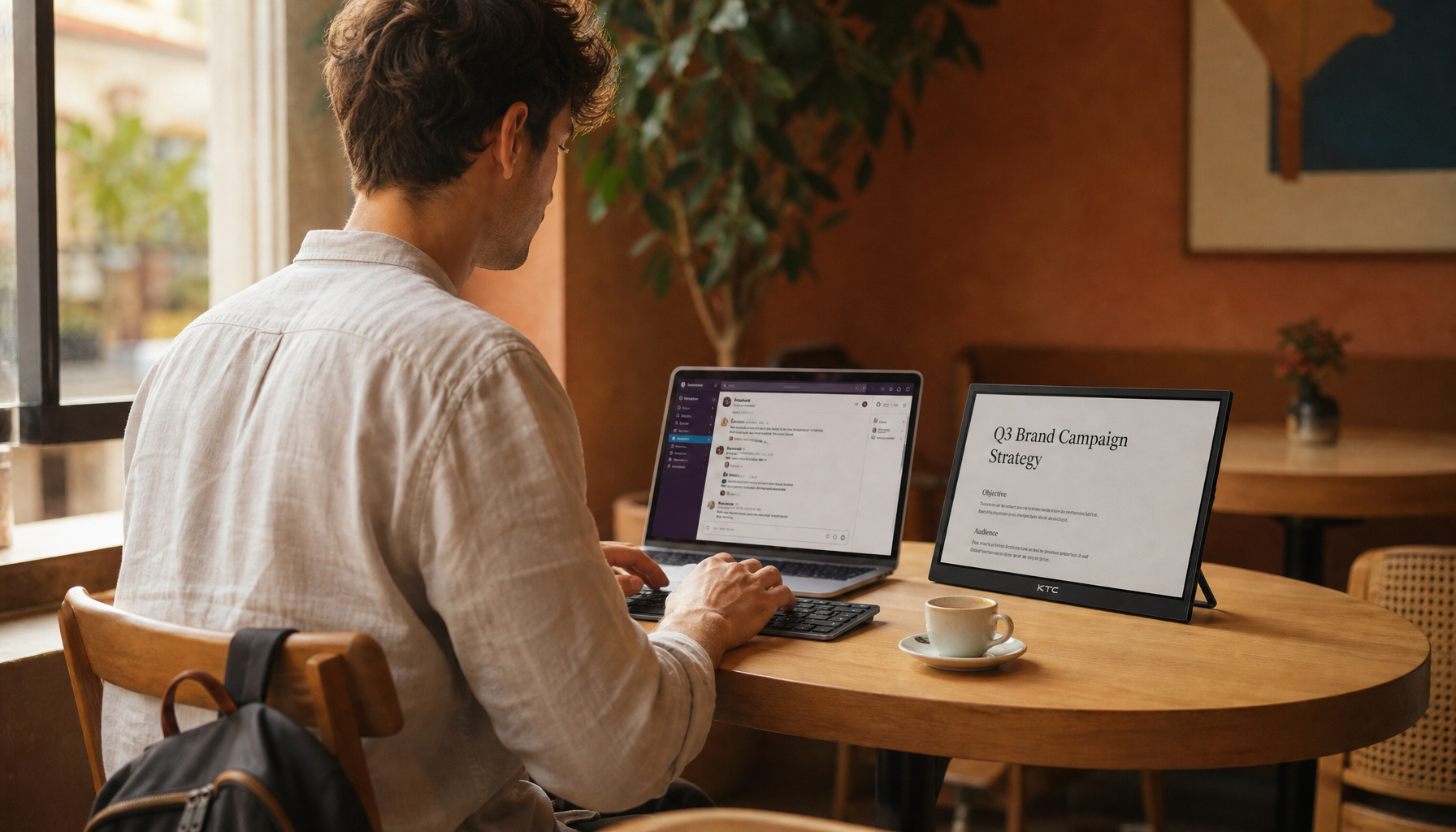
Using a laptop screen as a second display is not automatically harmful, but it often creates neck, shoulder, and eye-strain risks when the laptop sits low, close, or off to the side. For longer work sessions, a height-adjustable external monitor, portable monitor, or ultrawide display is usually easier to set up ergonomically.
Ever finish a workday with a stiff neck because your email, chat, or preview window lived on the laptop screen beside your main monitor? A few simple measurements, such as keeping screens about 20 to 40 inches from your eyes and aligning the top of the display near eye level, can turn a cramped dual-screen setup into a much more comfortable workstation. This guide explains when the laptop-as-second-screen setup works, when it creates risk, and what display upgrade makes the most sense.
Why a Laptop Screen Becomes an Ergonomic Problem
A laptop is a compromise by design: the screen and keyboard are attached, so one part is usually in the wrong place. If the laptop screen is raised to a comfortable viewing height, the built-in keyboard becomes too high for relaxed shoulders and wrists; if the keyboard is at a comfortable typing height, the screen is usually too low, creating the classic neck-bent laptop posture described in laptop design.
That tradeoff becomes more noticeable when the laptop screen is used as a secondary display next to a monitor. A typical desk setup might place a 27-inch monitor straight ahead and a 13- to 16-inch laptop off to the left or right. The monitor may sit at a decent height, but the laptop screen often sits several inches lower, forcing repeated downward glances, head rotation, and uneven viewing distance.

For short sessions, that may be acceptable. For a full workday, the problem is repetition: checking a messaging app, dashboards, code previews, spreadsheets, or reference documents hundreds of times can turn small posture faults into neck, shoulder, and eye fatigue. In monitor-buying terms, the issue is not only screen size or resolution; it is whether the display can be placed where your body can use it without strain.
The Main Risk Pattern
The risky pattern is simple: main monitor centered, laptop open beside it, laptop screen low, laptop keyboard unused, and the user twisting toward it every few minutes. That arrangement gives you more pixels, but it does not necessarily give you a better workstation.
A safer setup treats every active screen as part of the same visual field. Frequently used screens should be directly in front of you, while less-used secondary displays should sit to the side at a similar height and distance, because multiple monitors are easier on the body when the main display is centered and secondary screens do not require excessive neck movement.
The Biggest Ergonomic Risks: Neck, Eyes, Shoulders, and Desk Fit
Neck Flexion and Rotation
The most common issue is neck flexion: looking down at a laptop screen that sits below the main monitor. Ergonomic guidance generally favors placing the top of the monitor at or slightly below eye level, with the screen center below horizontal eye level rather than above it, because monitor choice and placement can affect awkward posture, fatigue, eye strain, and neck or back pain.

Side placement adds a second problem: rotation. Workplace safety guidance notes that screens should face the user and generally should not sit more than 35 degrees to either side. In practice, that means a laptop used for occasional chat or music controls can sit off to the side, but a laptop used for constant reading, coding, video calls, or spreadsheet work should not be treated as a distant corner display.
Eye Strain From Size, Distance, and Scaling
Laptop screens are often smaller and denser than desktop monitors. A 14-inch laptop display may have a sharp panel, but if it is set beside a 24-, 27-, or 32-inch monitor, text size and viewing distance can become inconsistent. A screen placed too far away can encourage leaning and squinting, while a screen placed too close can cause focusing discomfort; workplace safety guidance describes a preferred viewing distance of about 20 to 40 inches from the eyes to the screen surface.
Eye strain is not only about blue light or brightness. Poor monitor location can contribute to symptoms such as dry eyes, blurred vision, burning eyes, and headaches, while comfortable viewing depends heavily on viewing angle and viewing distance. If you need to increase scaling on the laptop to 125% or 150% just to read it comfortably, that is a sign the screen may be too small or poorly placed for its job.
Shoulder, Wrist, and Reach Problems
Using the laptop as a display while also using its keyboard and trackpad is usually worse than using it as a screen only. A comfortable setup keeps elbows close to the body and bent roughly 90 to 120 degrees, with the keyboard and mouse at or slightly below elbow height. Long-term laptop work is easier when you use an external keyboard and mouse, because external input devices let the screen and hands be positioned independently.
This matters for monitor buyers because the display purchase is only part of the workstation. A 27-inch monitor on a good stand may still be uncomfortable if the laptop trackpad is off to the side and the user reaches across the desk all day. The more displays you add, the more important it becomes to keep the keyboard, mouse, and main visual task centered.
How to Set Up a Laptop as a Safer Secondary Display
If you already own a laptop and an external monitor, you do not always need to buy another screen immediately. Start by improving placement. Put the display you use most directly in front of you, place the secondary screen beside it at roughly the same height, and keep both screens about an arm’s length away. If the laptop screen is much lower than the monitor, use a laptop stand or riser and switch to an external keyboard and mouse.

For a two-screen work setup, the top edge of the main display should generally be at or slightly below eye level, with the screen center modestly below your horizontal line of sight. The monitor should sit at least 20 inches away, and many users are most comfortable in the 20- to 40-inch range. A screen that is too high can be especially uncomfortable, while a slightly lower position usually works better than forcing a chin-up posture.
Practical Setup Checklist
- Choose your primary display based on the task you do most: writing, coding, editing, design, spreadsheets, gaming, or video calls.
- Center that display in front of your chair, keyboard, and mouse.
- Raise the laptop screen so its top edge is close to the height of the external monitor.
- Keep both displays roughly 20 to 40 inches from your eyes, adjusting text scaling instead of leaning forward.
- Angle the secondary screen toward you, but avoid placing it so far sideways that you rotate your neck repeatedly.
- Use an external keyboard and mouse when the session will last more than 1 hour.
- Take visual breaks by looking at distant objects, blinking regularly, and alternating tasks when possible.
Display Arrangement Matters
Physical placement and software arrangement should match. In a desktop operating system, you can identify numbered displays, drag them into the same layout as your desk, and select Apply so the pointer moves naturally between screens. A platform’s multiple-monitor instructions may also note a keyboard shortcut for choosing modes such as computer screen only, Duplicate, Extend, or Second screen only, which is useful when switching between laptop-only, dual-display, and closed-laptop modes through display settings.
This small software step affects ergonomics more than many people expect. If the operating system thinks the laptop display is above your main monitor when it is physically to the right, you will make unnecessary mouse movements and visual searches all day. The goal is to make the screen layout feel obvious enough that you stop thinking about it.
When a Portable Monitor Is a Better Choice
A portable monitor is often the cleanest upgrade when you like the laptop-plus-second-screen workflow but dislike the low screen height. Many 14- to 16-inch portable monitors can be placed beside the laptop at a matching height, especially when paired with a folding stand, magnetic case stand, or compact mounting arm. That makes them useful for apartment desks, hybrid work, travel, and hot-desk setups where a full 27-inch monitor is not practical.

The key advantage is symmetry. A portable monitor can sit closer to the laptop’s screen size, height, and viewing distance, reducing the mismatch that often happens when a small laptop is placed beside a large desktop monitor. It also lets you keep the laptop on a stand or closed while still gaining extra screen space.
Portable monitors are not perfect. Many have limited brightness, basic stands, fewer ports, and lower refresh rates than full-size desktop monitors. If you are buying for long spreadsheet sessions, video editing timelines, or gaming, a portable monitor may be a convenience display rather than the best primary display. But for email, chat, reference documents, dashboards, and travel productivity, it is usually more ergonomic than staring down at a laptop screen on the desk.
Laptop Screen vs Portable Monitor vs Full-Size Monitor vs Ultrawide

The best choice depends on how often you use the secondary display and what you put on it. A laptop screen can work for occasional reference. A portable monitor is better when you need a second screen in small spaces. A full-size monitor is better for daily desk work; for example, a 27-inch 4K IPS option such as a 27-inch 4K IPS 60Hz low blue light home and office monitor still needs proper stand or arm placement to keep height and distance ergonomic. An ultrawide monitor can replace a two-screen setup entirely, reducing neck rotation by keeping work inside one broad, continuous display.
High-refresh-rate monitors are a separate buying decision. A 144 Hz, 165 Hz, or 240 Hz gaming monitor can improve motion clarity and responsiveness, but refresh rate does not fix poor screen height or distance. For gaming and work, the better ergonomic purchase is a display that combines the right size, adjustable stand, readable resolution, and suitable refresh rate.
Setup Option |
Best For |
Ergonomic Strength |
Main Risk |
Buying Guidance |
Laptop screen as secondary display |
Occasional chat, notes, music, reference windows |
No extra hardware required |
Often too low, too close, or too far sideways |
Acceptable for short sessions if raised and angled properly |
Portable monitor |
Hybrid work, travel, small desks, apartment setups |
Easier to match laptop height and distance |
Weak stand or small text can still cause strain |
Choose a stable stand, readable size, and modern cable compatibility |
Full-size external monitor |
Daily work, coding, design, spreadsheets, video calls |
Larger text area and better height adjustment |
Poor placement can still cause neck rotation |
Look for height, tilt, and ideally standard mounting |
Ultrawide monitor |
Multitasking, timelines, trading layouts, content creation |
Reduces two-screen neck turning |
Very wide panels can push side content too far out |
Choose enough curvature and width for your desk depth |
High-refresh gaming monitor |
PC gaming, esports, smooth scrolling, mixed work and play |
Fast motion and clearer tracking |
Ergonomics depends on stand, size, and placement |
Prioritize adjustable stand plus refresh rate, not refresh alone |
Focused desk work with limited space |
Frees desk space and centers one main display |
Heat, dock clutter, or sleep settings can interfere |
Use external keyboard, mouse, power, and correct lid settings |
A single larger monitor can be more comfortable than a mismatched dual-screen layout. A company notes that using a bigger screen can make it easier to sit upright, and extra monitors can help multitasking by showing separate documents or programs; the ergonomic advantage comes from placing that screen where your posture stays neutral through external monitors.
Should You Close the Laptop and Use Only an External Monitor?
Closing the laptop can be the best ergonomic option when your desk is cramped and the laptop screen is not essential. A closed-laptop setup lets you center the external monitor, keyboard, and mouse, which often produces a cleaner posture than splitting attention between a large monitor and a low laptop screen. It also frees desk space for a better keyboard position, mouse area, notebook, or desk mat.
There are setup details to handle. On one desktop platform, lid-close behavior can be changed in power settings so the laptop does not sleep when closed, while laptops on another desktop platform generally need to be connected to power for closed-display use. A closed-laptop setup also requires the right cable, dock, or hub, plus an external keyboard and mouse; after closing the laptop, you may need to adjust resolution, scaling, and refresh rate in system settings.
Heat is the main caution. Some laptops run warmer when closed, especially during gaming, video exports, rendering, or long docked sessions. If the laptop fans get loud, performance drops, or the chassis becomes noticeably hot, open the lid without using the screen, place the laptop vertically in a stand that does not block vents, or choose a docked layout with better airflow. For heavy gaming, a full-size monitor paired with a properly ventilated laptop stand is usually better than a fully closed laptop tucked behind the display.
Buying Guidance for a More Ergonomic Display Setup
If you are buying a display mainly for work, prioritize adjustability before flashy specs. A good office monitor should have height adjustment, tilt, readable pixel density, matte or low-glare coating, and enough screen area that you do not lean forward. A 24-inch monitor can work well on shallow desks, while a 27-inch monitor is often a practical sweet spot for everyday productivity if your desk depth allows a comfortable viewing distance.
If you are buying for gaming and work, avoid treating refresh rate as the only premium feature. A high-refresh-rate display with a poor stand can still leave you craning your neck. Look for 144 Hz or higher if gaming responsiveness matters, but also check stand height, tilt range, standard mounting support, panel size, and whether the resolution keeps text comfortable at your normal distance.
If you are considering an ultrawide monitor, think about content placement. A 34-inch ultrawide can reduce the need for a laptop side screen by keeping browser, editor, chat, and preview windows on one panel. However, very wide displays should be positioned so the center of the screen aligns with your body and the outer windows are used for lower-frequency tasks, not constant reading.
FAQ
Q: Is it bad to use a laptop screen as a second monitor every day?
A: It can be fine if the laptop screen is raised, close to the same height as the main monitor, about 20 to 40 inches from your eyes, and used for lower-frequency tasks. It becomes risky when the screen stays low on the desk or far to the side, causing repeated downward glances or neck rotation throughout the day.
Q: Is a portable monitor better than a laptop screen for ergonomics?
A: Often, yes. A portable monitor is easier to place at a matching height and distance, especially with a stable stand, while a built-in laptop screen is tied to the laptop base. The advantage is strongest for hybrid workers, travelers, and small-desk users who need a second display but cannot fit a full-size monitor.
Q: Is an ultrawide monitor better than dual monitors?
A: An ultrawide can be better if it reduces neck turning and keeps your main work centered. It is not automatically better for everyone: if you constantly read content at the far left and far right edges, a very wide monitor can still create rotation. The best ultrawide setups keep primary work in the center and secondary panels toward the sides.
Key Takeaways
Using a laptop screen as a secondary display is a convenience, not a complete ergonomic solution. The biggest risks are predictable: the laptop screen is usually too low, often too small, sometimes too close, and frequently placed too far to one side. Those issues can contribute to neck strain, shoulder discomfort, eye fatigue, and a workstation that feels busy but not comfortable.
For short sessions, raise the laptop, match screen heights, use an external keyboard and mouse, and align your software display layout with your physical desk. For daily use, consider whether a portable monitor, height-adjustable full-size monitor, ultrawide display, or closed-laptop setup would give you the same screen space with less posture compromise.
The most practical rule is simple: your most-used screen should be centered, readable, and positioned so your head, neck, shoulders, and torso stay relaxed. If your current laptop-as-second-screen setup cannot meet that standard, the next display purchase should solve placement first and specifications second.