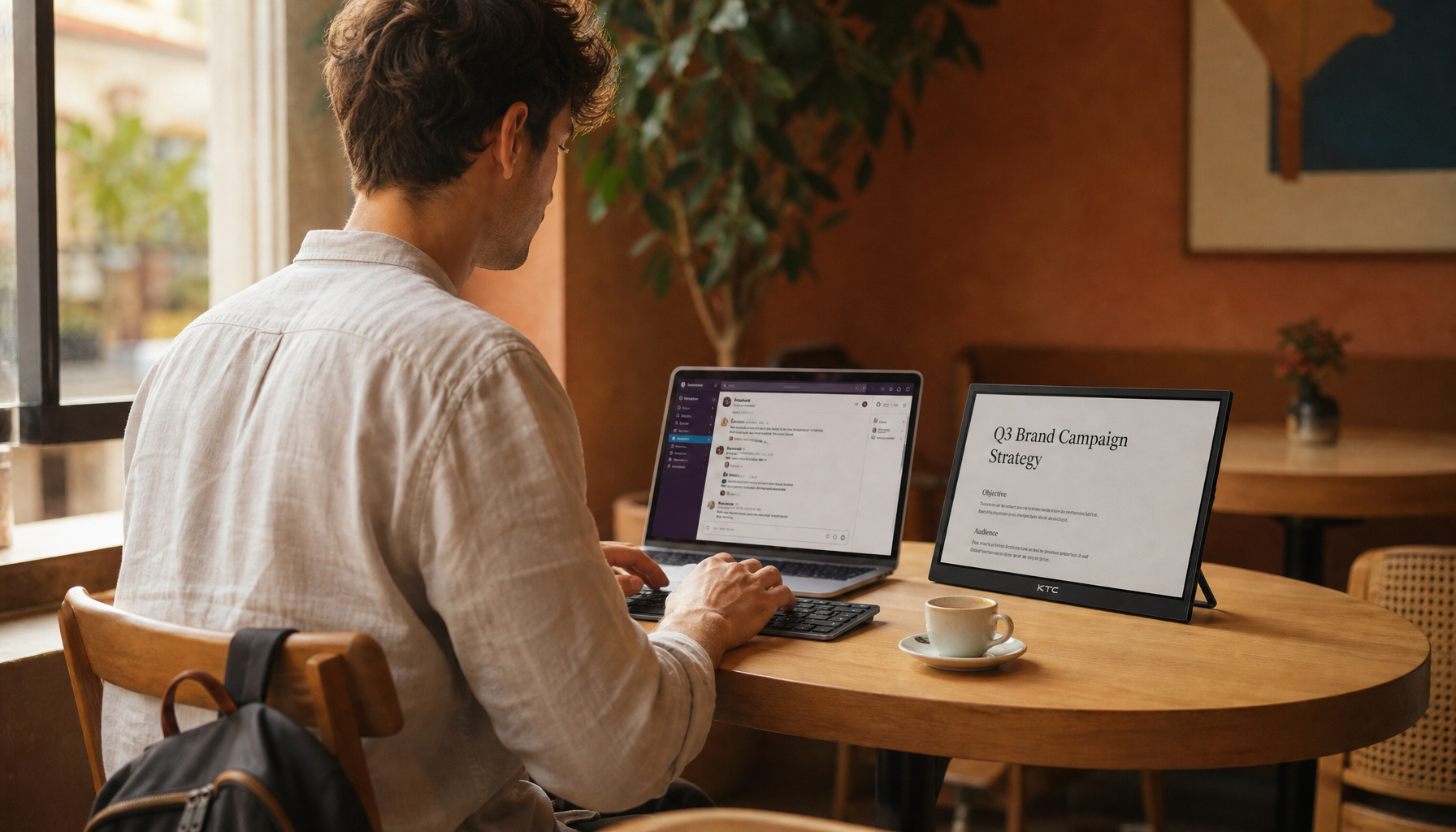
Eye comfort is not only about refresh rate, blue-light modes, or panel quality. The biggest overlooked drivers are screen position, viewing distance, glare, text size, posture, airflow, and break rhythm.
Do your eyes feel dry at 4:00 PM even though you bought a better monitor? A practical setup check can often reduce squinting, leaning, neck tension, and glare without another expensive upgrade. This workstation-first method can make gaming monitors, office displays, and portable screens easier to use for long sessions.
Eye Strain Is a Setup Problem, Not Just a Screen Problem
Digital eye strain usually shows up as tired eyes, burning, dryness, blurred focus, headaches, or neck and shoulder tension. The display can contribute, but the body’s position around the display often determines whether the screen feels effortless or punishing after two hours.
Eye strain treatment commonly combines habit and environment changes rather than relying on a single technology fix. That matters for buyers because a 240 Hz panel, OLED contrast, or eye-care preset cannot compensate for a monitor that is too high, too close, too reflective, or paired with tiny text.
For competitive gaming, the issue is often tracking comfort. For office productivity, it is usually sustained focus on text and spreadsheets. For portable smart screens, it is almost always height and distance, because the screen follows the laptop posture unless you deliberately separate viewing from typing.
Viewing Distance: The Arm’s-Length Rule Needs Context

A strong baseline is to place the screen about 20 to 30 inches from your eyes. Monitor guidance emphasizes arranging components to reduce awkward posture and localized strain, while clinical guidance gives a similar arm’s-length monitor position with the top at or just below eye level.
The overlooked nuance is that bigger and sharper screens often need more distance, not less. A 24-inch office display may feel good near 24 inches, while a 32-inch 4K monitor often feels calmer closer to 30 inches if scaling is set correctly. A 34-inch ultrawide may need to sit farther back so your eyes and neck are not constantly sweeping across the panel.
The practical test is simple: open a normal work document, sit back in your chair, and read without leaning forward. If you move your head toward the monitor, increase text scaling before pulling the screen closer. Sharper text only helps if the size is readable from a relaxed posture.
Height and Angle: Slightly Down Beats Straight Up
Monitor height is one of the most common comfort failures. Ergonomic posture tips recommend keeping the top of the screen around eye level and the display about an arm’s length away, with a lower setup for progressive lenses when needed.
A slightly downward gaze is usually more comfortable than looking up. If the screen is too high, you may raise your chin, expose more of the eye surface, blink less completely, and strain your neck. If the screen is too low, you may collapse forward and turn a display problem into a shoulder and back problem.
For a real-world setup, place your primary monitor directly behind the keyboard, then adjust height until your eyes land near the top third of the visible image. Tilt the screen slightly back only enough to reduce reflections and keep text square to your line of sight. If you wear bifocals or progressive lenses, lower the monitor by about 1 to 2 inches so you are not craning your neck to find the correct lens zone.

Glare and Room Lighting: Brightness Matching Beats Maximum Brightness

A premium panel can still feel harsh in a bad lighting environment. Tips for reducing eye strain include reducing glare, matching screen brightness to room lighting, increasing contrast, and keeping the screen center slightly below eye level.
The rule is not to make the monitor dim. The rule is to make the monitor belong in the room. A white document on screen should look similar in brightness to a sheet of white paper on your desk. If the screen glows like a lightbox in a dark room, your eyes keep adapting between extremes. If the display is too dim in a bright office, you squint and lose text precision.
Matte panels and anti-glare filters reduce reflections and are excellent for office productivity, but they can slightly soften perceived contrast. Glossy panels may look punchier for media and gaming, but they punish poor window placement. Bias lighting behind a monitor can help in dim rooms by reducing the contrast between a bright panel and a dark wall, but it should be soft and indirect, not another glare source.
Text Size, Scaling, and Contrast: Sharp Pixels Still Need Human-Sized UI
Many users buy higher resolution for eye comfort, then run the interface too small. That wastes the ergonomic advantage. Practical accessibility settings such as display tint, dark mode, high contrast, and reduced white point can make screens more readable.
For office displays, increase scaling until you can read body text from your normal seated position without leaning. On a 27-inch QHD monitor, that may be standard scaling. On a 32-inch 4K monitor, many users need larger UI scaling to get the comfort benefit of clean text. On a portable 15-inch screen, a small scaling increase can be the difference between a useful second display and a squinting machine.
Contrast should make text crisp, not aggressive. Very low contrast makes the eyes hunt for edges. Very high contrast, especially pure white pages in a dark room, can feel sharp in the wrong way. Dark mode can help at night, but it is not automatically better in bright rooms; light backgrounds often remain more readable when ambient light is high.
Posture, Input Reach, and the Hidden Neck-to-Eye Loop

Eye strain often begins outside the eyes. Office ergonomics guidance recommends positioning the monitor straight in front of the user, placing the keyboard and mouse within easy reach, and keeping feet supported.
When the mouse is too far away, the shoulder drifts forward. When the keyboard is too high, the wrists and shoulders tighten. When the laptop is used flat on a desk, the neck bends down to see the screen. All of that makes the visual system work from an unstable base.
The fix is performance-oriented but inexpensive. Center the primary screen, bring the mouse close to the keyboard, support the forearms lightly, and keep feet flat or on a footrest. For laptop-heavy work, use a stand plus external keyboard and mouse. For portable smart screens, do not place the second panel so far to the side that every notification requires a neck turn.
Blinking, Airflow, and Breaks: The Low-Tech Comfort Stack

Reduced blinking is one of the least glamorous causes of screen discomfort. Digital eye strain is often worsened by reduced blinking, while common care guidance recommends blinking often, using artificial tears when appropriate, reducing blowing air, and taking regular eye breaks.
The 20-20-20 rule is still useful because it is simple enough to survive a busy day: every 20 minutes, look about 20 ft away for at least 20 seconds. For deep work or long ranked matches, pair that with a short movement break every hour. Stand up, look across the room, roll your shoulders, and return before fatigue changes your posture.
Airflow matters more than most monitor buyers expect. A ceiling fan, HVAC vent, or desk fan aimed at the face can dry the tear film and make a well-adjusted screen feel irritating. Redirect the air before changing monitor settings again.
Blue Light and Refresh Rate: Useful, but Not the Whole Answer
Higher refresh rates can improve comfort when motion matters, especially in gaming, scrolling, and fast cursor movement. A 144 Hz or 165 Hz monitor can feel smoother than 60 Hz if the PC can deliver matching frame rates. But refresh rate does not solve glare, poor distance, tiny fonts, dry eyes, or a monitor mounted above eye level.
Blue-light settings deserve the same balanced treatment. Warmer color temperature can be comfortable at night and may support sleep routines, but the position that blue-light glasses are not recommended for eye strain is based on limited supporting evidence. In practical terms, use night modes if they feel better, but do not treat them as a replacement for brightness matching, breaks, and correct screen placement.
Quick Comparison: Technology Fixes vs. Ergonomic Fixes
Factor |
What It Helps |
Main Limitation |
Higher refresh rate |
Motion smoothness, gaming tracking, scrolling comfort |
Does not fix glare, dryness, posture, or tiny text |
Blue-light or warm mode |
Evening comfort and less harsh screen tone |
Evidence for eye-strain relief is limited |
Matte panel or anti-glare filter |
Reflections from windows and lights |
May slightly soften perceived image clarity |
Monitor arm or stand |
Height, distance, angle, dual-screen alignment |
Must be adjusted correctly to matter |
Larger text and scaling |
Reading comfort and reduced leaning |
Reduces visible workspace if overdone |
Break rhythm and blinking |
Dryness, focusing fatigue, posture reset |
Requires habit, reminders, or software prompts |
When to Get an Eye Exam
Self-care has limits. If discomfort, headaches, blurred vision, or focusing changes continue after setup improvements, make an appointment with an eye specialist. Uncorrected vision, dry eye, contact lens irritation, or the need for computer-specific glasses can make even a well-built workstation feel wrong.
This is especially important if symptoms appear suddenly, affect one eye more than the other, or interfere with work accuracy. Ergonomics can reduce strain, but it should not be used to ignore persistent visual changes.
Final Word
The best display setup is not the most expensive screen on the desk; it is the screen your eyes, neck, and hands can use without compensation. Start with distance, height, glare, text size, posture, airflow, and breaks, then let display technology add performance on top of a workstation that already works.