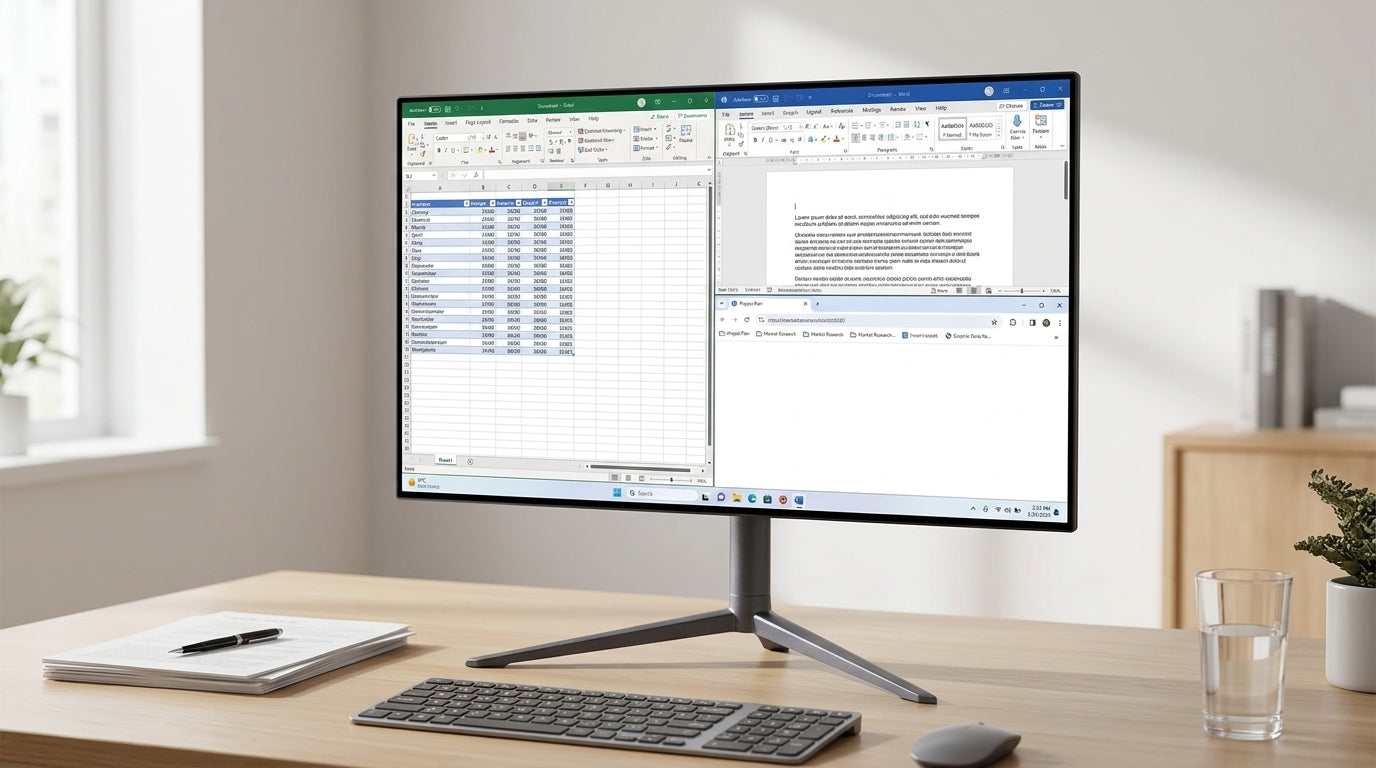
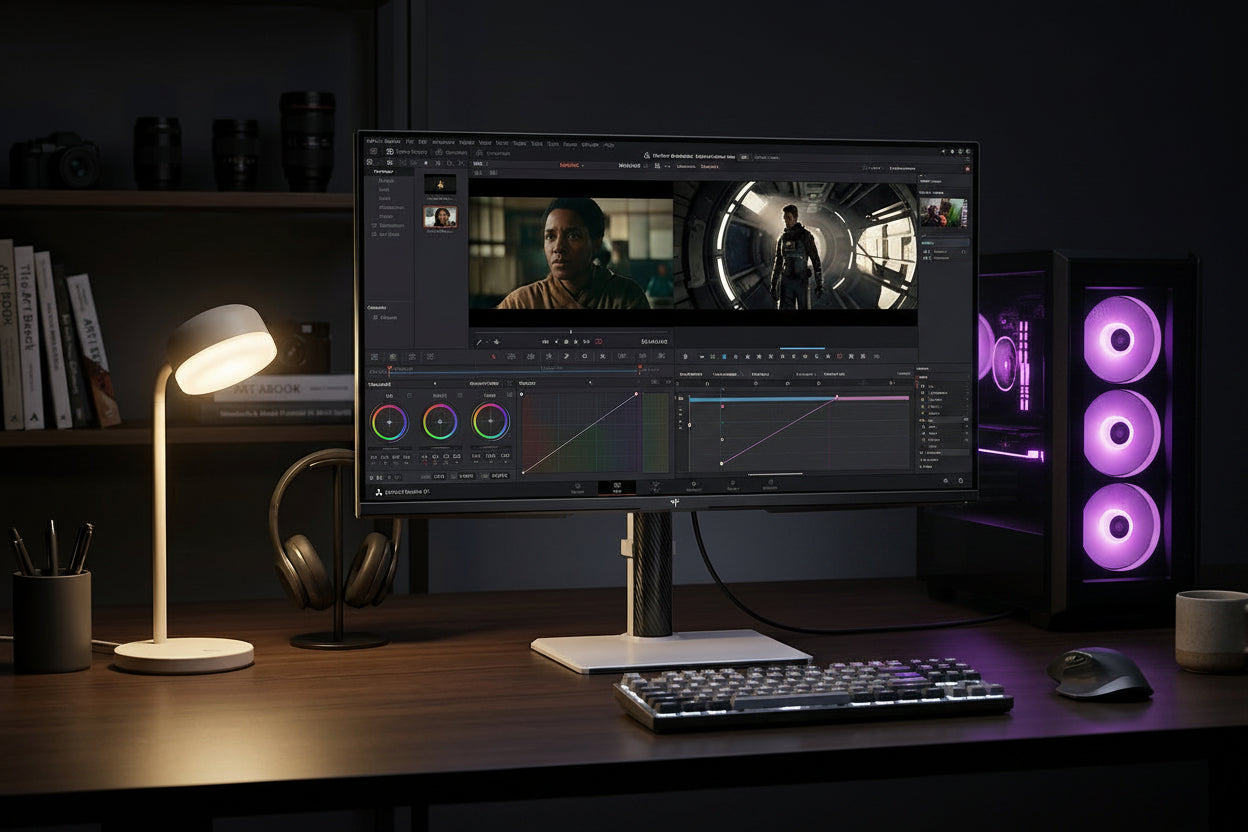
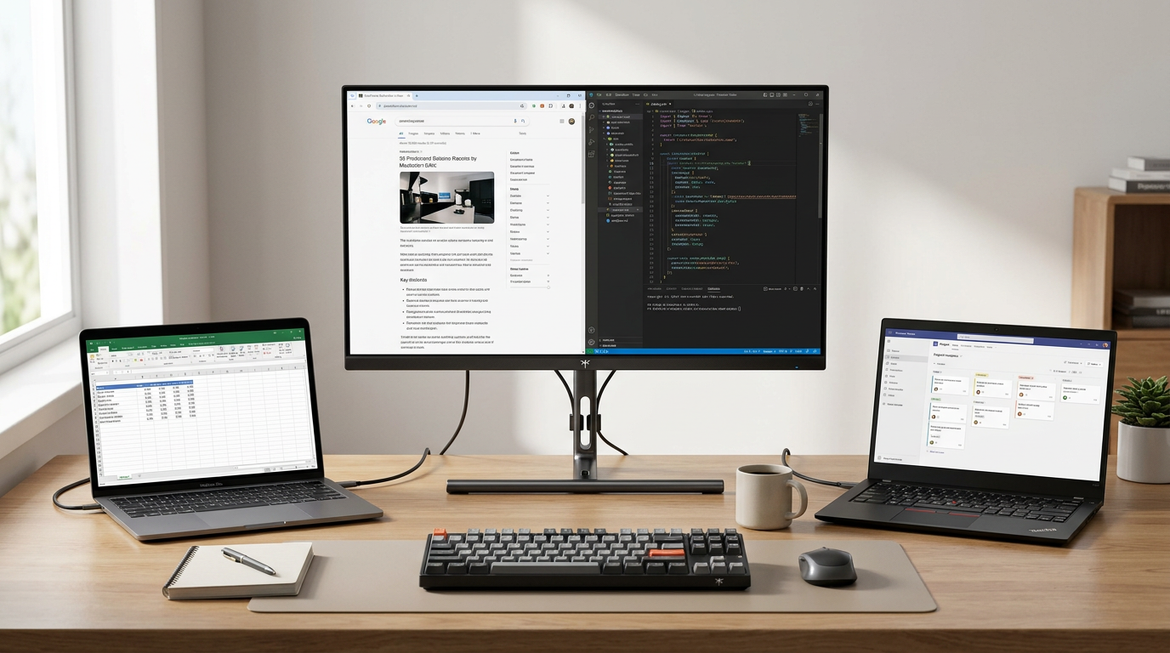
A USB-C KVM monitor can clean up a Mac and Windows desk, but only if the laptop port, cable, and monitor all support the same video, power, and data path. Start with compatibility checks first, then cable choice, then switching behavior. That order avoids the most common one-cable mistakes.

Compatibility Checks Before You Buy
For most hybrid desks, the first question is not which monitor to buy. It is whether the exact USB-C port on each laptop can actually do the job. Apple's own support guidance on video over USB-C is a good reminder that charging alone does not prove display support.
A MacBook or Windows laptop usually needs more than a USB-C label. You want a port that supports DisplayPort Alt Mode or Thunderbolt for video, plus the charging profile you expect. USB-IF's Type-C overview also shows why the port, cable, and monitor have to negotiate the same path before a single cable can carry display, data, and power.
If your setup depends on a keyboard, mouse, webcam, or storage drive following the active source, do not treat that as automatic. KVM behavior depends on how the monitor routes the USB path, not just whether the image appears. In practice, a port that works for charging-only docks can still fail for a USB-C KVM monitor.
Decision sentence: If the laptop port cannot do video, do not buy the monitor for one-cable switching, even if the wattage looks right. If the video path is there but the power is lower than your workload needs, expect charging compromises rather than a clean desk win.
Mac users should also check whether the specific laptop model allows external display output on the port they plan to use, especially on base configurations where port behavior can vary. Windows users should check the same thing on a per-port basis, not just by laptop family. On some machines, one USB-C port carries everything while another is data-only or charge-only.
Mac and Windows Port Requirements
Treat the Mac and Windows sides separately. One laptop may support video over USB-C, while the other only supports charging and USB data. That difference is enough to break a shared monitor setup.
A reliable check is simple: confirm the laptop spec sheet names DisplayPort Alt Mode, Thunderbolt, or another explicit video-output mode for the exact USB-C port you plan to use. If the spec only says USB-C charging, that is not enough information for a KVM desk.
Video, Charging, and Data Lane Checks
A USB-C KVM monitor only feels "one-cable" when the same connection carries video, power, and USB data at the same time. The USB-IF describes USB-C as a system that can support multiple roles through negotiated alternate modes and power delivery, not as a universal jack that always does everything.
That matters because a cable or adapter can work for one task and still fail for another. A setup may charge a laptop but not carry a stable display signal, or it may pass video but not keep peripherals attached cleanly after switching.
Firmware, Sleep, and Resolution Caveats
Sleep and wake behavior is where many clean-looking setups get annoying. If one laptop wakes more slowly, changes resolution, or renegotiates the display path differently, the KVM handoff can pause even when the cable is fine.
That is why it helps to test both computers before you declare the setup finished. A desk can look compatible on paper and still feel inconsistent in daily use if one machine wakes more slowly than the other.
Pick the Right Cable Path
Use a full-function USB-C cable when you want video, charging, and data on one link. Cornell's guidance is clear on the practical side: charge-only or data-only USB-C cables do not reliably support the full display-and-peripheral path that a KVM setup needs.
That is also why cable quality matters more than many buyers expect. A cable that is fine for charging a phone may still cause black screens, dropped USB accessories, or wake issues on a monitor-based KVM setup. If the desk uses a dock or adapter, verify that the whole chain still supports the same video mode and charging behavior.
For higher-resolution or higher-refresh setups, keep the path as direct as possible. Every extra adapter is another chance for the monitor to negotiate the wrong mode or for the laptop to wake into a downgraded signal. If you are trying to reduce desk clutter, a short direct cable is usually better than a long, complicated route.
Decision sentence: If your setup needs both high-bandwidth video and stable USB peripherals, the cable should be treated as a compatibility part, not an accessory. If you are using a longer run or a dock, expect more troubleshooting, not less.
KTC's own display signal cable set is a reasonable browsing stop if you are comparing USB-C and DisplayPort cable paths for a mixed desk. The product page lists a USB-C to USB-C option with E-Marker support and up to 20V/5A power support.
Full-Function Cable Versus Charge-Only Cable
A full-function cable is the safe baseline for a USB-C KVM monitor. It is the kind of cable that can carry display signals, accessory data, and power negotiation together.
A charge-only cable is a dead end for this use case. It may still power something, but it will not complete the full path that makes the monitor behave like a hub.
Direct Connection Versus Docked Path
A direct USB-C path is easier to debug because every handoff stays visible. If the image drops, you know where to look. If a dock sits between the laptop and the monitor, you now have one more device that can change the negotiated mode.
That is not a reason to avoid docks entirely. It is a reason to use them only when you need the extra ports or desk layout flexibility and you are willing to verify that the dock preserves the exact video mode you want.
Connect the Mac and Windows Devices
Start with one computer at a time. Confirm the image first, then add the second device, then test the keyboard and mouse sharing, and only then judge the KVM behavior. That order saves time because it separates a video problem from a peripheral problem.
- Connect the MacBook directly to the monitor's USB-C input and confirm that the image appears at the expected resolution.
- If the monitor also receives power from the same cable, confirm that the MacBook shows charging as expected.
- Add the keyboard and mouse to the monitor's USB hub or downstream ports.
- Repeat the same direct test with the Windows PC.
- Switch between inputs and confirm that the monitor, the USB devices, and the source selection all follow the active machine.
- Put both machines to sleep and wake them one at a time to see whether the handoff stays clean.
If you want to see a monitor example that is built around this kind of desk use, the 27-inch 4K 160Hz gaming monitor is one product page to check once you have already confirmed your laptop ports and cable path. Based on the published product facts, it includes USB-C power delivery support and KVM support when the upstream path and full-function cable are used.
That does not mean it is the only fit. It means it is worth checking when your setup needs a higher-refresh monitor with a USB-C-based desk path. If your real need is slower office work and basic switching, a less aggressive display class may be enough.
Direct Video Test
The direct video test is the fastest way to prove whether the port and cable are working together. If the image appears without adapters, your starting point is much better.
If the image only appears after extra dongles or a fallback cable, note that as a compatibility warning. The setup may still work, but it is no longer a true one-cable desk.
Input Selection
Do not assume auto-detect will always pick the right source. Set the input manually during the first setup, then see whether the monitor remembers it after sleep and wake.
If the source keeps flipping or the monitor takes too long to land on the right port, that is usually a signal-routing problem, not a sign that the whole desk is broken.
Sleep and Wake Test
Test sleep and wake on both computers before you call the setup finished. The real question is whether the monitor wakes with the correct source and whether the USB peripherals follow the active device without a long lag.
If wake behavior is inconsistent, keep a direct fallback cable nearby. It is often faster to reselect the input or replug once than to restart a computer.
How KVM Switching Behaves Day to Day
The most common surprise is that video and USB accessories do not always switch at the same speed. A monitor may show the image from the new computer before the keyboard and mouse fully follow it. That gap is normal in many setups and is one reason users think the monitor is failing when it is really just handoff timing.
The University of Michigan's KVM troubleshooting guidance notes that sleep and resolution changes can delay handoff or briefly drop signal, and that reselecting the input is often faster than rebooting. That matches the lived reality of many hybrid desks.
Resolution changes can also create a short blank screen even when the cable is fine. This is especially likely when one computer wakes at a different refresh rate or aspect ratio than the other. In that moment, the cleanest fix is usually to confirm the input, then let the display settle before touching anything else.
Decision sentence: If the monitor wakes but the USB devices lag behind, that is annoying but not necessarily a defect. If the signal keeps failing after wake, check the cable and input path first, then the monitor settings, before assuming the KVM feature is broken.
KTC's support article on random input switching is useful background if your monitor keeps changing sources on its own. It frames the behavior as signal detection trouble rather than a mysterious fault, which is a helpful way to debug the problem.
Sleep-State Hand-Offs
Sleep-state hand-offs are where one machine wakes while the other remains asleep or half-awake. That can create a short delay before the monitor and USB hub fully agree on the active source.
If that happens often, test the machines one by one. The problem may be tied to only one laptop, not the whole monitor chain.
Resolution Changes and Black Screens
A black screen after wake is not always a dead signal. Sometimes the computer and monitor are simply renegotiating resolution or refresh rate.
If the image returns after a few seconds or after reselecting the input, the hardware is often still fine. What changes is the timing, not necessarily the compatibility.
Peripherals That Lag Behind Video
USB peripherals can take longer than the image to follow the new source. That is especially noticeable with a monitor that shares keyboard, mouse, or webcam access between two computers.
When that lag appears, separate the problem into two parts: video first, USB second. That makes troubleshooting faster and keeps you from replacing the wrong cable.
Features That Make the Setup Worth It
For a shared Mac and Windows desk, the useful features are the ones that reduce friction after the first day. USB-C power delivery, KVM support, stable source switching, and a stand that fits your desk posture matter more than headline refresh numbers if the machines only need office-level performance.
A good USB-C KVM monitor should support the resolution and refresh rate you actually plan to use. If your MacBook is mostly for work and your Windows machine is mostly for browsing or office apps, a simpler monitor may be the better fit. If you also game or edit, a higher-refresh model can make more sense, but only if your port and cable path can support it.
KTC's Mini LED 27-inch 4K 160Hz monitor is a natural example of a more feature-rich option when the desk needs both high image quality and fast motion support. The published facts show USB-C power delivery support and a fully adjustable stand.
That said, the right answer is not always a premium gaming model. For many hybrid workers, the simpler Office Monitor collection or the broader All Monitors collection is a better place to compare sizes, stand styles, and refresh rates before adding KVM expectations.
USB-C Power Delivery
Power delivery matters when you want the monitor to charge the laptop and reduce cable count at the same time. The important question is not just how much wattage the monitor advertises, but whether that wattage is enough for your laptop under normal use.
If your machine needs more power than the monitor can supply, the setup may still work, but the laptop may charge slowly or hold charge instead of building it. That is acceptable for some office rigs and frustrating for others.
Full-Function USB-C
A full-function USB-C path is what makes the setup feel clean. Without it, the monitor may still work as a screen, but not as a proper hub for display and peripherals.
When you shop, treat "USB-C" as a starting point, not a guarantee. The exact behavior depends on the port mode, cable, and monitor routing together.
KVM Support
KVM support matters when you want the keyboard, mouse, and possibly other peripherals to follow whichever machine is active. It is less important if you only care about the display and plan to use separate peripherals.
If the monitor includes KVM but the port path is incomplete, the feature will not feel like a feature. It will feel like extra menu steps.
Resolution and Refresh Balance
A high refresh rate is useful only if the source can drive it reliably. For office work, 60Hz or 100Hz can already feel smoother than older 60Hz-only setups. For gaming or fast motion, higher refresh becomes more important, but only on a stable cable path.
If you are choosing between a refined productivity setup and a speed-focused gaming setup, let the source device decide. The wrong monitor class can turn a clean one-cable desk into a constant compromise.

Copy This Compatibility Checklist
Before you buy, confirm each box below for both the MacBook and the Windows device:
- The USB-C port supports video output, not just charging.
- The USB-C path supports the power level you need for normal use.
- The cable is full-function and rated for the video mode you plan to run.
- The monitor input supports the chosen resolution and refresh rate.
- Keyboard, mouse, and any other USB accessories follow the active source after switching.
- Sleep and wake work cleanly on both devices.
- You have a fallback cable path if the one-cable route misbehaves.
If one of those checks fails, fix the weak link before buying a more expensive monitor. A USB-C KVM monitor only feels seamless when the whole chain is compatible, not just the display panel.
Related Resources
Explore these targeted guides for deeper KVM and hybrid-desk troubleshooting:
- Gaming Monitor collection
- The Ultimate Hybrid Desk: Switching Between MacBook Work and PC Gaming
- How to Determine If Your USB-C Monitor Supports Daisy-Chaining Additional Displays
- Maximum USB-C Video Cable Length
- Premium Display Signal Cables
FAQs
Q1. How Do I Check Whether My MacBook USB-C Port Supports Video Output?
Look up the exact MacBook model and confirm that the specific USB-C or Thunderbolt port supports external display output. Do not rely on the fact that it charges over USB-C. The key is whether the port explicitly supports video, usually through Thunderbolt or DisplayPort Alt Mode.
Q2. How Much USB-C Power Delivery Do I Need for a Mac and Windows Desk?
Use the laptop's normal charging need as your baseline, then leave some margin for real use. A monitor that supplies less power than the laptop expects may still run the setup, but it can charge slowly or hold steady instead of replenishing the battery. Check the exact laptop and workload.
Q3. Can One USB-C Cable Carry Video, Charging, and Data at the Same Time?
Yes, but only when the laptop port, cable, and monitor all support the full path. If any one part is charge-only, data-only, or missing video support, the one-cable plan breaks down. That is why the port spec and cable spec matter as much as the monitor spec.
Q4. Why Does My Monitor Switch Slowly After Sleep or Wake?
Sleep-state handoff often makes the monitor wait while the computer renegotiates video and USB access. The result can be a short black screen, delayed peripherals, or a source that needs reselecting. In many cases, that is normal behavior, not a hardware failure.
Q5. What Should I Do If a Dual-Monitor Setup Stops KVM From Working?
First verify whether both display paths are still supported and whether the monitor is actually routing USB access to the active source. Dual-monitor or multi-display setups can change lane allocation and make the KVM path less predictable. If the problem started after adding a second display, simplify the path and test one monitor at a time.
Choose the Setup That Fails Less
The best USB-C KVM monitor setup matches your actual ports, cable limits, and wake behavior rather than headline specs. When Mac and Windows ports both support video, the cable is full-function, and the monitor keeps input changes stable, the desk feels much cleaner. If any link is weak, fix it first before buying.