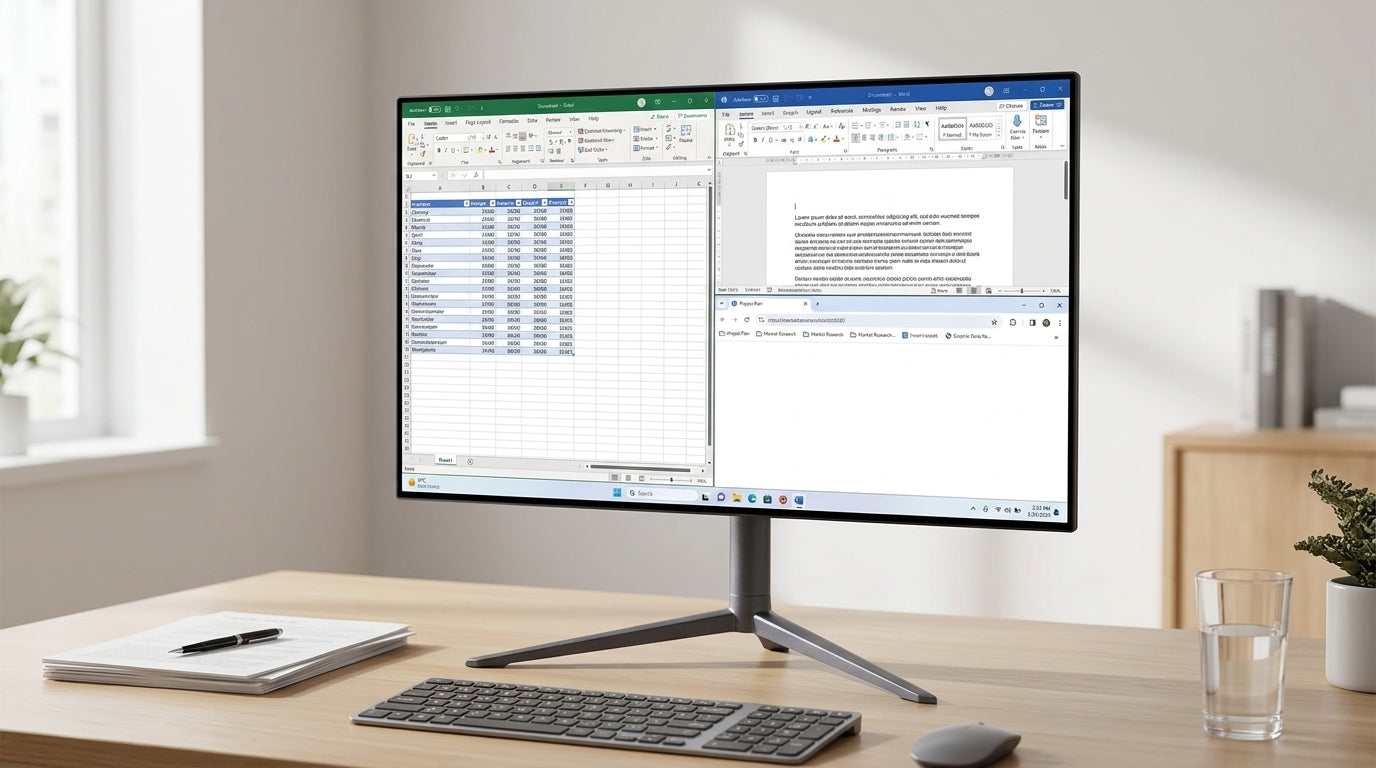
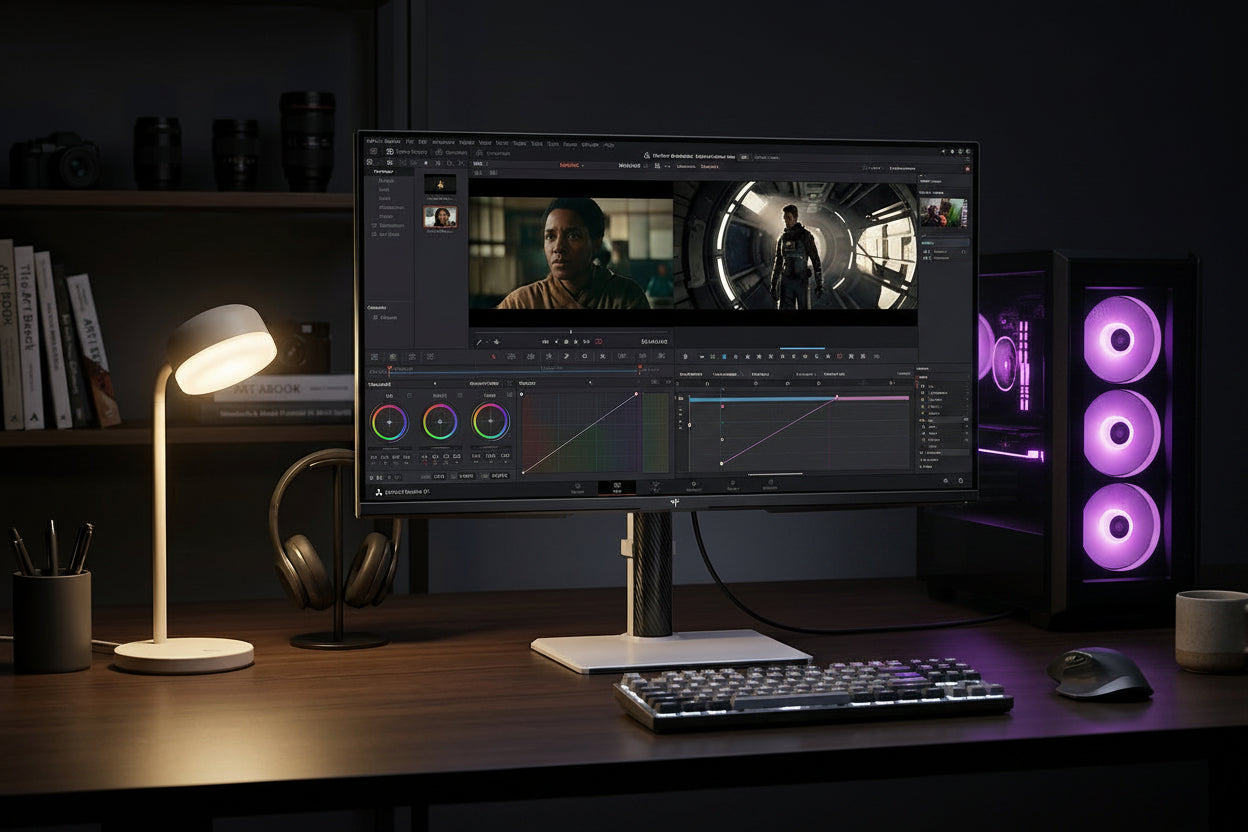
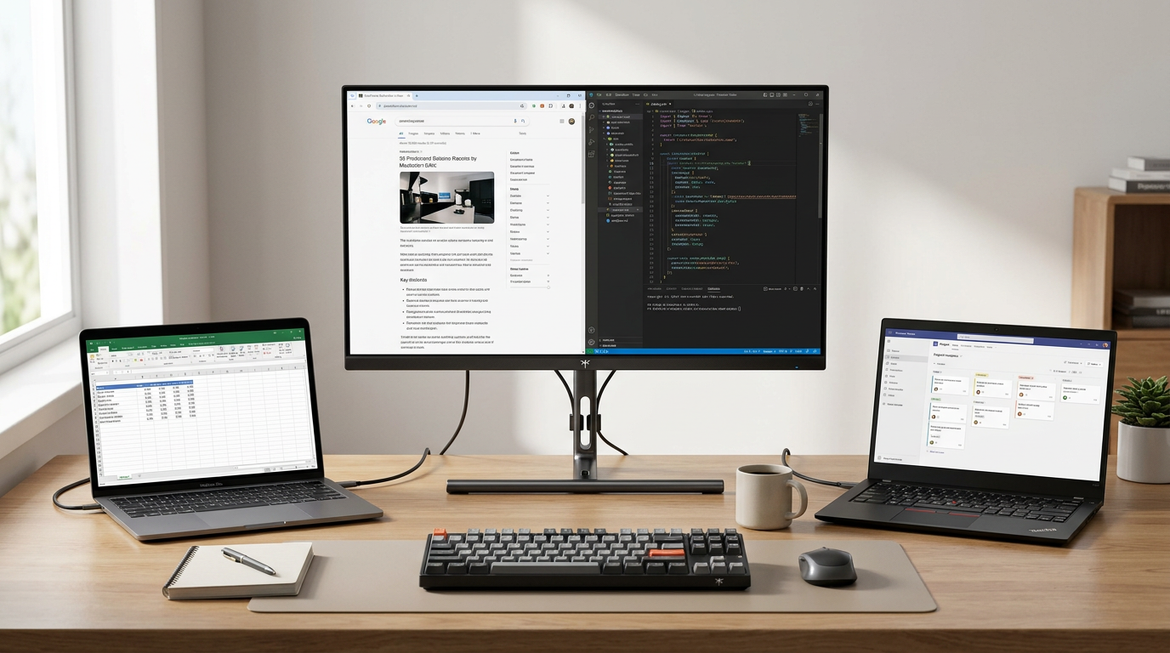
A USB-C KVM monitor can simplify a hybrid desk, but only if the monitor, cable, and devices all match the right paths. The main check is not just power or just video. USB-C video, USB upstream, and KVM switching are separate pieces, and a good fit depends on whether you need one or all of them.

What a USB-C KVM Monitor Actually Does
A USB-C KVM monitor is a display that can accept USB-C video on one side and, on some models, route keyboard and mouse control across more than one device. That is useful on a desk where a MacBook, Windows PC, and sometimes a console all need to share the same screen.
The convenience is real, but the feature set is not universal. Some monitors only use USB-C for video and charging. Others add USB upstream or KVM-style switching for peripherals. The difference matters because a cable that powers a laptop does not automatically mean it can send video too, as USB-C video support and cable output are separate checks.
For most buyers, the category makes sense when they want fewer swaps and less desk clutter. It is not a fit if they only need a simple display for one laptop or if they expect every attached device to switch perfectly without checking the ports first. If your desk only needs charging and a single screen, a true KVM setup may be more than you need.
A second useful boundary is power delivery. If the monitor is supposed to replace a charger, the USB-C wattage has to match the laptop's needs, which is why USB Power Delivery guidance from USB-IF is worth checking before you buy.
Compatibility Checks Before You Buy
Start with the device that is most likely to fail the test. On a hybrid desk, that is usually the laptop, not the monitor. A USB-C port that charges a machine is not the same as a USB-C port that carries video, so confirm display output support before you care about switching behavior.

Here is the order that prevents the most regrets:
| Check first | What it tells you | Why it matters |
|---|---|---|
| USB-C video support | Whether the laptop can send picture through USB-C | Charging-only USB-C is not enough |
| USB-C PD wattage | Whether the monitor can replace the charger | Low wattage may leave some laptops underpowered during heavy use |
| USB upstream or KVM path | Whether keyboard and mouse can follow the selected source | Video can work while peripherals stay on the wrong device |
| Console input path | Whether the console should use HDMI or another input | Console handoff may need manual input selection |
That separation is the main decision filter. If the laptop lacks USB-C video output, this category is usually a poor fit unless another input path is available. If the monitor's PD wattage is lower than the laptop's real need, treat charging as a convenience, not a full replacement for the charger.
Console workflows need an extra check. A console can work on some monitor setups, but the handoff is not something to assume from the product name alone. In mixed desks, it is smarter to verify the console input path first and treat auto-switching as a nice-to-have, not a promise. For a more detailed cable-level explanation, the linked note on why a USB-C cable can charge without video is the right background read.
A practical way to judge the spec sheet is simple:
- Confirm USB-C video support on the laptop or dock.
- Confirm the monitor's PD wattage if you want one cable for power.
- Check whether the monitor actually supports the USB upstream or KVM path you need.
- Confirm which device should use HDMI, especially for a console.
How Setup Works on a Hybrid Desk
The cleanest setup is usually the boring one. Start with one direct video connection and confirm that the monitor shows a stable picture before you add USB switching, docks, or extra adapters.
Then add the USB upstream path and test whether the keyboard and mouse follow the selected source. If the picture works but the peripherals do not, the problem is often the USB path rather than the panel itself. That is why KVM USB device dropouts deserve separate attention from display troubleshooting.
For Mac and hybrid setups, test sleep and wake before you call the desk stable. Some monitors need a power cycle or an input-setting adjustment after wake, and that is a common friction point on real desks. A concise walkthrough is available in Mac wake detection troubleshooting.
If the first cable works but the second device does not, keep the setup simple until the display, source selection, and USB handoff all work separately. If the monitor works only after random replugging, the desk is not stable yet, even if it looks fine once it starts.
A reliable setup sequence looks like this:
- Connect one direct video cable.
- Verify the correct input is selected.
- Add the USB upstream cable.
- Attach keyboard and mouse.
- Switch sources once and confirm the peripherals follow.
- Only then add the second device or console.
Troubleshooting Common Switching Problems
When switching breaks, the fastest fix is usually to identify which layer failed. A blank screen, missing keyboard, and scrambled layout are not the same problem. The goal is to separate them instead of treating them as one defect.
No Image After Switching
First check the active input on the monitor. A good cable on the wrong source still gives you a black screen. If the display is still blank, remove docks, hubs, splitters, and extension cables, then retest with one direct connection.
If a Mac wakes to a blank image or the monitor does not wake cleanly, try power cycling the monitor and rechecking the input menu. That is a practical first step, not a guarantee, but it often helps with handshake issues after sleep. The background note on Mac wake detection behavior covers this pattern well.
Keyboard or Mouse Does Not Follow
If the picture changes but your keyboard and mouse stay on the old device, recheck the upstream USB path and the KVM selector. That is often a USB enumeration issue, meaning the monitor and device did not fully re-establish the peripheral connection after switching.
This is where cheap external splitters often disappoint. A monitor with integrated switching is usually more predictable than a loose chain of adapters, especially when the desk has several devices. USB dropouts after switching are common enough that they deserve a planned test.
Resolution or Layout Changes After Source Swap
If your desktop icons move or the resolution changes after switching, the issue may be EDID handling. EDID is the monitor identity data that helps a source remember how the display should look. A KVM or monitor with EDID emulation can make switching less annoying, because it helps keep the display profile stable.
That does not mean every layout change disappears. It means the monitor is more likely to preserve the desktop behavior you want. The background guide on EDID and display stability explains why that matters on a multi-device desk.
USB-C Flicker or Power-Related Glitches
If the picture flickers when a laptop is on AC power, isolate the cable path first. The issue can be caused by power delivery, bandwidth, cable quality, or a dock in the chain. Start with one direct cable, then test again with charging removed if possible.
That way you learn whether the problem is tied to the power path or the display path. USB-C flickering on AC power is usually a symptom, not a final diagnosis.
Which KTC Monitor Fits Your Workflow
For buyers comparing models, the best choice depends on whether the desk is really a switching desk or mostly a single-laptop desk. The first needs true KVM behavior. The second may only need USB-C video and enough charging to reduce cable clutter.
| Workflow need | What to prioritize | Likely fit | Why it matters |
|---|---|---|---|
| MacBook plus creator work | Sharp text, color accuracy, USB-C charging, simple desk layout | H27P3 | Better when the desk is mainly one laptop and one screen |
| Hybrid work plus gaming | USB-C convenience, KVM behavior, stronger switching flexibility, enough power delivery | H27P6 | Better when one monitor must follow more than one device |
| Still browsing options | Category browsing and port verification first | Gaming Monitor or 4K Monitor | Useful when you want to compare classes before choosing a specific model |
For a buyer who wants a hybrid work-and-play desk, the featured fit is the KTC 27-inch 4K gaming monitor. Its 90W USB-C, 4K/1080p dual-mode display, and KVM support line up better with mixed-device switching than a productivity-first monitor does. That said, it is still worth checking the exact device ports before you buy.
For a Mac-first workflow, the 27-inch 5K home and office monitor is the cleaner fit if text clarity and creator work matter more than true multi-device KVM behavior. Choose the simpler monitor when you do not actually need peripheral switching. Choose the KVM-capable option when keyboard and mouse handoff is part of the job.
Buyer Checklist for a Clean Hybrid Desk
Before checkout, verify the device mix, the cable types, and whether charging is supposed to replace a separate charger. Then test one device at a time before you try the full switch routine.
- Confirm that the laptop supports USB-C video.
- Confirm the monitor's USB-C PD wattage matches the laptop's needs.
- Confirm which devices use HDMI and which use USB-C.
- Connect one direct video path first.
- Add USB upstream only after the picture is stable.
- Test source switching, then sleep and wake.
- Keep the return window in mind in case the desk does not behave the way you expected.
If you are comparing a USB-C KVM monitor for MacBook and gaming PC use, the safest move is still to verify the exact port map before ordering. That one step prevents most of the regret.
Related Resources
FAQs
How Do I Verify That My Laptop Supports USB-C Video Output?
Check the laptop's official specs for display output, not just charging. A USB-C port can power a device without sending video, so the monitor cable and the laptop port both need to support display data.
What Is the Difference Between USB-C Video, USB Upstream, and KVM Switching?
USB-C video carries the picture, USB upstream carries peripheral data to the monitor, and KVM switching decides which device your keyboard and mouse follow. Those functions are related, but they are not the same thing.
Can a USB-C KVM Monitor Replace a Dock for a Hybrid Desk?
Sometimes, but only partly. It may replace some docking tasks if the monitor's video path, charging wattage, and USB switching all match your setup. If any one of those is off, you may still need a dock.
Why Does My Monitor Switch Display but Not Keyboard and Mouse?
That usually points to the USB upstream path or the KVM selector, not the screen itself. Recheck the upstream cable, confirm the right source is selected, and test whether the device needs to reconnect after switching.
Can a USB-C KVM Monitor Work With a Console and a MacBook in the Same Setup?
It can on some desks, but verify the console input path separately. Do not assume console auto-switching will behave like a laptop connection. The safest setup is the one where each device has a confirmed port and a clear switching habit.