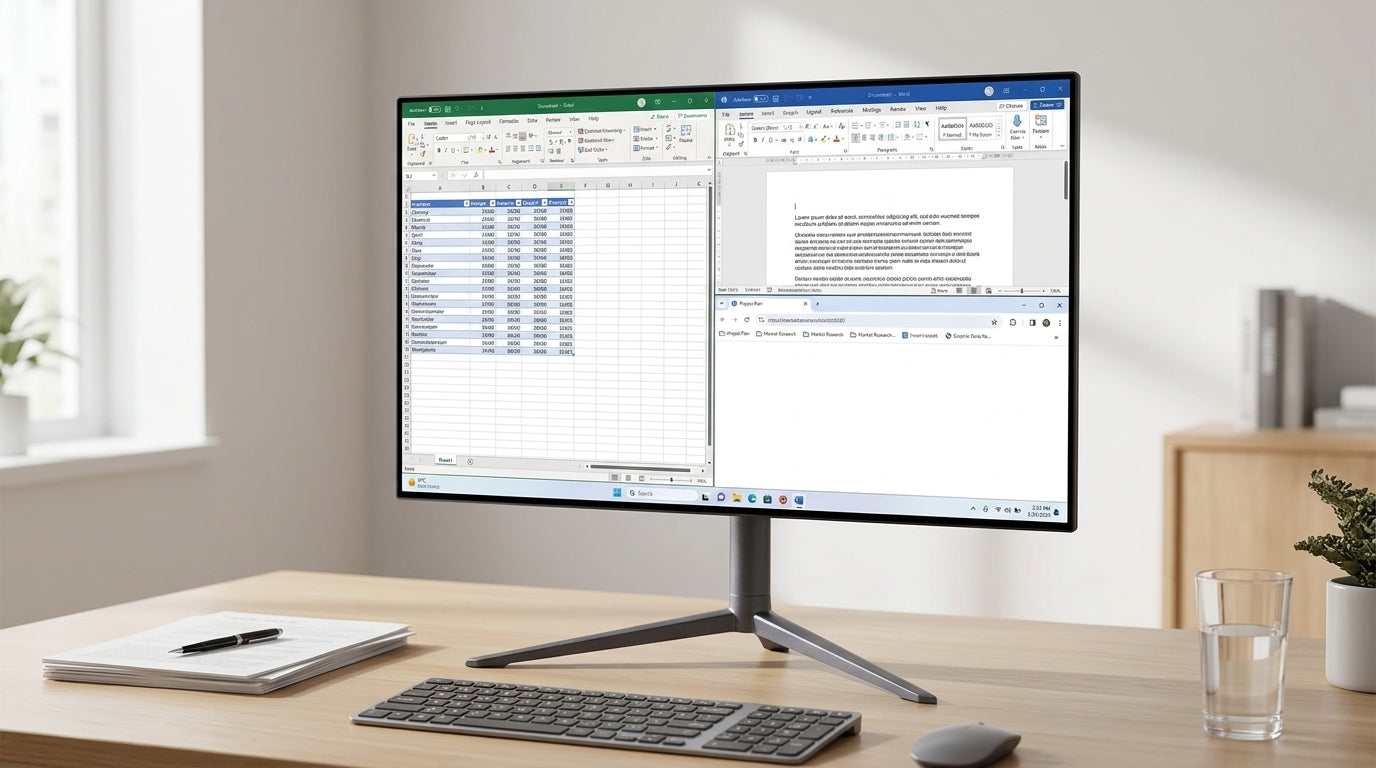
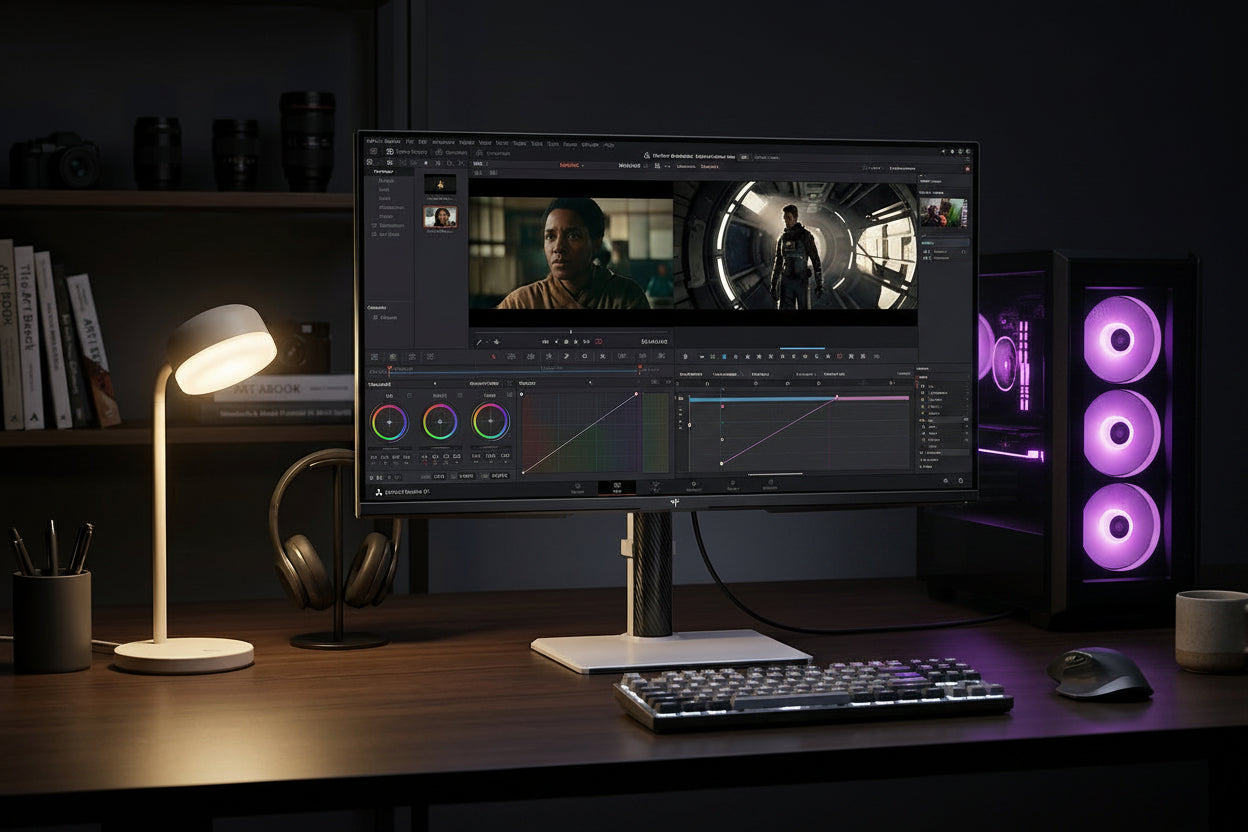
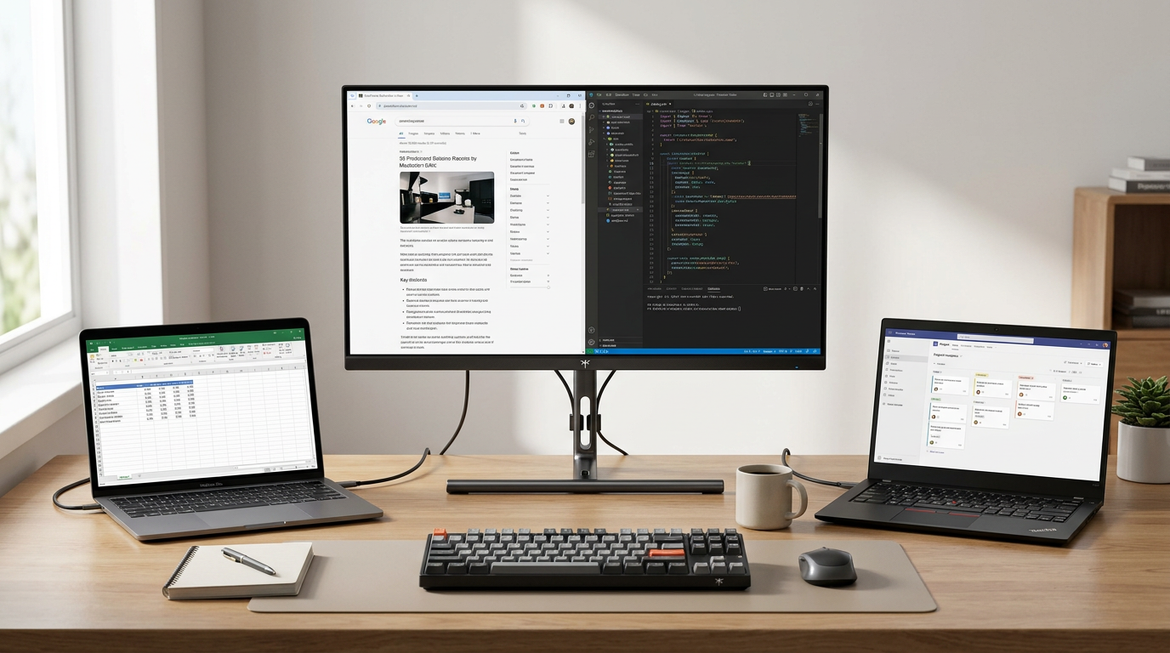
OLED monitor text clarity is good enough for some mixed-use setups, but it is not automatically the best choice for coding, spreadsheets, or all-day office work. If gaming is the priority and text work is lighter, OLED can be a strong fit. If you want the cleanest desktop text first, IPS or Mini-LED is usually the safer lane.

Why OLED Text Can Look Softer
The short version is that OLED monitor text clarity depends on more than resolution. The issue usually shows up when the panel's subpixel layout does not line up well with how the operating system expects to render fonts. That mismatch can create colored edges, a faint glow, or slightly softer letterforms in browser tabs, spreadsheets, and code editors.
That does not mean OLED looks bad in general. In motion, OLED can still look excellent for games because the panel's fast response and contrast make movement feel crisp. The trade-off is that static desktop text can expose layout quirks that are easy to miss in games.
If you want a deeper explanation of how screen size and pixel density change the result, Why 4K Looks Sharper on Some Monitors Than Others at the Same Size is a useful follow-up. A second useful read is Why Your Monitor's Text Rendering Looks Blurry in Specific Professional Applications, especially if the problem shows up more in Office apps than in games.
For most buyers, the real question is not "Is OLED sharp?" It is "Is it sharp enough at my desk distance, with my scaling, for the amount of text I read each day?" That is the decision layer to get right before comparing models.
What Causes Fringing on OLED
Fringing is usually a subpixel layout problem first, and a software rendering problem second. Standard LCD text rendering often assumes a predictable RGB stripe layout. Many OLED panels use different layouts, such as RGB, BGR, or RGBW-style arrangements, so font edges can land on subpixels in ways that make red, green, or blue outlines easier to see. See the subpixel rendering overview for how operating systems handle non-standard layouts.

Higher pixel density can help because the artifacts are packed into a smaller physical area. In practice, that means a denser panel can look cleaner at normal desk distance even if the underlying layout has not changed. As a planning rule, this is a visibility improvement, not a guarantee that fringing disappears.
Scaling and rendering also matter. Windows font smoothing and ClearType-style tuning can improve the look of some OLED setups, but they do not fully cancel a layout mismatch. A monitor can be technically excellent for motion and still be annoying for static desktop work if the text edges keep drawing your eye.
If you are cross-checking causes, What Causes Color Fringing on Displays gives a broader explanation of where fringing comes from. For a buyer, the useful takeaway is simple: panel layout, pixel density, and rendering path all matter, and no single one tells the whole story.
Best Settings to Tame Fringing
Start with the simplest checks first. Native resolution should be your baseline, not an afterthought, because mismatched output is one of the easiest ways to make text look worse than it should. After that, check OS scaling, then font smoothing, then GPU output settings, then any monitor sharpening or picture processing.
A practical order looks like this:
- Set the monitor to native resolution.
- Use a normal desktop scaling level before changing apps.
- Run ClearType or the OS font calibration tool if available.
- Check that the cable and port are carrying the correct signal.
- Only then try firmware sharpening or extra picture processing.
Be careful with sharpening. A little can make text edges feel more defined, but too much can create halos that are just as distracting as fringing. That is why sharpening is a tuning step, not a universal fix.
If the image still looks muddy, revisit the setup guide in Blurry 4K Text? Fixing Resolution Mismatches and Scaling Artifacts. The practical goal is to remove avoidable blur before blaming the panel itself.
OLED, IPS, and Mini-LED Compared
For mixed gaming and office use, the best choice depends on which problem you care about most. OLED usually wins on motion clarity, contrast, and game immersion. IPS usually feels safer for long text-heavy workdays. Mini-LED often sits in the middle for buyers who want stronger contrast than IPS without taking the same text-fringing risk as OLED. See the IPS vs OLED comparison for side-by-side motion and text notes.
| Panel Type | Text Clarity For Desk Work | Motion Clarity For Games | Best Strength | Main Trade-Off | Best Fit |
|---|---|---|---|---|---|
| OLED | Good to very good on the right setup, but layout-sensitive | Excellent | Deep contrast and fast motion | Text fringing can show up in static apps | Mixed-use buyers who game a lot |
| IPS | Very good and usually the safest for text | Good to very good | Stable desktop readability | Blacks and contrast are less dramatic | Coding, spreadsheets, office-first work |
| Mini-LED | Very good, often a strong middle ground | Very good | Better contrast than standard IPS | More expensive than basic IPS | Buyers who want both office comfort and stronger HDR |
If you want a neutral browsing path, IPS Monitors is the straightforward place to compare readability-first models, while the OLED gaming monitors collection is better if you already know you want OLED and just need to narrow the range.
The comparison flips when your day is mostly static work. If spreadsheets, code editors, and documents dominate the screen for hours, IPS or Mini-LED usually becomes the safer buy. If game time and motion clarity matter more, OLED can still be the more satisfying screen overall.
Who Should Still Buy OLED
OLED still makes sense when gaming is the main reason you are shopping. If you spend a lot of time in competitive titles, action games, or HDR content, OLED's contrast and motion behavior can matter more than the text trade-off. That is especially true if your desk work is shorter or more app-based than document-heavy.
A high-PPI OLED is a better compromise than a lower-density one. At normal desk distance, higher pixel density can make fringing less noticeable, so the panel can feel more acceptable for mixed use. It is still a compromise, though, not a magic fix.
For a featured OLED example, the KTC OLED 27" 2K 240Hz/0.03ms USB-C Gaming Monitor | G27P6 fits the kind of buyer who wants one fast panel for play and lighter productivity. Its 27-inch 1440p class setup and 240Hz refresh are the sort of specs that help gaming feel fluid, while the 27-inch size keeps it in the common desk-monitor range.
That said, it is not the cleanest choice if your top priority is all-day text work with no visible artifacts. If your job is mostly reading and writing, a good IPS or Mini-LED option can be the calmer choice even if it looks less dramatic in games.
Final Checks Before You Buy
Before you commit to an OLED monitor for work and play, check the panel layout, read real text tests, and think about how many hours each day you spend in static desktop apps. Then compare that against your desk distance, scaling preference, and gaming priorities.
A simple filter helps: if text is the main reason you are buying the monitor, start with IPS or Mini-LED. If games are the main reason and text is a secondary task, OLED stays in the conversation. The right choice is the one that fits your actual desk habits, not the one that looks best on a spec sheet.
For buyers who still want OLED after that check, the OLED gaming monitors collection is the best place to review the current lineup, and the KTC OLED 27" 2K 240Hz/0.03ms USB-C Gaming Monitor | G27P6 is the most direct starting point. If the workday is more static than playful, compare it against 4K Monitor and 2K Monitor options before deciding.
Related Resources
- How OLED Panel Color Volume Compares to LCD with Quantum Dot Enhancement covers color performance differences that affect mixed-use viewing.
- The 2026 Dual-Purpose Desk: Merging 4K 240Hz Speed with 5K Color Accuracy explores scaling and workflow trade-offs for hybrid desks.
FAQs
Q1. Can You Fix OLED Text Fringing Completely?
Usually not. You can reduce it with native resolution, better scaling, font smoothing, and the right signal path, but you cannot fully erase a panel's subpixel layout. If the fringing is obvious at your normal desk distance, the safer move is often to choose a different panel type instead of chasing a perfect fix.
Q2. What Resolution Makes OLED Text Look Best?
Higher pixel density usually helps, but the best resolution still depends on screen size and how far you sit from the panel. A 27-inch 1440p OLED can work well for many people, while a higher-density option can be easier on the eyes for long text sessions. The key is density plus distance, not resolution alone.
Q3. Why Does OLED Text Look Worse in Windows Than in Games?
Games hide the issue because motion, color, and changing scenes draw your attention away from fine text edges. Windows desktop apps are static, so fringing stands out more on toolbars, menus, and code lines. The panel has not changed, but the use case has.
Q4. Is OLED Good for Coding and Spreadsheets?
It can be, if your text workload is moderate and you value gaming performance too. For long coding or spreadsheet sessions, IPS is usually the safer readability-first choice, and Mini-LED is a strong middle ground. OLED becomes more attractive when the workday is mixed, not text-only.
Q5. Should I Choose IPS or Mini-LED Instead of OLED for Work?
Choose IPS if text clarity and predictability matter most. Choose Mini-LED if you want better contrast and stronger HDR behavior while staying closer to an office-friendly experience. OLED is still compelling for mixed use, but it is the least forgiving option when static desktop text is the main task.
The Safer Choice Depends on Your Desk Time
OLED monitor text clarity is a real trade-off, not a dealbreaker. If gaming is the priority and work is lighter, OLED can be the better experience. If your day is dominated by code, spreadsheets, or documents, IPS or Mini-LED is usually the calmer, lower-regret choice. The right answer is the one that matches your actual hours at the desk.