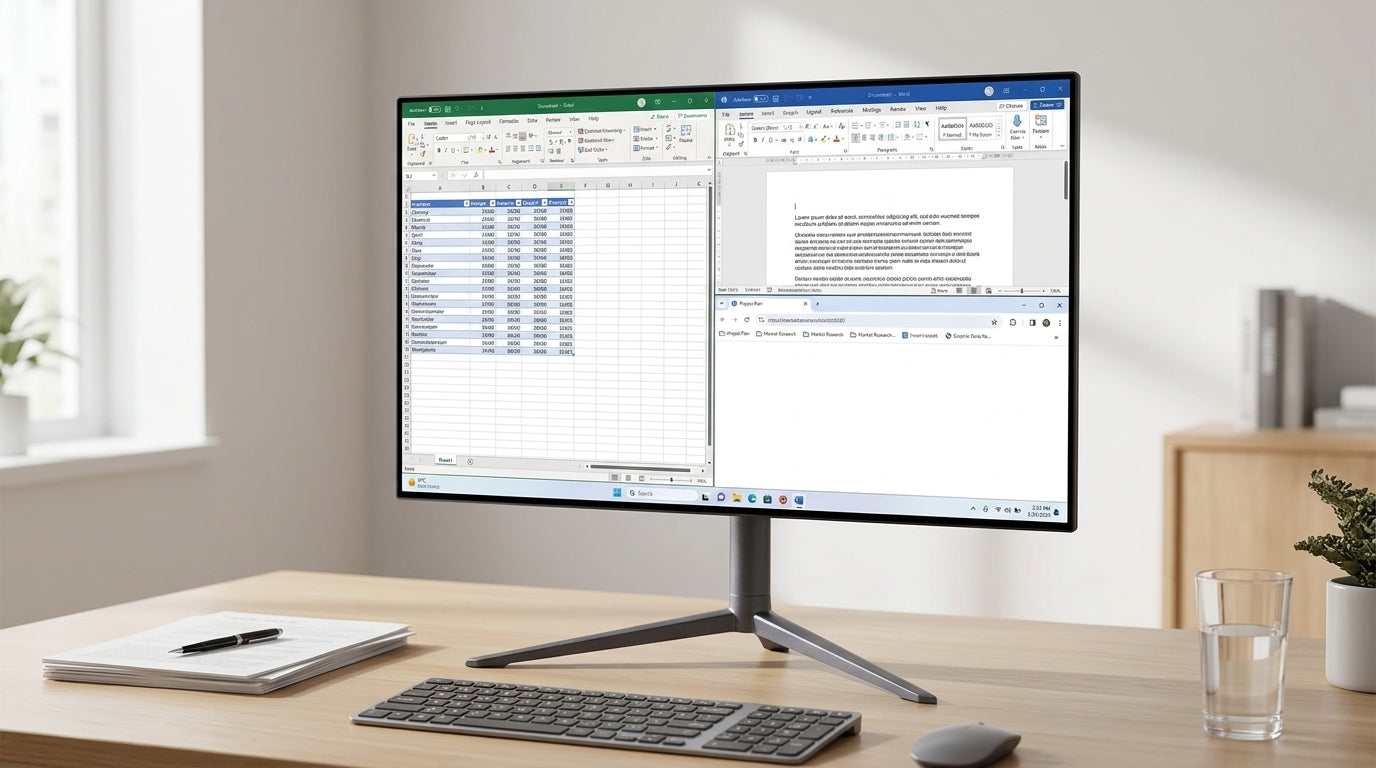
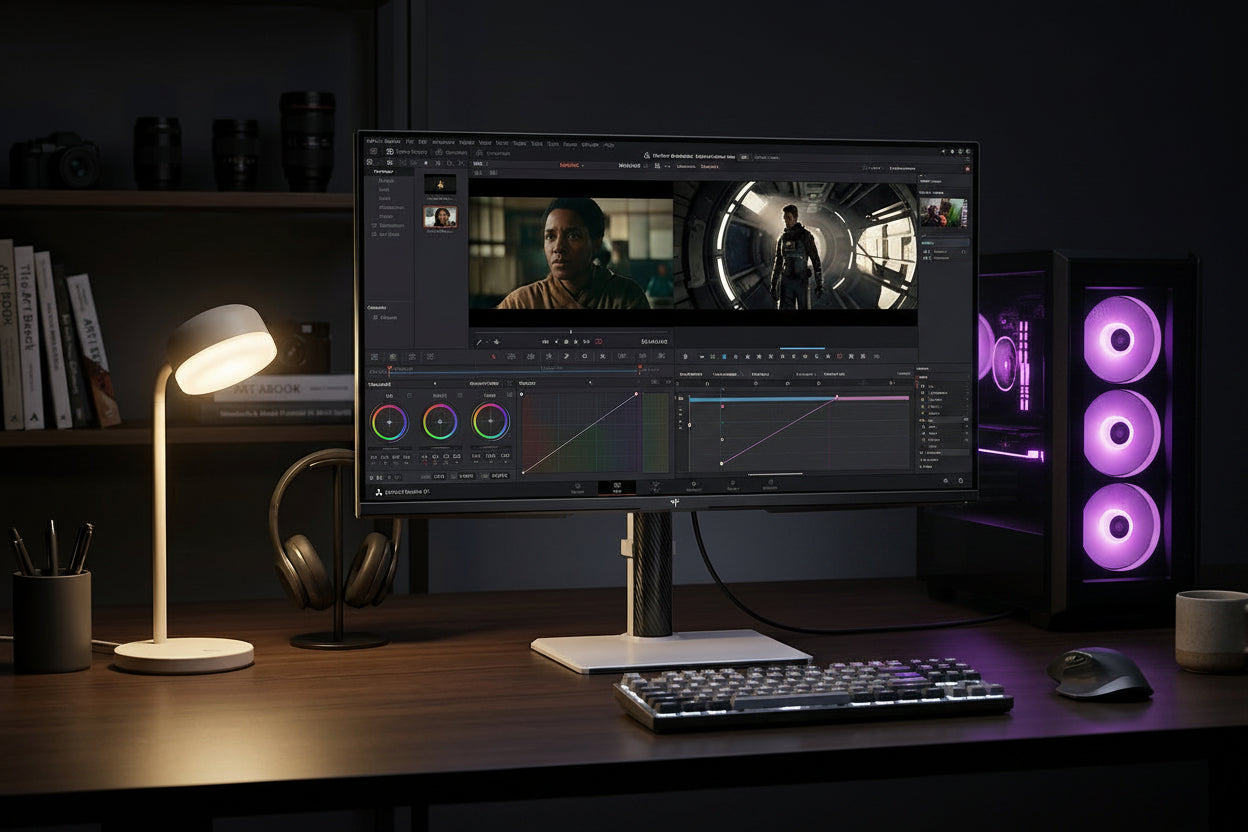
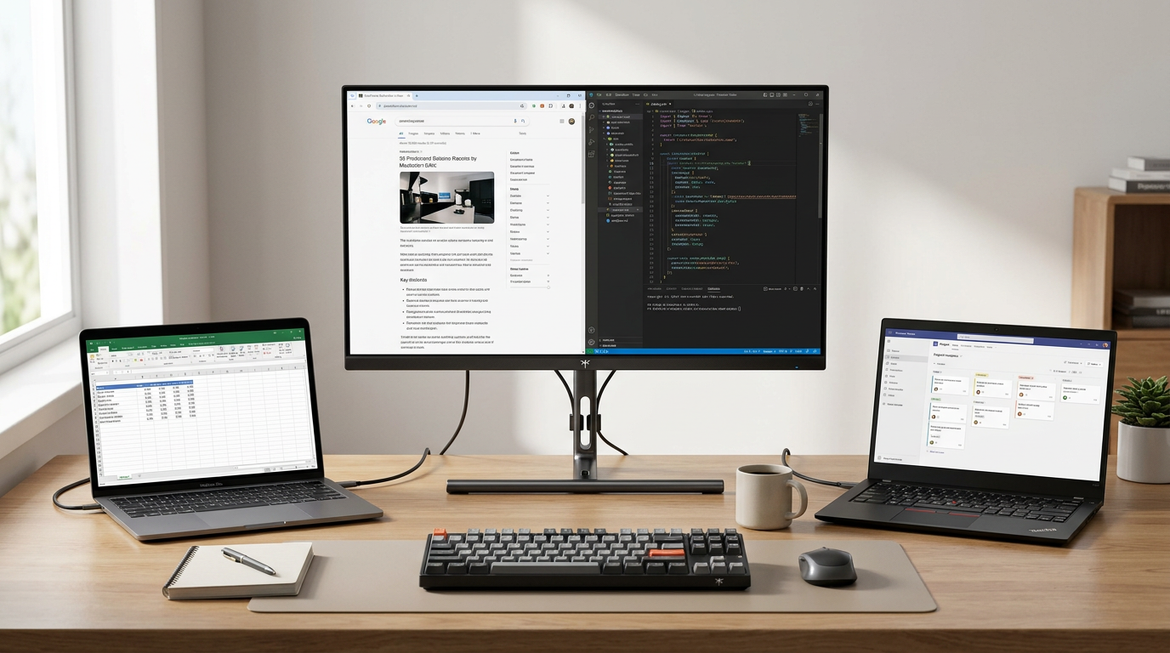
Hybrid workers who split their day between spreadsheets, calls, and casual gaming after hours need one monitor that keeps both workflows comfortable without forcing desk clutter or repeated compromises. The key is selecting a display whose resolution, panel type, refresh rate, and connectivity actually match the 8-hour workday plus evening play rather than chasing peak gaming specs alone.

Why One Desk Demands a Different Kind of Monitor
A standard gaming monitor often prioritizes high refresh rates and vivid colors at the expense of long-session text clarity and eye comfort. Office-focused displays, on the other hand, frequently lack the motion smoothness that makes casual gaming enjoyable. The result is a daily choice between neck strain from poor ergonomics or visual fatigue from flicker during spreadsheets. OSHA guidance on monitor positioning recommends placing the top of the screen at or slightly below eye level with a viewing distance of 20 to 40 inches to reduce neck and eye strain in exactly these mixed-use setups.
The Resolution Trilemma: Choosing Between 1440p, 4K, and 5K
Resolution choices create three distinct paths that rarely overlap perfectly. Windows users with mid-range GPUs usually find 1440p the practical balance of sharpness and frame rates. Mac users, however, often encounter blurry font rendering at the same resolution because macOS scaling favors higher pixel densities. A 4K panel at 144-160 Hz delivers sharp text for productivity while still supporting smooth gameplay on capable hardware. The 5K option provides the cleanest text for Mac professionals but typically caps at 60 Hz, limiting fast-paced gaming.
Use this chart to compare which resolution is the best fit for your setup: 1440p is the easy win for Windows with a mid-range GPU, 4K is the most balanced middle ground, and 5K is the strongest choice for Mac text clarity when gaming refresh rate is less important.
Resolution Fit by OS and GPU
A quick fit guide for choosing a display resolution based on your operating system and graphics hardware.
View chart data
| Scenario | Windows + Mid-range GPU | Windows + High-end GPU | Mac + Mid-range GPU | Mac + High-end GPU |
|---|---|---|---|---|
| 1440p | 3.0 | 2.0 | 1.0 | 1.0 |
| 4K | 2.0 | 3.0 | 2.0 | 2.0 |
| 5K | 1.0 | 1.0 | 3.0 | 2.0 |

Panel Technology for the 8-Hour Workday: Why the 90% Rule Matters
Mini-LED panels deliver high brightness and strong contrast without the static-image burn-in risk that comes with OLED. In a bright home office, the ability to sustain 400-1000 nits helps keep text readable against daylight while still providing HDR impact for evening gaming. Many hybrid users find Mini-LED supplies roughly 90 percent of the visual pop they want from high-contrast displays without the need to constantly manage brightness limits or worry about taskbar retention during long work sessions. The American Academy of Ophthalmology recommends following the 20-20-20 rule during extended screen time regardless of panel type to reduce eye strain.
Connectivity and Ergonomics: Keeping the Hybrid Setup Clean
USB-C with 90 W power delivery can reduce cable clutter for laptop users, yet heavy workloads or certain Mac models may still experience occasional wake-from-sleep issues or power sag at maximum brightness. A built-in KVM switch lets the same keyboard and mouse serve both a work laptop and gaming PC without constant swapping. Proper monitor height and angle further support comfort: the center of the screen should sit 15 to 20 degrees below eye level according to the American Optometric Association to maintain neutral neck posture during long hours.
Avoiding the 'Toggle Tax' and Other Common Pitfalls
Local dimming improves movie and game contrast but can create blooming around text or icons in SDR productivity apps. Models with 1152 or more dimming zones usually keep this effect minimal enough that users can leave the feature enabled. Lower-zone panels often require repeated OSD menu navigation, which quickly becomes tedious. VESA DisplayHDR standards show why higher-tier certifications include 2D local dimming for better black levels, but they also highlight that real-world text clarity still depends on zone count and software controls such as DDC/CI tools.
Which Monitor Spec Fits Your Workflow?
Users who want straightforward productivity with light evening gaming often start with a 27-inch 1440p 100 Hz+ IPS model that offers wide color coverage and simple tilt adjustment. Those prioritizing HDR impact and smoother motion in games tend to choose a 27-inch 1440p Mini-LED panel around 180-200 Hz. A 27-inch 4K 160 Hz Mini-LED option suits high-end hybrid setups that need both sharp text and console-level detail. Mac-focused professionals who value maximum text clarity frequently select the 27-inch 5K 60 Hz display, accepting lower refresh rates in exchange for Retina-level sharpness.
Check the Office Monitor collection for ergonomic 1440p and 4K options, explore the Gaming Monitor collection when higher refresh rates matter, or browse the full 27 inch Monitors range to compare current models side by side.