In 2026, the real bottleneck for many AI developers running local LLMs or generating art isn't just GPU power—it's visual throughput, the ability to view, compare, and manage sprawling context windows, intricate node graphs, and high-fidelity outputs without constant scrolling or tab-switching.
The right monitor setup can dramatically reduce comprehension debt in coding sessions and improve accuracy when evaluating generative outputs, but only if it matches your dominant workflow. LLM-heavy users benefit most from high pixel density and vertical real estate, while generative artists need wide canvases and accurate HDR. This guide helps you identify the practical requirements, compare layout options, and choose specs that genuinely improve daily productivity.

The 2026 AI Workstation Bottleneck: Visual Throughput
While GPU VRAM and inference speed dominate discussions about local AI, the physical workspace often determines how effectively you can iterate. Visual throughput—the volume of code, nodes, documentation, and high-fidelity imagery you can evaluate at once—directly affects how quickly you spot errors, compare outputs, or debug complex prompts.
For local LLM development in tools like Ollama or LM Studio, this means seeing more of a long context window alongside reference material without losing your place. For generative art in ComfyUI or similar node-based pipelines, it means maintaining an uninterrupted view of complex graphs and preview renders. The monitor choice therefore shifts from a secondary peripheral to a core workflow optimizer.
Prosumers assembling an AI workstation should assess their text-to-visual work ratio first. Heavy coding sessions reward crisp text and efficient window management, whereas generative pipelines reward canvas continuity and color accuracy. Getting this balance wrong leads to daily friction that no amount of extra VRAM can fix.
Defining Display Requirements for Local LLM Workflows
When coding and running local LLMs all day, text density matters more than raw size. Higher resolution displays, such as 4K or 5K panels, let you view significantly more lines of code, documentation, and debug output simultaneously. This reduces the cognitive load of constantly scrolling through long context windows or switching between tabs, a benefit widely noted in professional workstation research.

As this productivity study on multiple monitors and resolution shows, increasing visible context directly improves comprehension and reduces errors in data-heavy tasks. For LLM developers, a 27-inch 5K monitor like the KTC H27P3 delivers roughly 218 PPI, making small syntax fonts remain sharp even in dark-mode IDEs.
Subpixel layout also plays a critical role. RGB arrangements generally provide the cleanest text rendering, especially for syntax highlighting. Some OLED panels can introduce fringing that makes color-coded elements harder to distinguish, which is why high-PPI IPS or Mini-LED panels remain the safer default for pure coding. You can explore the mechanics further in our guide to what subpixel layout is and why RGB and RGBW panels look different.
Many developers also rotate a secondary monitor to vertical (portrait) orientation. This creates an ideal “infinite scroll” space for terminal logs, API responses, or lengthy chat histories. Our article on vertical vs. horizontal dual monitor setups explains how portrait mode aligns naturally with code and documentation workflows.
Eye strain becomes a real concern during marathon sessions. Flicker-free backlighting, adequate contrast, and proper ergonomics help maintain focus. Monitors with full height, tilt, and pivot adjustment make it easier to achieve comfortable viewing angles across a dual-monitor array.
Display Requirements for Generative AI Art Workflows
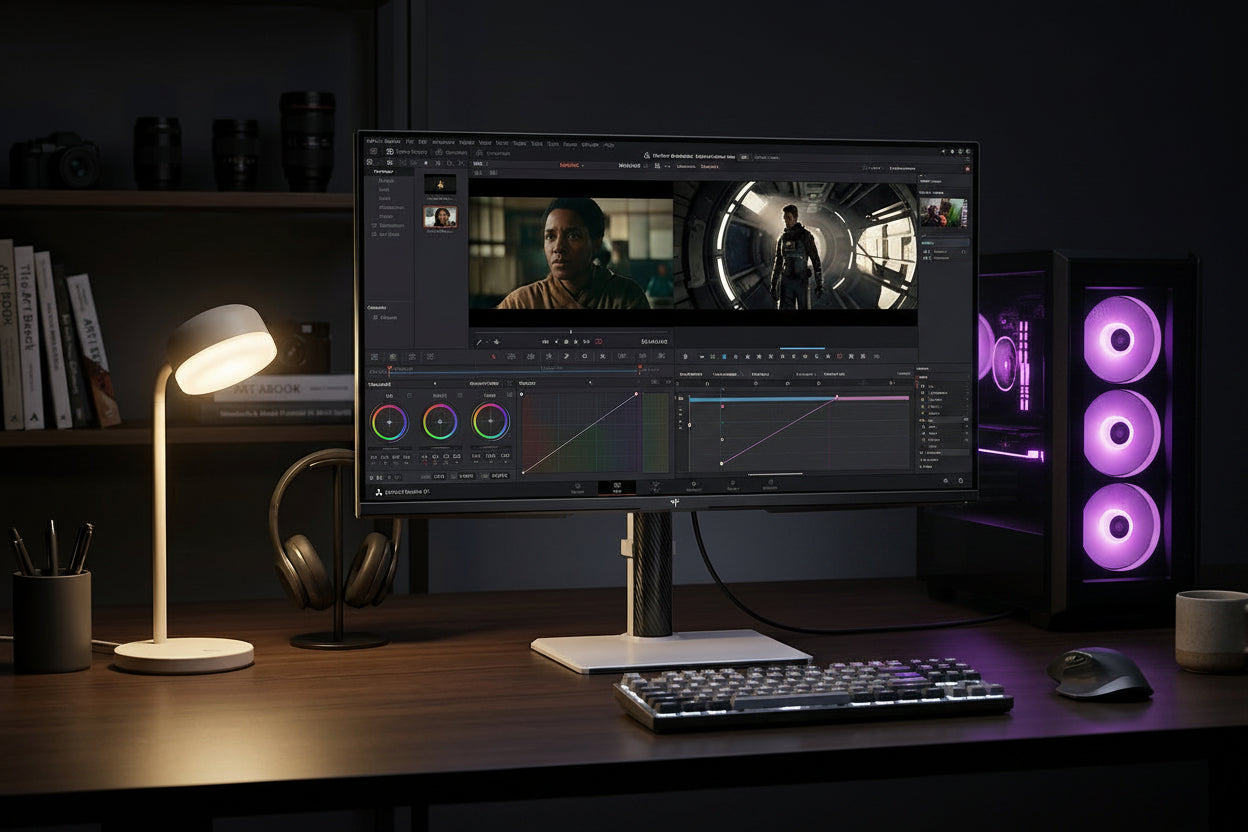
Generative models in 2026, including Luma’s Ray3 and FLUX.2, increasingly output native HDR content with expanded dynamic range. Evaluating these outputs on an SDR monitor often leads to misjudged lighting and textures, causing artists to over-correct prompts and produce final assets that look inconsistent across devices.
The “ghost lighting” effect is particularly common: compressed shadows and highlights on lower-tier displays hide subtle details that the model actually generated. Similarly, insufficient color gamut can turn iridescent or metallic textures into flat blocks, masking prompt-level problems before they reach clients or portfolios.
Professional evaluation therefore requires a clear threshold. VESA DisplayHDR 1000 certification, sustained high brightness, true 10-bit color, and at least 98% DCI-P3 coverage form the practical minimum for serious generative work. Mini-LED panels such as the KTC M27P6 meet these criteria while avoiding the burn-in risks associated with OLED in mixed-use environments.
One daily trade-off is the “toggle tax.” Many Mini-LED monitors perform best with local dimming enabled for HDR content, yet that same feature can produce blooming or halos around text in SDR desktop applications. Users often disable dimming for coding or browsing, then re-enable it for art review—a repeatable but noticeable workflow interruption.
For color-critical decisions, understanding what Delta E values actually mean for your creative work helps separate marketing numbers from real accuracy. Lower Delta E ensures that the colors you see on-screen match the model’s intended output.
The chart below visualizes typical layout trade-offs that emerge when comparing these requirements in practice.
Workstation Layout Trade-off: Dual High-PPI vs Super-Ultrawide
A compact decision aid for choosing between two monitor layouts. Higher values indicate stronger continuity and sharper text; lower values indicate less window-management friction.
View chart data
| Category | Dual High-PPI | Super-Ultrawide |
|---|---|---|
| Workspace Continuity | 3.0 | 5.0 |
| Text Sharpness (PPI) | 5.0 | 3.0 |
| Window Management Friction | 3.0 | 5.0 |
Single-Monitor vs. Multi-Monitor Workstation Layouts
AI developers generally choose between two philosophies: a dual high-PPI setup that maximizes text sharpness and window-snapping discipline, or a single super-ultrawide that offers seamless horizontal continuity for node-based tools.
LLM developers who spend most of their time in code, terminals, and documentation usually prefer dual monitors. A 5K main display paired with a vertical 4K secondary screen provides crisp text density and natural physical boundaries that align with operating-system snap features. The vertical monitor becomes an ideal home for long context histories without forcing horizontal scrolling.
Generative artists working in ComfyUI or similar node-based environments often favor a large ultrawide or super-ultrawide canvas. As NVIDIA’s own ComfyUI workflow guidance notes, these tools expand horizontally; an uninterrupted 49-inch 32:9 display like the KTC H49S66 prevents the constant panning and bezel-jumping that occurs when dragging nodes across separate screens.
Data-science and model-monitoring tasks sit in the middle. Some practitioners report that super-ultrawide monitors improve dashboard continuity, while others prefer dual setups for easier separation of notebooks from logs. Community discussions, such as those on Databricks forums, show both approaches remain viable depending on personal window-management habits.
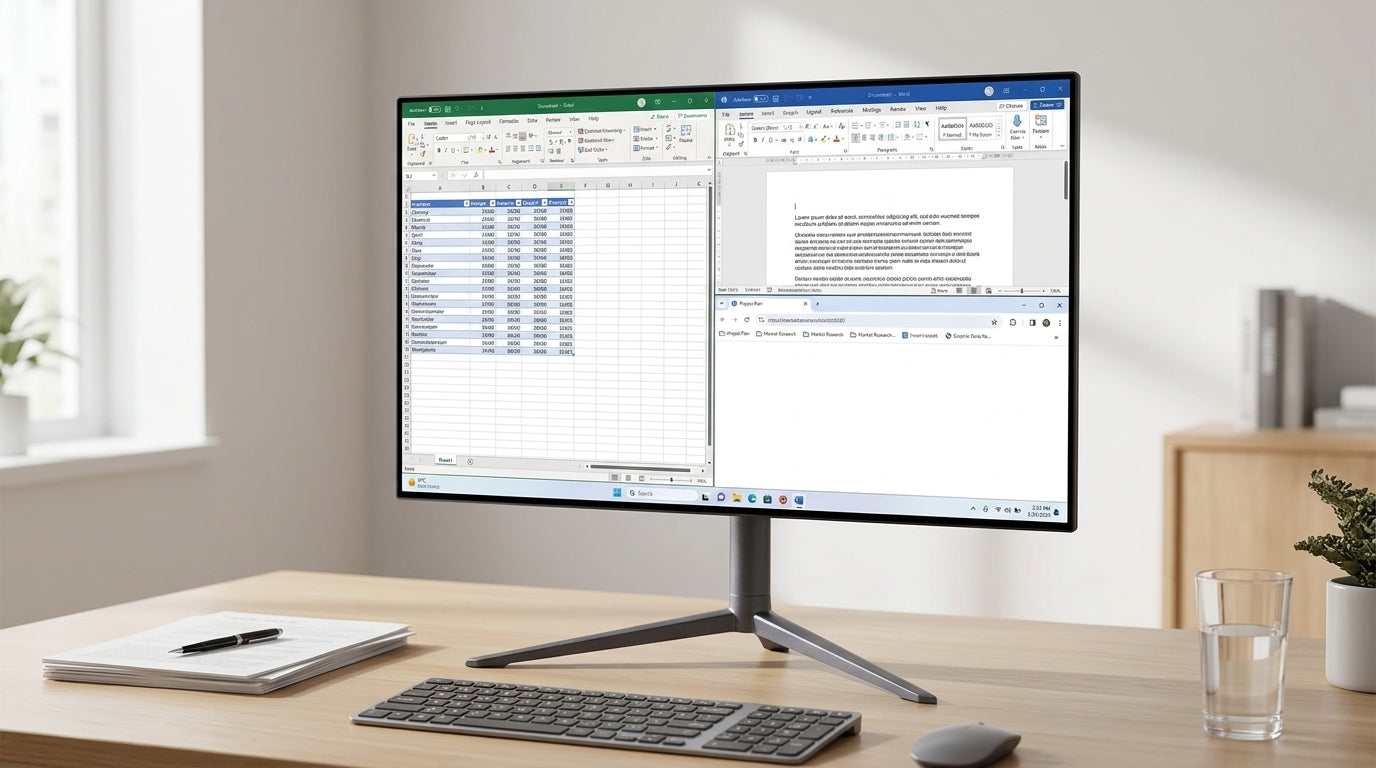
The primary friction with 32:9 displays is software dependency. Without tools like Microsoft PowerToys FancyZones, the vast workspace can feel disorganized. Dual-monitor setups provide built-in physical dividers that many users find more intuitive for partitioning IDE, documentation, and preview panes.
Our deeper exploration of vertical vs. horizontal dual monitor productivity setups offers concrete configuration examples for AI-specific workflows.
Translating Technical Specs into Buyer-Relevant Decisions
Panel technology choices carry concrete daily consequences. Mini-LED models deliver high sustained brightness and thousands of local-dimming zones without burn-in risk, making them practical for mixed coding and creative sessions. OLED offers perfect blacks and vivid contrast ideal for dark-room art evaluation, yet its text clarity can still show fringing in prolonged coding, and static UI elements raise long-term burn-in concerns.
The KTC M27P6 illustrates a pragmatic middle ground: HDR1400 brightness, 98% DCI-P3 coverage, and full ergonomic adjustment without forcing users into OLED maintenance routines. For users who code 80% of the time, high-PPI IPS or Mini-LED panels remain the lower-regret choice.
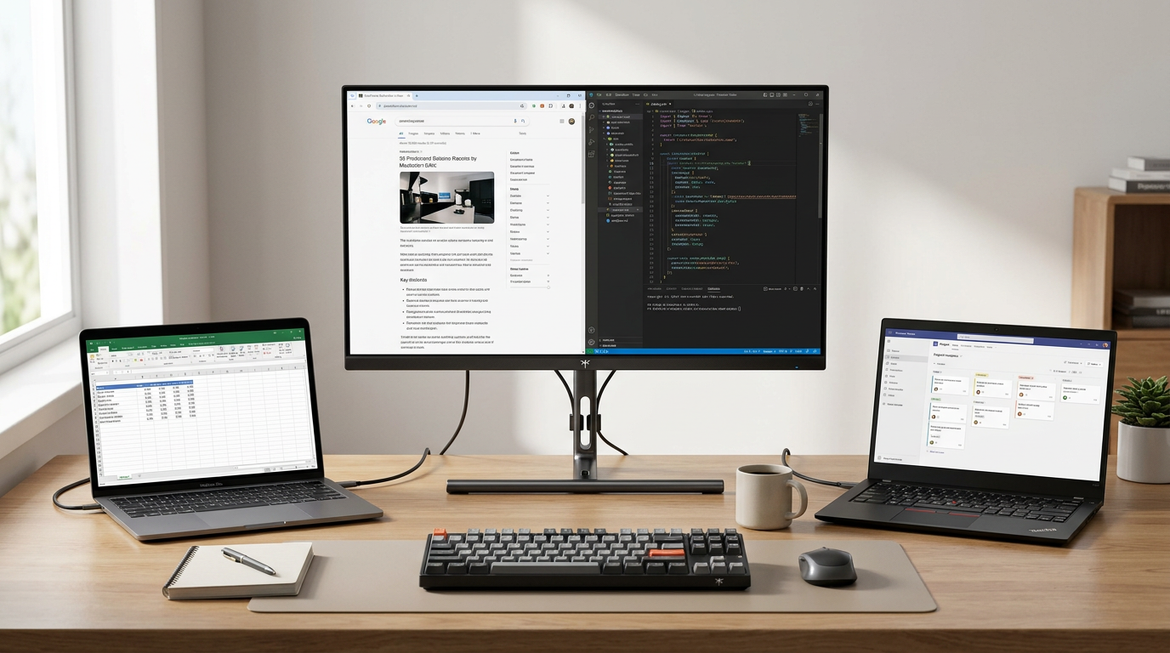
Connectivity features also affect real productivity. 90W USB-C power delivery lets many AI developers run a single-cable MacBook or laptop setup, reducing desk clutter and enabling quick docking. Our guide to how a USB-C monitor can streamline your workspace details the measurable difference this makes in hybrid development environments.
Ergonomics matter when you spend hours comparing outputs. Full height, swivel, and pivot stands let you rotate a secondary monitor to portrait mode or fine-tune viewing angles to minimize neck strain. Fixed-tilt stands often require an additional VESA arm for serious dual-monitor AI stations.
Professional HDR standards emphasize controlled viewing conditions and accurate brightness and color reproduction. As outlined in EIZO’s HDR workflow overview, these factors determine whether you can trust what you see on screen when judging AI-generated content.
A simple heuristic helps cut through the options: if coding dominates your week, prioritize PPI, RGB subpixel layout, and flicker-free IPS/Mini-LED. If generative art and visual evaluation occupy most of your time, prioritize HDR certification, wide color gamut, and horizontal canvas size.
Future-Proofing Your 2026 AI Workspace
The most effective AI workstation monitor is the one that removes friction specific to your dominant tasks—whether that friction is eye strain from low-density text, inaccurate lighting evaluation, or constant window-management overhead.
KTC’s current lineup addresses the major scenarios without forcing unnecessary compromises. The H27P3 5K monitor excels at dense code and documentation viewing. The M27P6 Mini-LED meets the HDR and color thresholds generative artists need. The H49S66 49-inch super-ultrawide provides the expansive canvas ComfyUI users often request.
Before purchasing, calculate your actual text-to-visual ratio over a typical week. That single metric usually clarifies whether high pixel density, HDR performance, or canvas width should take priority. Matching the display to that ratio, rather than chasing the highest headline specification, delivers the largest productivity return in 2026 AI workflows.
FAQs
What resolution is best for local LLM development in 2026?
4K or 5K resolution on a 27-inch panel typically provides the sweet spot. The resulting high PPI keeps small syntax fonts and dense documentation readable, reducing the need to scroll or zoom constantly. A secondary vertical monitor further improves visibility of long context windows and logs.
Do generative AI artists need HDR monitors?
For professional evaluation of 2026 models that output native HDR, yes. HDR1000 or higher with strong DCI-P3 coverage prevents misjudging lighting and texture details that would otherwise lead to repeated prompt revisions. SDR monitors compress the dynamic range, often hiding problems until the final asset is viewed elsewhere.
Is a super-ultrawide better than dual monitors for AI work?
It depends on the dominant task. Super-ultrawides excel at uninterrupted node graphs in ComfyUI and panoramic data dashboards. Dual high-PPI monitors usually work better for LLM coding because they provide physical boundaries for window snapping and maximum text sharpness. Many users combine both by adding a vertical secondary display.
Should I choose Mini-LED or OLED for an AI workstation?
Mini-LED is generally the safer long-term choice for mixed coding and creative use. It delivers high brightness and contrast without burn-in risk from static IDE toolbars or terminal windows. OLED remains attractive for pure dark-room art evaluation if you accept the maintenance steps required to mitigate burn-in.
How important is USB-C power delivery for AI developers?
Very important for laptop-based workflows. 90W or higher USB-C PD allows a single cable to carry video, data, and charging, dramatically reducing desk clutter and setup time when moving between MacBooks, Windows laptops, or portable AI stations.
What causes washed-out syntax highlighting on some monitors?
Poor contrast ratios, inaccurate gamma curves, or incorrect color-temperature settings are the usual culprits. Choosing a monitor with strong sRGB accuracy and calibrating it for your lighting conditions usually restores clear differentiation between syntax colors.
How can I reduce eye strain during long local LLM sessions?
Prioritize flicker-free backlighting, adequate brightness uniformity, and proper ergonomics. A monitor with full height and tilt adjustment lets you maintain a comfortable viewing angle. Taking regular breaks and ensuring ambient room lighting matches screen brightness also helps.