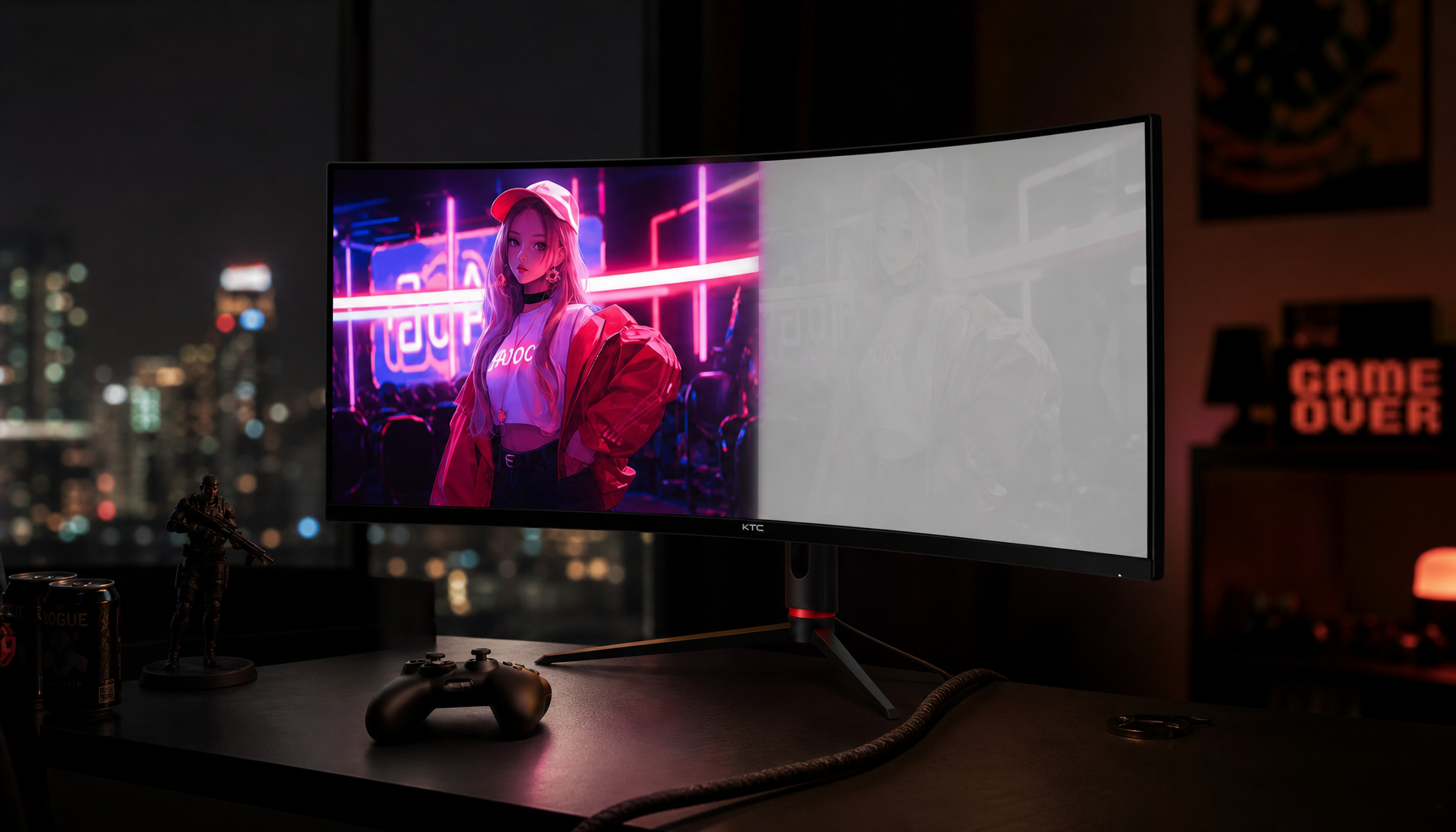
VA panels are slowest in near-black transitions because their crystals are tuned to block light deeply, not leave dark states quickly. That tradeoff creates high contrast but also the black smearing visible in shadow-heavy motion.
The Physics Behind Dark Smearing
VA stands for Vertical Alignment: the liquid crystals sit more upright when blocking light, which helps create deeper blacks than many IPS displays. The tradeoff is that small black-to-gray changes require those crystals to move out of a strongly light-blocking state with high precision.
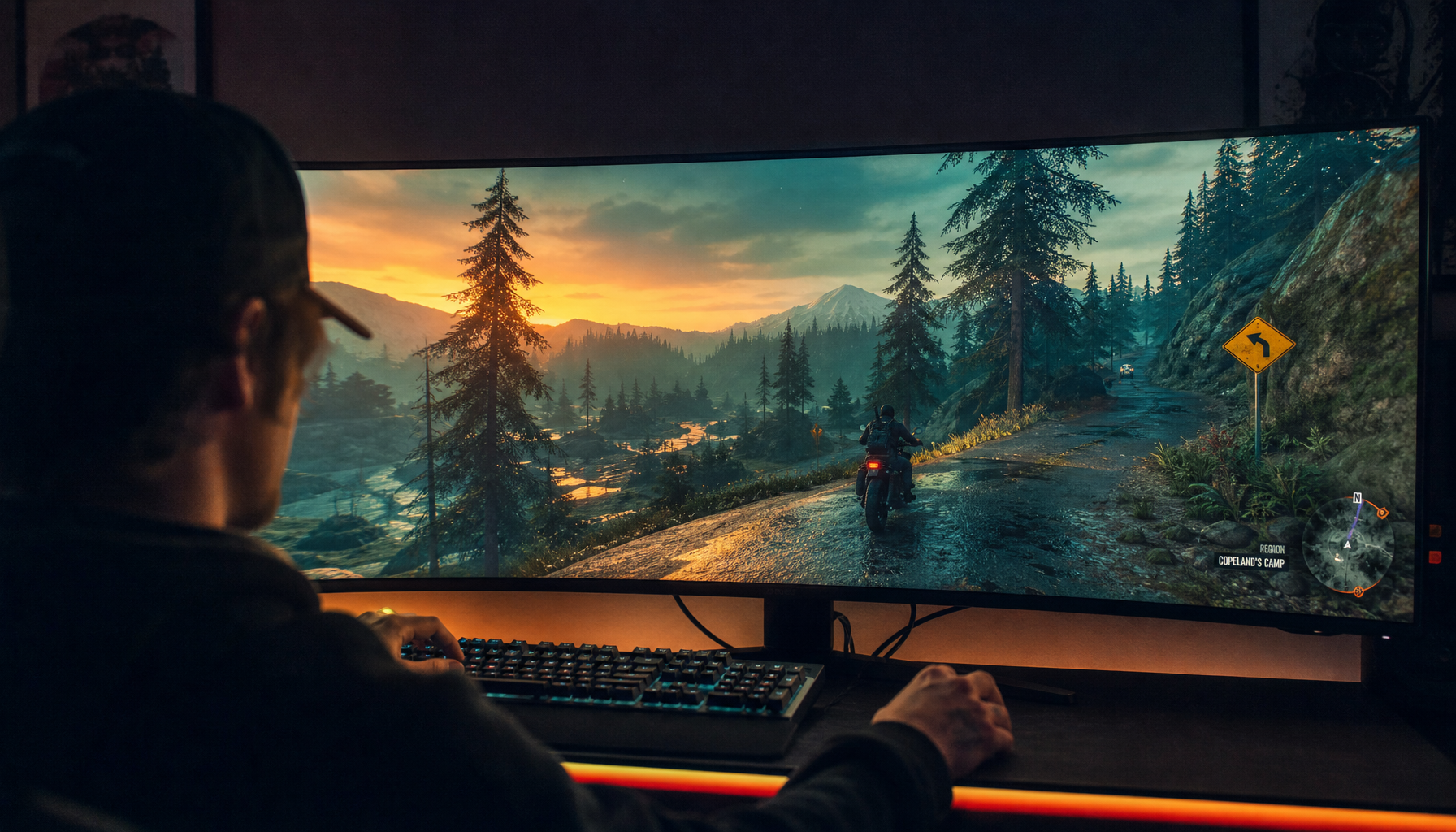
That movement is slower and less uniform than brighter gray-to-gray shifts. This is why dark-level smearing appears as smoky trails behind dark objects, especially in night maps, horror games, and high-contrast UI motion.

Put simply, VA is excellent at keeping backlight leakage under control. Opening that barrier just a little, very quickly, is the hard part.
Why Refresh Rate Exposes the Problem
High refresh rates shorten the time each frame stays on screen. At 144 Hz, a frame lasts about 6.94 ms; if a dark VA transition takes about 20 ms, that pixel can still be catching up for roughly three frames.
At 240 Hz, the window gets even tighter: each frame lasts only 4.17 ms, so response time must be extremely fast to preserve the full clarity benefit of the refresh rate. That is why a 240 Hz VA panel can feel responsive in input latency while still showing blur in dark motion.
This does not make high-refresh VA pointless. It can still feel smoother and more immediate, but motion clarity depends on whether the pixels, especially the darkest ones, can keep up.
Why Overdrive Is Not a Magic Fix
Monitor makers use overdrive to push pixels harder with extra voltage. When tuned well, it speeds transitions and improves tracking in fast games.
The challenge is that dark VA transitions need careful tuning. Push too little, and black smearing remains; push too much, and you get overshoot, also called inverse ghosting, where bright halos trail objects instead.
That is why many VA monitors look best on a middle overdrive setting. Newer VA designs use improved materials, thinner liquid-crystal layers, and higher driving voltage to reduce this weakness, with some faster VA designs targeting 1 ms GTG performance.
Headline 1 ms claims usually describe best-case transitions, not every dark shade a game actually renders.
What This Means for Buyers
Choose VA when contrast, immersion, and dark-room depth matter more than top-tier motion purity. A good VA panel can make space games, RPGs, movies, and curved ultrawide setups feel richer than a typical IPS screen.

Choose IPS or OLED if your priority is cleaner motion in competitive shooters. Fast IPS delivers more consistent transitions, while OLED offers near-instant pixel response with premium pricing and burn-in considerations. For an OLED comparison point, the KTC OLED 27” 2K 240Hz/0.03ms USB-C Gaming Monitor is a 27-inch 2560×1440 240Hz OLED option to weigh if dark-motion clarity matters more to you than VA contrast.
- Pick VA for deep blacks, cinematic contrast, and value.
- Pick Fast IPS for competitive shooters and cleaner motion.
- Start with medium overdrive, then test in dark scenes.
- Match refresh rate to GPU output, not spec-sheet hype.
- Read motion testing, not just the advertised response time.
The Bottom Line
VA panels are slower in dark transitions because their biggest strength, blocking light for high contrast, also makes near-black pixel movement harder to accelerate cleanly. For immersive gaming and media, that tradeoff can be worth it; for high-level competitive play, response consistency usually matters more than contrast alone.