An ultrawide monitor usually has one native panel resolution, but its spec sheet may also list input, scaled, split-screen, or connection-limited resolutions. The number that matters most for image sharpness is the native resolution; the number that matters for compatibility is the supported signal resolution.
You are comparing two gaming monitors, and one spec table says 5120 x 1440 while another line says 3840 x 2160, 3440 x 1440, or 2560 x 1440. That can make a monitor look like it has two screens hiding inside one panel, or like the advertised resolution changes depending on the cable. The practical benefit of reading these lines correctly is simple: you can predict the real desktop space, gaming sharpness, refresh rate, and cable requirements before you buy.
The Short Answer: One Panel, Several Signal Modes
Most ultrawide monitors are fixed-pixel displays. That means the panel has a physical grid of pixels, and display resolution is commonly written as width x height, such as 3440 x 1440 or 5120 x 1440. On this kind of monitor, the native resolution is the panel’s real pixel grid.

The second resolution in a spec sheet is usually not a second native resolution. It is often a supported input format, a recommended PC setting, a console fallback mode, a picture-by-picture layout, or a lower-bandwidth mode used by a common video input, a USB-style video connection, or an older PC display connection.
For buyers, the key question is not “Which number is bigger?” It is “Which resolution can this monitor show natively at the refresh rate I want, through the port I plan to use?”
Resolution Terms That Get Mixed Together
Native Resolution
Native resolution is the monitor panel’s fixed pixel grid. A 3440 x 1440 ultrawide panel has about 4.95 million pixels, while a 2560 x 1440 16:9 monitor has about 3.69 million pixels. That difference matters in games because the graphics card has to render more pixels on the ultrawide screen before refresh rate and visual settings are even considered.
For image quality, native resolution is the cleanest target. Native resolution gives 1:1 pixel mapping, so text, HUD elements, desktop windows, and game edges are not being stretched across a different grid.
Maximum Supported Resolution
Maximum supported resolution means the highest signal format the monitor can accept from a source device. A monitor may accept a 3840 x 2160 signal from a console or laptop even if its panel is not physically 3840 x 2160. In that case, the monitor scales the signal to fit its actual pixel grid.
This is useful for compatibility but easy to misread. If a 3440 x 1440 ultrawide lists 3840 x 2160 under a common video input support, that does not make it a native 4K display. It means the monitor may be able to receive a 4K video signal, then downscale or crop it depending on the monitor’s firmware and aspect-ratio settings.
Recommended Resolution
Recommended resolution is the setting the operating system or monitor maker expects most users to choose. On a gaming PC connected to a 3440 x 1440 ultrawide, the recommended setting should normally match 3440 x 1440. If it does not, the first suspects are the cable, port version, graphics output, dock, adapter, or monitor input mode.
This term is especially important with portable monitors and USB-style displays. A USB-style connection can carry video through a PC display alternate mode, but some setups divide lanes between display data and USB data, which can limit the resolution or refresh rate available over that one cable.
Aspect-Ratio Modes
Ultrawide monitor specs often list several resolutions because ultrawide formats cover more than one shape. The consumer term “21:9” can describe several ratios, and ultrawide formats include common monitor resolutions such as 2560 x 1080, 3440 x 1440, and 5120 x 2160.
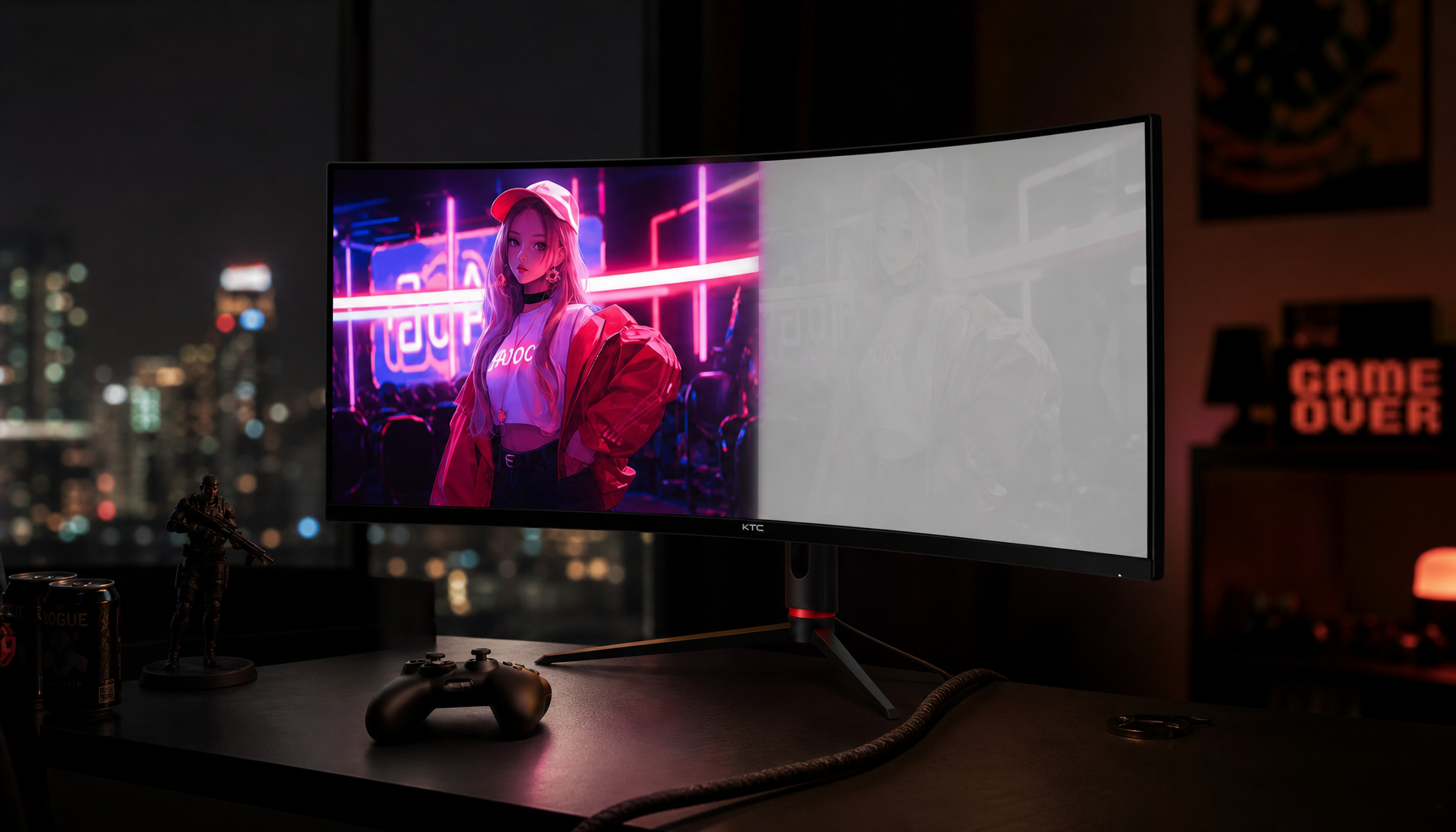
A 32:9 super-ultrawide is even more likely to show multiple resolution labels. A 5120 x 1440 monitor is often described as “dual QHD” because it is roughly like placing two 2560 x 1440 screens side by side. That marketing phrase is helpful for imagining workspace width, but the panel is still one 5120 x 1440 grid.
Why Two Resolutions Appear in Ultrawide Specs
Panel Resolution vs. Accepted Input Resolution
The most common reason is that the monitor has one native panel resolution but accepts several incoming video resolutions. A fixed-grid display can use a scaling engine to match the incoming signal to the panel, so input resolution is not always the same as native resolution.
For example, a 3440 x 1440 ultrawide may support 2560 x 1440, 1920 x 1080, and 3840 x 2160 input. A PC should use 3440 x 1440 for the sharpest desktop. A console may output 3840 x 2160 or 1920 x 1080 because many consoles are designed around 16:9 formats rather than 21:9 ultrawide output.
Full-Screen, Scaled, and 1:1 Modes
Monitor menus often include aspect-ratio options such as full, auto, 16:9, 21:9, or 1:1. These settings decide what happens when the incoming signal does not match the panel shape. A 1920 x 1080 input can be stretched across the whole ultrawide screen, centered with black side bars, or scaled while preserving its original shape.
This is why a lower resolution may look soft even when the spec sheet says it is supported. Dropping a 2560 x 1440 monitor to 1920 x 1080 reduces rendered pixels by about 44%, but the screen still has to stretch that image across the native panel grid. The result can be softer text, less precise UI edges, and more visible scaling artifacts.
Picture-by-Picture and Split-Screen Modes
Many 32:9 monitors support picture-by-picture, often shortened to PBP. In this mode, the monitor behaves like two displays inside one physical panel. A 5120 x 1440 monitor may run as two 2560 x 1440 halves, each receiving a separate input from one PC or from two different devices.

For example, a brand’s 49-inch DQHD 180Hz 1000R curved gaming monitor is listed as a 49-inch DQHD 5120 x 1440 ultrawide, so a QHD-style split-screen mode should be read as a divided use of the full panel rather than a separate native resolution.
This is not the same as having two native resolutions. It is one 5120 x 1440 panel being divided into zones. For productivity, this can be excellent: one side can show a work laptop, while the other side shows a gaming PC, streaming dashboard, or editing timeline. For full-screen gaming, however, you usually want the full native resolution mode instead of PBP.
Connection Type Can Change the Resolution and Refresh Rate
Resolution does not travel alone. The cable also has to carry refresh rate, color depth, HDR data, and timing overhead. Bandwidth demand rises with horizontal pixels, vertical pixels, refresh rate, and bit depth, which is why the same monitor may list different limits for a common video input, a PC display connection, and a USB-style video connection.

Refresh rate is separate from frame rate: refresh rate is how many times per second the display can show a new image, while frame rate is how many images the PC or console generates. For gaming monitors, the spec that matters is the full combination, such as 3440 x 1440 at 144 Hz, 5120 x 1440 at 240 Hz, or 3840 x 2160 at 120 Hz.
A practical example: a 3840 x 2160 monitor at 160 Hz with 10-bit color can require about 35.8 Gbps before extra HDR demands. One common PC display connection version has about 25.9 Gbps of effective uncompressed bandwidth, so high-resolution, high-refresh displays often rely on display signal compression, lower color settings, or a newer interface to hit their advertised modes.
Spec Line You See |
What It Usually Means |
What to Check Before Buying |
Native: 3440 x 1440 |
Physical panel grid |
Use this for sharp PC gaming and desktop work |
Maximum input: 3840 x 2160 |
Signal the monitor can accept |
Confirm whether it downscales, crops, or adds black bars |
Common video input: 2560 x 1440 at 144 Hz |
Port-specific mode |
Check input version and graphics or console output |
PC display connection: 3440 x 1440 at 165 Hz |
Best PC mode in many cases |
Use the included cable or a certified replacement |
USB-style video connection: 3440 x 1440 at 60 Hz |
USB-style bandwidth or lane limit |
Check whether the port also carries USB data and charging |
Split-screen input mode |
Useful for two sources, not full-screen ultrawide gaming |
How This Affects Gaming, Consoles, and Work Setups
PC Gaming
For PC gaming, the target should usually be the monitor’s native resolution at the highest refresh rate your graphics card can sustain. A 3440 x 1440 ultrawide renders about 4.95 million pixels per frame, so it is heavier than standard 2560 x 1440 but lighter than 3840 x 2160. If your graphics card struggles, use render scale, quality upscaling, or moderate anti-aliasing before forcing the monitor to run at a lower output resolution.
Anti-aliasing can smooth jagged edges, but it does not create real panel pixels. If a game is rendered at 2560 x 1080 and stretched to 3440 x 1440, the monitor or graphics processor still has to estimate missing detail. That is why native output with adjusted internal render scale often looks cleaner than changing the desktop resolution.
Console Use
Console support is where dual-resolution specs cause the most confusion. Many consoles are built around 16:9 output modes such as 1920 x 1080, 2560 x 1440, or 3840 x 2160. A 21:9 or 32:9 ultrawide may accept those signals, but that does not guarantee true ultrawide gameplay.

If the monitor accepts 4K input, a console may send 3840 x 2160 even though the panel is 3440 x 1440. The monitor may downscale the image and show it with black bars, stretch it, or preserve the 16:9 shape depending on settings. For console-first buyers, the “supported input” line can matter more than the native ultrawide resolution because it controls whether the console recognizes the display properly.
Productivity and Portable Monitor Setups
For work, two different resolutions can be a feature rather than a warning sign. A 49-inch 32:9 monitor running at 5120 x 1440 gives a wide canvas for spreadsheets, timelines, dashboards, and side-by-side browser windows. In PBP mode, it can also behave like two 2560 x 1440 monitors without a center bezel.
Portable monitors and USB-style ultrawides require extra care. PC display alternate mode over a USB-style connection can share lanes between video and USB data, so a dock that works fine at 60 Hz may fail to unlock 120 Hz, 144 Hz, or 165 Hz. If the monitor’s best mode is only listed under a PC display connection, assume a USB-style connection may be more limited unless the spec sheet clearly says otherwise.
How to Read a Dual-Resolution Spec Sheet
Start with the native resolution. That tells you the real pixel grid, desktop workspace, gaming workload, and expected sharpness. Then read the port table, because it tells you which cable can actually deliver that resolution at the advertised refresh rate.
Next, separate PC modes from console and fallback modes. A monitor may advertise 5120 x 1440 at 240 Hz over a PC display connection, 5120 x 1440 at 144 Hz over a common video input, and 3840 x 2160 at 60 Hz as a supported input. Those are not contradictions; they are different signal paths and use cases.
Finally, watch for footnotes. Small print about display signal compression, HDR, 10-bit color, USB-style lane sharing, included cables, or “recommended resolution” can decide whether the monitor performs as expected on your actual desk.
Practical Next Steps
Use this checklist before you treat two listed resolutions as a problem:
- Identify the native resolution and treat it as the real panel sharpness number.
- Check the refresh rate next to that native resolution, not the highest refresh rate listed anywhere on the page.
- Match the mode to the port you will use: a common video input, a PC display connection, or a USB-style video connection.
- Confirm your graphics card, laptop, dock, or console supports the same resolution and refresh-rate combination.
- Look for display signal compression, HDR, and 10-bit color notes if you are buying a high-refresh-rate ultrawide.
- For console use, check whether 16:9 signals are centered, stretched, downscaled, or shown with black bars.
- For PBP setups, confirm each half’s resolution and refresh rate separately.
The safest buying rule is straightforward: if you want the monitor for PC gaming, prioritize native resolution plus refresh rate over “maximum supported resolution.” If you want it for console use, prioritize accepted input formats and aspect-ratio behavior. If you want it for productivity, check whether the monitor supports the split-screen mode you actually plan to use.
FAQ
Q: Does an ultrawide monitor with two listed resolutions have two native resolutions?
A: Usually, no. The panel normally has one native pixel grid, such as 3440 x 1440 or 5120 x 1440. The second number is commonly a supported input signal, scaled mode, split-screen mode, or port-specific limit.
Q: Why would a 3440 x 1440 monitor list 3840 x 2160 in the specs?
A: It may accept a 3840 x 2160 4K signal from a console, media player, or laptop and then scale it to the ultrawide panel. That helps compatibility, but it does not turn the monitor into a native 4K display.
Q: Which resolution should I choose in the operating system or a game menu?
A: For the sharpest image, choose the monitor’s native resolution. If performance is too low in games, keep the output at native resolution and reduce internal render scale, use quality upscaling, or adjust anti-aliasing before switching the whole display to a lower resolution.