Ultrawide monitors often cost more because the diagonal inch number hides what buyers are really paying for: a wider panel shape, more pixels, gaming-grade electronics, curvature, and a smaller specialty market.
If a 34-inch ultrawide seems overpriced next to a 32-inch standard monitor, the comparison may feel unfair because both boxes advertise a similar size. In practice, a 3440 x 1440 ultrawide asks your computer to render just under 5 million pixels, about 35% more than standard 2560 x 1440. This guide breaks down where the premium comes from and how to judge whether it is worth paying.
Why Price Per Inch Misleads Monitor Buyers
Monitor size is usually sold as a diagonal measurement, but that single number does not tell you the width, height, area, resolution, or workload of the display. A display’s stated size is the diagonal distance across the viewable image area, while the actual experience depends heavily on aspect ratio and pixel resolution display size. That is why a 34-inch ultrawide and a 34-inch standard widescreen monitor can feel like different products even before you compare refresh rate, panel type, or ports.
The trap is simple: diagonal inches reward height differently than width. A 34-inch 21:9 ultrawide is much wider and shorter than a 34-inch 16:9 monitor. It can feel larger for timelines, spreadsheets, racing games, and cinematic games, but it may not give as much vertical room for reading long documents or editing portrait photos.
The Same Diagonal Does Not Mean the Same Screen
Aspect ratio describes the relationship between screen width and height, and common monitor formats include 16:9, 16:10, and wider layouts used for gaming and multitasking aspect ratio. That is the key reason price per inch becomes a weak value metric for ultrawide monitors.
A practical way to think about it:

Monitor Type |
Common Size |
Aspect Ratio |
Common Resolution |
Approx. Screen Area |
Best Comparison |
Standard QHD monitor |
27 inches |
16:9 |
2560 x 1440 |
312 sq in |
Baseline for 1440p gaming |
Ultrawide QHD monitor |
34 inches |
21:9 |
3440 x 1440 |
419 sq in |
Similar height to 27-inch QHD, much wider |
Standard 4K monitor |
32 inches |
16:9 |
3840 x 2160 |
438 sq in |
More vertical space and more pixels |
Super ultrawide |
49 inches |
32:9 |
5120 x 1440 |
Varies by curve and model |
Like two 27-inch QHD screens side by side |
The most useful comparison is not always 34 inches versus 34 inches. For many desk setups, a 34-inch ultrawide competes more directly with a 27-inch QHD monitor plus extra horizontal workspace, or with a dual-monitor setup without the center bezel.
You Are Paying for Width, Not Just Size
A standard 27-inch 1440p monitor gives you a tall, balanced rectangle. A 34-inch ultrawide gives you roughly the same height class but adds meaningful width for side-by-side windows, video timelines, racing games, flight simulators, and wide field-of-view scenes. That extra width is the main reason the monitor feels premium even when the diagonal number does not look dramatically larger.
The economics change because ultrawide buyers are not just buying inches. They are buying a less common panel format, usually with a higher native resolution than standard 1440p. A 2560 x 1440 standard monitor has about 3.7 million pixels, while a 3440 x 1440 ultrawide has just under 5 million pixels and creates about 35% more GPU workload 3440 x 1440 ultrawide. That additional pixel count affects the panel, scaler, refresh-rate tuning, cable bandwidth, and the graphics card needed to drive it well.

Why a 34-Inch Ultrawide Often Costs More Than a 27-Inch QHD Display
The 34-inch ultrawide has to deliver a wider image at the same 1440-pixel height. For productivity, that means more room for two full-size browser windows, a code editor beside documentation, or a video editing timeline with fewer horizontal scrolls. For gaming, it means more peripheral image detail when the game supports the wider aspect ratio.
That extra width also makes defects more expensive. A larger, wider panel has more surface area where dead pixels, uniformity problems, backlight bleed, OLED banding, or curve-related alignment issues can appear. Manufacturers have to bin, test, and tune these panels for a smaller audience than mainstream 24-inch, 27-inch, and 32-inch 16:9 monitors.
Resolution and Refresh Rate Raise the Real Cost
Ultrawide gaming monitors tend to combine several expensive traits in one product: a wide panel, higher pixel count, fast refresh rate, adaptive sync, low response times, HDR features, modern connector hubs, KVM switches, or OLED and mini-LED backlighting. Any one of those features can raise cost. Combining them in a 21:9 or 32:9 format raises the difficulty further.
For example, a 3440 x 1440 monitor at 144 Hz is pushing far more data than a 2560 x 1440 monitor at the same refresh rate. That does not automatically mean the ultrawide is better, but it explains why it costs more to make and why it needs stronger hardware to use properly. A buyer pairing a 34-inch ultrawide with a midrange graphics card may need to lower settings in demanding games, while the same computer might handle standard 1440p more comfortably.
Gaming Features Add Cost Quickly
High-refresh-rate ultrawides are especially expensive because they sit at the intersection of wide-format panels and performance display engineering. A 165 Hz or 240 Hz ultrawide has to refresh millions of pixels quickly and consistently while keeping motion clear, input lag low, and adaptive sync stable.
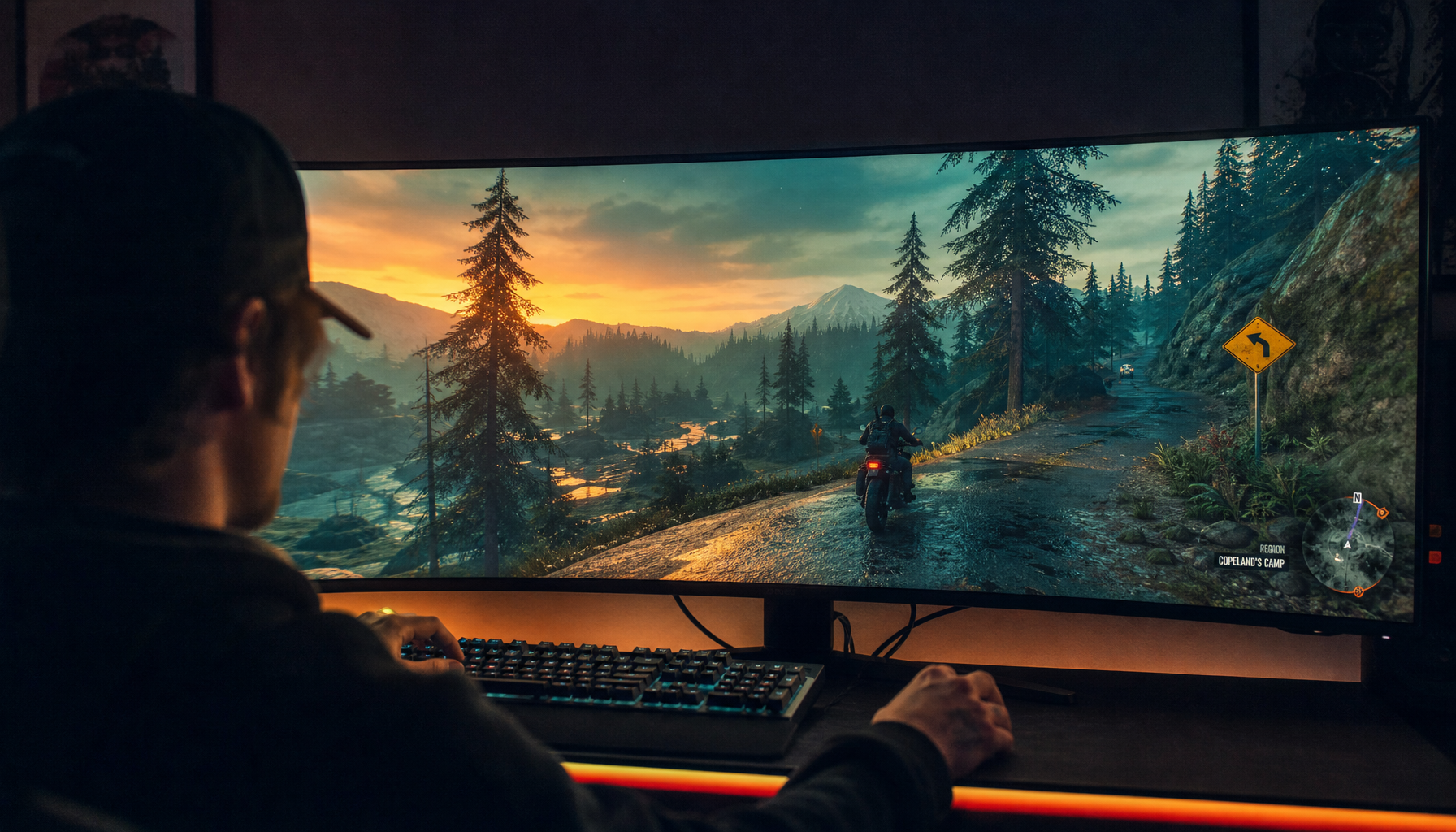
That premium is easier to justify if you play immersive games that support 21:9 well: racing, open-world RPGs, flight sims, space sims, and cinematic single-player titles. It is harder to justify if your main games are competitive shooters that lock the image to 16:9 or use black bars to avoid giving ultrawide users extra peripheral vision. Some modern games still do not fully support 21:9, and some cutscenes appear with black bars on both sides modern games.

Curved Panels and Specialty Formats Add Manufacturing Complexity
Many ultrawide monitors are curved because a wide flat panel can make the far left and right edges feel distant from the viewer. A curve can improve comfort by bringing the edges into a more natural viewing angle, especially on 34-inch, 38-inch, 45-inch, and 49-inch displays. That curve is not just a style choice; it affects panel production, structural design, packaging, shipping protection, and quality control.

A curved ultrawide also needs a stand that can handle a wider load without wobble. The monitor may require a deeper desk, stronger arm, or compatible mount with higher weight support. These practical details are part of the real cost of ownership, even though they do not appear in a simple price-per-inch comparison.
The Market Is Smaller, So Discounts Are Less Aggressive
Standard 24-inch and 27-inch monitors sell in large volumes to offices, schools, home users, and gamers. That scale helps push prices down. Ultrawides are more specialized: they appeal strongly to gamers, video editors, traders, developers, and productivity-focused home office users, but they are not the default monitor choice for every desk.
That smaller market means fewer budget models, fewer panel suppliers, and fewer aggressive sale prices. A mainstream 27-inch 1440p 144 Hz monitor may have dozens of close competitors at any given time. A specific 34-inch OLED ultrawide, 38-inch productivity ultrawide, or 49-inch super ultrawide may have only a few direct rivals, which keeps prices higher for longer.
When the Ultrawide Premium Is Worth Paying
An ultrawide is worth considering when width directly improves your daily workflow or game experience. If you regularly keep two or three windows open, edit long timelines, compare documents, work in large spreadsheets, or play immersive titles, the wider canvas can replace a dual-monitor setup with a cleaner single-panel experience. You avoid a center bezel, reduce cable clutter, and keep the main work area centered.
For first-hand buying logic, compare the ultrawide against the setup it replaces. If a 34-inch ultrawide costs $650.00 but replaces two $300.00 monitors plus an arm, the premium may be reasonable. If it costs $1,200.00 and you mostly browse, email, and play 16:9 esports titles, a fast 27-inch or 32-inch standard monitor may deliver better value.
Good Use Cases
Ultrawides make the most sense for:
- Video editing, because timelines benefit from horizontal space.
- Software development, because code, previews, terminals, and documentation can fit side by side.
- Sim racing and flight simulation, because peripheral width adds immersion.
- Open-world and cinematic gaming, when the game supports 21:9 properly.
- Home office desks where one clean monitor is preferable to two separate displays.
They make less sense when vertical space matters more than width. Writers, researchers, photographers, and spreadsheet users may prefer a 32-inch 4K display, a 27-inch 1440p monitor in portrait orientation, or a dual-monitor setup with one screen rotated.
How to Evaluate Ultrawide Value Before Buying
Do not start with price per inch. Start with the job the monitor needs to do. A good buying comparison should include aspect ratio, resolution, refresh rate, panel type, curve, desk depth, GPU requirements, warranty terms, and whether your apps or games handle the wider format well.
Screen size needs more than one descriptor when aspect ratios differ one number. For monitors, the minimum useful description is diagonal size plus aspect ratio plus resolution. A “34-inch monitor” is incomplete; “34-inch 21:9 3440 x 1440 at 165 Hz” tells you much more about value and hardware demands.
At the high end, a 49-inch DQHD 180Hz 1000R curved monitor like a high-end ultrawide model can be a useful comparison anchor: it shows how width, resolution, refresh rate, and curvature compound the ultrawide premium before you decide whether a smaller 21:9 screen or a standard 16:9 display is enough.
Action Checklist
- Measure your desk depth and width before shopping; large curved ultrawides need more physical room than their diagonal size suggests.
- Compare height, not just diagonal size; a 34-inch ultrawide is closer to a 27-inch 16:9 monitor in height.
- Check your GPU against the monitor’s native resolution and refresh rate, especially for 3440 x 1440 or 5120 x 1440 gaming.
- Search your top five games for 21:9 or 32:9 support before paying a gaming premium.
- Decide whether you need OLED, mini-LED, IPS, or VA based on your use: gaming motion, text clarity, contrast, or office longevity.
- Budget for a monitor arm if the included stand is too deep or too limited.
- Use price per usable workflow, not price per inch, as the final decision metric.
FAQ
Q: Is a 34-inch ultrawide bigger than a 32-inch standard monitor?
A: It is wider, but not always bigger in total screen area. A 34-inch 21:9 ultrawide is usually shorter than a 32-inch 16:9 monitor and has similar height to a 27-inch 16:9 monitor. It feels larger for horizontal workflows, but a 32-inch 4K monitor gives more vertical space.
Q: Why do ultrawide gaming monitors cost more than regular gaming monitors?
A: They often combine wide panels, higher pixel counts, fast refresh rates, adaptive sync, curved glass, stronger stands, and more complex tuning. A 3440 x 1440 ultrawide also requires about 35% more rendering work than standard 2560 x 1440, so the display and the computer both have more to handle.
Q: Should I buy an ultrawide or two standard monitors?
A: Buy an ultrawide if you want one continuous workspace, immersive gaming, and no center bezel. Buy two standard monitors if you need flexible positioning, one portrait display, easier window separation, or lower replacement cost. For many office users, two 27-inch 1440p monitors remain the better value; for gaming and timeline-heavy work, one good ultrawide can feel cleaner.
Key Takeaways
Ultrawide monitors cost more per advertised inch because the inch count is the wrong measuring stick. The premium usually comes from the wider aspect ratio, less common panel format, higher pixel workload, curvature, gaming features, and smaller production scale.
The most practical buying rule is this: compare a 34-inch ultrawide against a 27-inch 1440p monitor plus extra width, not against a random standard monitor with a similar diagonal. If the added width improves your games, timelines, multitasking, or desk layout every day, the premium can make sense. If you only want the most screen area or sharpness for the money, a standard 27-inch QHD or 32-inch 4K display is often the smarter buy.