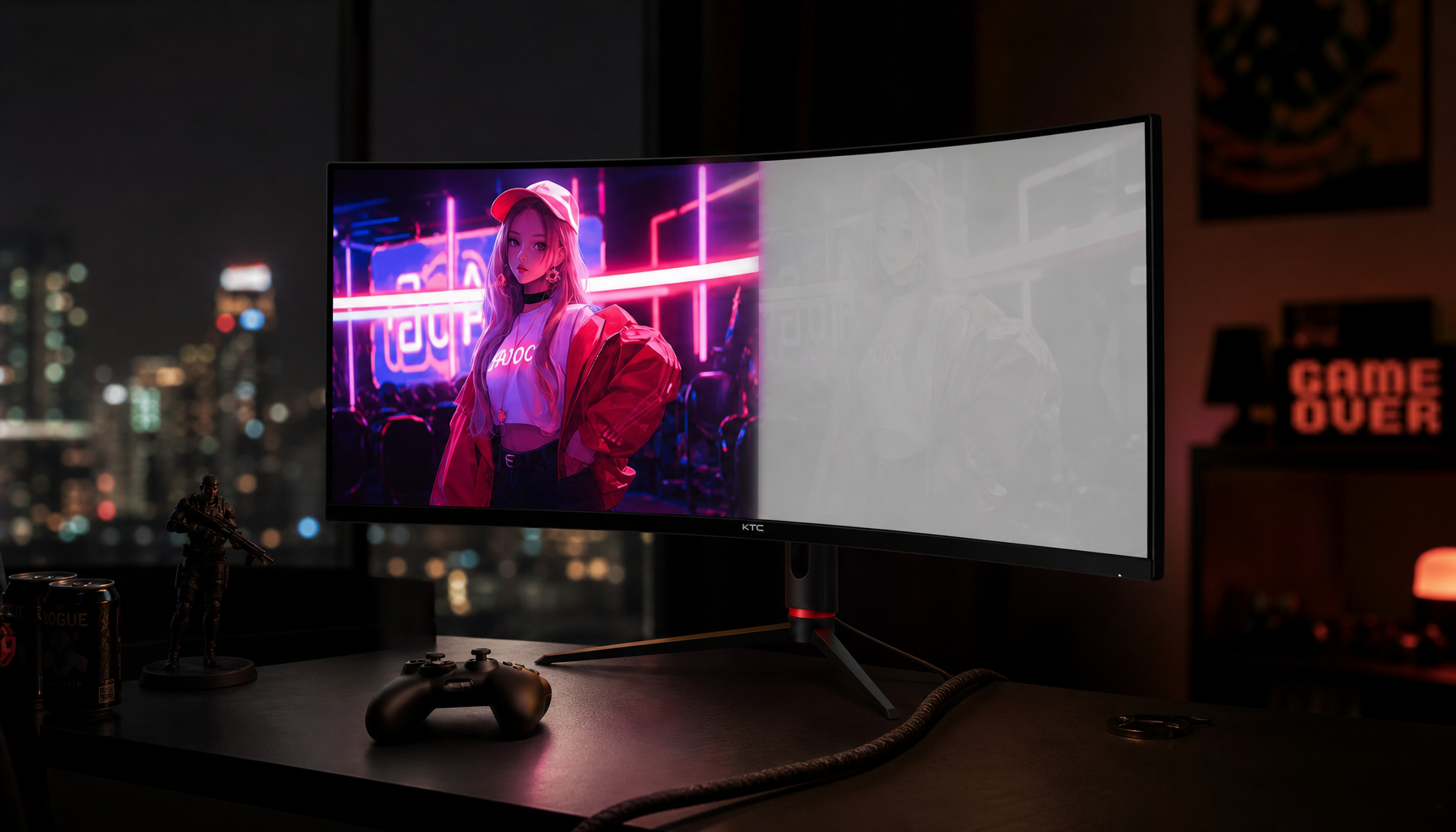
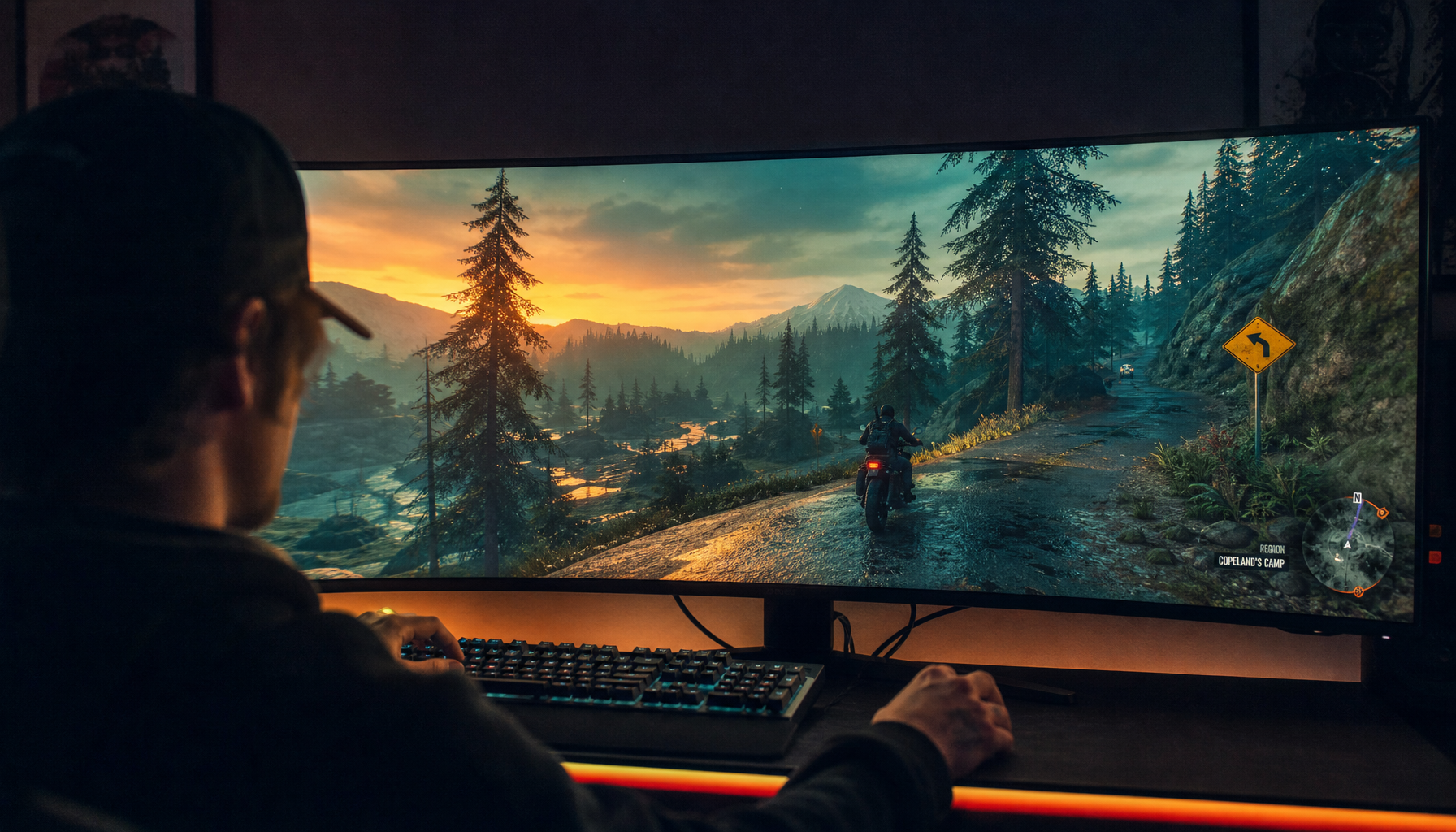
Older games look pixelated on high-resolution monitors because the game image often starts at a much lower resolution than the panel, then gets enlarged across a fixed grid of modern display pixels. The result can be sharp and blocky, soft and blurry, stretched, or surrounded by black bars depending on the game, monitor, GPU, and scaling mode.
You launch a classic computer game on a 27-inch 4K gaming monitor, expecting it to look cleaner, but the characters suddenly look chunky and the menus feel oddly soft. The practical fix is usually not “buy the sharpest monitor,” but choosing the right scaling behavior, preserving the original aspect ratio, and avoiding unnecessary full-screen stretching. This guide explains why the problem happens and how to set up a modern monitor so older games look intentional instead of broken.
Why High Resolution Does Not Automatically Improve Old Games
Older Games Start With Fewer Pixels
Many older games were built around fixed low resolutions, fixed 2D sprites, or assets designed for displays that were far less dense than today’s gaming monitors. A modern 4K UHD monitor has 3840 x 2160 physical pixels, while a Full HD monitor has 1920 x 1080, meaning 4K has four times as many pixels to fill as Full HD 4K UHD monitor. If the game only renders a small image, the monitor or GPU must enlarge it.
That enlargement does not create new original detail. A 320 x 240, 640 x 480, or 800 x 600 game can be displayed on a 1440p or 4K monitor, but the source artwork still contains the same amount of information. The higher-resolution panel makes the structure of that artwork easier to see, especially on a larger screen viewed from a normal desk distance.
Fixed Pixel Grids Change the Problem
Flat-panel displays are different from CRTs because they use a fixed native pixel grid, so non-native resolutions have to be resized, centered, or stretched fixed native pixel grid. On a CRT, the image was drawn through analog behavior, phosphors, masks, and video signal characteristics; on an LCD or OLED monitor, every final image lands on exact physical pixels.

That is why an old game can look harsher on a modern high-resolution screen than it did on an older TV or monitor. The game may not have changed, but the display is now more precise. Edges that once blended into the display’s analog characteristics may become visible as hard square blocks, while scaling filters can create the opposite problem by smearing those edges.
Pixelated, Blurry, or Stretched: Three Different Problems
Pixelation Is Not Always a Defect
Pixelation means the enlarged source pixels are visible. For pixel art games, that can be the desired look when each original pixel is expanded cleanly into a larger square. Integer scaling preserves that style by copying each source pixel into a same-color block, such as turning one pixel into a 2 x 2 block at 2x or a 3 x 3 block at 3x integer scaling.
Blurriness is different. It usually appears when the image is enlarged with interpolation, where the scaler blends neighboring pixels to fit an uneven size. That can make old menus, thin UI lines, and pixel-art edges look soft instead of crisp. On a gaming monitor, the difference is obvious: integer scaling looks sharp but blocky, while filtered scaling may hide hard pixels at the cost of fine detail.
Aspect Ratio Can Make the Image Look Wrong
Older games were often designed for 4:3 or other older aspect ratios, while many current monitors are 16:9, 21:9, or wider. If the monitor stretches a 4:3 image across a 16:9 screen, characters become wider, circles become ovals, and the whole game looks subtly incorrect. Centered scaling avoids that by fitting the game image without stretching it centered scaling.

Black bars are not automatically a sign of a bad monitor. They often mean the monitor or GPU is preserving aspect ratio, handling underscan or overscan, or centering a lower-resolution signal instead of stretching it black bars. For older games, black bars are often the correct tradeoff if the alternative is distorted geometry.
Display Result |
What You See |
Common Cause |
Best Monitor or GPU Setting |
Sharp but blocky |
Large square pixels are clearly visible |
Clean scaling of low-resolution artwork |
Integer scaling or nearest-neighbor style scaling |
Soft or smeared |
Edges and text look blurry |
Non-integer scaling with interpolation |
Native desktop resolution, GPU scaling, or sharper scaling mode |
Wide or squashed |
Characters and UI look stretched |
Wrong aspect-ratio handling |
Preserve aspect ratio or centered scaling |
Black bars |
Image has borders on the sides or top and bottom |
Aspect ratio mismatch or centered output |
Keep bars if geometry is correct |
Off-center image |
Game is shifted or partially cropped |
Legacy resolution, overscan, or custom mode issue |
GPU scaling, custom resolution, or monitor aspect control |
Why Integer Scaling Often Looks Best for Older Games
Whole-Number Scaling Keeps Pixels Even
Integer scaling works because every source pixel receives the same amount of space on the final display. A 640 x 360 image can scale cleanly to 1280 x 720 at 2x and to 1920 x 1080 at 3x, which is why some pixel-art games choose 640 x 360 as a reference resolution 640×360 reference resolution. The artwork remains crisp because the display is not inventing uneven partial pixels.

Non-integer scaling is messier. If a game image has to be enlarged by 2.4x or 3.7x, some source pixels effectively become wider than others, or the scaler blends pixels to smooth the mismatch. That is where shimmer, uneven line thickness, and soft pixel art often come from. On a high-resolution monitor, those small inconsistencies become easier to notice.
The Tradeoff Is Screen Fill
Integer scaling does not always fill the entire panel. If the largest clean whole-number scale leaves unused space, the monitor may show black borders. That is especially common with 4:3 games on 16:9 monitors, older console-style resolutions, and ultrawide displays. A perfectly sharp image may be smaller than a fully stretched one.
This is not a failure of high-resolution monitors. It is a geometry tradeoff. The sharper the scaler tries to keep the original pixel structure, the less freedom it has to fill every inch of the screen. For many retro and older computer games, a smaller centered image on a 27-inch or 32-inch monitor can look more faithful than a stretched full-screen image.
How Different Monitor Types Affect Older Games
4K and 1440p Gaming Monitors
High-resolution gaming monitors can be excellent for older games when scaling is handled carefully. A 4K monitor has enough pixels to support cleaner whole-number scaling for many low-resolution sources, and modern GPU drivers often include scaling controls that are more flexible than older monitor menus. The key is to keep the desktop at native resolution and let the game, GPU, or emulator scale the image appropriately.

A 1440p monitor can still look good, but it may hit more awkward scaling ratios with older 720p, 480p, or 240p-style content. If the game cannot render at the monitor’s native resolution, the panel or GPU must resize the image. In practice, 1440p is often a strong all-around choice for modern high-refresh gaming, while 4K gives more room for clean scaling and sharp desktop use.
Ultrawide Monitors
Ultrawide monitors add another decision: immersion versus compatibility. Many older games were not designed for 21:9 or 32:9 displays, so they may stretch the image, crop the view, place HUD elements incorrectly, or show large side bars. Widescreen hacks can help some older computer games by adding modern display support, but results vary by title widescreen hacks.
For older games, an ultrawide monitor is best when it offers strong aspect-ratio controls and easy switching between full, aspect, and centered modes. If you mostly play classic 4:3 or fixed-resolution games, do not judge the monitor by whether every game fills the whole panel. Judge it by whether it can preserve the game’s proportions cleanly.
High-Refresh-Rate and Portable Monitors
High-refresh-rate displays do not directly fix pixelation. A 144 Hz, 165 Hz, or 240 Hz monitor can make motion feel smoother when the game supports it, but the artwork still depends on source resolution and scaling. Some older games are locked to 30 fps or 60 fps, and forcing higher refresh behavior can cause timing issues in certain titles.
Portable monitors can be useful for older games because smaller screen sizes make pixelation less visually aggressive. A low-resolution game stretched across a 15.6-inch portable display may look more controlled than the same image stretched across a large desktop monitor. The tradeoff is that portable monitors often have simpler onboard scaling menus, so GPU scaling becomes more important.
Settings That Usually Make Older Games Look Better
Start With the Desktop and GPU
Set the desktop to the monitor’s native resolution first. Changing the whole display to a lower resolution makes the monitor scale everything, including the game, desktop, capture overlays, and system UI. Native desktop resolution with OS-level scaling for readability is usually a cleaner starting point than lowering the monitor resolution globally native desktop resolution.
Then check whether the GPU or monitor should handle scaling. GPU scaling sends the display a signal that already matches the monitor’s native format, while monitor scaling sends a lower-resolution signal and lets the display’s internal processor resize it GPU scaling. For older games, GPU scaling often gives more predictable control because the driver usually exposes aspect ratio, centered, and integer-style options.
Improve 3D Games Differently Than Pixel Art Games
Older 3D computer games are not always best served by pure integer scaling. If the game can render internally at a higher resolution, supersampling can improve crispness by rendering above the display target and shrinking the image back down supersampling. Driver-level virtual resolution and supersampling features are examples of approaches for supported systems.
Texture filtering also matters for older 3D games. Anisotropic filtering can sharpen distant floors, roads, and walls, and modern graphics driver controls may allow multiple filtering strength settings anisotropic filtering. That helps 3D scenes more than 2D sprites, where filtering may make the art look less faithful.
Quick Action Checklist
- Set your monitor and desktop to the panel’s native resolution.
- In the GPU control panel, choose aspect-ratio scaling or centered scaling before trying full-screen stretching.
- Enable integer scaling when playing pixel-art games, emulators, or titles with fixed low-resolution artwork.
- For older 3D games, try the game’s highest internal resolution before changing the monitor resolution.
- Add anisotropic filtering for older 3D titles with blurry ground textures or distant surfaces.
- Use widescreen patches only for games known to support them cleanly; check HUD placement after enabling them.
- Keep black bars when they preserve correct geometry, especially for 4:3 games on 16:9 or ultrawide monitors.
What to Look For When Buying a Monitor for Older Games
Scaling Controls Matter More Than Raw Resolution Alone
A sharp panel with weak scaling controls can make old games harder to enjoy. Look for monitor menus that include aspect ratio control, 1:1 or centered display modes, and fast switching between scaling options. If the monitor lacks those features, make sure your GPU driver supports the scaling modes you need.
Resolution still matters, but it should fit your mix of games. A 4K monitor gives more room for clean scaling and modern desktop sharpness, while a 1440p high-refresh monitor may be better if you spend most of your time in current competitive games. For older fixed-resolution games, the best display is not always the one with the largest pixel count; it is the one that lets the original image map cleanly without distortion.
Size and Viewing Distance Change the Perception
A low-resolution game looks more pixelated when enlarged across a big screen. A 24-inch 1080p monitor, a 27-inch 1440p monitor, and a 32-inch 4K monitor can all show the same old game differently because screen size affects how obvious each enlarged source pixel becomes. At a desk, larger screens make scaling artifacts easier to spot.
If older games are a serious part of your library, prioritize a monitor that gives you control. For a mixed setup, a 27-inch or 32-inch 4K gaming monitor with strong GPU scaling support is often flexible. For classic 4:3 games, a smaller secondary or portable monitor can be a practical choice if you prefer a more compact, less exaggerated image.
FAQ
Q: Why does an old game look worse on my new 4K monitor than it did years ago?
A: The monitor is showing the old source image with more precision and often at a much larger size. The game may have been designed for lower-resolution displays or CRT behavior, while your 4K monitor uses a fixed pixel grid that exposes the original pixel structure and any scaling artifacts.
Q: Should I use GPU scaling or monitor scaling for older games?
A: Start with GPU scaling because it usually gives clearer control over aspect ratio, centered scaling, and integer-style scaling. Monitor scaling can still work well, but onboard scalers vary by model, and some displays offer fewer options.
Q: Are black bars bad for gaming?
A: No. Black bars are often the correct result when preserving the game’s original aspect ratio. Removing them by stretching the image can make the game fill the screen, but it may distort characters, menus, and 2D artwork.
Final Takeaway
Older games look pixelated on high-resolution monitors because the monitor is enlarging a low-resolution source, not because the panel is defective. The best results come from matching the scaling method to the game: integer or centered scaling for pixel art and fixed-resolution games, higher internal resolution and filtering for older 3D games, and strict aspect-ratio preservation whenever stretching changes the shape of the image.
For monitor buyers, the practical priorities are native resolution, good aspect-ratio controls, low-lag scaling behavior, and GPU driver support. A high-refresh-rate or ultrawide monitor can still be a good choice, but only if it gives you enough control to keep older games sharp, proportional, and comfortable to play.