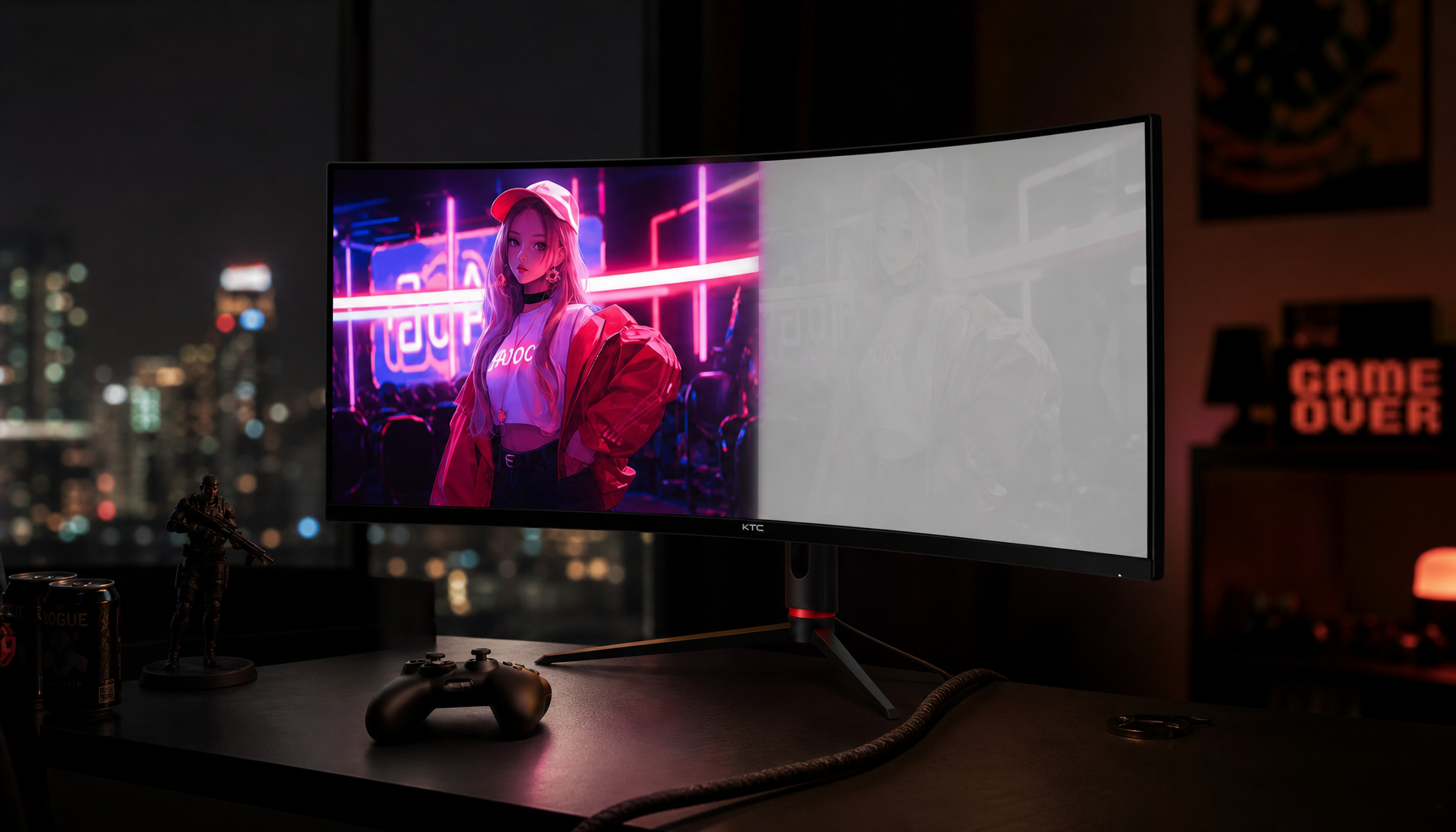
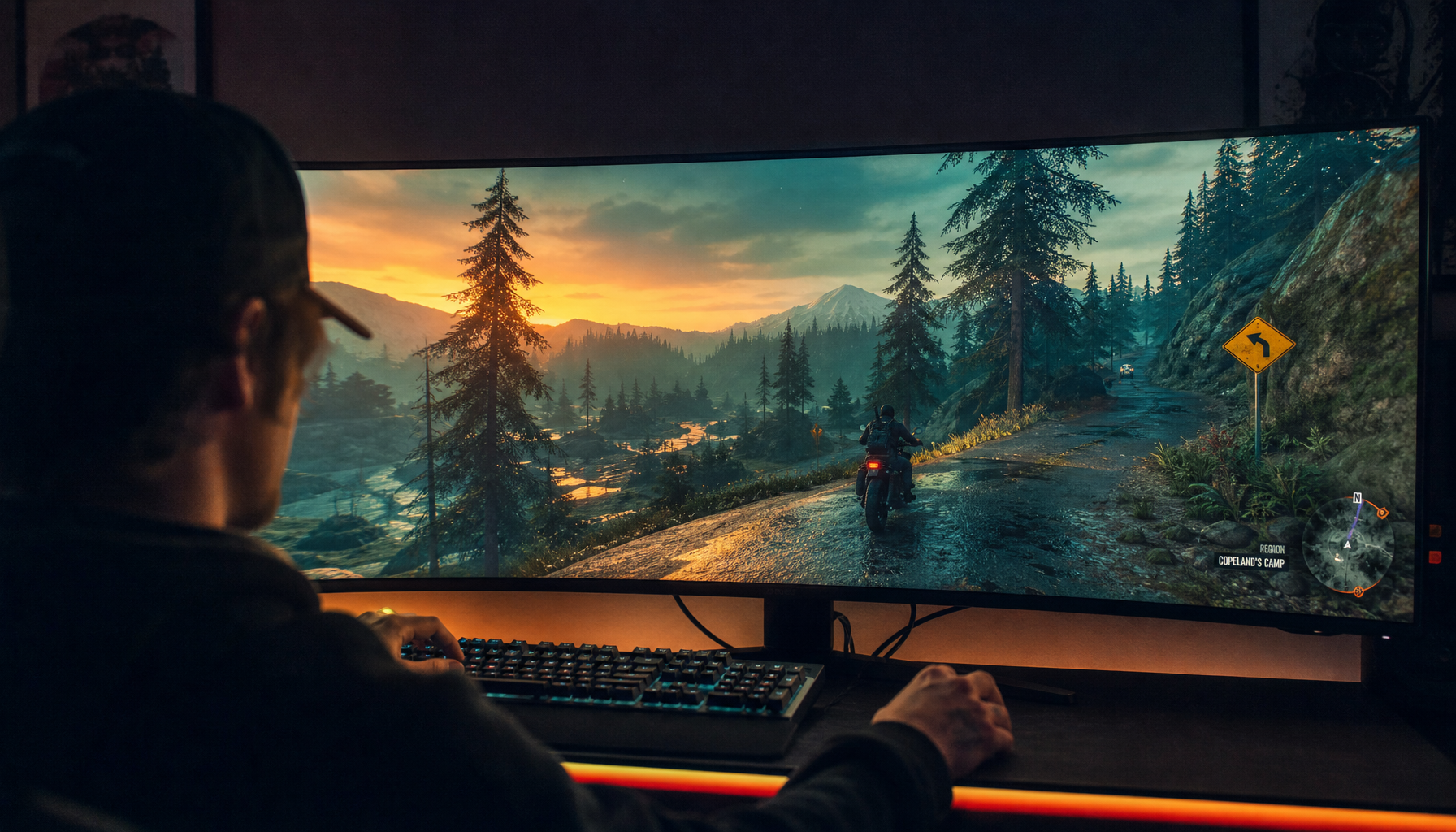
Local dimming can make identical windows look different because a monitor adjusts backlight zones based on nearby content, not just the window itself. Dark areas, bright UI elements, subtitles, cursor movement, and HDR highlights can all affect how bright each zone appears.
Does one white document window look clean and bright while the same window beside it looks slightly gray, pulsing, or uneven? With the right test pattern and settings check, you can separate normal zone behavior from a bad panel, poor HDR setup, or an overactive power-saving feature. Here is how to understand the cause, reduce the effect, and choose the right display settings for gaming, office work, and portable-screen use.
Local Dimming in Plain English
Local dimming is a backlight-control system used in LCD monitors and TVs. Instead of lighting the entire panel at one fixed level, the display divides the backlight into zones and changes those zones independently so dark areas can look darker while bright areas stay bright. That is why LED local dimming is valuable for HDR games, movies, and high-contrast scenes: it helps an LCD display create stronger perceived contrast than a simple always-on backlight.
The important detail is that local dimming controls the backlight, not each LCD pixel. If a white app window sits inside one dimming zone and another identical white window crosses into zones influenced by a dark wallpaper, video frame, or black sidebar, the backlight decisions behind those two windows may differ. The pixel data can be identical while the light behind it is not.
That is the core reason identical content windows can show inconsistent brightness. The monitor is making a scene-level lighting decision, not a document-level fairness decision.
Why Identical Windows Do Not Always Look Identical
A local dimming algorithm usually evaluates the average brightness, peak highlights, motion, and contrast inside each zone. If you place two identical browser windows side by side, the window near a black desktop background may cause its local zone to dim more aggressively than the window surrounded by lighter UI. The result can look like one window has a different white point, even though the operating system is sending the same color values to both.

This becomes easier to see on monitors with fewer or larger dimming zones. Full-array local dimming is generally more precise than edge-lit local dimming because its light sources sit behind the panel instead of only along the edges. Still, even a good full-array system cannot treat every small UI element independently unless the zone count is extremely high and the algorithm is tuned well.
For a simple office example, imagine a 32-inch mini-LED monitor showing a white spreadsheet on the left and the same spreadsheet on the right. If the left sheet is next to a black chat sidebar and the right sheet is next to a bright email pane, the backlight zones behind each spreadsheet may receive different instructions. The left side may dim to preserve black depth, while the right side may stay brighter because its surrounding zone average is higher.
The Zone Boundary Problem
Local dimming zones are physical regions. A window edge does not necessarily align with those regions. When a white rectangle straddles a zone boundary, one part of the rectangle may sit over a zone that is being boosted, while another part sits over a zone that is being restrained to protect nearby dark content.

This is why brightness inconsistency often appears as blocks, bands, soft patches, or uneven corners rather than a smooth whole-screen change. It is also why moving the same window a few inches can change its appearance. The content did not change; its relationship to the backlight grid changed.
Blooming is the more famous version of this limitation. When a bright object appears on a dark background, light from its active zone can spill visually into nearby darker areas. Demanding scenes such as stars, fireworks, and subtitles make this behavior especially visible because small bright objects force larger backlight regions to light up. The same physics can affect desktop use, only the symptom may look like inconsistent white windows instead of obvious halos.
HDR, Game Mode, and Fast Motion Make It More Obvious
HDR pushes the display to produce bright highlights and deep dark areas at the same time. That is exactly the workload local dimming was built for, but it is also where tradeoffs become visible. If an HDR game has a bright HUD, dark sky, and flashing effects, the dimming system must decide quickly which zones deserve more light and which should stay low.
Gaming monitors add another challenge: latency. A competitive display cannot spend too long analyzing every frame, especially at high refresh rates. Faster response protects input feel, but it can make zone transitions more abrupt or conservative. In practice, a high local dimming setting may look dramatic in a cinematic HDR scene but distracting on a desktop, in an esports title, or when dragging a bright window across a dark background.
Mini-LED monitor setup advice often treats HDR and local dimming as settings that need to be matched to usage rather than left blindly maxed out. Mini-LED monitors can deliver stronger HDR impact, but the best setting for a movie is not always the best setting for productivity or fast gaming.
Brightness Inconsistency Is Not Always a Defect
A panel defect usually stays in the same physical location no matter what content is displayed. Local dimming inconsistency changes with content, window position, brightness level, HDR mode, and the surrounding desktop. That distinction matters before you start a return process or assume the monitor is failing.
Screen uniformity is a separate issue. A display with poor uniformity may show uneven brightness or color from the center to the corners even with local dimming off. A local dimming artifact, by contrast, usually responds to scene composition. If the dim patch follows the window as you move it, suspect the dimming algorithm. If the patch stays fixed on the panel, suspect uniformity, backlight variation, or panel aging.
There is also automatic brightness behavior to consider. Ambient light detection, energy-saving modes, dynamic contrast, and contrast enhancers can all change luminance while you work. For calibration workflows, forum guidance often recommends turning off local dimming and dynamic range enhancement because these systems can interfere with predictable measurements. That same logic applies to practical troubleshooting: reduce variables before judging the panel.
Local Dimming Pros and Cons for Real Workflows
Use Case |
Benefit |
Tradeoff |
HDR gaming |
Brighter highlights and deeper blacks |
Possible blooming, pulsing, or delayed zone transitions |
Movie watching |
Stronger perceived contrast in dark scenes |
Subtitles can trigger halos or raised blacks |
Office productivity |
Better black depth in dark mode |
Identical windows may look uneven near zone boundaries |
Color work |
Can reveal HDR contrast capability |
Should usually be disabled for calibration and critical SDR editing |
Portable smart screens |
Better perceived punch when implemented well |
Smaller designs may have limited zone precision or aggressive power behavior |
For productivity, the biggest problem is not that local dimming exists. The problem is using a cinematic contrast feature for static, precision-oriented content. A spreadsheet, code editor, design canvas, and browser page reward consistency more than dramatic black depth.
For gaming and video, the equation changes. A little brightness variance may be worth accepting if the display produces more convincing HDR depth, better explosions, cleaner night scenes, and stronger separation between UI and environment.
How to Test the Cause at Your Desk
Start with a controlled desktop. Use the same white or light-gray window duplicated side by side, then place one over a dark wallpaper area and the other over a bright background. Move both windows slowly across the screen. If the brightness changes as the windows cross invisible regions, local dimming is influencing the result.

Next, turn local dimming off and repeat the test. If the two windows become more consistent, the panel is probably behaving as designed. If the unevenness remains in the same physical area, you may be looking at screen uniformity rather than zone processing.
Then test SDR and HDR separately. Many displays store different settings for SDR, HDR, and each input. A monitor can look stable in SDR but inconsistent in HDR because the local dimming algorithm becomes more aggressive when peak brightness is available.
Finally, check the room. Monitor brightness that is too high for a dim room can make halos, blooming, and white-window mismatch easier to notice, while brightness that is too low in a bright room can flatten contrast and make the display seem dull. For typical indoor work, the cited comfort range of about 200 to 300 nits is a practical starting point, then adjust for glare and task type.
Settings That Usually Reduce the Problem
For office work, coding, writing, spreadsheets, and SDR design review, set local dimming to Off or Low if your monitor allows it. This gives up some black depth but makes white documents, gray panels, and app windows more stable. It is the right trade when consistency beats punch.
For HDR gaming and movies, use Medium or High only if the image stays clean enough for your eyes. High local dimming can deepen blacks, but it can also make zone changes, halos, and brightness shifts more obvious. Medium often gives the better balance: enough HDR contrast to feel immersive, with fewer artifacts during motion.
Turn off eco dimming, ambient light detection, dynamic contrast, and automatic brightness features during testing. Those controls can stack on top of local dimming and make the display look unpredictable. Once you find a stable baseline, re-enable only the features that solve a real problem in your room.
Brightness should match the environment. For bright offices, digital signage practice uses the idea that a display must overcome its surroundings without becoming uncomfortable or wasteful; screen brightness is tied directly to readability, power use, and placement. On a desk, that means lowering brightness in a dark room and raising it only enough to overcome daylight or reflections.
When to Choose a Different Display Technology
If your work depends on identical windows matching perfectly across the screen, prioritize uniformity and predictable SDR behavior over maximum HDR marketing numbers. A strong IPS or professional monitor with excellent uniformity may serve office and creative work better than an aggressive mini-LED gaming display left in HDR mode all day.

If you want deep blacks without zone-based backlight decisions, OLED is the cleaner visual solution because each pixel emits its own light. The tradeoff is different: OLED avoids local dimming halos and zone mismatch, but static desktop use raises image retention and burn-in considerations. For users who keep taskbars, toolbars, dashboards, and spreadsheets open for long sessions, that trade deserves careful thought.
For LCD buyers, do not shop by zone count alone. More zones usually help, but implementation quality, firmware, dimming speed, panel uniformity, and available settings decide how clean the experience feels. A well-tuned full-array monitor can outperform a higher-spec screen with distracting transitions.
FAQ
Why does one browser window look dimmer than another?
The dimmer window is probably sitting in or near a backlight zone that the monitor is lowering to protect nearby dark content. The browser windows can contain identical pixels while the backlight behind them runs at different levels.
Should I leave local dimming on all the time?
For HDR games and movies, local dimming is often worth using. For office work, web browsing, writing, and calibration, Off or Low is usually more consistent.
Does this mean my monitor is broken?
Not necessarily. If the brightness difference changes when you move windows or switch local dimming modes, it is likely normal local dimming behavior. If the uneven area stays fixed with local dimming off, investigate panel uniformity, backlight defects, or warranty support.
Can calibration fix local dimming inconsistency?
Calibration can improve color and tonal accuracy, but it cannot remove the physical limits of zone-based backlighting. For measurement work, disable dynamic backlight features so the display response stays predictable.
Local dimming is a performance feature with a visible cost: it trades perfect desktop uniformity for stronger contrast and HDR impact. Use it aggressively when immersion matters, tame it when productivity demands consistency, and judge the monitor by how well its settings fit your real workday, not by the feature label alone.