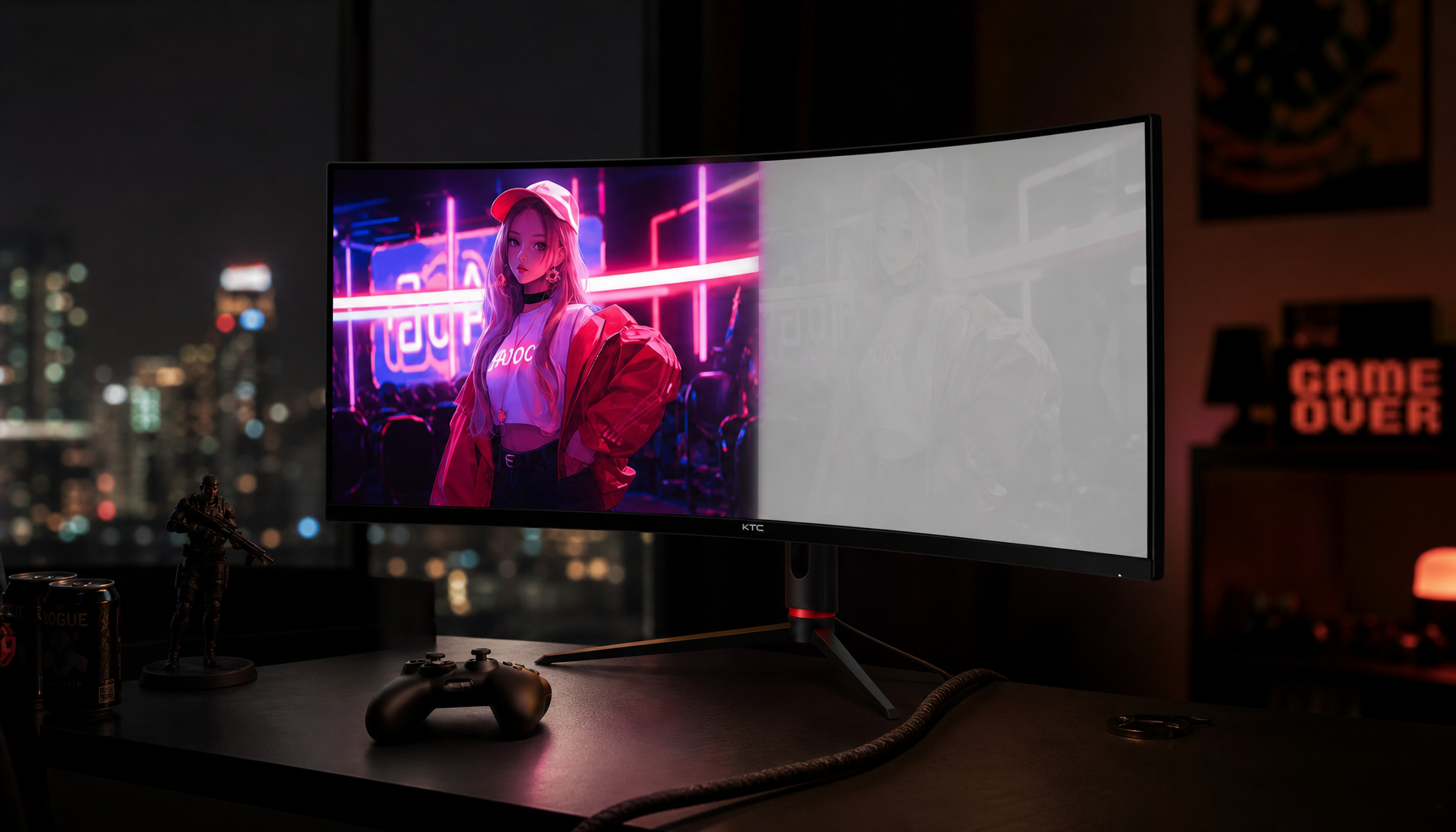
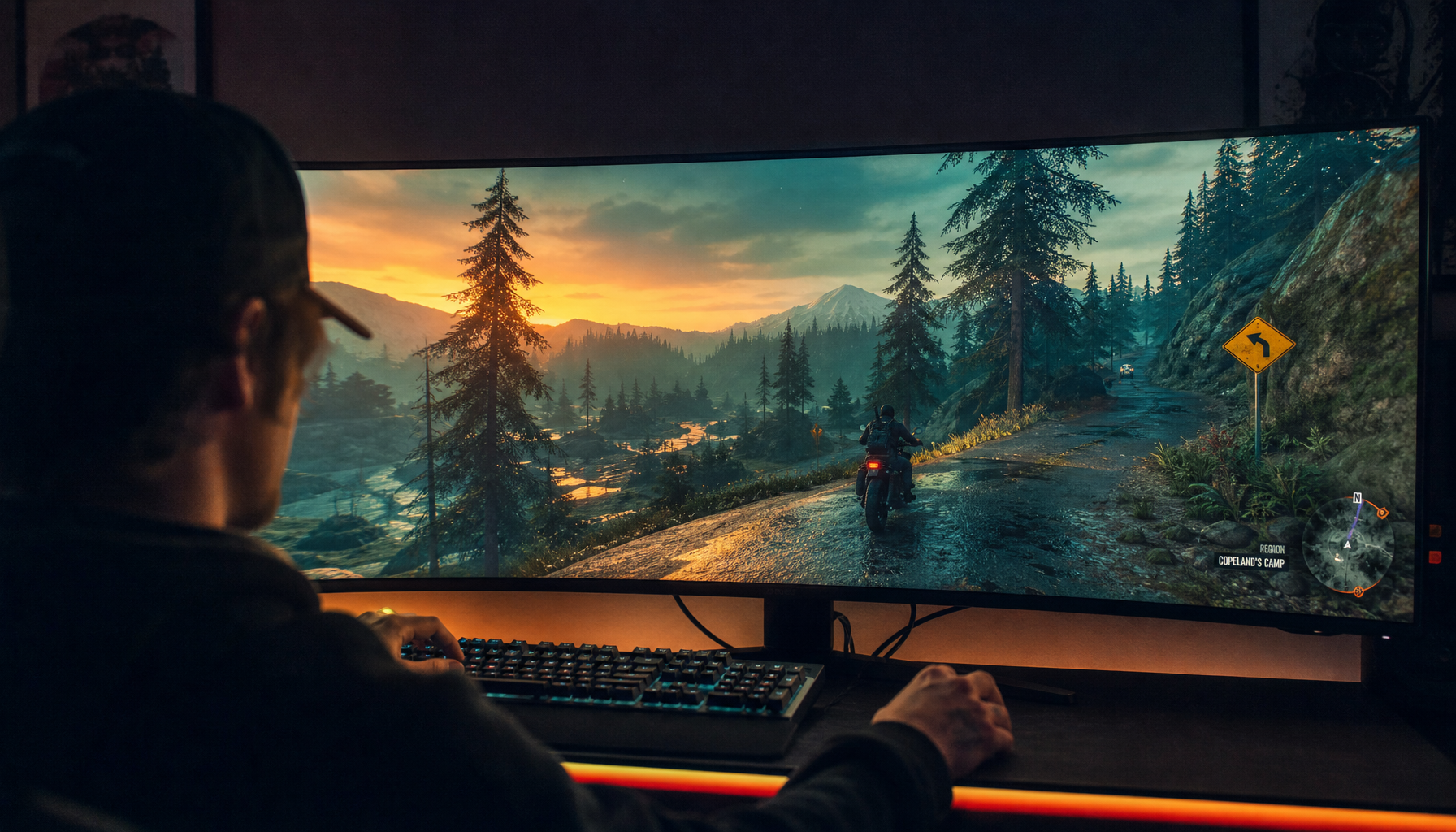
Some dimming algorithms protect the center of the screen because that is where your eyes, game reticle, movie subject, document text, and video-call faces usually sit. The tradeoff is practical: better perceived contrast and fewer distracting brightness shifts in the main viewing area, sometimes at the cost of edge accuracy.
Have you ever noticed a bright cursor, subtitle, mini-map, or white browser edge making the corners glow while the middle of the image still looks controlled? A well-tuned local dimming system can make HDR highlights feel deeper and more stable without constantly overreacting to small edge details. Here is why that happens, when it helps, when it hurts, and how to choose or tune a monitor around it.

The Short Answer: Local Dimming Is a Compromise Engine
An LCD monitor does not create light at each pixel the way OLED does. It uses a backlight behind the LCD layer, and local dimming improves contrast by changing the brightness of separate backlight zones instead of lighting the whole panel evenly. Local dimming divides the backlight into controllable areas, so dark parts can be dimmed while bright parts stay bright.
The catch is that zones are much larger than pixels. A 4K screen has more than 8.2 million pixels. Even a strong 1,152-zone Mini LED monitor still asks each zone to influence roughly 7,200 pixels on average, before optical diffusion and panel leakage are considered. That is why a dimming algorithm has to choose priorities. It cannot perfectly satisfy every bright pixel, black background, subtitle, UI panel, and edge highlight at the same time.
In practice, the algorithm decides which visual error is least damaging. It may preserve the center subject, soften a halo near the edge, avoid sudden brightness pumping, or reduce power draw. That decision-making is why two monitors with similar zone counts can look dramatically different in real games and desktop work.
Why the Center Often Gets Priority
Your Eyes Usually Judge the Center First
Most screen content is composed around the center. A shooter reticle, racing line, strategy-game battlefield, spreadsheet focus cell, video-call face, movie character, and portable-screen presentation slide all tend to land near the middle. If the center looks crushed, washed out, or unstable, the whole display feels worse, even if the edges are technically more accurate.
This is not only a human-factors choice. It is also a performance choice. A gaming monitor has to keep up with fast scene changes, camera pans, HUD overlays, and VRR timing. If the dimming system reacts equally aggressively to every edge highlight, it can create visible flicker, trailing halos, or exposure shifts. A center-weighted approach can keep the main action more stable.
For example, in a dark RPG cave scene, a torch near the center deserves strong local brightness because it defines the scene. A small white quest marker near the far edge may be handled more conservatively because fully lighting that edge zone could lift a large dark area and make the black level look gray.

Backlight Zones Are Coarse Compared With Image Detail
Full-array local dimming can use hundreds or thousands of zones, but each zone still covers a block of screen area. Full-array local dimming improves contrast by spreading many controllable LEDs behind the panel, yet blooming can still appear when a bright object shares zone influence with dark pixels nearby.
Edges are especially tricky because optical films, diffuser layers, bezels, and zone geometry can make brightness less uniform. A center zone is often surrounded by other zones on all sides, giving the algorithm more room to blend transitions. An edge or corner zone has fewer neighboring zones, so a sudden brightness change can look more obvious.
That is why an algorithm may brighten the center more confidently while being more cautious at the edge. The goal is not to ignore edge content; it is to prevent an edge highlight from forcing a large, ugly glow across a dark border.
Power, Heat, and Latency Matter
High-brightness Mini LED monitors are not just image devices; they are power and thermal systems. More zones, higher brightness, and faster dimming transitions require more processing and tighter electrical control. FALD displays are more complex because their circuitry, processing demands, heat output, and thermal design are more demanding than simpler backlights.
In a portable smart screen, the same tradeoff affects battery life. In an office monitor, it affects fan noise, heat, and long-session comfort. In a gaming monitor, it affects responsiveness. A center-weighted algorithm can spend its power and processing budget where it produces the most visible improvement.
A useful way to think about it: if a monitor has to choose between stabilizing a bright enemy silhouette in the center or perfectly reproducing a tiny white icon at the edge, the better user experience usually comes from protecting the center.
What the Algorithm Is Actually Balancing
Local dimming is not a single “brighter or darker” switch. It is a layered decision involving the video signal, the LED zones, the LCD pixel values, and sometimes tone mapping.
Research on LED-backlit LCDs frames this as a joint optimization problem: the backlight intensity and LCD pixel attenuation need to be managed together to reduce luminance error. Linear programming research treats local dimming as a coordinated backlight-and-panel problem rather than a simple zone brightness lookup.
That matters because LCD pixels leak light. If the backlight under a dark area is too bright, blacks rise. If the backlight is too dim, highlights lose punch or detail. If the algorithm follows only the brightest pixel in each zone, it can preserve sparkle but waste power and cause blooming. If it follows only the average, it can save power but darken small highlights too much.
Recent Mini LED research takes a more content-aware route. A 55-inch 4K prototype with 2,304 Mini LED backlight partitions used grayscale distribution analysis and root-mean-square estimation to balance detail, contrast, and power use. The 55-inch 4K prototype reported a peak luminance around 2,197.5 nits, a minimum luminance around 0.00135 nits, and a dynamic contrast ratio of 1.628 × 10^6:1.
Those numbers are prototype results, not a guarantee for every retail monitor. The important buying lesson is clearer: smarter algorithms look at the distribution of image data inside zones, not just the single brightest pixel.
Center Priority: Pros and Cons
Behavior |
Why It Helps |
Where It Can Hurt |
Center-weighted dimming |
Keeps faces, crosshairs, documents, and main gameplay more stable |
Edge subtitles, side HUDs, and corner UI can bloom or dim |
Maximum-based zone response |
Protects small bright highlights |
Can raise power use and exaggerate halos |
Average-based zone response |
Reduces power and can calm blooming |
Can mute sparks, stars, cursors, and fine HDR details |
Smoother zone transitions |
Makes halos less harsh |
May spread glow over a wider area |
Aggressive local contrast |
Makes HDR look punchy |
Can create brightness pumping during fast motion |
When Center-Screen Priority Is a Good Thing
For competitive gaming, center priority often makes sense. Your focus is usually the reticle, opponent movement, central corridor, or vehicle path. A dimming system that keeps the center readable while preventing large brightness swings can feel faster and more reliable than one chasing every edge highlight.
For office productivity, center priority can also help. Long documents, spreadsheets, dashboards, and design canvases usually place active work in the middle. If you use dark mode with white panels or toolbars, a monitor that overreacts to edge UI can make borders pulse or glow. A calmer algorithm is easier to live with for an eight-hour workday.
For portable smart screens, the value is even more practical. These displays often run in mixed lighting, on limited power, and with smaller thermal headroom. A dimming algorithm that protects central content can make presentations, remote-work windows, and streaming video look more consistent without draining the battery as quickly.
When It Becomes a Problem
Center priority becomes a liability when important content lives at the edges. Subtitles near the bottom, game HUDs in corners, timeline controls in editing software, side-by-side documents, ultrawide mini-maps, and stock-trading panels can all expose weak edge handling.
This is why zone count alone is not enough. Mini LED resources often promote 1,152 or more zones as a practical target for better desktop HDR blooming control, but algorithm quality can matter as much as raw zone count. A higher-zone display with poor transitions can still look worse than a lower-zone display with smarter control.
A real-world test is simple. Open a black background, move a white mouse cursor from the center to each corner, then repeat with subtitles or a small white window near the bottom edge. If the cursor leaves a wide glow trail, if corners flash, or if the center stays stable while edge text dims, you are seeing the algorithm’s priorities.
Practical Buying and Setup Advice
For HDR gaming, prioritize a monitor with strong measured HDR brightness, meaningful local dimming, fast response time, and a refresh rate your GPU can actually drive. Gaming monitor quality depends on panel type, resolution, refresh rate, adaptive sync, brightness, and HDR behavior together, not one headline spec.
For Mini LED, look beyond “HDR capable.” Check the number of dimming zones, whether the panel is edge-lit or full-array, how the monitor behaves in game mode, and whether local dimming can be adjusted separately for SDR and HDR. If you use static desktop apps all day, also check whether SDR local dimming causes glow around white windows on a dark wallpaper.
For office and creative work, color consistency matters as much as contrast. Modern operating systems include system-level color management for supported displays, and auto color management can help maintain more consistent color across apps that handle color differently. That will not fix local dimming halos, but it can reduce color surprises when you move between browsers, editors, and creative software.
For comfort, do not treat brightness as a trophy number. A screen that is too bright for the room can make blooming more visible and eye strain more likely. Technology support guidance often frames brightness adjustment as a visibility and comfort issue, and screen brightness should match the room rather than stay pinned at maximum.
How to Tune It on Your Own Monitor
Start with the monitor’s accurate or standard HDR mode rather than the most exaggerated preset. Then test local dimming at low, medium, and high settings using the same dark scene, subtitle sample, and game HUD. High local dimming usually gives deeper blacks and brighter highlights, but it can also make halos and zone transitions more noticeable.

For SDR desktop work, consider reducing local dimming or disabling it if white windows on dark backgrounds create distracting glow. For HDR games and movies, turn it back on and use the game or operating system HDR calibration tool so the display is not forced into bad tone mapping. If the monitor has separate profiles, save one for productivity and one for HDR gaming.
If you work with photos, video, or UI design, judge the display in the mode you actually use. A monitor that looks cinematic in a demo reel may not be the best tool for judging dark gradients, app interfaces, or edge-positioned controls. The best setup is not always the most aggressive one; it is the one that keeps the important content accurate and stable.
FAQ
Does center-prioritized dimming mean the monitor is defective?
No. It usually means the dimming algorithm is making a perceptual tradeoff. It becomes a defect only if edge blooming, dimming delay, flicker, or brightness shifts are severe enough to distract you in normal use.
Is OLED better because it avoids this problem?
OLED avoids backlight-zone compromises because each pixel controls its own light, so black levels and small highlights can be extremely precise. Mini LED still has advantages for high sustained brightness, long static desktop sessions, and lower burn-in concern, which is why it remains compelling for mixed gaming and productivity setups.
Should I always buy the monitor with the most dimming zones?
No. More zones help, but processing quality, panel contrast, optical design, tone mapping, and local dimming controls decide how those zones behave. A balanced monitor with good controls often beats a spec-heavy one that blooms, pumps brightness, or mishandles game mode.
Center-screen priority is not a shortcut; it is a display engineer’s bet on where image quality matters most to the person using the screen. Choose a monitor that matches where your important content lives, then tune local dimming for the job: stable center action for gaming, calm edges for desktop work, and controlled HDR when immersion matters.