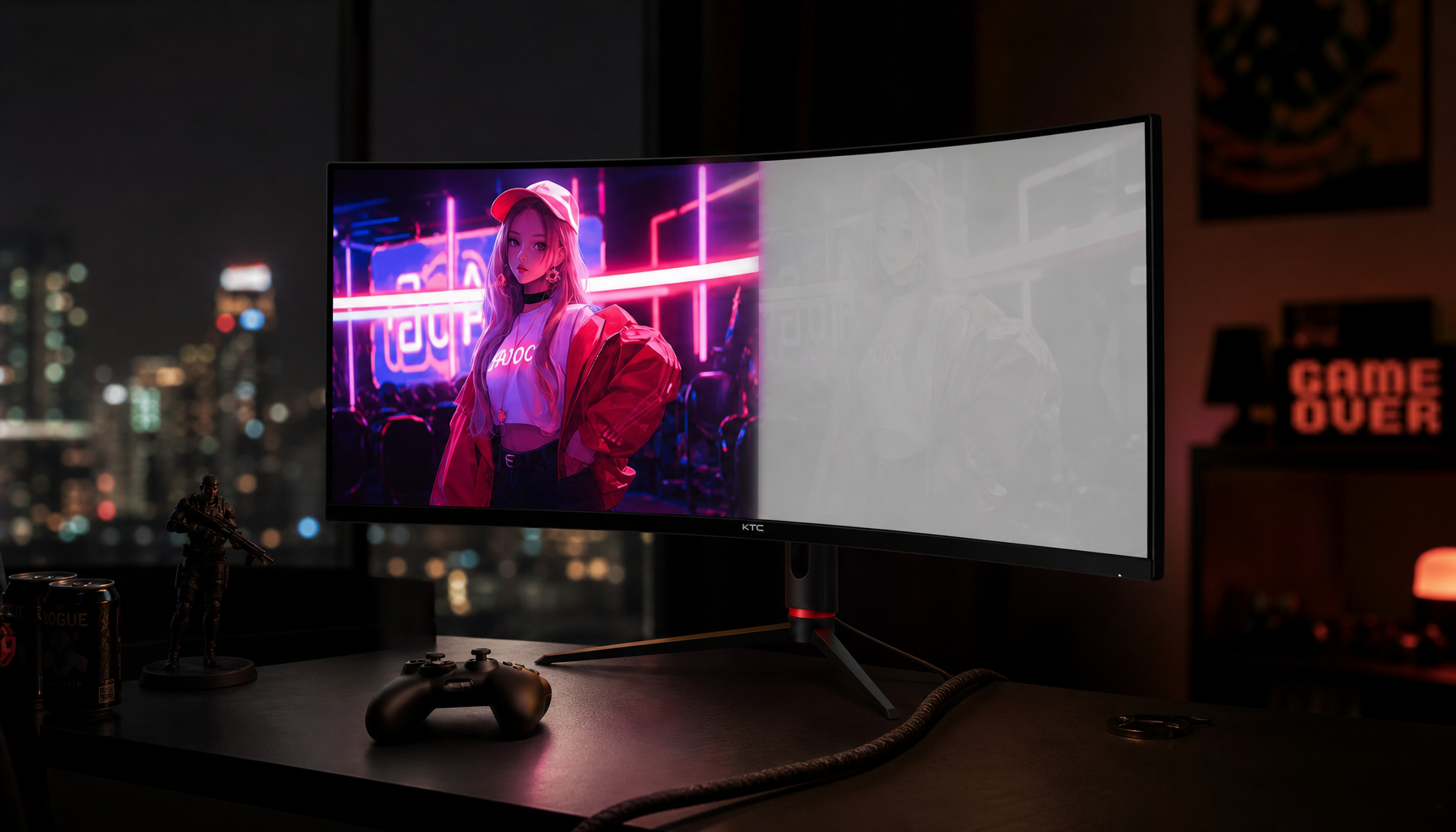
Black tones look gray when your screen cannot fully control light in dark scenes, or when its black level, gamma, brightness, and room lighting are mismatched. In a dark room, your eyes adapt quickly, so backlight glow, IPS haze, blooming, and raised shadow settings become much easier to see.
Your Display May Not Be Built for Deep Blacks
The biggest factor is display technology. LCD monitors and TVs use a backlight, so “black” often means blocking light, not turning light off completely.
OLED and QD-OLED panels perform best in dark rooms because each pixel can shut off independently, producing true black and high contrast. By contrast, QLED and standard LED LCD screens rely on backlighting, so their black levels are limited even when contrast processing is strong; QLED uses an LED backlight behind its color-enhancing layer.

VA LCD panels usually beat IPS panels for native contrast, which helps movies look richer at night. IPS can still be excellent for work, color, and wide viewing angles, but dark-room movie scenes may show more gray glow, especially near the corners.
Mini-LED improves LCD black levels with local dimming zones, but it can create halos around bright subtitles, stars, or interface elements. In total darkness, those halos stand out more because the rest of the room gives your eyes no visual reference.

Brightness, Black Level, and Gamma Can Raise the Floor
If screen brightness is set for daytime use, dark-room blacks can look washed out. Brightness controls the backlight or panel luminance, and nits describe screen brightness as perceived by the eye.
For movie watching at night, you usually want lower SDR brightness than you would use in an office. A 300-nit monitor can look balanced in a lit room but harsh and gray in a dark room if left near maximum output.

Black level is just as important. If it is set too high, near-black details are lifted into smoky gray. If it is too low, shadow detail gets crushed and dark coats, hair, and backgrounds merge into flat black.
Gamma also changes the feel of dark scenes. A lower gamma brightens midtones and shadows, which can help visibility in games but make cinematic blacks look elevated. A higher gamma can deepen the image, but too much may hide detail.
Quick setup checks:
- Lower SDR brightness until whites stop glowing.
- Use a near-black test pattern to separate black from dark gray.
- Try gamma 2.2 first, then adjust by room and taste.
- Disable aggressive dynamic contrast if it pumps brightness.
- Check HDMI black range; a full-versus-limited mismatch can wash out blacks.
A Dark Room Makes Display Flaws More Visible
A fully dark room sounds ideal for immersion, but it also exposes every weakness in the display. Backlight bleed, IPS glow, local-dimming halos, compression noise, and low-bitrate streaming artifacts all become easier to notice.
Room reflections matter too. Even small light leaks from walls, ceilings, or desk surfaces can bounce back onto the screen and reduce perceived contrast. For accurate viewing, ambient light should be controlled because reflected light affects detail in subtle image areas.
This is why a small bias light behind the display can improve perceived black. It does not make the panel physically darker, but it reduces the extreme contrast between the bright screen and the black room, making gray glow less distracting.

If you are mastering color or judging exposure, bias lighting should be neutral and controlled. For casual movies, comfort and consistency matter more.
How to Get Richer Blacks Without Overspending
Start with settings before buying hardware. Many “gray black” complaints come from a bright picture mode, incorrect black range, raised shadow controls, or HDR being forced onto SDR content.
If you are shopping, match the screen to the room. For dark-room movies, prioritize OLED, QD-OLED, high-contrast VA, or well-reviewed Mini-LED over raw peak brightness. In a totally dark room, excellent black levels matter more than extreme full-screen brightness.
For gaming monitors, balance contrast with motion. VA gives deeper blacks but can smear in dark transitions on slower panels. OLED delivers the cleanest blacks and fastest response, but costs more and needs burn-in-aware use.
The value approach is simple: calibrate first, add soft bias lighting, then upgrade only if the panel’s native contrast is the bottleneck. If the screen still looks gray after proper brightness, gamma, black range, and room control, the display technology is likely the limit.