A 144Hz monitor can still look choppy when pixel response, frame pacing, overdrive, or game FPS does not keep up with the refresh rate. The fix is usually to identify whether you are seeing ghosting, stutter, overshoot, or persistence blur before buying a higher-refresh display.
Does your game feel smooth when standing still, then smear or judder the moment you whip the camera across a doorway, skyline, or bright wall? In real setup checks, switching from the wrong overdrive preset to a balanced mode can make moving text, cursors, and target edges visibly cleaner without changing the GPU. You’ll get a practical way to identify the cause and tune your display for sharper motion.
144Hz Is Fast, but It Is Not a Motion-Clarity Guarantee
Refresh rate tells you how often the monitor can draw a new image. At 144Hz, the screen has about 6.94 ms for each refresh cycle, which is much tighter than the 16.67 ms window at 60Hz. That is why 144Hz often feels dramatically better than 60Hz for aiming, scrolling, and camera movement.
The catch is simple: every pixel still has to change from one color to another before the next refresh matters. If those transitions lag behind, the monitor can show trails, smearing, or repeated “echoes” behind moving objects even while the operating system, the monitor OSD, and your GPU panel all correctly report 144Hz. A 144Hz monitor with weak response behavior can look worse in motion than its spec sheet suggests.
This is why display reviewers and experienced buyers separate refresh rate from response time. Response time describes how quickly pixels change properties, while input lag describes how quickly your actions appear on screen. One affects clarity; the other affects control feel. You need both to be good for a premium gaming experience.
The Most Common Cause: Pixel Ghosting
Ghosting is the classic “my 144Hz monitor looks blurry” problem. It appears as a faded trail behind a moving object, often most visible when a white cursor crosses a black background or when bright text moves over a dark UI. In games, it shows up as softened enemy outlines, smeared fences, repeated edges on buildings, or muddy scenery during fast pans.
A useful real-world test is to drag a window with sharp black text across a light background. If the text turns into a soft blur or leaves shadow copies behind it, you are likely seeing pixel response limitations. If a white mouse cursor leaves short repeated copies on a black desktop, that is not necessarily an operating-system setting problem; it can be the panel’s transition behavior.
Advertised “1ms” figures deserve careful reading. Many gaming monitors quote best-case gray-to-gray numbers, but not every transition is equally fast. High-contrast transitions, such as black-to-white or dark-gray-to-bright-gray, are often harder. GtG response time is still a useful speed indicator, but a single marketing number does not prove clean motion across every shade, refresh rate, and overdrive mode.
Overdrive Can Help, or It Can Make Things Worse
Monitor overdrive pushes pixels harder so they reach the next color state faster. When tuned well, it shortens trails and sharpens moving edges. When pushed too far, it creates overshoot, also called inverse ghosting, where the pixel shoots past the intended shade and produces bright halos, pale coronas, or strange outlines around motion.
The best overdrive setting is rarely the most aggressive one. In hands-on tuning, “Normal” or “Medium” is often the first mode worth testing because it balances reduced trailing against fewer artifacts. “Extreme” can look impressive in a response-time chart but worse in actual games, especially if the image develops bright fringes during a sideways pan.
Monitor overdrive also changes with frame rate. A preset that looks clean at a locked 144 fps can overshoot badly around 80 fps when variable refresh rate is active. That is why the right test is not only a motion pattern at max refresh; it is also your actual game at the frame rates you normally play.
Symptom during fast pans |
Likely cause |
First setting to test |
Dark trails behind objects |
Slow pixel response |
Increase overdrive one step |
Bright halos or pale outlines |
Too much overdrive |
Lower overdrive from Extreme to Normal |
Uneven hitching with no trails |
Frame pacing or FPS drops |
Cap FPS, enable VRR, check performance |
Blurry but stable motion |
Persistence blur |
Try blur reduction or higher frame rate |

Your Game May Not Be Feeding 144Hz Properly
A monitor can refresh at 144Hz while the game delivers only 60 to 90 fps. That mismatch does not automatically mean disaster, especially with adaptive sync, but it does mean you are not seeing 144 unique frames every second. Fast camera pans expose this immediately because the scene moves a large distance between frames.
If your game runs at 72 fps on a 144Hz display, each unique frame may effectively occupy two refresh intervals. If frame delivery is inconsistent, the pan can feel choppy even when the average FPS counter looks respectable. This is why a flat frame-time graph usually matters more than a big average FPS number.
Adaptive sync can reduce tearing and help smooth variable frame delivery, but it does not fix slow pixels. Adaptive sync technologies match the monitor’s refresh behavior to GPU output, which helps with tearing and stutter, yet ghosting can remain if the panel cannot transition cleanly. For a 144Hz monitor, aim for stable frame pacing first, then tune overdrive around the frame-rate range you actually hold.
Panel Type Still Matters
IPS, VA, and TN panels can all be sold as gaming monitors, but they do not behave the same in motion. VA panels often deliver stronger contrast and deeper blacks, which can look excellent in dark games and movies. Their weakness is that dark transitions can be slower, causing black smearing during camera movement.

IPS panels are usually the safer all-around choice for fast motion, color consistency, and wide viewing angles. IPS panels generally have better motion handling, while VA panels are more likely to show black smearing in dark scenes. TN panels can be very fast, but they usually trade away image quality, viewing angles, and color richness.

This tradeoff matters for office productivity displays too. If you spend the day moving windows, scrolling spreadsheets, and reading dark-mode code, slow dark transitions can become fatiguing. A display that is technically “gaming grade” on the box may still be the wrong tool if its panel tuning makes text smear every time you scroll.
Blur Reduction Is Powerful, but It Has Costs
Some monitors offer backlight strobing or black frame insertion as motion blur reduction features. These modes reduce persistence blur by flickering the backlight so each frame is visible for a shorter time. The result can be much sharper motion, especially in test patterns and fast side-scrolling scenes.
The compromise is that strobing can reduce brightness, add visible flicker for sensitive users, and sometimes create duplicate images if poorly implemented. It also often cannot run at the same time as adaptive sync. BFI works by flickering the backlight, so it is best treated as a specialized motion-clarity mode rather than a universal default.
For competitive shooters, blur reduction can be excellent when your FPS is stable and locked to the strobe range. For open-world games with fluctuating frame rates, VRR may feel better overall. For office work, strobing is usually unnecessary and may be uncomfortable over long sessions.
A Practical Diagnostic Workflow
Start by confirming the basics: native resolution, 144Hz selected in your operating system or GPU control panel, and a compatible cable and port mode that actually supports the target refresh rate. If the monitor OSD also reports 144Hz, the link is probably not the issue.
Next, test overdrive. Use a repeatable motion test, then switch between Off, Normal, Fast, and Extreme. Watch for two different failures: dark trailing means response is too slow, while bright halos mean overdrive is too strong. The best setting is the one with the least objectionable artifact, not the one with the fastest name.
Then check frame pacing in the game that bothers you. Lower graphics settings enough to hold a stable 144 fps, then repeat the same camera pan. If the choppiness improves, your bottleneck is performance or frame pacing. If the blur remains almost identical, your bottleneck is likely the monitor’s motion handling.
Finally, compare against another display if possible. If the same PC and cable look cleaner on a different monitor, the panel or firmware tuning is the likely culprit. If both displays show the same hitching, focus on game settings, FPS caps, VRR behavior, driver settings, and background load.
When It Is Worth Upgrading
Upgrade only after you know what you are trying to fix. If your current monitor shows obvious trails even at the best overdrive setting, a faster IPS, OLED, or well-reviewed gaming panel can be a meaningful improvement. If the problem is unstable FPS, a new monitor will not solve it unless it also gives you a better VRR range and you tune the game properly.
A 240Hz display can improve motion clarity, but only if your system can produce enough frames and the pixels are fast enough to keep up. For many players, a strong 1440p 144Hz to 180Hz IPS monitor with good response tuning is a better value than a cheap 240Hz panel with messy overshoot. There is no universal best gaming monitor, because FPS players, cinematic RPG fans, racing sim users, and productivity-heavy desk setups stress different parts of the display.
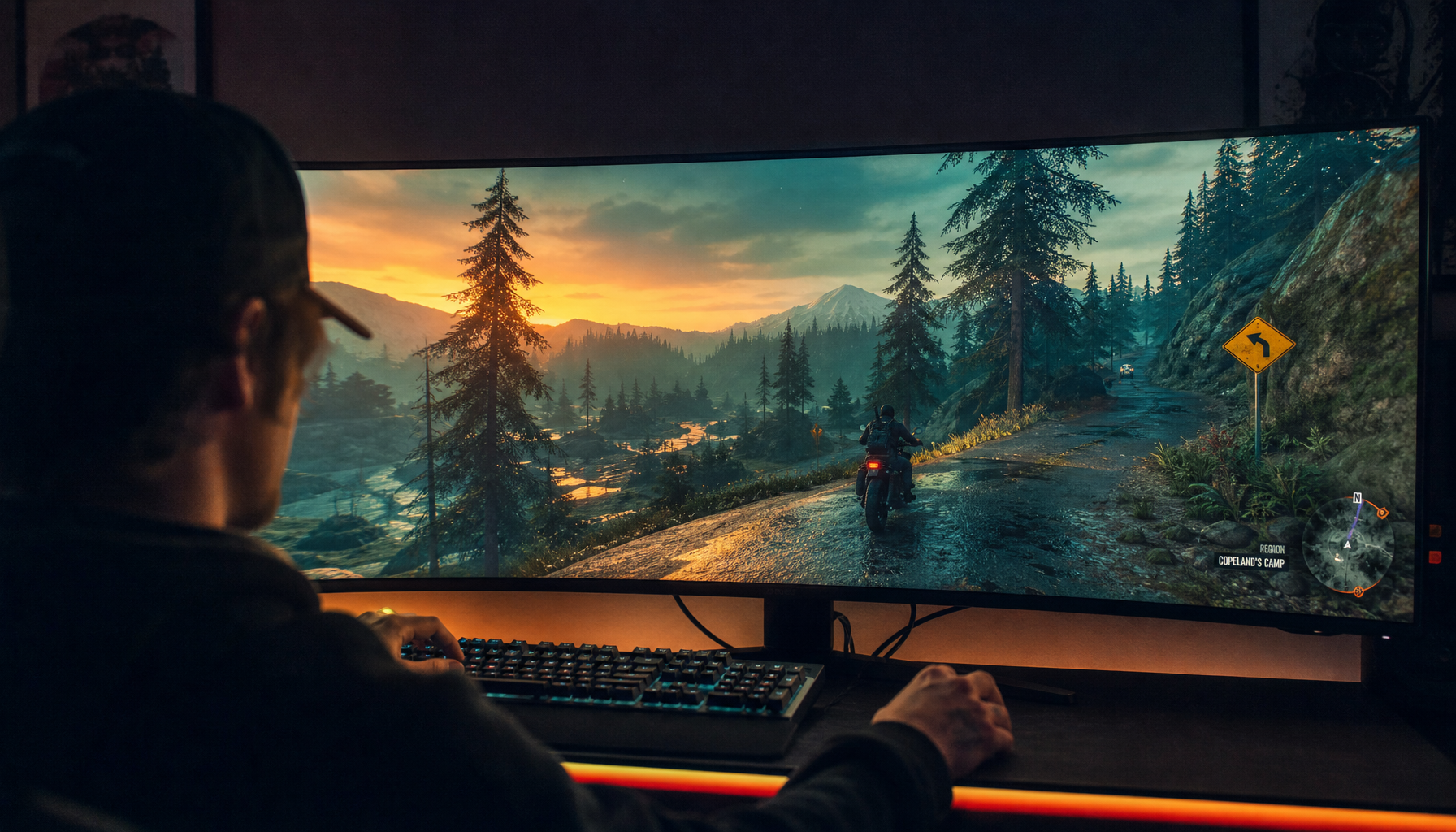
For immersive gaming, ultrawide can make camera movement feel more expansive, but it does not automatically make motion cleaner. Ultrawide monitors mainly change field of view and immersion; response time, refresh rate, and overdrive tuning still decide whether fast pans look sharp.
FAQ
Why does my 144Hz monitor look worse in videos than games?
Most video is 24, 30, or 60 fps, so it will not match the motion smoothness of a game running near 144 fps. Camera pans in low-frame-rate video can look juddery even on a fast monitor because the source itself contains fewer motion samples.
Should I turn on adaptive sync?
Yes, if your FPS fluctuates and your monitor supports it well. VRR can reduce tearing and uneven pacing, but if it increases overshoot on your monitor, try a lower overdrive setting while VRR is enabled.
Is 1ms MPRT the same as 1ms GtG?
No. MPRT is tied to perceived motion blur and often involves backlight strobing, while GtG describes pixel transition speed. A low MPRT number can look sharp in the right mode, but it does not guarantee clean pixel behavior in every game or refresh range.
A sharp 144Hz experience comes from the full chain: stable frames, sensible overdrive, fast pixel transitions, and the right panel for your use. Treat the refresh-rate number as the starting line, then tune the monitor like performance hardware.