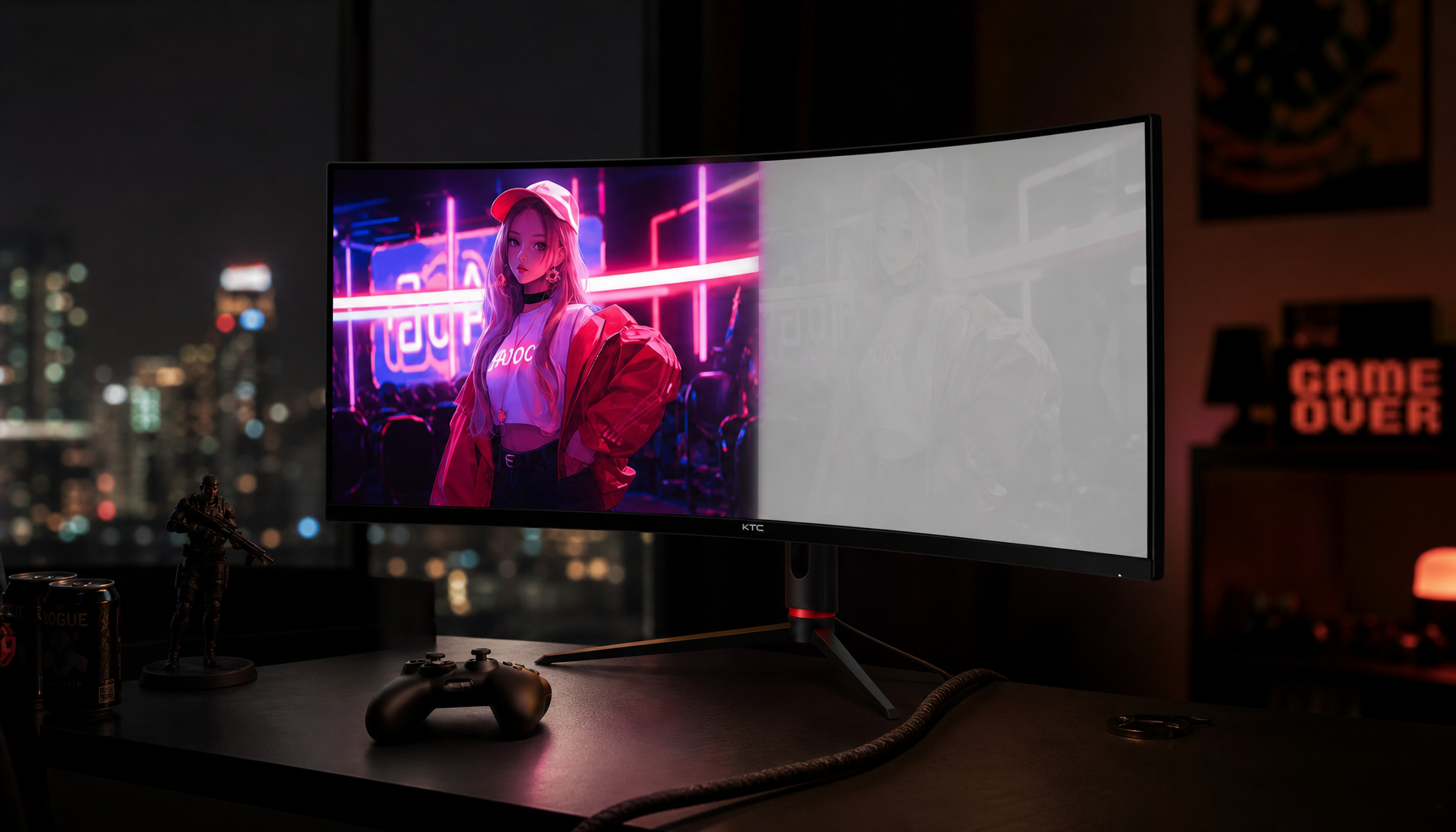
A 1440p ultrawide monitor usually demands more GPU power because it renders about 34% more pixels per frame than a standard 1440p monitor, even though both share the same 1,440-pixel vertical resolution.
If your frame rate drops after moving from a 27-inch 1440p gaming monitor to a 34-inch ultrawide, the monitor is not “just wider” from the GPU’s point of view. A common 3440 x 1440 ultrawide screen asks the graphics card to draw 4,953,600 pixels every frame instead of 3,686,400 pixels, which is a practical difference you can feel in demanding games. Here is how that extra width affects GPU load, refresh-rate targets, cable choice, and what to buy next.
The Pixel Count Difference Is the Main Reason
A standard 1440p monitor is usually 2560 x 1440, while a common 1440p ultrawide monitor is 3440 x 1440. The 3440 x 1440 ultrawide format contains about 4.95 million pixels, compared with about 3.69 million pixels on standard 1440p. That extra 1.27 million pixels per frame is the core reason ultrawide needs more GPU power.

The important detail is that the vertical resolution stays the same, but the horizontal resolution increases sharply. The GPU still has to shade, light, texture, and post-process every visible pixel. At the same graphics settings and refresh rate, 3440 x 1440 gives the GPU roughly 1.34 times as much image data to produce as 2560 x 1440.
Standard 1440p vs 1440p Ultrawide vs 4K
Display format |
Common resolution |
Approx. pixels per frame |
Workload compared with standard 1440p |
Practical gaming takeaway |
Standard 1440p |
2560 x 1440 |
3.69 million |
1.00x |
Easier to drive at 144 Hz, 165 Hz, or 240 Hz |
1440p ultrawide |
3440 x 1440 |
4.95 million |
1.34x |
Noticeably heavier, especially in AAA games |
Dual-QHD super ultrawide |
5120 x 1440 |
7.37 million |
2.00x |
Closer to a dual-monitor workload |
4K UHD |
3840 x 2160 |
8.29 million |
2.25x |
Heaviest of these common gaming options |
This also explains why 1440p ultrawide does not perform exactly like 4K. A 1440p ultrawide has about 1.34x as many pixels as standard 1440p, while 4K has more than double the pixels of standard 1440p. In practice, 3440 x 1440 often feels like a middle step: harder than regular 1440p, but still usually easier to run than 4K.
Why More Pixels Lower Frame Rates
A game frame is not a flat picture that appears for free. The GPU calculates color, lighting, shadows, reflections, anti-aliasing, and effects for the scene, then outputs that image to the monitor. Because GPU workload rises with pixel count, a wider 1440p image can reduce frame rates even when every other setting remains unchanged.

For example, a GPU that averages 120 FPS at 2560 x 1440 will not automatically average 120 FPS at 3440 x 1440. The exact drop depends on the game engine, graphics settings, CPU limits, and whether upscaling is enabled, but the monitor is asking for about one-third more rendered pixels before any ray tracing or heavy visual effects enter the picture.
The Extra Width Also Changes What the Game Shows
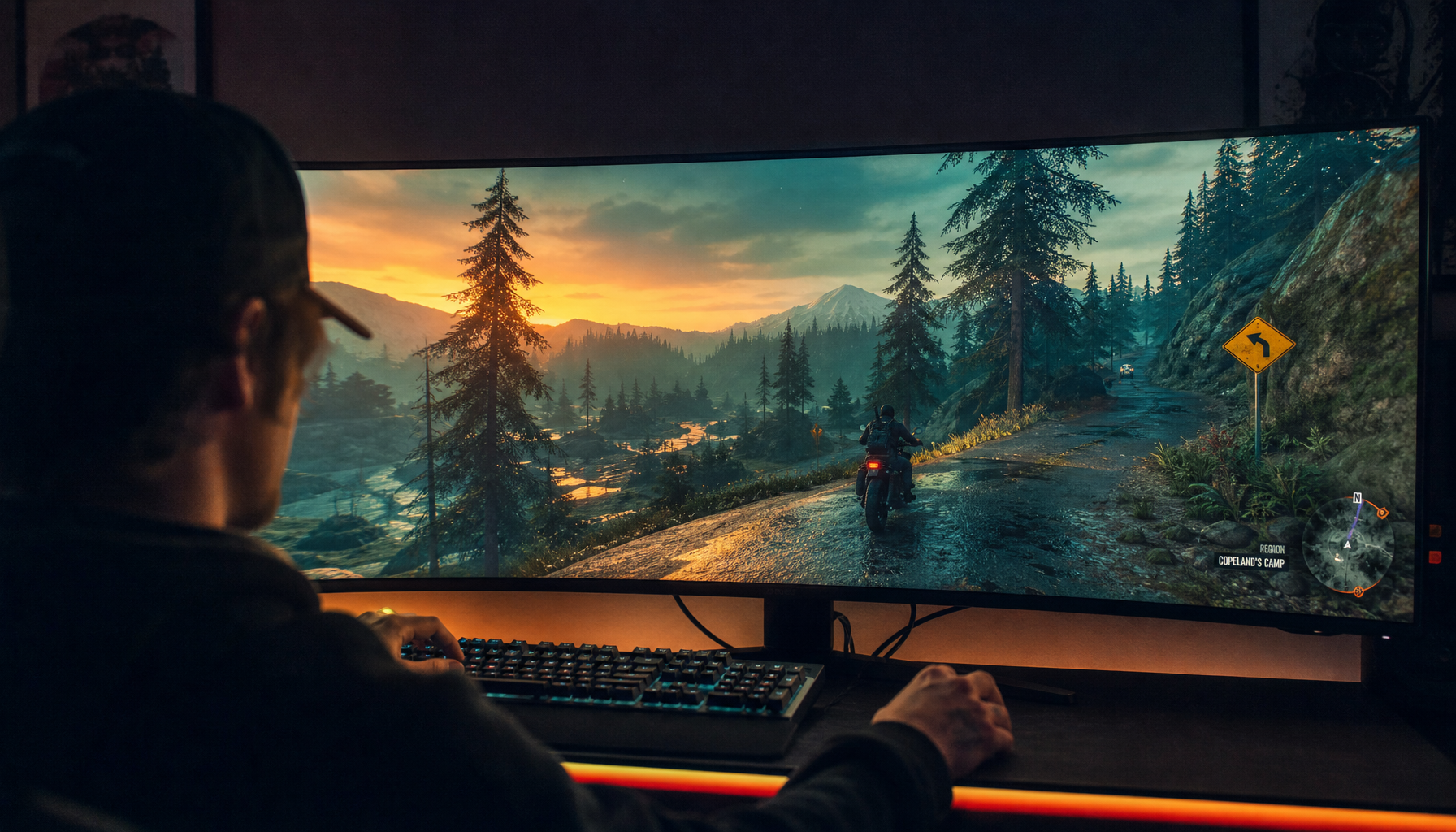
Ultrawide gaming can increase immersion because many games show more horizontal scenery, cockpit space, track width, or battlefield context. That wider field of view can be useful in racing games, flight simulators, open-world games, and single-player RPGs. It is one reason 34-inch ultrawide gaming monitors remain popular despite their higher GPU demand.

However, the GPU cost is not only about the number on the spec sheet. In some games, a wider view can expose more objects, effects, and shadows at the screen edges. That can increase load beyond the simple pixel-count difference, especially in dense city scenes, large raids, or visually complex racing grids.
Not Every Game Scales the Same Way
Competitive esports titles are often easier to run at 3440 x 1440 than visually dense single-player games. A high-end GPU may keep games like tactical shooters or MOBAs near a 165 Hz target, while heavy ray-traced games may need reduced settings, upscaling, or frame generation to feel smooth.
This is why monitor buying advice should start with the games you actually play. If most of your library is competitive and you value low input latency, a 1440p ultrawide at 165 Hz can be practical with a midrange-to-upper-midrange GPU. If you want max settings in new AAA games at 3440 x 1440 and high refresh, the GPU tier matters much more.
Refresh Rate Multiplies the Challenge
Resolution tells you how many pixels the GPU must draw per frame. Refresh rate tells you how many times per second the monitor can display a new frame. A 3440 x 1440 monitor at 165 Hz is asking for far more delivered frames per second than the same monitor at 60 Hz, and a 240 Hz ultrawide raises the bar again.

Good GPU-monitor pairing means matching sustained GPU frame output to resolution, refresh rate, and display bandwidth. A GPU-monitor pairing guide frames this as hardware synergy: when the GPU and monitor are mismatched, users may see stutter, tearing, motion blur, lag, or unused display capability.
144 Hz, 165 Hz, and 240 Hz Are Different Buying Targets
For many gamers, 3440 x 1440 at 144 Hz or 165 Hz is the practical sweet spot. It gives a visibly smoother experience than 60 Hz while staying realistic for a wide range of current GPUs, especially with tuned settings. A 240 Hz 1440p ultrawide is more demanding and mainly makes sense if your GPU can sustain very high frame rates in your chosen games.
For 2026 gaming builds, 1440p at 165 Hz to 240 Hz is often treated as the mainstream balance of image quality and performance. That guidance is easier to hit on standard 2560 x 1440 than on 3440 x 1440 because ultrawide adds about 34% more pixels before refresh rate is considered.
Motion Clarity Is Not Only About FPS
Panel response time also affects perceived clarity. OLED gaming monitors with very fast gray-to-gray response can look cleaner in motion at 240 Hz than some LCD monitors with higher advertised refresh rates but slower pixel transitions. The same GPU may feel better paired with a fast 165 Hz or 240 Hz panel than with a monitor that has weak response behavior.
That does not eliminate the need for GPU power. It means buyers should avoid judging a monitor by refresh rate alone. A strong 3440 x 1440 experience depends on the combined result of resolution, refresh rate, panel response, adaptive sync behavior, and the GPU’s ability to feed the display consistently.
Is 1440p Ultrawide Closer to Standard 1440p or 4K?
In raw pixel count, 1440p ultrawide sits closer to standard 1440p than to 4K. Standard 1440p is about 3.69 million pixels, 3440 x 1440 is about 4.95 million, and 4K is about 8.29 million. So if you are worried that a 34-inch 1440p ultrawide will be as hard to run as a 4K monitor, the numbers do not support that.
But in real gaming, it can still feel like a major upgrade in GPU demand. If your current GPU is already near its limit at 2560 x 1440, moving to 3440 x 1440 may push frame rates below your preferred range. That is especially true if you are also moving from a 60 Hz or 75 Hz display to a 144 Hz, 165 Hz, or 240 Hz ultrawide gaming monitor.
A Practical Performance Expectation
A useful rule: if a game barely holds 100 FPS at standard 1440p with your preferred settings, expect 3440 x 1440 to need compromises. Those compromises might include lowering shadows, turning down ray tracing, using balanced upscaling, reducing screen-space reflections, or targeting 90 FPS to 120 FPS instead of trying to max out a 165 Hz panel. By contrast, a standard 27-inch 2K 180Hz option such as a 27” 2K 180Hz/1ms 1500R curved gaming monitor keeps the GPU workload at 2560 x 1440 rather than 3440 x 1440.
If your current system has a lot of headroom at 2560 x 1440, the move is easier. For example, if you regularly see frame rates far above your monitor’s refresh limit, the ultrawide’s extra pixels may simply use GPU performance that was previously unused. That is the best-case upgrade path: the monitor becomes more immersive without making the system feel underpowered.
Visual Sharpness, Pixel Density, and Anti-Aliasing
Pixel count affects GPU load, but pixel density affects how sharp the display looks from your seat. A 27-inch 2560 x 1440 monitor is commonly around 109 pixels per inch, while a 32-inch 4K monitor is about 138 pixels per inch. Many 34-inch 3440 x 1440 ultrawide monitors land close to the familiar 27-inch 1440p sharpness level, just stretched wider.
Visual detail also depends on viewing distance. A screen density calculator describes perceived density through pixels per degree, which accounts for both pixel density and how far your eyes are from the screen. The practical point for monitor buyers is simple: a display can look sharper or softer depending on size, resolution, and where it sits on the desk.
Why This Matters for GPU Settings
A sharper display can sometimes let you reduce anti-aliasing without making the image look too jagged. On a 1440p ultrawide, you may be able to use a lighter anti-aliasing option or rely on modern temporal upscaling, depending on the game. That can recover some performance after moving from standard 1440p.
Do not expect anti-aliasing changes to erase the whole 34% pixel increase, though. They are tuning tools, not magic. The strongest gains usually come from reducing expensive settings such as ray tracing, volumetric effects, ultra shadows, and reflection quality.
How to Choose the Right GPU for a 1440p Ultrawide Monitor
Start with the monitor’s resolution and refresh rate, then match the GPU to the frame rate you realistically want. A 3440 x 1440 100 Hz monitor is a different buying target than a 3440 x 1440 240 Hz OLED. The second display may look spectacular, but it needs a much stronger GPU to avoid wasting the monitor’s refresh capability.
Connection bandwidth matters too. A common display connection standard provides roughly 32 Gbps and can support high-refresh 1440p scenarios, while newer high-bandwidth display connection standards reach much higher bandwidth for demanding uncompressed display modes. The newer display connection bandwidth point becomes more important as buyers move toward very high refresh rates, 4K 240 Hz displays, or advanced multi-monitor setups.
Practical GPU Pairing Guidance
For 3440 x 1440 at 100 Hz to 144 Hz, look for a GPU that performs comfortably above standard 1440p requirements in the games you play. For 165 Hz ultrawide, aim higher, especially if you play new AAA games. For 240 Hz ultrawide, treat the monitor as a premium performance target rather than a simple 1440p upgrade.
Upscaling and frame generation can help, but they should not be the only reason a GPU makes sense. Competitive players may prefer native rendering or lower-latency settings, while single-player gamers may accept quality-mode upscaling for smoother visuals. The right answer depends on whether you prioritize responsiveness, image quality, or cinematic settings.
Buying Checklist
- Confirm the exact resolution: 2560 x 1440, 3440 x 1440, or 5120 x 1440.
- Match the GPU to the monitor’s refresh rate, not just its resolution.
- Check benchmarks at 3440 x 1440 when available; standard 1440p benchmarks can overstate expected performance.
- For AAA games, budget for setting adjustments such as shadows, ray tracing, reflections, and volumetrics.
- Use a high-bandwidth display connection when targeting high refresh rates, and verify the GPU and monitor support the needed version.
- Consider panel response time and adaptive sync quality, not only the refresh-rate number.
- Leave performance headroom if you plan to keep the monitor through future GPU or game upgrades.
FAQ
Q: Does 1440p ultrawide always reduce FPS by exactly 34%?
A: No. The 34% figure describes the increase in pixel count from 2560 x 1440 to 3440 x 1440, not a guaranteed frame-rate loss. Some games are mostly GPU-limited and may scale close to the pixel increase, while others are limited by the CPU, engine, memory bandwidth, or specific graphics effects.
Q: Is 3440 x 1440 harder to run than 4K?
A: No. A 3440 x 1440 monitor has about 4.95 million pixels, while 4K has about 8.29 million pixels. That makes 1440p ultrawide significantly lighter than 4K in raw pixel workload, although high refresh rates and demanding settings can still make it challenging.
Q: Should I buy standard 1440p or 1440p ultrawide for gaming?
A: Choose standard 1440p if you want the easiest path to high frame rates, especially for competitive games. Choose 1440p ultrawide if you value immersion, wider views, and a larger desktop workspace, and you are willing to use a stronger GPU or tune settings to maintain smooth performance.
Key Takeaways
1440p ultrawide needs more GPU power because it is not the same workload as standard 1440p. A common 3440 x 1440 monitor renders about 1.27 million more pixels per frame than a 2560 x 1440 monitor, which is about a 34% increase. That extra width is excellent for immersion, but it directly affects frame rates, graphics settings, and GPU buying decisions.
For most gaming monitor buyers, 3440 x 1440 is best understood as a middle ground between standard 1440p and 4K. It is much easier to drive than 4K, but it still deserves a stronger GPU than a regular 1440p display, especially at 144 Hz, 165 Hz, or 240 Hz. Before buying, compare benchmarks at the actual ultrawide resolution, check the connection standard, and decide whether your priority is competitive speed, visual quality, or a wider, more immersive screen.