




Dual-layer LCD gets closer to OLED-like contrast by adding a second LCD layer that blocks light before it reaches the main color panel. That extra light control can deepen blacks dramatically and cut blooming, but it does not erase the usual LCD tradeoffs in speed, thickness, power, and brightness efficiency.
Ever loaded a dark game, only to watch shadow detail turn into a gray haze around bright HUD elements? Real dual-cell implementations have shown black levels as low as 0.0003 and peak brightness above 2,900 nits, while rough DIY builds proved the same idea can also crush brightness if the optical stack is inefficient. You’ll see how the technology works, where it genuinely narrows the gap with OLED, and what matters most if you’re choosing a gaming monitor, ultrawide, or portable display.
What Dual-Layer LCD Changes Inside the Panel
A second LCD layer handles light before color
A dual-layer LCD stack places a grayscale or monochrome panel behind the main color panel, between the backlight and the front RGB image layer. The rear layer controls luminance, while the front layer handles color and final image detail, so the display gets two chances to block unwanted light instead of one.
That matters because standard LCD contrast is usually limited by backlight leakage, even on good IPS or VA panels. OLED solves this differently by letting each pixel emit its own light and switch fully off, while dual-layer LCD stays transmissive and tries to mimic deep blacks by stacking more light control in front of a powerful backlight.
It is not the same as dual-mode or tandem OLED
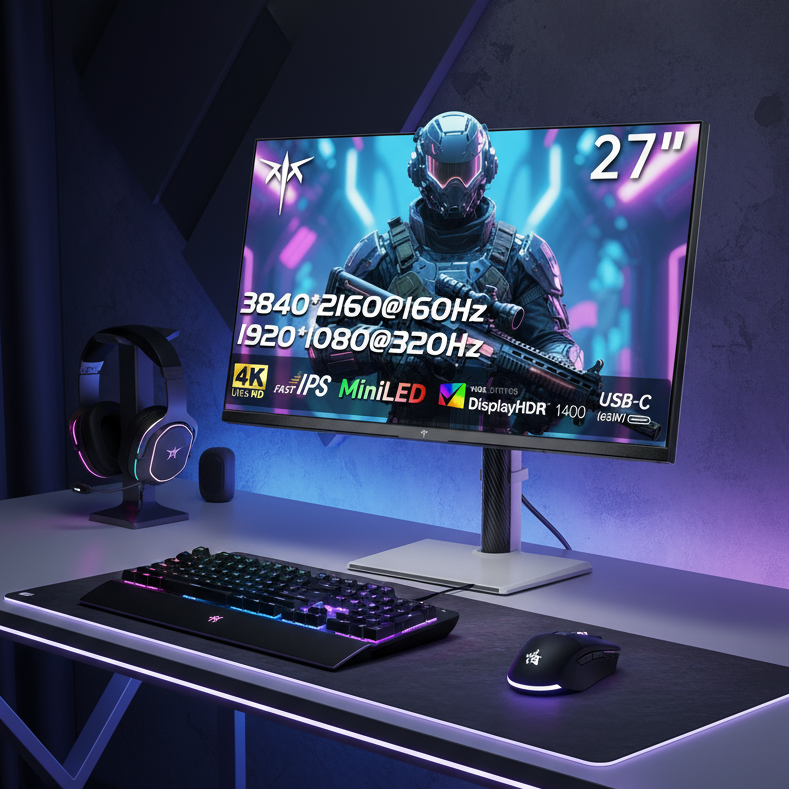
A dual-mode monitor switches between native display modes such as 4K at a lower refresh rate and 1080p at a much higher one. Dual-layer LCD does not change resolution modes; it changes the optical structure of the panel to improve contrast.
Why Contrast Can Jump So Much
The two layers multiply light blocking
The contrast-multiplication principle is the core reason this design gets so much attention: if one LCD layer can attenuate light to roughly 1,000:1, a second independent layer can theoretically push the combined result toward 1,000,000:1. In practice, real performance depends on alignment, scatter control, and panel quality, but the idea is sound enough to make dark scenes look far less washed out than on a normal edge-lit or basic full-screen-lit LCD monitor.

A dual-cell implementation using a 1080p monochrome layer behind a 4K color layer was described as delivering about two million dimming zones by bonding the two LCDs together. That is why dual-layer LCD can suppress halos more precisely than zone-based backlighting alone: the rear panel modulates luminance at far finer granularity than a conventional local-dimming array.
Real-world contrast still depends on the room
Ambient contrast is the practical reminder that deep blacks on paper do not always look equally deep on a desk near a window. Room light raises the black floor for every display, so a very bright LCD with strong black control can look more convincing in daytime use than its dark-room specs alone would suggest.
Why It Still Does Not Behave Like OLED
Brightness efficiency is the biggest penalty
A stacked LCD design loses a lot of light because each layer, polarizer, and diffusion or depolarizing element cuts transmission. In one 24-inch DIY test, a stock backlight around 300 nits fell to roughly 9 to 10 nits with tracing paper in the stack, while a flipped arrangement improved output to about 25 nits. A production display can compensate with a much stronger backlight, but that raises cost, heat, and power demand.
Motion can still be LCD-limited
Response time matters more than raw refresh rate when you are judging motion clarity on a gaming monitor. At 240Hz and 360Hz, each frame window is so short that slow gray-to-gray transitions, overshoot, and dark smearing become obvious, which means a dual-layer LCD can post impressive contrast and still look less clean in motion than OLED.

The known engineering headaches include ghosting, color banding, stronger heat output, added thickness, and in some cases active cooling. That is the practical reason OLED still feels more natural for fast shooters and esports use: it combines black depth with near-instant pixel response instead of trading one for the other.
Optical complexity adds more risk points
Light scatter and alignment issues are not side notes; they are central to whether dual-layer LCD looks premium or compromised. Polarization alignment, moire, viewing-angle behavior, IPS glow interactions, and panel-driving artifacts all become harder to manage when two LCD structures are stacked.
Where Dual-Layer LCD Fits in Monitor Buying
For a desktop monitor focused on HDR movies, single-player games, or editing work where black depth matters, dual-layer LCD can outperform normal LCD designs by attacking the biggest LCD weakness directly: uncontrolled backlight leakage. It is most compelling when you want brighter highlights than OLED often delivers, but still want much darker blacks than a basic IPS gaming monitor can manage.

For portable monitors, slim ultrawides, and very high-refresh competitive displays, the power-and-thickness penalty becomes harder to ignore. Two LCD layers need more optical precision and usually a stronger backlight, which works against thin chassis, simple USB-C power budgets, and cool, quiet operation.
A mini-LED LCD approach is still the more practical LCD path for many buyers because it gets closer to OLED-like perceived contrast without stacking two full LCD panels. Dual-layer LCD is the more radical contrast-first idea; mini-LED is usually the easier engineering compromise.
Display type |
How black control works |
Contrast outlook |
Motion outlook |
Main tradeoff |
Best fit |
Standard IPS/VA LCD |
One LCD layer modulates a constant backlight |
Usually about 1,000:1 to 3,000:1 static contrast |
Depends heavily on overdrive and panel quality |
Weaker blacks and more visible bleed |
General office, budget gaming |
Mini-LED LCD |
One LCD layer plus many backlight dimming zones |
Strong HDR and better perceived contrast than basic LCD |
Can be very good, but blooming still depends on zone control |
Blooming and dimming behavior vary a lot |
Bright-room gaming, mixed use |
Dual-layer LCD |
Rear grayscale layer plus front color layer |
Can approach OLED-like black depth and sharply reduce halos |
Still LCD-limited, with more optical complexity |
Lower efficiency, more heat, more thickness |
HDR-focused desktop use |
OLED |
Self-emissive pixels switch fully on or off |
Near-infinite black level in dark-room viewing |
Excellent due to extremely fast pixel response |
Burn-in risk and often lower full-screen brightness |
Dark-room gaming and cinematic use |
What to Check Before You Buy
Do not buy on contrast alone
A high-refresh monitor is only as clear as its real pixel transitions, so check dark-level response, overshoot behavior, and whether the panel stays clean at its top refresh rate. A dual-layer LCD with mediocre transitions can still look blurrier than a well-tuned single-layer gaming monitor in actual play.
Judge brightness, heat, and use case together
Real-world contrast performance depends on both black level and usable brightness, especially in brighter rooms. If you want a monitor for daytime work, HDR gaming, and occasional movies, full-screen brightness and reflection handling may matter as much as the headline contrast story.
Read the term “dual-layer” carefully
A dual-layer architecture can also mean a two-state design built for power savings or standby visibility rather than cinematic contrast. If a spec sheet says “dual-layer,” verify whether it is a contrast-boosting rear luminance layer, a power-saving secondary panel, or something else entirely.
FAQ
Q: Can dual-layer LCD match OLED for dark-room gaming?
A: Dual-layer LCD can get much closer to OLED than a normal LCD by cutting light leakage twice, so blacks and shadow separation can look dramatically better. It still does not use self-emissive pixels, so motion clarity, thickness, and efficiency usually remain less OLED-like.
Q: Is dual-layer LCD better than mini-LED for gaming monitors?
A: A mini-LED monitor is usually the safer mainstream choice if you want high brightness, good HDR, and more product variety. Dual-layer LCD has the potential for finer black control, but it asks more from the backlight and panel stack.
Q: Are dual-mode gaming monitors the same thing as dual-layer LCD monitors?
A: No. dual-mode monitors switch between display modes such as 4K and high-refresh 1080p, while dual-layer LCD uses two stacked LCD panels to improve contrast.
Final Takeaway
Dual-layer LCD achieves OLED-like contrast by splitting the job in two: a rear LCD layer handles luminance, and a front LCD layer handles color and detail. When that stack is well executed, black levels drop, blooming shrinks, and HDR scenes can look far more convincing than they do on a standard gaming monitor.
For buying decisions, the right question is not “Can it look like OLED?” but “What am I willing to trade to get there?” If your priority is deep blacks with strong brightness on a desk-bound display, dual-layer LCD is technically compelling. If you want the cleanest motion, the thinnest chassis, or a portable and power-efficient setup, OLED or a strong mini-LED monitor is usually the more practical fit.
References
- a forum, “DIY Dual-Layer LCD monitor”
https://forum.diyperks.com/displays-and-monitors-tvs/diy-dual-layer-lcd-monitor/ - a forum, “DIY Dual-Layer LCD monitor – Page 2”
https://forum.diyperks.com/displays-and-monitors-tvs/diy-dual-layer-lcd-monitor/paged/2/ - a forum, “Two LCD Layers to amplify 1000:1 contrast to 1,000,000:1”
https://forums.blurbusters.com/viewtopic.php?t=3090 - a forum, “DUAL Layer LCD Display Info Thread”
https://hardforum.com/threads/dual-layer-lcd-display-info-thread-mono-lcd-as-backlight.1976079/ - a company, “Why LCDs Have Two Polarized Layers”
https://nelsonmillergroup.com/why-lcds-have-two-polarized-layers/ - a publication, “Your monitor’s refresh rate matters less than response time”
https://www.xda-developers.com/monitors-refresh-rate-matters-less-than-response-time/ - a company, “Complete Guide to Contrast Ratio”
https://www.absen.com/complete-guide-to-contrast-ratio/ - a company, “What Is Screen Contrast Ratio?”
https://www.unit-led.com/display-screen-contrast-ratio - a publication, “Should you bother with dual-mode monitors?”
https://www.rockpapershotgun.com/should-you-bother-with-dual-mode-monitors - a company, “Dual-Layer LCD Architecture Balancing Power Efficiency and Visual Performance”
https://www.orientdisplay.com/dual-layer-lcd-architecture-balancing-power-efficiency-and-visual-performance/ - a company, “Choosing Between OLED and LCD Displays for Your Needs”
https://www.goldenvision.com/choosing-between-oled-and-lcd-displays-for-your-needs - a platform discussion on dual-layer LCD tradeoffs
https://news.ycombinator.com/item?id=41672188


