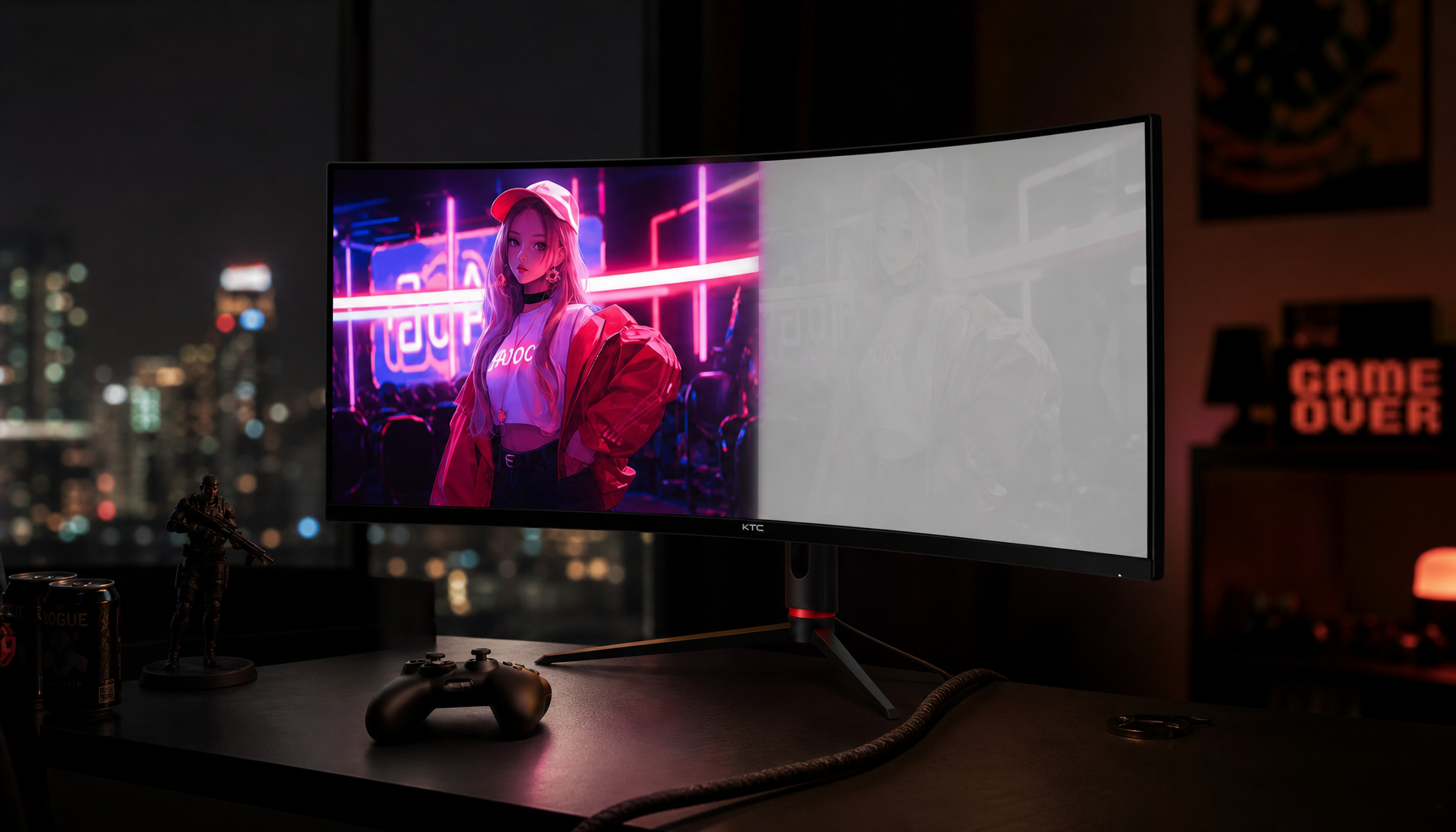
Viewing angle determines how stable color, contrast, and brightness remain while you play. The farther your eyes move off-center, the more likely the image is to shift, wash out, or lose shadow detail, especially on TN and many VA panels.
Have you ever leaned back during a boss fight or glanced toward the edge of an ultrawide and felt the scene suddenly look duller, darker, or oddly tinted? In real setups, a small change in seat position, monitor height, or panel type can make enemy silhouettes, minimap colors, and shadow detail harder to read. This article explains how to tell whether viewing angle is hurting your image, which panel types handle it best, and how to tune your setup for more reliable color during long sessions.
Why viewing angle matters more in gaming than most people expect
Viewing angle is the range from which a display can be seen without obvious image degradation. In plain terms, it answers a simple question: how far can your eyes move away from the center before colors, brightness, and contrast stop looking correct?
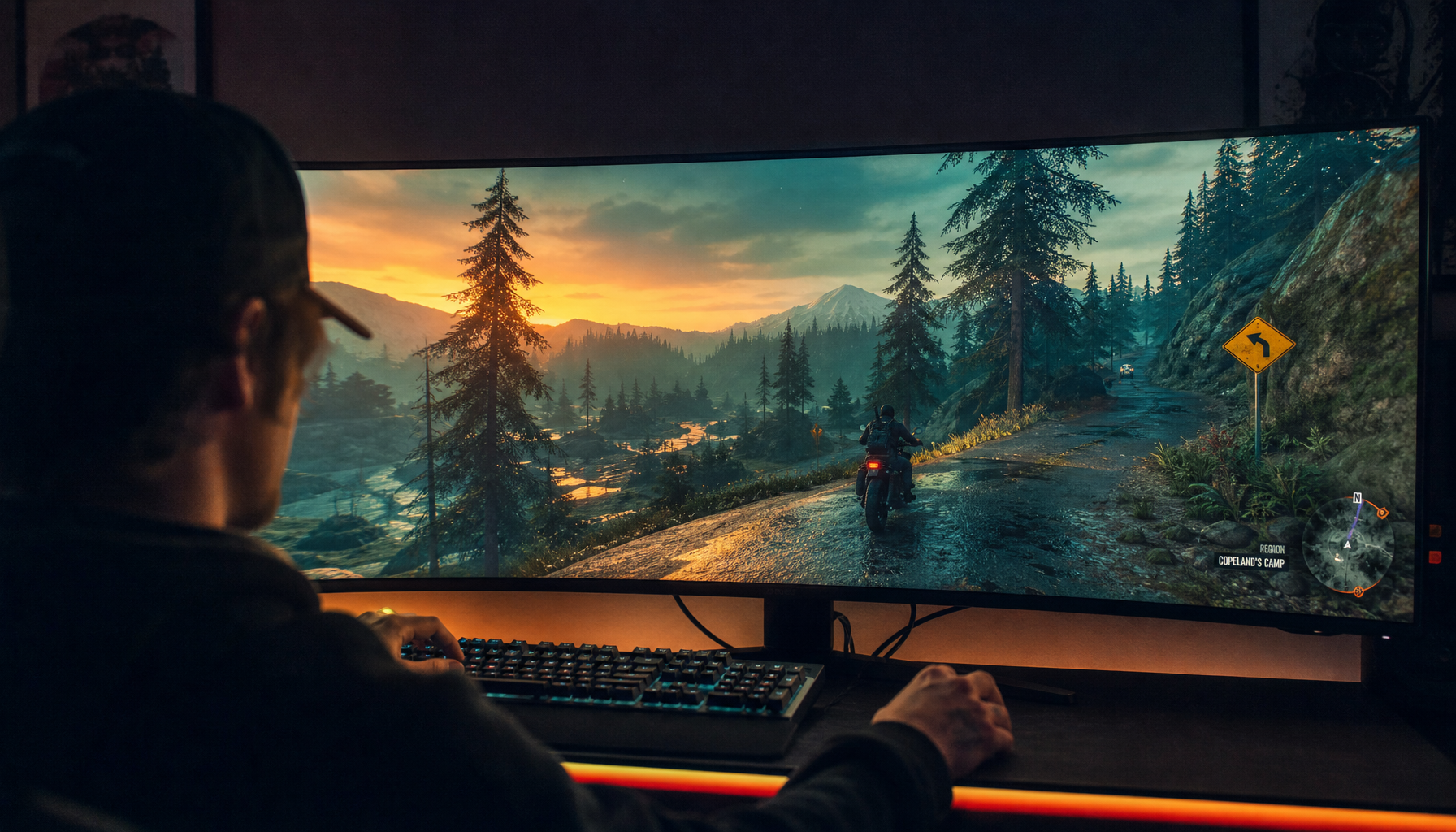
That matters in gaming because you rarely sit perfectly still. You shift in your chair, lean into aim duels, recline during cutscenes, and scan the corners of the screen under pressure. On a 27-inch screen this may be manageable, but on a 32-inch panel or an ultrawide, the outer edges are already being viewed at a slight angle even when you are centered. Guidance on desk distance and posture about ideal monitor placement points out that sitting about 20 to 30 inches away and keeping the top of the screen at or slightly below eye level reduces both strain and the amount of off-angle viewing you create yourself.

Color accuracy during gaming is not only about whether red is “correct red” in a lab sense. It is also about consistency. If a dark hallway becomes grayer at the edges, or if a health bar looks less saturated when your head moves a few inches, your eyes have to work harder to interpret the scene. That costs comfort first, and in competitive play it can also cost speed.
What actually changes when the viewing angle gets worse
The first thing most players notice is not a dramatic rainbow effect. It is subtle instability. Blacks look raised, highlights lose punch, and colors stop matching from the center to the edges. That can make a horror game look flatter, a tactical shooter look hazier, or a racing game lose the vivid road-and-sky separation that helps depth perception.
In practice, the damage shows up in three ways. Color can shift, meaning hues no longer look the same from one position to another. Brightness can fall off, so edge detail looks dimmer than center detail. Contrast can collapse, which is especially bad in games that rely on shadow information. If you play extraction shooters or stealth-heavy titles, that last part matters more than many spec sheets suggest.
There is also a difference between image quality and comfort. A screen can have decent color capability on paper and still look wrong if it is placed too high or too low. Advice on ideal monitor height and angle and practical calibration guidance on basic monitor setup support the same pattern: let the display sit slightly below eye level, give it time to warm up, and control glare before judging color. If a lamp is bouncing off the panel or your neck angle forces you to view from below, you are no longer seeing the display at its best.
Panel type changes the answer
This is where buying decisions become clearer. Not every panel handles off-angle viewing the same way, and that directly changes how trustworthy color remains during a gaming session.
Panel type |
Viewing-angle behavior |
Gaming tradeoff |
TN |
Narrowest angles, with the most visible color and brightness shift |
Very fast feel, but the weakest image stability |
VA |
Better than TN, with stronger contrast, but edge consistency can still vary |
Great for deep blacks, but less reliable off-center than IPS |
IPS |
Strong color consistency and wide angles |
Best all-around balance for color-focused gaming |
OLED |
Excellent off-angle stability and black depth |
Premium image quality, usually at a higher cost |
That pattern lines up with broader monitor selection advice on gaming monitor panel types, monitors for color-critical work, and creator-focused display picks. These sources are not written only for esports, but they agree on the core point: if you care about stable color, panels that perform well for creative work usually perform well for immersive gaming too, because both use cases expose inconsistency.
A simple real-world example helps. Imagine a 32-inch VA monitor used for a dark single-player game. The center of the screen may look rich and cinematic, but the far left and right edges can appear slightly lighter or less color-stable when you sit close. Move the same game to a good IPS or OLED panel and those edge differences usually shrink. The result is not just prettier; it is easier to read.

Gaming scenarios where viewing angle matters most
Viewing angle becomes more important as screen size grows, as your seating distance gets shorter, and as the game depends more on subtle visual information. That is why players often notice the problem first on ultrawides, curved displays, and dual-use work-and-play setups.

A fast competitive player on a 24-inch or 27-inch screen may accept weaker viewing angles if the monitor delivers the speed they want. But once you move to 32-inch and larger displays, or sit very close for high-refresh play, the edges start behaving like off-angle content. Size guidance on larger display tradeoffs and other color-focused display recommendations keep circling back to the same reality: larger screens improve immersion and workspace, but they also demand more disciplined positioning and a panel that holds color together.
Portable smart screens are even trickier. They move around, they get used on uneven surfaces, and they are often viewed from above or below rather than straight on. In that category, stable off-angle behavior matters almost as much as brightness. If you use a portable display for cloud gaming, a sidecar setup, or couch play, IPS or OLED is usually a safer bet than a bargain panel with narrow vertical tolerance.
Can calibration fix viewing-angle problems?
Only part of the problem.
Calibration improves how accurate the screen is when you view it correctly. It can align white point, gamma, and brightness more reliably, and that absolutely helps if your monitor is too cool, too warm, too dim, or oversaturated. Practical calibration workflows in a monitor calibration walkthrough and a monitor calibration process show why hardware measurement is more dependable than guessing by eye.
What calibration cannot do is change the physical viewing-angle behavior of the panel. A calibrated TN panel is still a TN panel. If colors invert or wash out when you shift vertically, no ICC profile will erase that limitation. That is why the most reliable upgrade path is usually this sequence: start with neutral picture settings, set the correct monitor height and distance, reduce glare, then calibrate if needed. If the display still changes too much as you move, the real fix is panel choice, not menu tweaking.
There is one useful middle ground. If your current monitor is basically good but looks inconsistent during long sessions, you may gain more from setup correction than from replacement. Moving the screen back a few inches, raising or lowering it so the top edge sits near eye level, and avoiding direct overhead light can make the panel behave more consistently from your actual seat. That is a low-cost improvement with immediate payoff.
How to choose for better color stability in actual play
If you mainly play competitive games and care most about tracking, clarity, and reaction speed, a fast IPS panel is the safest modern choice because it preserves much more color consistency than older TN-first logic suggests. If you mainly play cinematic RPGs, racing games, or open-world titles in darker rooms, OLED gives the most convincing image and the least off-angle compromise, while IPS remains the strongest value option. VA still makes sense when you want deeper blacks at a lower price, but it rewards careful positioning more than the other two.
The reliable rule is simple: the larger the screen, the closer you sit, and the more visual subtlety your games demand, the more viewing angle should move up your priority list. Refresh rate still matters, and so does response time, but color that shifts every time you move is not a premium experience no matter how high the refresh rate is.
A strong gaming image is not only fast. It stays believable from the way you actually sit, scan, and react. When the panel, placement, and calibration all work together, color stops being a distraction and starts becoming part of your edge.