VA panels shift color and gamma off-angle because their crystal structure favors blocking light for higher contrast, while IPS panels keep light behavior more uniform across wider viewing positions. For monitor buyers, that usually means deeper blacks on VA and steadier color on IPS.
If you have ever leaned back in your chair and noticed a dark game scene look slightly different at the edges than it did a second ago, you have already seen this tradeoff. It becomes easier to spot on bigger screens, especially 34-inch ultrawides and shared-viewing setups. Here is what causes it, when it matters, and how to choose the right panel for your next monitor.

What Actually Causes VA Color Shift
VA is built for contrast first
The biggest reason VA panels look different at angles is that VA panels align liquid crystals to emphasize contrast. That alignment helps block more light, which is why VA monitors commonly reach around 2,500:1 to 3,000:1 contrast while IPS often sits near 1,000:1 on gaming and productivity displays. The tradeoff is that once you move off-center, light passes through the panel less evenly, so brightness, saturation, and gamma change faster.
That is why a VA gaming monitor can look excellent straight on in a dark room, then start looking slightly washed out or uneven when you slide left or right. A monitor site’s explanation of VA glow, gamma shift, and black crush matches what buyers often notice in practice: blacks stay impressively deep head-on, but dark tones and color balance change more obviously from an angle.
IPS is built for consistency first
IPS works differently because its crystals rotate parallel to the panel surface, which helps colors stay more consistent across a wider range of viewing positions. That is why IPS is the safer choice for monitor tasks where the whole screen needs to look stable at once, such as editing photos, using a large ultrawide, or gaming on a desk where your eyes are never perfectly centered on every part of the display.
In plain terms, IPS usually looks more uniform from the center to the corners. You give up some black depth to get that behavior, which is why IPS can show grayish blacks in a dark room even when color consistency is strong.
Why the Side View Spec Does Not Tell the Whole Story
The published angle number is often too generous
A lot of monitor listings make VA look unbeatable on paper because the quoted viewing angle is usually based on when contrast falls below 10:1. That measurement standard can make a panel sound usable far beyond the point where most people would already notice color or gamma errors.
For real buying decisions, the more useful question is not “Can I still see an image?” but “Does the image still look correct?” That is where VA and IPS separate. A panel can still meet a marketing-style angle claim and yet look visibly off before you get anywhere near that limit.
Lab tests show the practical gap
In controlled testing, lab-style viewing-angle measurements track color washout, hue shift, brightness loss, black-level raise, and gamma shift as the viewer moves off-center. Example results in the same data set show IPS color shift around 54° to 56° left and right, while VA can be closer to 30° to 36°. A 10° difference is already noticeable, so that gap is not academic.
Lab-style examples point in the same direction. IPS held color and brightness better than VA in off-angle examples, while VA lost image accuracy faster, especially when dark tones were involved.
Panel type |
Typical strength |
Typical weakness |
Common contrast range |
Off-angle behavior |
IPS |
Color consistency, wide usable angles |
Lower black depth, possible IPS glow |
Around 1,000:1 |
Usually stays more uniform across the screen |
VA |
Deep blacks, strong dark-room contrast |
Gamma shift, black crush, narrower angles |
Around 2,500:1 to 3,000:1 |
More likely to wash out or shift off-center |
TN |
Speed and low cost |
Weak color and poor vertical angles |
Around 1,000:1 |
Usually the least stable overall |
When VA Color Shift Matters Most on Real Monitors
Ultrawide monitors make the issue easier to see
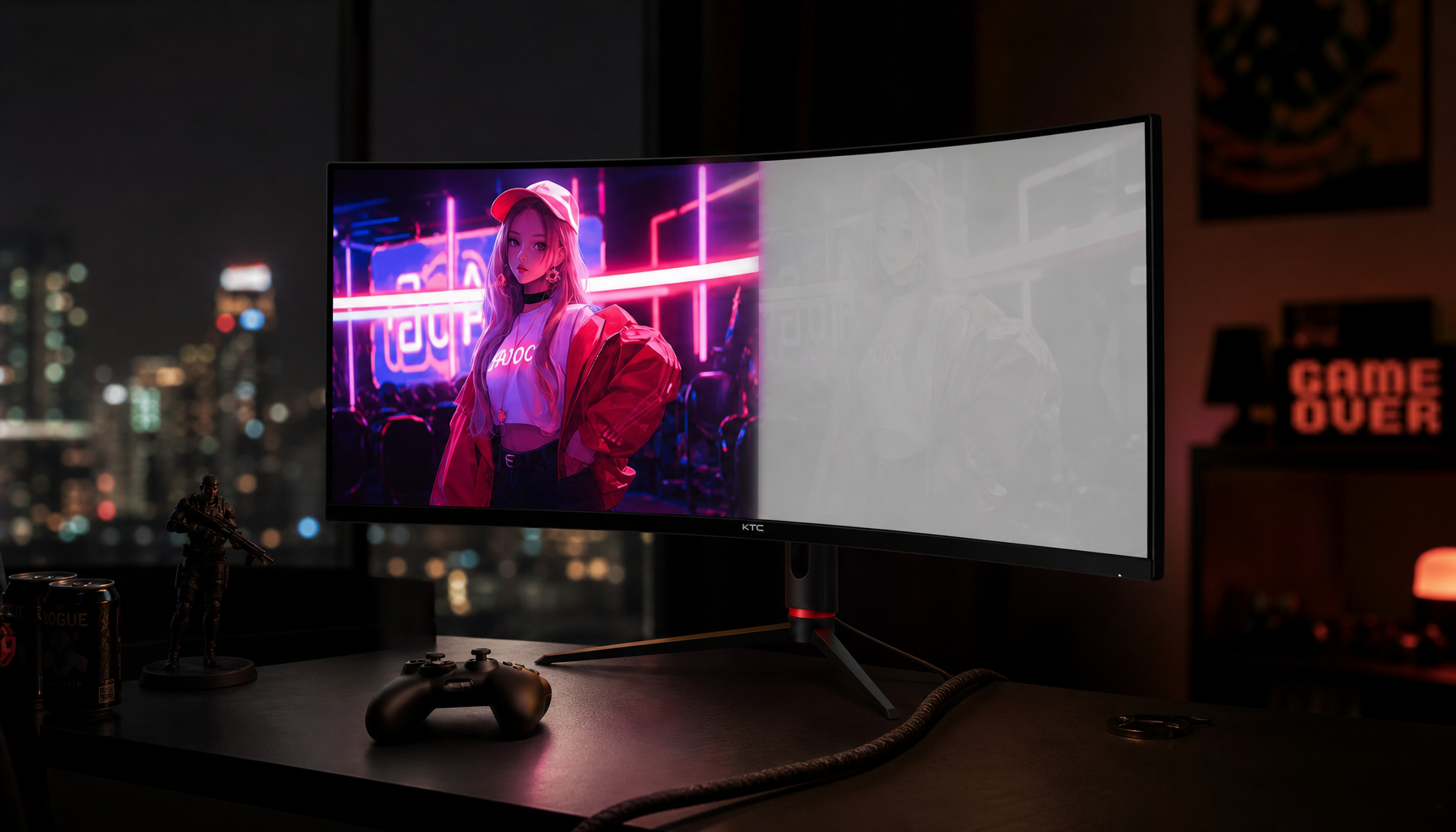
VA color shift is more noticeable on wider screens, and that matches real desk use. On a 34-inch ultrawide, your eyes are close enough that the edges are already being viewed from an angle even when you sit centered. That can make the middle of the screen look darker and richer while the sides look slightly lighter or less accurate.
This is also why curved VA ultrawides are so common. The curve helps reduce how extreme those edge angles feel, but it does not eliminate the underlying panel behavior. If you are buying an ultrawide for immersive single-player gaming or movies, VA can still make sense. If you are buying it for color-sensitive work or uniform desktop use, IPS is usually the safer pick.
Dark-room gaming makes the tradeoff more obvious
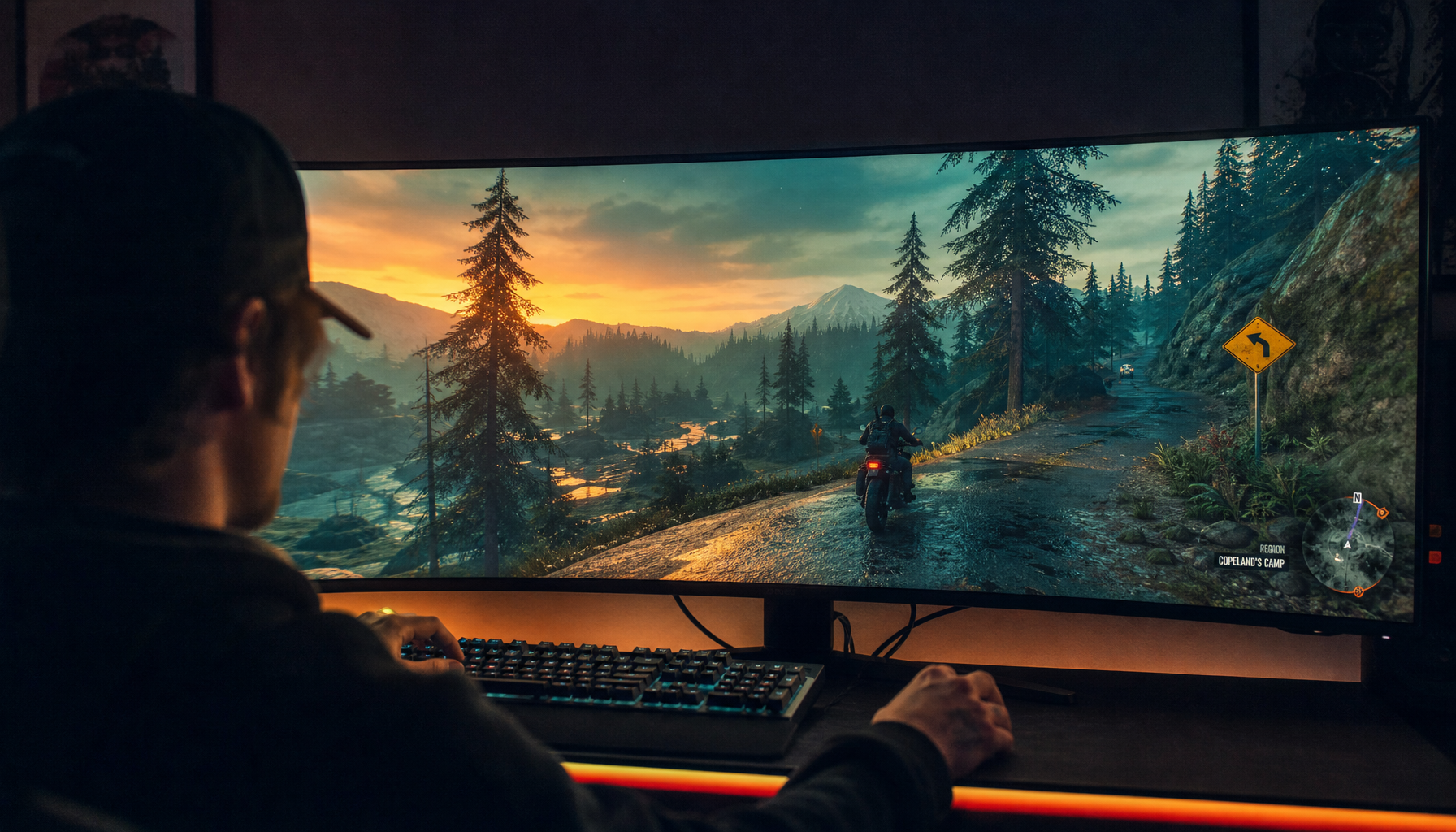
VA panels offer higher static contrast, so shadow-heavy games and SDR movie watching can look more dramatic on VA than on IPS. Real buyer discussions often focus on this exact reason: an IPS black level around 0.14 to 0.17 nits can look weak next to VA options that drop below 0.10 nits, with some reports going below 0.05 nits in dark-room use.

The catch is that the same dark scenes that benefit from VA contrast also make black crush and gamma shift easier to notice. In practice, that means a horror game can look excellent in the center of the screen, while some edge detail looks slightly different unless you stay in the sweet spot.
Shared viewing and portable monitors favor IPS
If two people are looking at one screen, or if you use a portable monitor from changing positions, IPS image quality is less compromised at different viewing angles. That matters more than spec-sheet contrast in these cases because consistency is the entire point.

A portable monitor used beside a laptop is a good example. You often glance at it from an angle, not straight on. That use pattern naturally favors IPS over VA, even if the VA model looks stronger on a black-level spec.
What Buyers Should Prioritize for Gaming Monitors
Choose VA when contrast is the priority
VA panels are especially strong in contrast, which makes them a strong fit for players who mainly want deeper blacks for RPGs, story-driven games, racing games, and late-night media use. If you play in a dim room and care more about atmosphere than perfect screen-wide color uniformity, a good VA gaming monitor can be the better experience.
That is particularly true when budget matters. VA often gives you high refresh rates, curved ultrawide formats, and stronger dark-scene performance at a lower price than comparable IPS options.
Choose IPS when screen-wide consistency is the priority
IPS panels are preferred for color-critical work and wider viewing angles, but that advice also applies to many gamers. Fast camera movement, bright HUD elements, minimaps in the corners, and large desktop windows all benefit from a panel that stays visually stable across the screen.

For mixed use, IPS is usually the easier recommendation. If your monitor handles work by day and gaming at night, IPS asks for fewer compromises unless deep-black performance is your top requirement. If you are comparing larger gaming displays, a 32-inch IPS model such as a monitor model is the kind of alternative worth weighing against VA options when steadier off-angle color matters more than contrast.
Do not judge panel type by refresh rate alone
High refresh rate does not cancel out panel behavior. A 165 Hz or 240 Hz VA monitor can still show more off-angle shift than a lower-contrast IPS model, just as an IPS can still look worse in a dark room. Panel choice remains a tradeoff between contrast, color behavior, and speed, not a single-number decision.
That is why the best buying approach is to rank your priorities first: dark-room contrast, screen-wide uniformity, motion performance, screen size, and viewing distance. Once those are in order, the panel decision gets much easier.
How to Decide Between VA and IPS for Your Setup
VA usually makes more sense if you match these conditions
If you sit centered, use the monitor mostly alone, and want stronger black depth for games or movies, VA is still a very rational choice. It is especially appealing on value-focused gaming monitors where you want high refresh rate plus better contrast than IPS typically offers.
A curved VA ultrawide also makes more sense than a flat one if your goal is immersion. The curve helps keep the edges closer to your natural line of sight, which reduces how distracting the off-angle behavior can feel.
IPS usually makes more sense if you match these conditions
If you edit photos, compare content across multiple windows, use a monitor arm that changes angle often, or care about corner-to-corner consistency, IPS is the safer choice. The same applies if more than one person frequently watches the screen.
For everyday monitor buying guidance, this is the simplest rule: if you are worried about noticing color shift, you are probably already in IPS territory. Buyers who truly benefit most from VA usually know they are trading some angle consistency for better contrast.
FAQ
Q: Do VA panels always look bad from the side?
A: No. Straight on, many VA monitors look excellent, especially in dark rooms. The issue is that they usually change faster than IPS as your viewing position moves off-center, which becomes more obvious on larger and wider screens.
Q: Is a curved VA ultrawide enough to fix color shift?
A: It helps, but it does not fully fix it. The curve reduces how sharply you view the edges, so the screen can feel more uniform, but the underlying VA gamma and color behavior is still there.
Q: Should competitive gamers avoid VA completely?
A: Not completely. If your main concern is contrast and immersion, VA can still work well. If you care more about consistent image behavior across the whole screen, especially for desktop use and fast competitive play, IPS is usually the safer recommendation.
Final Takeaway
VA panels show more color shift at angles because their structure is optimized for blocking light and producing higher contrast, while IPS is optimized for keeping the image stable from different positions. For monitor buyers, that usually means VA is better for deep blacks and dark-room immersion, while IPS is better for ultrawides, portable monitors, shared viewing, and any setup where screen-wide color consistency matters more than black depth.
References
- A forum discussion on LCD viewing angles
- A brand monitor buying guide on contrast and panel tradeoffs
- A company overview of monitor panel technologies
- A forum discussion on VA, IPS, and gaming tradeoffs
- A platform discussion with black-level examples for IPS and VA
- A lab analysis of picture quality versus viewing position
- A lab’s vertical viewing angle methodology and results
- A monitor site’s guide to VA glow, gamma shift, and black crush
- A site summary of viewing-angle definitions and example data
- A lab overview of IPS vs VA