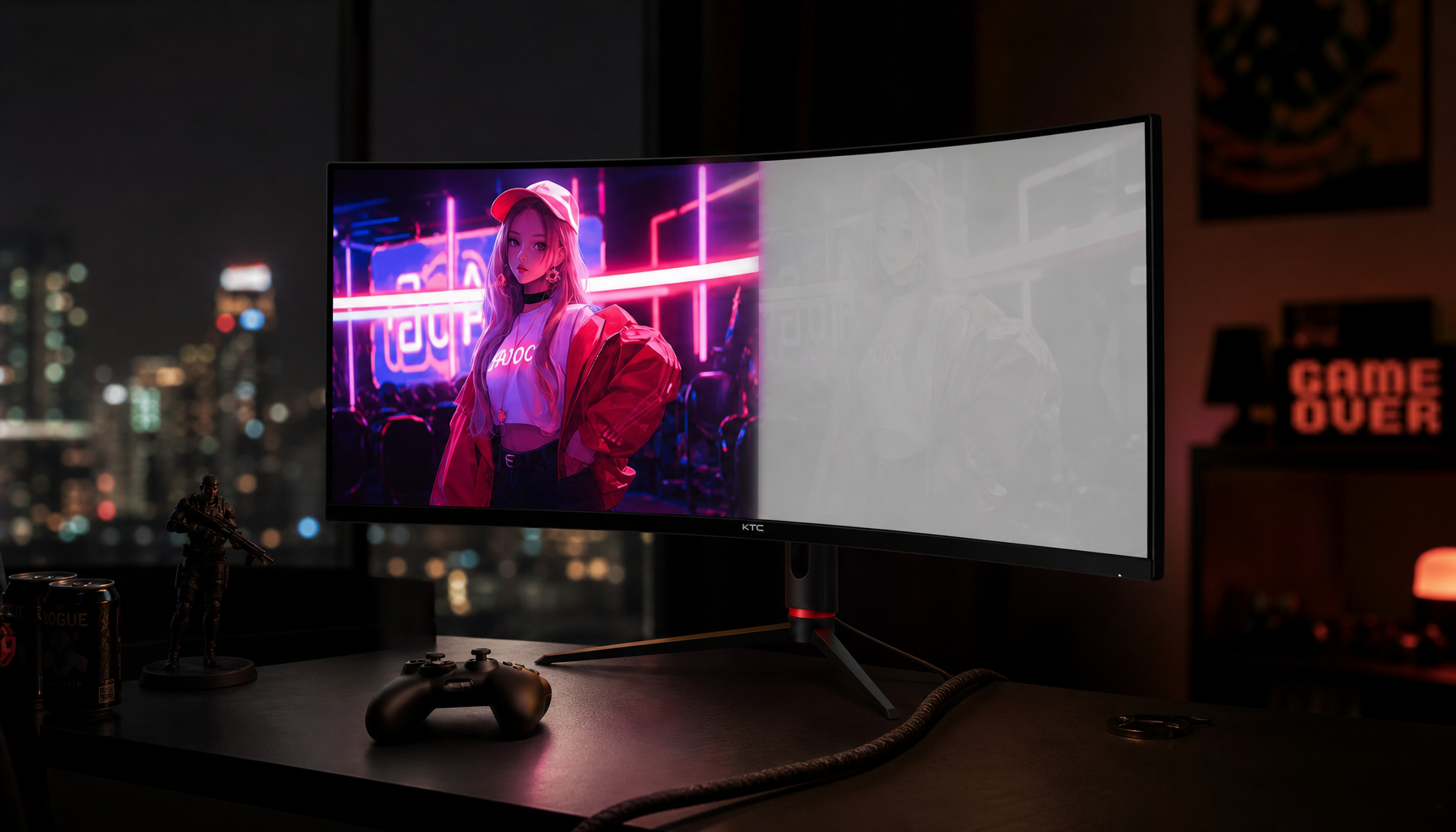
Both numbers can be legitimate, but they do not always describe the same test conditions or the same kind of contrast.
If you have ever compared two VA gaming monitors and wondered why one promises much deeper blacks on paper, the confusion usually starts with the spec sheet, not your eyes. A higher native contrast figure can produce visibly darker shadow areas in a dim room, but room light, panel tuning, and measurement method can shrink or exaggerate that gap. What follows will help you tell when 5000:1 is a real panel advantage and when it is mostly a reporting choice.

What 3000:1 and 5000:1 Actually Mean
Same white level, different black level
On a monitor spec sheet, contrast ratio is the brightness of white divided by the brightness of black. If two monitors both hit 300 nits for white, the one with the lower black level earns the higher ratio.
That is why a native contrast ratio of 3000:1 and 5000:1 can both be true for VA panels. At the same 300-nit white level, a 3000:1 panel implies about 0.10 nits black, while a 5000:1 panel implies about 0.06 nits black. In a dark room, that lower black floor is usually visible in night maps, black bars, and shadow detail.
Example panel state |
White level |
Black level |
Reported contrast |
What it means |
Basic IPS-like LCD |
300 nits |
0.30 nits |
1000:1 |
Blacks look more gray in dark scenes |
Common VA LCD |
300 nits |
0.10 nits |
3000:1 |
Noticeably deeper blacks for gaming and movies |
Stronger VA LCD |
300 nits |
0.06 nits |
5000:1 |
Dark scenes look richer if room light is controlled |
Dynamic marketing mode |
Varies |
Varies |
Millions:1 |
Not a same-scene measure of real panel contrast |
Native contrast matters more than huge marketing numbers
For buying a monitor, static or native contrast is the useful number because it reflects bright and dark content shown at the same time. That is far more relevant to a game HUD over a dark cave, a movie letterbox scene, or a desktop app with mixed tones.
By contrast, dynamic contrast can shoot into the millions-to-one by changing backlight or image processing between scenes. One common shopping trap is comparing a monitor listed at 1000:1 with another listed at 50,000,000:1, even though the second number may describe a dynamic mode rather than stronger same-scene blacks.
Why One VA Panel Lands Near 3000:1 and Another Near 5000:1
VA is a panel family, not one fixed performance tier
VA panels are designed to block more backlight than IPS or TN, which is why they are known for deeper blacks. But “VA” does not guarantee one exact result. In monitor guides, IPS and TN often sit around 1000:1, while VA commonly reaches about 3000:1, and some older marketing around some desktop monitors pushed native/static claims as high as 5000:1.
That spread exists because many LCDs span different native contrast ranges, even before local dimming or dynamic tricks are involved. A 5000:1 VA panel is not impossible or automatically suspicious, but it is not the baseline outcome for every VA gaming monitor, ultrawide monitor, or office display.
The black floor is where the real difference lives
In practical terms, contrast is simple division: lower black luminance at the same white luminance creates the higher rating. That is why two VA monitors with similar brightness can still look different in dark content. One panel leaks less light into black, so blacks look inkier and dark gray steps are easier to separate.

That advantage usually survives calibration. The same source notes that when a monitor is adjusted to a more typical desktop brightness, higher-contrast panels still keep darker blacks rather than losing the gap completely. For buyers, that is the important point: 5000:1 is not just a bigger number if it is measured natively under the same conditions.
Why Spec-Sheet Methods Create Bigger Gaps Than You Expect
There is no single universal comparison method
Published contrast numbers are not directly comparable across all brands because there is no single official standardized method for display contrast. Some measurements compare white and black in the same image, while others compare them over time. Those methods do not reward the panel in the same way.
A native or static test usually measures white and black together, often with a checkerboard-style pattern. A full-on/full-off style test measures a full white screen and a full black screen separately, which often produces a higher figure. That is one reason a 5000:1 claim can be real under one method without meaning every mixed game scene will look 67% better than a 3000:1 panel.
Dynamic modes inflate numbers and can add tradeoffs
In shopping guides and user comparisons, dynamic contrast ratios can climb into extremely large numbers because the display changes settings in real time. That can make a spec sheet look impressive without improving the way a mixed bright-and-dark frame actually looks during play.
Some dynamic contrast systems also depend on backlight control and image processing, which is why they are better treated as feature behavior than core panel quality. If the only contrast number on the page is enormous and not labeled native, static, or typical, it is safer to assume it is a marketing mode.
Your room can erase part of the difference
Real-world viewing is where ambient light lowers effective contrast by raising visible black levels through reflections. In a bright apartment, office, or hotel room, a strong VA panel may still look better than IPS in dark scenes, but the gap can shrink because the room is brightening the screen’s darkest areas for you.

That is also why display contrast in real rooms is lower than the lab number. A higher native rating matters most when the room is dim and the screen surface is not fighting glare.
What You Will Actually See in Gaming, Ultrawide, and Portable Use
Dark-room gaming benefits the most
Higher contrast helps darker scenes because low contrast can hide detail in shadows and wash out separation between near-black tones. In story-driven games, horror titles, racing at night, and movie watching, a solid VA panel usually looks more cinematic than a 1000:1 LCD.
That does not mean contrast is the whole display story. HDR performance also depends on brightness and not just black level. A monitor with strong native contrast but modest brightness can still look limited in HDR highlights, while a brighter screen may hold up better in daylight use.
Ultrawide shape does not create native contrast by itself
For screen format, ultrawide and super ultrawide monitors change field of view and immersion, not the underlying math of contrast. A 21:9 VA monitor can look excellent in dark games, but its native contrast still depends on the panel and the test method, not on the aspect ratio alone. That is also why a VA super ultrawide such as a monitor may make deeper blacks easier to notice in dim-room gaming, while the more important comparison still comes from its measured native contrast rather than the format or spec list alone.
Portable monitors deserve a different expectation. Because ambient conditions strongly affect perceived contrast, a portable display used on a desk near a window or in travel lighting can lose much of the visible advantage that its VA spec suggests. In that class, brightness and screen reflectivity matter almost as much as the contrast ratio itself.
High refresh can shift the tradeoff
Once you move into faster gaming displays, refresh rate matters less after roughly 144–165Hz than buyers often expect. Motion clarity, response behavior, and overdrive tuning start to matter more, especially if you are comparing two monitors that already hit the refresh target you want.
That matters for VA because the panel type’s higher contrast can come with response-time tradeoffs. A high-refresh VA gaming monitor may be tuned to reduce smearing or ghosting, and that broader design balance can matter more to real play than chasing the highest possible contrast figure alone.
How to Compare VA Monitors Without Getting Fooled by the Headline Number
Read the label before you read the ratio
For spec sheets, labels like native, static, or typical are the ones to trust first. Those terms are not perfect, but they usually describe same-scene panel performance. A huge ratio with no qualifier is much more likely to be dynamic.
Exact measured data is even better. The same source recommends looking for white luminance, black luminance, native contrast, and local dimming behavior in reviews. That gives you something concrete to compare across gaming monitors, ultrawides, and budget displays.
Pair contrast with brightness and use case
Typical monitor brightness sits around 250 to 350 nits and 400+ nits is more useful for bright rooms and entry-level HDR behavior. A 5000:1 VA monitor with weak brightness may still underperform a 3000:1 option in a sunny room if the darker screen loses the fight against glare.
For gaming, panel type is only one buying priority. Resolution, motion clarity, full-screen brightness, and form factor are often just as important. If you mostly play in a dim room, favor higher native contrast. If you play competitive titles in brighter spaces, a slightly lower-contrast display with better motion tuning may be the smarter pick.
A practical shortlist for buyers
- Trust native, static, or typical contrast before any “millions-to-one” claim.
- Compare brightness with contrast, especially if the monitor will live in a bright room.
- For high-refresh gaming, check motion clarity and response tuning, not refresh rate alone.
- On ultrawide monitors, treat contrast as panel-specific, not aspect-ratio-specific.
- On portable monitors, assume room light will reduce visible contrast more than it would on a fixed desk setup.
FAQ
Q: Is a 5000:1 VA monitor always better than a 3000:1 VA monitor?
A: A higher native contrast ratio usually means deeper blacks under the same conditions, but it is not automatically better in every setup. Bright rooms, lower brightness, aggressive overdrive, or a dynamic-only spec can erase much of the benefit.
Q: Can I ignore dynamic contrast numbers?
A: For buying decisions, dynamic contrast numbers should mostly be treated as secondary information. They can describe a feature, but they are not the best predictor of how dark scenes will look in normal mixed content.
Q: Does a higher refresh-rate VA monitor usually have lower contrast?
A: Not necessarily, but VA panels often involve response-time tradeoffs, so fast gaming tuning can matter as much as the raw contrast figure. A well-tuned 3000:1 VA can be a better gaming buy than a slower 5000:1 model if motion clarity is your priority.
Final Takeaway
The cleanest answer is that some VA monitors are truly closer to 3000:1 while others really can push toward 5000:1, but those numbers only mean something when they are measured natively under the same conditions. For monitor buyers, the safest move is to prioritize native/static contrast, then check brightness, motion behavior, and room lighting. That approach will tell you more about a gaming monitor, ultrawide display, or portable screen than the biggest ratio on the box ever will.