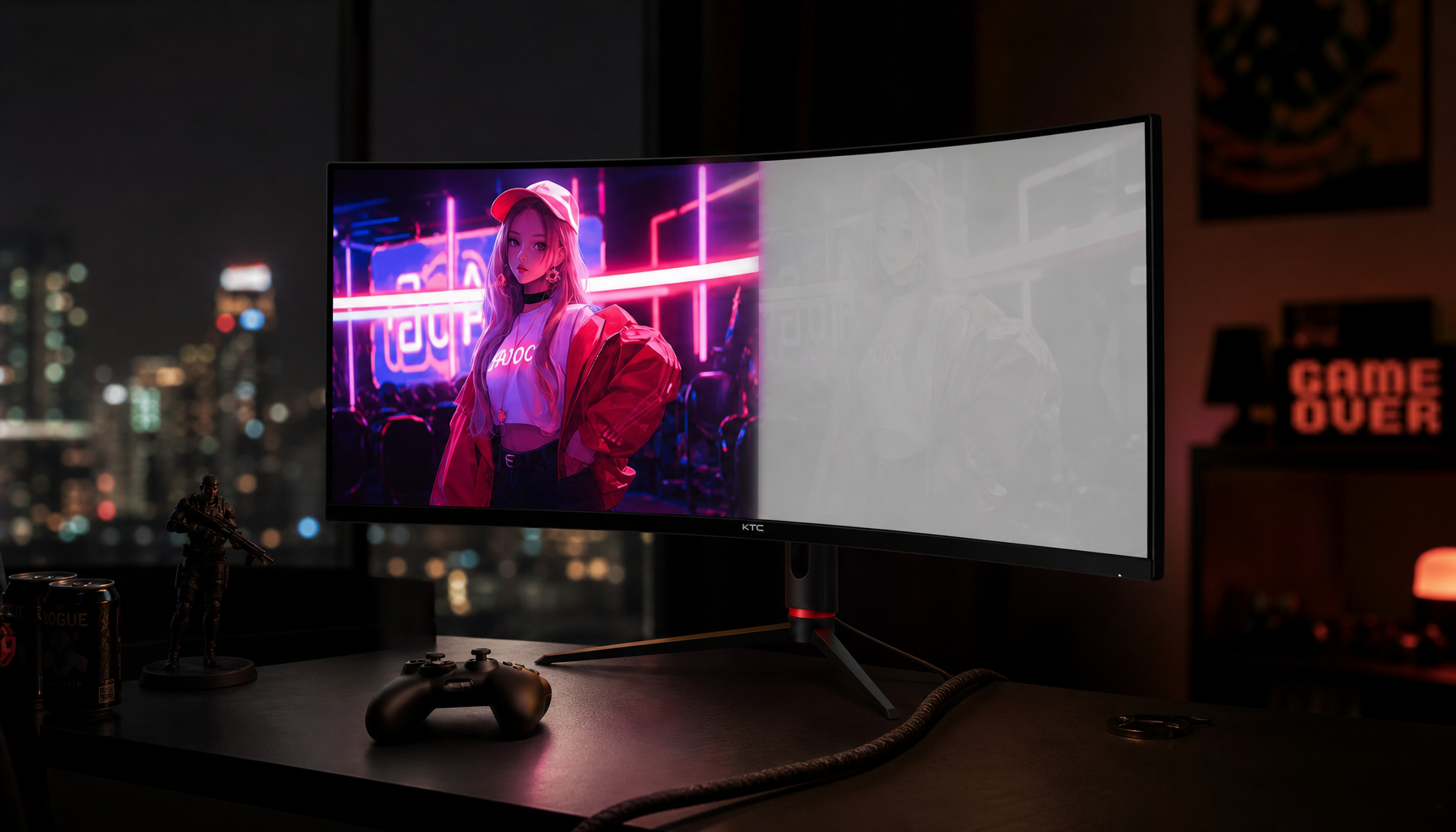
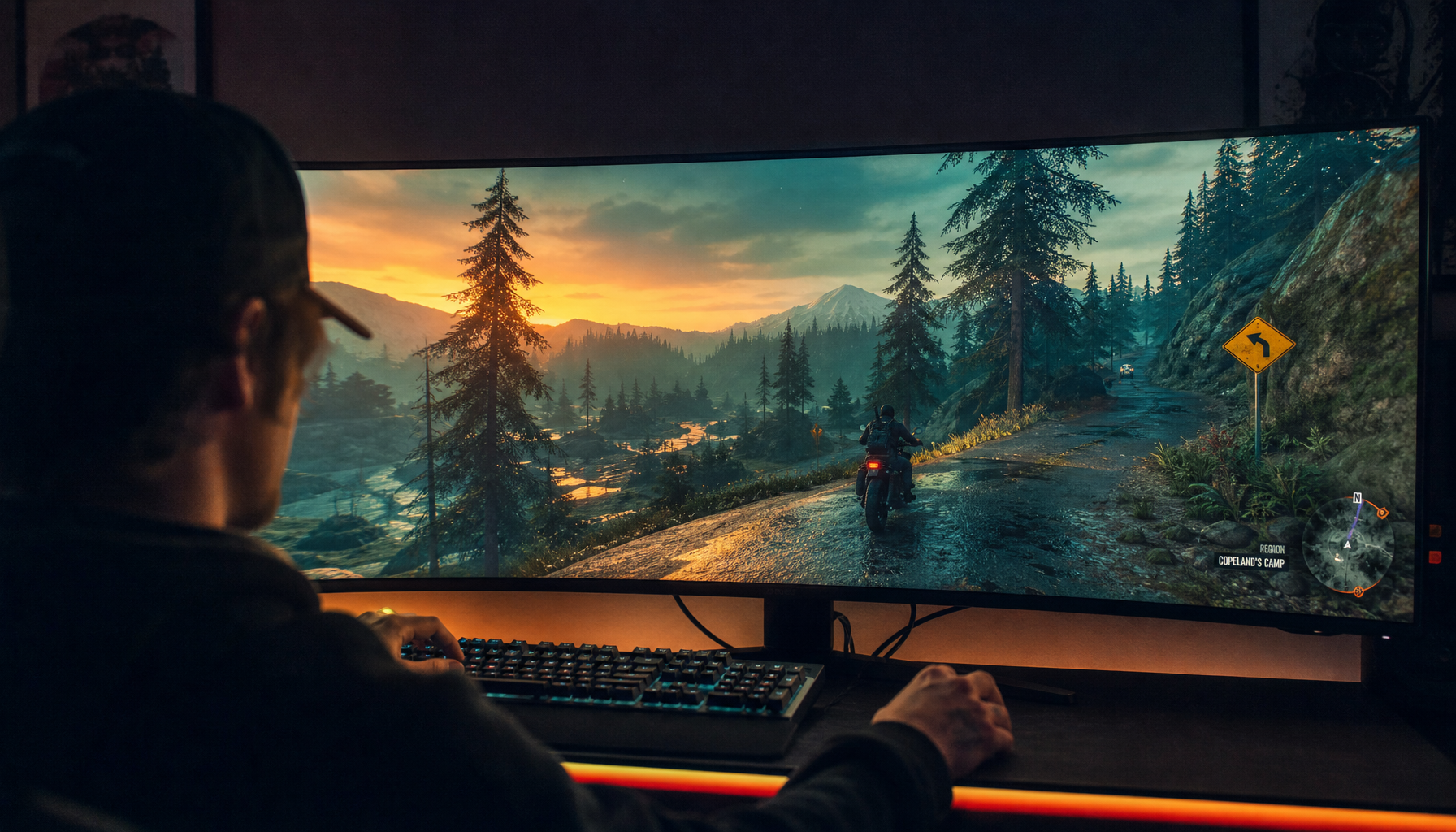
Yes, it can, but usually not because ultrawide monitors are flawed. The issues come from aspect ratio, pixel count, game support, and whether your capture canvas matches where viewers will watch.
Ever recorded a clean-looking ultrawide session, then opened the video and found black bars, tiny HUD text, or a stretched image? A 3440 x 1440 ultrawide monitor pushes nearly 5 million pixels, about 34% more GPU work than a 2560 x 1440 display, so capture settings matter as much as the monitor itself. Here is how to decide whether ultrawide gameplay is worth streaming or recording, and how to set it up without surprising your viewers.
The Real Compatibility Problem: Aspect Ratio, Not Just Resolution
Most gaming monitors still fit into a few common shapes. A standard gaming display is usually 16:9, a typical ultrawide monitor is 21:9, and a super ultrawide monitor is commonly 32:9. That extra width is useful in racing games, flight simulators, open-world games, and multitasking-heavy streaming setups because ultrawide screens add more horizontal viewing space.

The issue is that streaming platforms, video players, phones, TVs, and many web embeds are still built around 16:9 playback. If you send a 21:9 or 32:9 recording directly to a 16:9 player, the player has only a few choices: preserve the whole frame with black bars, crop the sides, or scale the image until the gameplay looks too small. None of these are automatically wrong, but each affects how readable the game looks to viewers.
What Happens With 21:9 Footage
A 21:9 monitor, such as a 3440 x 1440 gaming display, is the most manageable ultrawide format for streaming and recording. It is wide enough to show more game world, but not so wide that the center action becomes tiny when fitted into a 16:9 stream. For recorded video-platform-style videos, 21:9 can look cinematic on desktop, especially if the viewer uses an ultrawide monitor too.

The tradeoff appears on 16:9 screens. A native 21:9 upload may show black bars above and below the gameplay, similar to widescreen movies. That is not a technical failure, but it does mean smaller gameplay on laptops, tablets, TVs, and cell phones unless you crop or design a custom layout.
What Happens With 32:9 Footage
A 32:9 super ultrawide monitor is more demanding. It is often described as similar to two 16:9 monitors side by side without a center bezel, which is excellent for immersion and software space but harder for viewers to watch. When a 32:9 frame is fitted into 16:9 video, the gameplay can become very short vertically, making menus, minimaps, and subtitles harder to read.
A 49-inch DQHD model such as a 49-inch DQHD 180Hz 1000R curved gaming monitor sits in this super ultrawide class, so creators should plan ahead for 16:9 cropping, black bars, or a separate capture layout.
This is the same practical problem seen with ultrawide video playback. A 32:9 display can leave unused side space with movie content, and some 21:9 content may still be delivered inside a 16:9 container, creating bars on multiple sides; streaming platforms may package content in ways that do not fully match the monitor shape.
Common Streaming and Recording Issues on Ultrawide Monitors
Ultrawide capture problems usually show up in five places: game support, capture canvas, overlays, performance, and playback. The monitor may be working perfectly while the game, software, or platform is making a different assumption about the final image.
Older games are the most common source of trouble. Some do not include native 21:9 or 32:9 resolutions, and some stretch a 16:9 image across the whole panel. In one 49-inch 32:9 upgrade example, an older role-playing game lacked a proper ultrawide option and displayed interface elements incorrectly, while newer open-world games worked much better on the same screen; older PC games were the weak point, not the monitor hardware.
Black Bars, Cropping, and Stretched Video
Black bars are usually the least destructive option. They preserve the whole ultrawide image, which is useful for recorded gameplay, tutorials, racing lines, simulation cockpit views, and competitive analysis. The downside is that the visible game area becomes smaller on 16:9 screens.
Cropping fills the viewer’s screen but removes side information. That can work well for centered first-person shooters or action games, but it can cut off mirrors in racing games, instrument panels in flight sims, quest markers in RPGs, or UI windows placed near the edges. Stretching should generally be avoided because it distorts movement, aim perception, UI shape, and visual quality.
HUD and Overlay Problems
Ultrawide monitors often push game HUD elements toward the far left and far right edges. That is fine while sitting at the desk, but it can be poor for viewers watching a compressed 1080p stream. Health bars, minimaps, ammo counters, chat boxes, and quest logs may become difficult to read after downscaling.

Streaming overlays add another layer. Alerts, webcam frames, chat panels, sponsor labels, and recording status indicators designed for 16:9 may sit in awkward places on a 21:9 canvas. On 32:9, the overlay can look like it belongs on a desktop workspace instead of a video frame unless you intentionally group viewer-critical elements near the center.
Performance: Ultrawide Capture Demands More From the GPU and Encoder
The wider the monitor, the more pixels your PC must render and capture. A 2560 x 1440 16:9 display has about 3.7 million pixels, while a 3440 x 1440 21:9 display has about 5 million pixels. That higher pixel count can reduce frame rates in demanding games because more pixels must be rendered every frame.

For streaming, the performance hit does not stop at the game. The GPU or CPU also needs headroom for encoding, compositing overlays, scaling the canvas, and writing or sending the video. If your game already runs near the limit at native ultrawide resolution, recording can trigger stutters, dropped frames, audio desync, or inconsistent frame pacing.
Refresh Rate Is Separate From Stream FPS
A high-refresh-rate monitor can make gameplay feel better without requiring the stream to run at the same rate. A 144Hz display updates about every 6.94 ms, while a 60Hz display updates every 16.67 ms, so the player gets a smoother and more responsive local experience. Viewers, however, usually receive 30 FPS or 60 FPS video, even if the gamer is playing on a 144Hz, 165Hz, or 240Hz monitor.
A practical balance is to play at 1440p on a 120Hz or 144Hz monitor, cap the game at 120 FPS or 141 FPS, and stream at 1080p60. That kind of setup preserves responsive local gameplay while leaving encoder headroom, which is why a stable 60 FPS stream is often a better target than trying to broadcast every frame your monitor can show.
Recording Files Can Grow Quickly
Native ultrawide recording also increases file size. A 3440 x 1440 recording contains more visual data than 2560 x 1440, and far more than 1920 x 1080. If you record long sessions, that can mean larger files, higher bitrate requirements, more storage use, and slower editing exports.
For gameplay intended for editing, recording at native 3440 x 1440 can be worthwhile because it gives you flexibility to crop a 16:9 version later. For casual highlights, short-form clips, or streams with chat and webcam overlays, a 1920 x 1080 or 2560 x 1440 16:9 canvas is usually simpler.
Best Capture Settings for 21:9 and 32:9 Gameplay
The right setup depends on whether you care more about viewer compatibility, native ultrawide quality, or editing flexibility. For most streamers, the safest workflow is to play ultrawide locally, then output a viewer-friendly 16:9 stream. For recording, native ultrawide can make sense if your PC has enough headroom and you plan to edit intentionally.

A 21:9 monitor gives you more choices than a 32:9 monitor. You can preserve the full frame with modest letterboxing, crop to a centered 16:9 region, or use the extra horizontal space for a custom stream layout. A 32:9 monitor often benefits from a dedicated 16:9 capture region, picture-by-picture mode, or a separate scene that avoids showing the entire desktop-width frame.
Setup Option |
Best For |
Main Advantage |
Main Tradeoff |
Native 21:9 recording |
Desktop viewers, cinematic gameplay, editing later |
Preserves the full ultrawide image |
Black bars on 16:9 screens |
21:9 gameplay inside 16:9 canvas |
Live streaming, tutorials, casual broadcasts |
Works well on common players |
Gameplay appears smaller |
Center-cropped 16:9 capture |
Fast action, competitive play, short clips |
Fills the viewer’s screen |
Side HUD or peripheral view may be lost |
Native 32:9 recording |
Sim racing, flight sims, ultrawide showcase videos |
Shows the full super ultrawide experience |
Very small on 16:9 playback |
Older games, esports, simple streaming |
Better compatibility and readable UI |
Gives up some ultrawide immersion |
Recommended 21:9 Workflow
For a 3440 x 1440 ultrawide gaming monitor, start by playing at native resolution and streaming to a 1920 x 1080, 60 FPS canvas. Fit the full game capture into the width of the canvas if the game’s UI remains readable. If the HUD becomes too small, crop to a 16:9 center area or create a layout where gameplay sits above chat, alerts, or camera.
For local recording, use native 3440 x 1440 only when the game remains stable. If your frame rate drops during busy scenes, record at 2560 x 1080, 2560 x 1440 cropped, or 1920 x 1080 instead. Stable frame pacing is usually more valuable than preserving every horizontal pixel.
Recommended 32:9 Workflow
For a 49-inch 32:9 super ultrawide monitor, decide before streaming whether the audience needs to see the whole width. Sim racing, truck simulators, flight simulators, and cockpit-heavy games may benefit from full-width capture. Most shooters, RPGs, and strategy games are easier to watch when captured as a 16:9 region.
If an older game breaks at 32:9, do not force the stretched image into a stream. Use the game’s 16:9 resolution, a windowed mode, picture-by-picture mode, or a widescreen fix tool when appropriate. Freeware tools can fix some legacy titles, but support is inconsistent, and manual configuration may still be required for field of view, menus, overlays, and weapon display.
Should Streamers Buy Ultrawide or Stay With 16:9?
An ultrawide monitor is a strong choice if you value immersion, multitasking, and local play comfort. Streamers can keep gameplay, broadcast software, chat, and dashboards visible on one screen, which reduces the need for a second monitor. That is a real workflow advantage, especially for creators working from a compact desk or using a portable monitor as a secondary control surface.
A 16:9 gaming monitor is still simpler for pure content creation. It matches most platform layouts, capture presets, overlays, game menus, and viewer devices with fewer adjustments. If your priority is reliable streaming, competitive esports, or fast clip production, 16:9 reduces setup friction.
Buying Guidance for Gaming Monitor Shoppers
Choose 21:9 if you want the best middle ground. It gives meaningful immersion, usually manageable capture settings, and fewer playback problems than 32:9. Look for a GPU that can handle the extra pixel load, a refresh rate of at least 120Hz or 144Hz, adaptive sync support, and enough desk depth for comfortable viewing.
Choose 32:9 if your main games truly benefit from the format. Sim racing, flight simulation, space games, and productivity-heavy streaming setups can justify the width. For broad game compatibility and easy video output, however, a high-quality 27-inch or 32-inch 16:9 gaming monitor remains the more predictable choice.
Practical Next Steps
Before you go live or record a long session, test the exact game, resolution, refresh rate, and capture layout you plan to use. A five-minute test recording can reveal stretched menus, unreadable HUD text, dropped frames, bad scaling, or black-bar issues before they become part of a full video.
Use this checklist when setting up an ultrawide gaming monitor for capture:
- Confirm the game supports your monitor’s aspect ratio: 21:9 and 32:9 support varies, especially in older and indie games.
- Test the HUD at the final output size: watch a sample on a 16:9 laptop or phone-sized window, not only on the ultrawide monitor.
- Pick the output canvas first: use 1920 x 1080 for broad streaming compatibility, or native ultrawide for archival recording.
- Cap FPS below your monitor refresh rate: try 120 FPS or 141 FPS on a 144Hz display to leave encoder headroom.
- Watch encoder load during busy scenes: test explosions, fast camera movement, rain, crowds, or dense city areas.
- Build separate scenes for different formats: use one scene for full ultrawide recording and another for 16:9 streaming.
- Keep a fallback resolution ready: older games may need windowed 16:9, picture-by-picture mode, or manual configuration.
FAQ
Q: Will ultrawide gameplay look wrong on streaming platforms?
A: Not necessarily. It will look correct if the platform preserves the aspect ratio, but it may show black bars on 16:9 screens. That is normal for 21:9 or 32:9 footage. Problems happen when the capture software stretches the image, crops important HUD elements, or scales the gameplay so small that viewers cannot read it.
Q: Is 21:9 better than 32:9 for recording gameplay?
A: For most creators, yes. A 21:9 gaming monitor is easier to record and reframe because it is only moderately wider than 16:9. A 32:9 monitor can look impressive in simulation games, but it often needs custom capture regions, 16:9 crops, or special scene layouts to be comfortable for viewers.
Q: Can I stream at 60 FPS while playing on a 144Hz ultrawide monitor?
A: Yes. Your monitor refresh rate and stream FPS do not need to match. A common setup is to play at 120Hz or 144Hz while streaming at 1080p60, which keeps local gameplay smooth while giving viewers a standard, stable stream.
References
- Why Gamers Are Switching to Ultrawide Monitors?
- Refresh Rate & Stream Quality: Best Settings for Gameplay
- Ultrawide Movies: 21:9 vs 32:9 for Cinematic Viewing
- If you’re planning to upgrade to an ultrawide gaming monitor, don’t overlook the one critical mistake I made
- Ultrawide vs 16:9 Monitors: Which is Best for Windows Productivity?