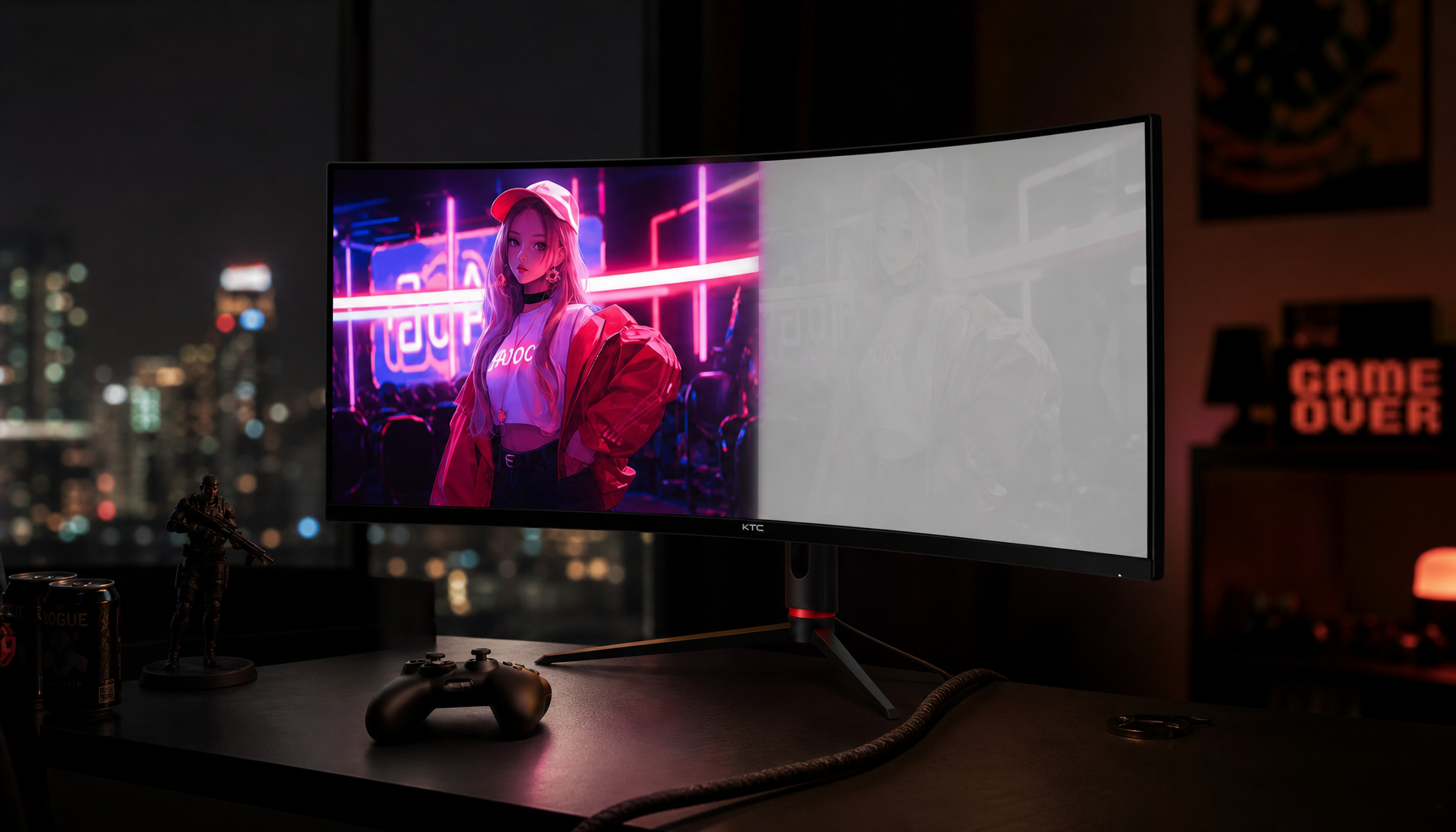
Invisible flicker on many monitors is a hidden driver of headaches and eye strain during long gaming or work sessions, especially at reduced brightness levels. While the screen may look perfectly steady to the naked eye, rapid backlight pulsing from PWM dimming can still trigger discomfort for sensitive users. DC dimming, the technology used across KTC's Eye Care lineup, maintains steady backlight intensity instead of cycling on and off, offering a more comfortable experience without sacrificing image quality.

The Science of Invisible Flicker: Why Your Steady Screen Causes Pain
Most people assume that if a monitor image looks stable, their eyes are receiving steady light. In reality, many screens use pulse width modulation (PWM) that turns the backlight on and off hundreds or thousands of times per second. The conscious mind cannot perceive this flicker, yet the retina and visual system still register the rapid changes.
According to the IEEE 1789-2015 standard, modulation frequencies between roughly 70 Hz and 200 Hz are linked to increased risk of visual fatigue, blurred vision, and headaches. This is known as the stroboscopic effect: even imperceptible flicker forces the eyes and brain to work harder to stabilize the image, especially in low-light or late-night sessions where brightness is turned down.
Digital eye strain, also called Computer Vision Syndrome, encompasses these symptoms along with dry eyes and neck discomfort. The American Optometric Association notes that flicker is one contributor among several factors including glare, poor ergonomics, and reduced blink rate. For gamers and power users who spend hours at reduced brightness, addressing flicker becomes a practical priority rather than an abstract concern.
PWM vs. DC Dimming: The Mechanics of Eye Strain
Pulse Width Modulation (PWM) achieves lower brightness by rapidly switching the backlight between full power and off. At high brightness the “off” periods are very short, but below 30–40% brightness the off intervals grow longer, making the pulsing more noticeable to sensitive eyes. This constant contraction and relaxation of the pupil is what many users experience as fatigue or headaches, even though they cannot consciously see the flicker.
DC dimming, also called Constant Current Reduction, works differently. It adjusts the actual electrical current supplied to the backlight LEDs so they emit a steady, continuous level of light at any brightness setting. There are no rapid on-off cycles, which removes the primary source of flicker-related strain.
This comparison of flicker-free technologies explains why DC dimming is generally preferred for users who notice discomfort at night or in dim rooms. KTC implements DC dimming across its Eye Care series so that gamers and office users can lower brightness without introducing the PWM behavior that often triggers symptoms.
The chart below visualizes the core trade-off using typical duty-cycle behavior across brightness bands. It helps clarify why the hybrid threshold around 20–30% brightness is a critical decision point for sensitive eyes.
PWM vs DC Dimming: Low-Brightness Threshold for Flicker Risk
A decision aid for comparing PWM and DC dimming across brightness bands. The highlighted band marks where low-brightness flicker sensitivity becomes more relevant and a hybrid transition is typically considered.
Show Data Table
| Brightness | PWM duty cycle | DC duty cycle | Hybrid threshold band |
|---|---|---|---|
| 0-10% | 10 | 100 | 30 |
| 10-20% | 18 | 100 | 30 |
| 20-30% | 28 | 100 | 70 |
| 30-100% | 100 | 100 | 70 |
The Mini-LED Factor: When Flicker-Free Isn't Enough
Even monitors marketed as flicker-free can introduce discomfort in certain scenarios. Mini-LED panels with Full Array Local Dimming (FALD) sometimes modulate backlight zones at 60 Hz during console gaming or static desktop work, creating stroboscopic artifacts that sensitive users can still perceive peripherally.
Another common issue is hybrid dimming. Many panels remain DC-based at higher brightness but switch to PWM below roughly 20% brightness to preserve color accuracy or avoid other artifacts. For late-night gamers who prefer darker rooms, this transition can reintroduce the very flicker they hoped to avoid.
The practical friction is the “toggle tax”: users may need to disable local dimming for office or productivity tasks to eliminate the 60 Hz pulsing, which can reduce contrast. This scenario split matters most for console gamers and professionals who alternate between bright HDR content and dim SDR desktop work.
A Buyer’s Checklist for True Flicker-Free Viewing
Third-party verification remains the most reliable way to confirm a monitor truly minimizes flicker. Look for TÜV Rheinland “Flicker Free” certification, which tests that no visible or invisible flicker occurs from 0 to 3,000 Hz across the full brightness range, as detailed in the TÜV Rheinland criteria.
A quick DIY test uses any modern smartphone. Set the camera shutter speed to 1/4000 s (or the fastest available), point it at the screen, and slowly lower brightness. Horizontal bands or scrolling lines in the preview indicate PWM activity. A clean, uniform image suggests DC-style behavior.
Prioritize monitors that combine pure DC dimming with low-blue-light hardware filters for night use. For sensitive eyes, the combination of flicker-free operation, accurate color at low brightness, and ergonomic features delivers the most consistent comfort. KTC’s Eye Care series integrates these elements across its office and productivity monitors so users do not have to trade responsiveness or image quality for reduced strain.

Beyond the Panel: A Holistic Approach to Eye Comfort
Flicker-free technology is an important foundation, yet it works best as part of a complete eye-care routine. Follow the 20-20-20 rule—every 20 minutes, look at something 20 feet away for 20 seconds—to reduce accommodative stress. Proper desk height, screen distance of roughly an arm’s length, and ambient lighting that avoids strong glare further limit fatigue.
KTC models such as the H27P27 4K office monitor and H25B7 100 Hz productivity display pair DC dimming with hardware low-blue-light filters and high color accuracy, making them practical choices for extended sessions. Pairing any flicker-free monitor with ergonomic monitor selection guidance and proper calibration steps creates a setup that supports both performance and long-term comfort.
For users seeking broader productivity improvements, exploring KTC’s full collection of office monitors or reading the complete productivity monitor buying guide can help match panel size, refresh rate, and eye-care features to specific workflows.
Frequently Asked Questions
Can a flicker-free monitor completely eliminate headaches?
No. While reducing flicker can lower one major contributor to digital eye strain, headaches often stem from multiple factors including blue light exposure, glare, poor posture, and dry eyes. A flicker-free panel with DC dimming helps many users feel more comfortable, but it is not a guaranteed cure.
How can I tell if my current monitor uses PWM?
Use the smartphone camera test at a fast shutter speed (around 1/4000 s). If horizontal bands appear when brightness is lowered, the monitor is likely using PWM. A uniformly lit preview suggests DC dimming or high-frequency PWM that is less likely to cause issues.
Is TÜV Rheinland certification necessary for sensitive eyes?
It is the most practical way to verify a manufacturer’s flicker-free claim. Certification confirms testing across brightness levels and frequencies up to 3,000 Hz. For users who experience headaches at night, it serves as a reliable buying filter beyond marketing language.
Do all Mini-LED monitors have flicker problems?
Not all, but many introduce 60 Hz zone modulation or switch to hybrid PWM at very low brightness. Disabling local dimming for static desktop work often resolves the issue, yet it represents a usability trade-off that buyers should test in their typical scenarios.
Does higher refresh rate automatically mean less eye strain?
Higher refresh rates improve motion clarity and can reduce perceived stutter, but they do not automatically eliminate backlight flicker. The dimming method (PWM versus DC) remains the dominant factor for flicker-related fatigue at reduced brightness levels.
Are KTC monitors suitable for people with high flicker sensitivity?
KTC’s Eye Care series uses DC dimming and hardware low-blue-light filtering in models designed for office and extended-use scenarios. Combined with TÜV-style validation on many units, they align well with the needs of sensitive users, provided the specific model’s brightness behavior is confirmed for your environment.