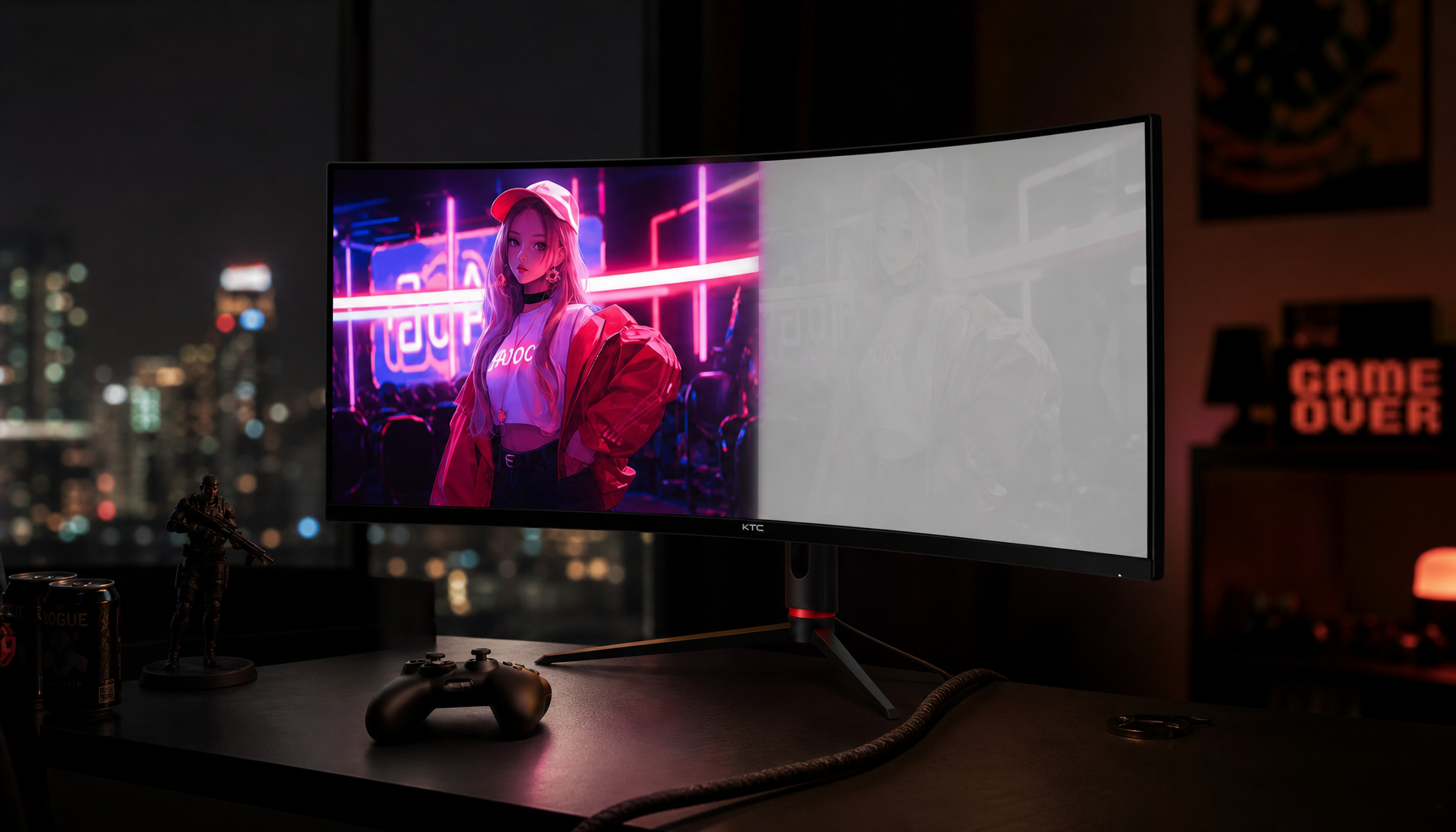
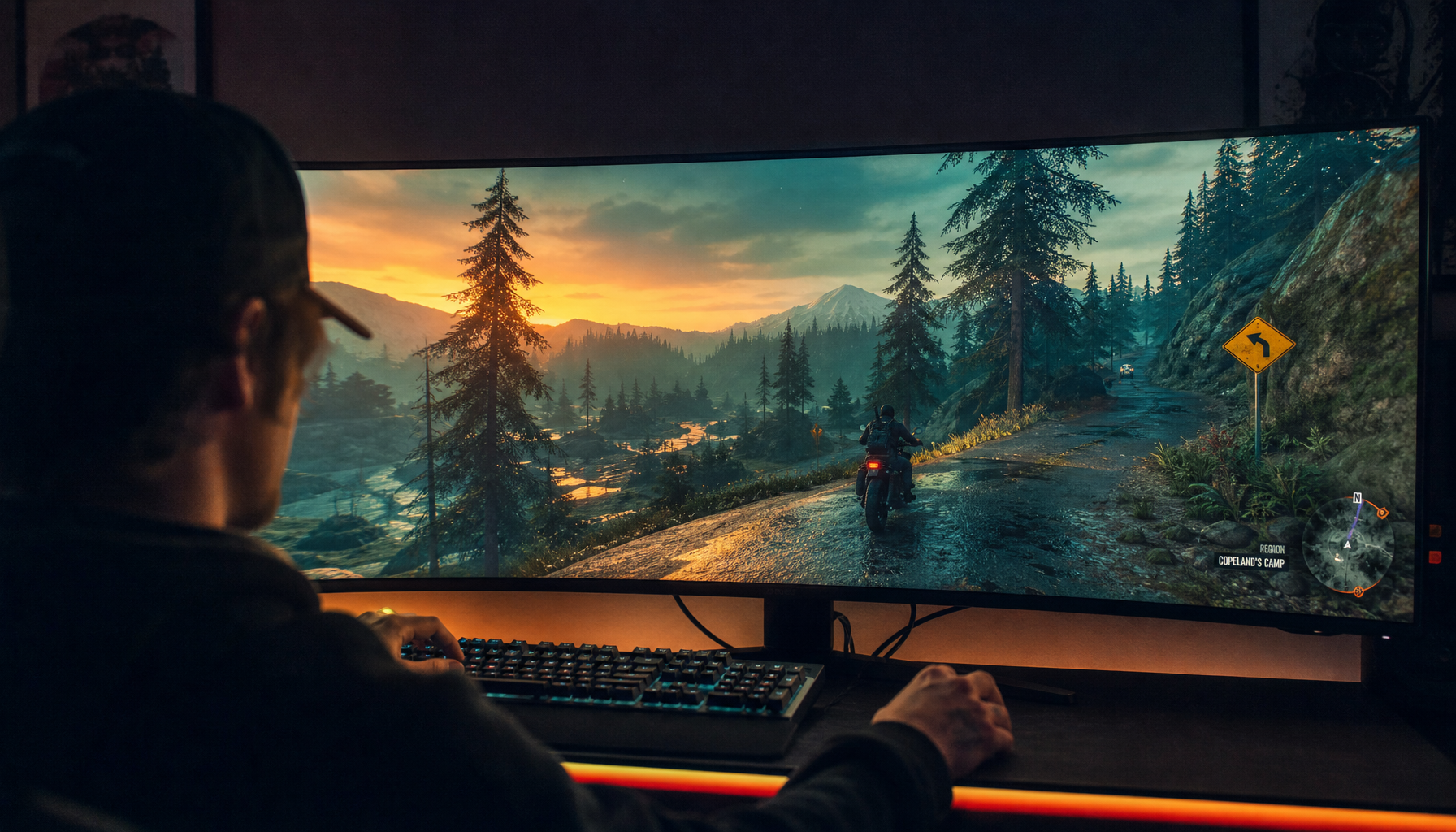
Most modern monitors are sample-and-hold displays, which means each frame stays visible until the next one arrives and moving objects look blurrier than they do on an impulse-style display. Impulse methods can make motion look much sharper, but they usually cost brightness, may add flicker, and often limit variable refresh features.
If a target looks crisp when you stop your camera but soft the moment you track it across the screen, you are not imagining it. On a fast gaming monitor, the gap between normal high-refresh behavior and a well-tuned blur-reduction mode is easy to spot in scrolling text, strafing enemies, and side-to-side map pans. This guide breaks down what changes, which tradeoffs matter, and how to choose the right monitor or setting for gaming, ultrawide use, and portable displays.

Why motion blur happens on modern monitors
Sample-and-hold keeps every frame visible for the full refresh window
A sample-and-hold display keeps each frame on screen until the next refresh replaces it. When your eyes smoothly follow a moving object, the object is not actually moving across the panel during that frame; it is being held in one position, so your eye movement creates blur on the retina even if the image looks perfectly sharp when paused.

The timing explains why this effect is so noticeable on monitors. A 240 Hz panel still holds each frame for about 4.2 ms, while 60 Hz holds it for about 16.7 ms. At 960 pixels per second, that works out to roughly 16 pixels of blur at 60 Hz, 8 pixels at 120 Hz, and 4 pixels at 240 Hz. Higher refresh clearly helps, but it does not erase the underlying hold behavior.
Motion blur is not the same thing as ghosting
The core sample-and-hold blur is different from ghosting. Ghosting comes from slow or poorly controlled pixel transitions, which leave streaks or double edges behind moving objects. Sample-and-hold blur happens even when transitions are fast, because the frame stays visible long enough for your eyes to smear it during tracking.
That distinction matters when reading monitor specs. A panel can advertise very fast gray-to-gray performance and still look softer in motion than expected, because response time mainly affects streaking while persistence drives much of the perceived blur. This is also why OLED gaming monitors can still show motion blur in normal mode even though their pixel response is extremely fast.
What impulse display behavior changes
Impulse displays shorten how long your eyes see each frame
An impulse-style display shows each frame briefly and then goes dark between refreshes. CRTs and plasma displays behaved this way naturally, which is why older displays often looked clearer in motion than newer flat panels despite having much lower resolution and older electronics.
That brief-flash behavior changes what your eye integrates during motion tracking. A pulse-and-fade display does not keep a moving object lit on your retina for the full frame interval, so the object appears sharper while panning. In practice, this is why old CRT-like motion still stands out when people compare it to even very fast LCDs.
Modern monitors fake impulse behavior with strobing or black frame insertion
A motion blur reduction mode turns a modern gaming monitor into something closer to an impulse display by shortening visible frame time. On LCDs, that usually means backlight strobing. On OLEDs, it usually means black frame insertion, because there is no backlight to pulse.
These features go by many names in monitor menus, but the goal is the same. Various branded blur-reduction modes and similar modes are trying to lower persistence, not simply lower gray-to-gray response numbers. When they are tuned well, moving edges, fine text, and target outlines can look dramatically cleaner than they do in a standard sample-and-hold mode.

Quick comparison for monitor buyers
A fixed-timing blur-reduction mode is not automatically better than standard high refresh. It is better at one thing: reducing persistence. The tradeoffs show up immediately in brightness, comfort, and feature compatibility.
Display approach |
Typical monitor use |
Effective visible frame time |
Motion clarity |
Main tradeoffs |
Best fit |
60-120 Hz sample-and-hold |
Office monitors, many portable monitors, entry gaming displays |
16.7-8.3 ms |
Softest motion of the group |
Blur during panning, but no strobe flicker |
Work, casual gaming, budget setups |
240-480 Hz sample-and-hold |
Modern high-refresh gaming monitors |
4.2-2.1 ms |
Much better than 60-120 Hz, still not CRT-like |
Motion still soft in very fast tracking scenes |
Mixed gaming, esports, VRR-heavy use |
Strobing or BFI impulse mode |
Gaming monitors and some OLED displays |
Much shorter than full-frame hold time |
Sharpest motion |
Lower brightness, flicker risk, crosstalk, VRR limits |
Competitive play with stable frame rates |
Is impulse better for competitive gaming?
It helps most when your eyes are tracking motion, not when the image is still
A backlight-strobed monitor can improve motion clarity in a CRT-like way that is especially useful for competitive shooters, racing games, sports titles, and rhythm games. The benefit is easiest to see when you track a moving target rather than flick to a stationary one. Thin objects stay better defined, and scrolling details remain easier to read during fast pans.

This is one reason many esports players still care more about motion handling than about raw resolution. A 240 Hz or 360 Hz gaming monitor in standard mode already looks good, but a well-implemented strobe mode can make side-to-side tracking look cleaner than refresh rate alone suggests. If your game runs at a locked frame rate and you care about target separation more than visual effects, impulse behavior often wins.
The tradeoff is timing discipline, brightness, and comfort
A strobe mode works best when frame rate closely matches refresh rate. If frame times swing too much, the result can be crosstalk, double images, or inconsistent motion. That is why blur reduction usually shines in esports titles that can hold a stable high frame rate, but becomes less convincing in cinematic single-player games or ultrawide setups that push the GPU harder.
The other costs are physical, not theoretical. Backlight strobing commonly cuts brightness by roughly 30% to 50% and may introduce visible flicker. If you play in a bright room, use HDR, or are sensitive to flicker, a strong sample-and-hold monitor running at 240 Hz or higher is often the better real-world choice even if it gives up some motion sharpness.
What specs and settings actually matter before you buy
Refresh rate helps, but only alongside frame rate and persistence
A higher refresh rate reduces hold time, which is why 240 Hz looks meaningfully clearer than 120 Hz, and 480 Hz improves again. But a fast panel only shows more unique motion detail if your PC or console is actually delivering those extra frames. Buying a 240 Hz monitor for a game that mostly runs at 90 to 120 fps will not unlock the same motion benefit as a locked 240 fps setup.
The blur model is easy to feel in practice. Persistence blur scales with motion speed and frame rate, so fast horizontal camera movement reveals the gap between 120 Hz and 240 Hz more clearly than slow strategy or desktop use. That is why monitor reviews that include pursuit-camera tests are far more useful than marketing claims built around still images.
Gray-to-gray and MPRT do not tell the whole story
A gray-to-gray number does not fully describe motion clarity. Gray-to-gray mainly measures transition speed, while motion picture response time is more related to visible persistence. Neither number alone tells you how much crosstalk, overshoot, or real tracking blur you will see in motion.
The better buying shortcut is to look for evidence of actual motion performance. A review process that checks blur-reduction range, duplication artifacts, and VRR compatibility is more useful than a headline “1 ms” claim. For serious gaming-monitor buyers, pursuit photos and clear notes about strobe quality matter more than one isolated spec.
Settings matter almost as much as the panel
A monitor’s blur-reduction mode is usually enabled in the OSD, and the best result often comes from matching refresh rate to a stable frame rate rather than simply maxing everything out. Many monitors also produce cleaner strobing below their top refresh, such as 120 Hz on a 144 Hz panel or 144 Hz on a 240 Hz panel.
For a practical setup, fixed-FPS esports is where impulse modes make the most sense. Run a stable refresh, cap your frame rate slightly below it for consistency, and check whether the monitor disables a variable refresh feature when blur reduction is active. If the image becomes too dim, too flickery, or too prone to double images, switch back to standard high refresh and keep VRR enabled.
How to choose for gaming monitors, ultrawides, and portable displays
Standard high-refresh is the safest default for most buyers
A modern high-refresh sample-and-hold monitor is usually the best starting point because it preserves brightness, VRR, and ease of use. For mixed workloads that include gaming, work, streaming, and browsing, a good 240 Hz monitor with solid pixel tuning is a more forgiving purchase than a monitor that only looks great in one carefully tuned strobe mode.
This is especially true for ultrawide monitors. The wider field of view makes motion artifacts easier to notice during sweeping pans, but ultrawide resolutions also make frame-rate stability harder to maintain. If your GPU cannot hold a tight frame-time budget, VRR on a clean 165 Hz or 240 Hz ultrawide usually beats an impulse mode that demands near-perfect timing.
Blur reduction is a premium feature for a narrower audience
A well-implemented MBR mode is worth prioritizing when competitive clarity is the main goal. If you mostly play fast-tracking competitive games, a 240 Hz or 360 Hz monitor with strong strobing can be more valuable than extra screen size or extra resolution.
Portable monitors are the opposite case. Many portable displays still live in the 60 Hz range, where 16.7 ms frame persistence makes motion blur obvious during scrolling and controller gaming. For travel, secondary-screen work, and media, that is usually acceptable. For motion-critical play, a portable monitor needs at least high refresh before sample-and-hold vs impulse even becomes an interesting buying question.
FAQ
Q: Is OLED automatically an impulse display?
A: No. Most OLEDs still behave as sample-and-hold displays in normal mode, even though their pixel response is extremely fast. They only act more like impulse displays when black frame insertion or a similar mode is enabled.
Q: Why does a 240 Hz monitor still look blurry during fast motion?
A: Because higher refresh reduces hold time but does not remove it. At 240 Hz, each frame is still visible for about 4.2 ms, which is long enough to create visible blur while your eyes track a fast-moving object.
Q: Should I use motion blur reduction or adaptive sync?
A: It depends on frame-rate stability. Blur reduction usually wins for locked, competitive high-fps play, while adaptive sync wins when frame times fluctuate. If you cannot keep performance steady, VRR is usually the better everyday choice.
Final Takeaway
For most monitor buyers, the practical rule is simple: start with the best high-refresh sample-and-hold display you can afford, then treat impulse-style blur reduction as a specialized upgrade for fixed-frame-rate competitive gaming. If you value VRR, HDR brightness, ultrawide immersion, portable convenience, or flicker-free comfort, standard high refresh is usually the better default. If you value target clarity above everything else and can keep frame timing tight, impulse-style motion reduction is still the sharpest tool available on a modern gaming monitor.
References
- Display motion blur - a platform
- Display Persistence Demo - a platform
- What Is Motion Blur Reduction?
- Sample-and-Hold Blur: Why High Refresh Rates Aren’t Enough
- Sample-and-Hold Blur: Why High Refresh Rates Aren’t Enough
- Motion Blur Reduction vs Adaptive Sync: Which to Use?
- Motion Blur in Monitors
- Why your new TV’s motion looks blurrier than a 20-year-old plasma
- The problem with modern displays = Motion Blur